@melodrna@nationalrailenq We are in the leeds to Manchester victoria in TPE. It would really great to know if there are any alternative or how much time this would take? Thanks!
On 28 November 1967, the world of astrophysics was forever changed by the remarkable discovery of pulsars, thanks to the diligent and pioneering work of Jocelyn Bell Burnell. 1/
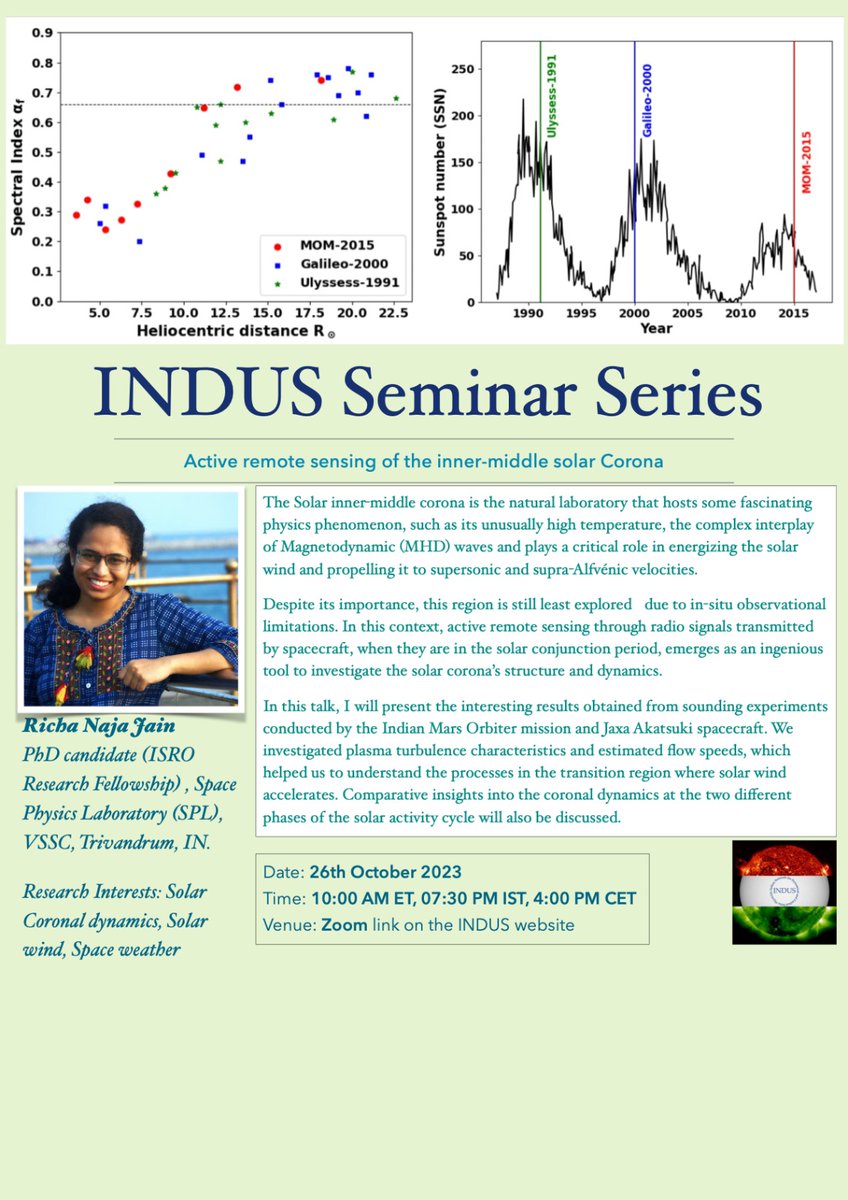
🚨Excited about the 3rd seminar in #INDUS#seminar series on 26th October🚨
@RichaNaja ,ISRO Research fellow, SPL/VSSC will talk about the ingenious #solar coronal sounding experiments conducted by @isro MOM & @JAXA_en Akatsuki spacecraft.
Zoom link - https://t.co/DOh4PSJ5O3
Here is the teaser of the most acclaimed Kannada film in the international festivals.
ಅಂತರಾಷ್ಟ್ರೀಯ ಚಿತ್ರೋತ್ಸವಗಳಲ್ಲಿ ಅತ್ಯಂತ ಮೆಚ್ಚುಗೆ ಪಡೆದ "ಶಿವಮ್ಮ,"
ಚಿತ್ರದ ಟೀಸರ್ ನಿಮ್ಮಮುಂದೆ.
#MAMI2023#shivamma
In the heart of World War II, as the Nazis took control of Copenhagen, a peculiar situation took place at the Institute of Theoretical Physics, led by physicist Niels Bohr. Two Nobel laureates Max von Laue and James Franck, fearing the confiscation of their gold Nobel Prize medals by the Nazis, had sent their medals to Bohr for safekeeping.
On the day the Nazis arrived in Copenhagen, Hungarian chemist Georgy de Hevesy, who was working in Bohr's lab, devised a plan to prevent the discovery of the medals. Initially considering burying the medals, they quickly dismissed the idea, fearing the thorough searches the Nazis would conduct. Instead, de Hevesy proposed a chemical solution — literally. Utilizing a mixture known as "aqua regia" (a blend of hydrochloric and nitric acids), he set about dissolving the gold medals. This concoction is one of the few substances capable of dissolving gold, a notably unreactive element. As the Nazis marched outside, de Hevesy dissolved the precious medals, reducing them to a colorless solution that eventually turned bright orange. The liquid containing the dissolved gold was then placed on a high shelf in the laboratory, where it remained unnoticed throughout the Nazi occupation.
Post World War II, upon returning to the laboratory after V-E Day, de Hevesy found the beaker undisturbed on the shelf. The gold was recovered from the solution and returned to the Nobel Prize committee, who then reminted the medals and presented them back to Laue and Franck in a ceremony in 1952.
#NCRA-TIFR invites applications for the Students Training Programme 2023 (#STP2023), which will be held at the Giant Metrewave Radio Telescope (#GMRT) site in Pune later this year.
For more details & online application, pls visit: https://t.co/Nl7uEaasmT
📅Deadline: Oct 20, 2023