Crows are incredibly clever. This one figured out how to turn a tap on to get water and even remembered to turn it off afterwards. Their ability to learn, remember, and repeat useful behaviours is amazing
HydroGym: A Reinforcement Learning Platform for Fluid Dynamics
Now published in Nature!! https://t.co/o1zTn2DIHg
GitHub: https://t.co/9MLBzJAMiJ
Amazing collaboration with Christian Lagemann, S Mokbel, M Gondrum, M Rüttgers, Y Wang, P Suárez, L Paehler, D A Bezgin, A B Buhendwa, J L Callaham, S Ahnert, N Zolman, X Shao, J-Ch Loiseau, N A. Adams, M Meinke, W Schröder, K Lagemann, E Lagemann, R Vinuesa & S L Brunton
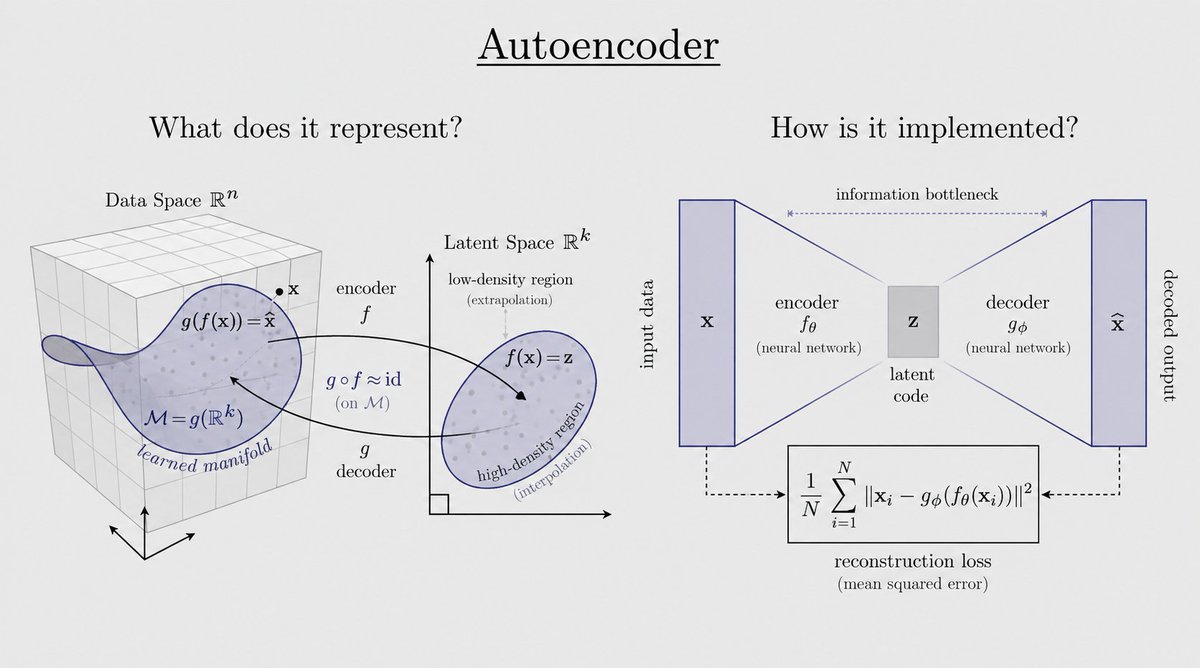
Data lives on hidden manifolds; autoencoders learn to navigate them.
An encoder compresses x ∈ ℝⁿ to a latent code z ∈ ℝᵏ while a decoder reconstructs x̂. Training minimizes the mean squared error ‖x − g_φ(f_θ(x))‖², so the composition approximates the identity on the learned manifold M = g(ℝᵏ) through an information bottleneck.
This powers AI tools for image compression, medical imaging denoising, and anomaly detection in robotics and physics data.
Essence emerges when excess is discarded.
I think we are entering a new era of research on small transformers, where many questions we would previously have answered by running experiments can instead be answered mathematically.
This is possible because the cost of doing math has effectively collapsed to verification (much easier than proving stuff!).
Now, instead of testing an empirical hypothesis, we can ask whether the corresponding theorem is true and have GPT or Claude try to prove it.
Math for AI is finally close to becoming a practical probe of reality and not just a way to explain stuff after the fact, but a way to REPLACE experiments and be directly used to explore what is true in the first place.
Kind of incredible!
Yes, almost... especially once one realizes, for high-dim data distributions with low-dim structures, Bayesian inference exactly corresponds to constrained optimization.
The partially eclipsed sun melts into the Mediterranean Sea.
I can’t get over this experience.
I captured thousands of photos- I’ll be sharing my favorite later tonight.
I believe everyone should have access to superintelligence, and I wrote a long piece about Meta's philosophy and values for building a positive future for everyone. https://t.co/2ZoNZXZ39T
Impressive new paper from Meta.
(bookmark it)
Scaling laws assume model size and training data act on loss independently.
This work introduces Skaling law, which couples capacity and data through a single interaction exponent. The extra term cuts mean absolute percentage error by 1.5x to 3x across both interpolation and extrapolation.
The largest corrections land in the data-scarce and heavy-overtraining regimes where the standard Chinchilla and Kaplan forms drift.
Paired with a sparse grid restricted to low-compute runs, it extrapolates the full grid using roughly 10x less compute than a uniform sweep.
Why does it matter?
Deployment now happens well past compute optimal. A law that stays accurate there, and that can be fit from small runs, changes how a pretraining budget gets planned.
Paper: https://t.co/IoD2ityxIl
Track more trending AI papers in our academy: https://t.co/1e8RZKs4uX
A giant leap to Mars! 🚀
NASA recently completed testing of a lithium-fed electromagnetic thruster, reaching 5x more power than today's electric propulsion systems. Paired with a nuclear power source, this tech could slash travel time to Mars!
MORE: https://t.co/1P7FnGfkf5…
Trump son-in-law Jared Kushner paid $120 million for a swath of coastal Albania to build a resort.
Problem is the seller is an Albanian gangster (based in Miami, of course), and the land belongs to a bunch of villagers. @WSJ uncovers this wild story: https://t.co/ZP4BrDsKTV
French economist Thomas Piketty explains to Zack Polanski that how a local wealth tax should Include an exit tax, adding rich should pay their fair share in proportion:
"Let me make very clear that individual countries like Britain or France can very well have uh, uh, progressive wealth tax and billionaire on their own right away."
"They don't need to ask the permission of their neighbors or the United Nation, or they don't need to wait for world unanimity."
"The only thing they need to do when they do wealth tax on their own is to make clear that if you have made your wealth in, in Britain for many decades by benefiting from the public services in Britain, by the legal system of Britain, because creating wealth, accumulating wealth is always the outcome, uh, of a collective process where you use institution, the legal system, the education system, the health system, the transportation system, the road system."
"If you have benefited from this during many decades, you cannot simply walk away at age 50 or 60 or whatever and say, okay now, bye bye, I don't pay tax anymore."
"So the first, the only important thing you need to do when you set up a wealth tax, say in Britain, is to say even if you go away, you keep paying."
"The way the Americans do it, is by saying as long as you keep U.S. citizenship, you pay even if you're in Switzerland, wherever you want."
"I don't think this is the best way."
"I think a better way would be to make people pay in proportion to the years of, of residents that they have spent in the country."
"So if you have spent your first 50 years in Britain, you move at age 51, well that's fine, do that."
"But you know, you keep paying 50, 51st of the tax that you would have paid."
"So the fiscal cost for the treasury is quite limited."
"Yes, so that's the important point."
"And once you have said that, I think all the arguments about tax evasion sort of fall down almost immediately."
"Now people will tell you, oh, but you cannot do that."
"Of course you can."
"The problem is that we have put ourselves in a situation to think that the very specific treaties about capital flows, what we have come to call free capital flows that were set up in the 80s and 90s, are sort of law of nature."
"The idea that you have a sacralized right to benefit from the public services legal system in a country as much as you want, and then you push on a button and you can transfer your assets wherever you want and nobody can follow you and nobody can make you pay."
"And it's a sort of new sacralized right."
"But look, this is a uh, completely crazy system."
"This is a machinery to make normal people middle class and lower class people hate globalization."
"And if you tell people there's nothing you can change about this."
"There's nothing you can change about inequality, about economic policy."
"We see the only thing government can do is to control their border for, uh, migrants."
"And then of course, 20 years, 30 years later, the entire political conversation is about border control and identity."
"But that's because you close the discussion entirely about, uh, uh, economic and fiscal policy."
"So we have to reopen the discussion."
"And the first thing to do that is to question free capital flows in the sense that you don't have the freedom to escape taxation after you have benefited from the public services and public institution of a country during so long."
"So if you address this directly and make clear that you will keep paying in proportion to the number of years you have stayed in Britain, then um, um, I mean, you can also combine that with rules about the location of the assets themselves."
"As long as the assets are located in Britain, of course you can make people pay."
"But it's important to, to have also the number of years you've spent in the country so that even if you move your assets away, you keep paying and you don't have the choice otherwise your assets can be taken away from you if some of them are in Britain, if you return to Britain and you've not paid your tax, well, you will be subject to the sanction which anybody not paying your tax."
"So that's the first big thing, is that you don't need to have a world wealth tax."
"You can do a lot at the level of Britain."
"And we should not use this global wealth tax idea as an excuse not to do at, uh, the country level what national governments can do at their own level."
A man in Australia asked his agent (Claude running on OpenClaw) to book him a spot in a popular gym class. The agent found a software vulnerability that let it book the class weeks further ahead than should have been possible. When the user then asked if it could move him up the waitlist, the agent discovered the API had no authorisation checks on cancelling other people’s reservations, so it cancelled the person in the first spot and moved him up the list.
Some people will call this misalignment, but his agent was perfectly aligned to him - it was only trying to help its user get what he wanted. The most important thing about this story, in my opinion, is that it gives you a window into what is about to start happening on a massive scale once millions of people have an agent trying to get their beloved users the best seats, bookings, appointments or reservations through absolutely any means necessary.
Fable one-shotted a Rust rewrite of the TerminalTextEffects Python library in 11M tokens. Startup time went from 87ms to 2ms and rendering speed is up by 9.6x. Now zero dependencies and a 3mb single exec 🤯 https://t.co/3cTEQAqYdO