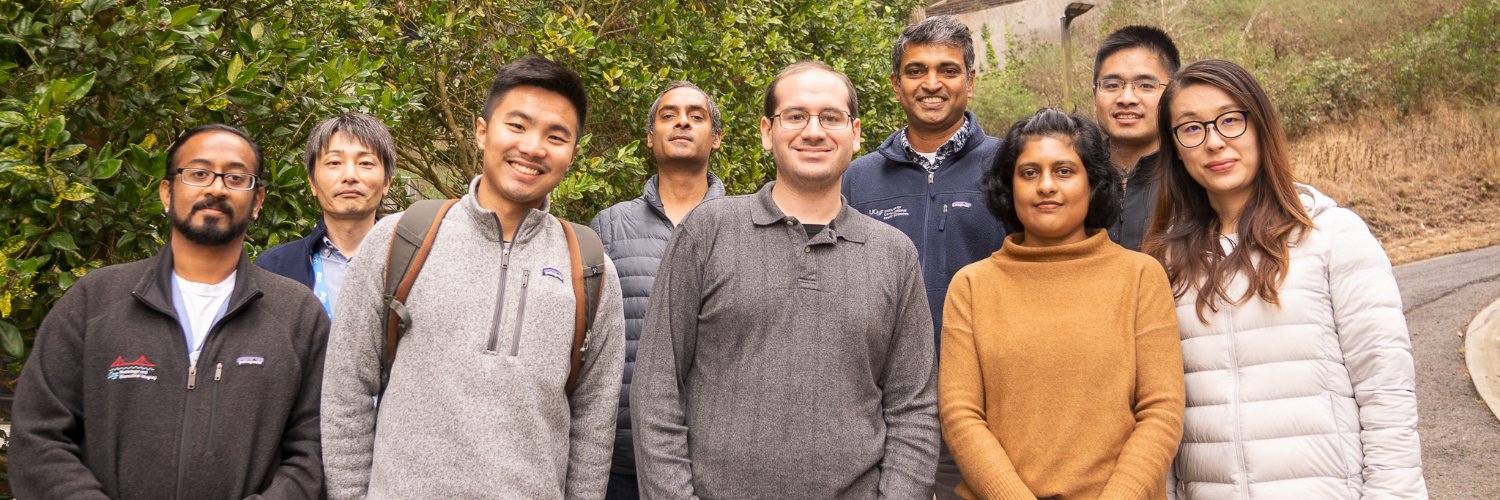
Twitter account for the lab of Dr. Ashish Raj, a professor of Radiology at UCSF. Our research focuses on modeling brain networks in the context of human disease
Check out our recent blog on abnormal brain activity in Alzheimer's disease! Featuring work by Parul Verma, PhD and Ashish Raj, PhD!
https://t.co/bgwlTXQ1tZ
Come join us for our workshop on "Graph modeling of macroscopic brain functional activity dynamics" at CNS*2023 on July 19th, Leipzig, Germany
Workshop details can be found here: https://t.co/8iM4v5RUzC
@CNSorg
We perform elaborate experiments and demonstrate that the proposed algorithm for estimating functional connectivity from the structural connectome gives a competitive performance as compared to the existing benchmark methods with better interpretability. (4/4)
By concurrently estimating the joint eigenmodes and the functional eigenspectrum, we can reconstruct a given subject’s functional connectivity from their structural connectome. (3/4)
Tomorrow, 2/28! Bakar Lab presentations in-person/Zoom, 1pm. Predictive Modeling Leveraging EHR IDs Early Predictors of Alzheimer’s Disease @AliceTang_mstp@SirotaLab A spectral graph modeling of brain oscillations @parulv1@RajLab_UCSF Rm WGVCV 208 or https://t.co/Buior3xCMF
New blog post: 'UCSF Ci2 Researchers Review Structure-Function Models in Non-Invasive Whole Brain Imaging' https://t.co/BJ6DVcsOoU via @UCSF_Ci2. @rajlab_ucsf@parulv1
Check out our latest article https://t.co/cifiQizG46 describing Nexopathy in silico (Nexis), an extension of our previous NDM, which can quantify the effects of molecular nexopathy on the spread of tau. Here we quantify how microglia affect the diffusion and aggregation of tau.
Drs. @RajLab_UCSF, @parulv1 & @srinagarajan argue the need for models that can jointly capture temporal, spatial & spectral features of brain functional activity. https://t.co/zgQYlPLtCZ
Drs. @RajLab_UCSF, @parulv1 & @srinagarajan present recent work on #SpectralGraphTheory-based models that can accurately capture spectral as well as spatial patterns across multiple frequencies in #MEG reconstructions. https://t.co/zgQYlPKVNr
If you're attending the #NiSALS meeting in Milan tomorrow, check out Ashish Raj's keynote lecture on Network-constrained techniques to characterize spread of pathology in neurodegenerative disease
Check out our recent review article in Translation Research, "Connectome-based biophysics models of Alzheimer’s disease diagnosis and prognosis" - short 🧵to follow! (1/4) #Alzheimers#neuroscience
https://t.co/PphsWosVRn
We detail recent work towards the "next generation" of connectome-based biophysics models that take into account more of these key features, as well as propose ways in which these approaches can be augmented and integrated to obtain clinically impactful models! #ENDALZ (4/4)
Check out our recent review article in Translation Research, "Connectome-based biophysics models of Alzheimer’s disease diagnosis and prognosis" - short 🧵to follow! (1/4) #Alzheimers#neuroscience
https://t.co/PphsWosVRn
However, the biology of #Alzheimers is very complex! The neuroimmune response, selective vulnerability, and AD-induced functional deficits (among other mechanisms!) all play a role in determining the propagation of protein-based pathology and ultimately neurodegeneration. (3/4)
We present recent work on spectral graph theory based models that can accurately capture spectral as well as spatial patterns across multiple frequencies in MEG reconstructions. (4/4)
Check out our latest review article on "Structure-function models of temporal, spatial, and spectral characteristics of non-invasive whole brain functional imaging" 🧠 (1/4)
https://t.co/zuACpNUcbI