What if a public company made HYPE its biggest bet?
A $2.5B financing facility is being used to support a HYPE-focused treasury strategy.
Bullish flywheel or risky gamble?
Here’s how the bet works
@CoinDCX Many of my biggest life lessons came from my father.
He taught me to rise after failure, take responsibility, work hard, and stay humble. I learned more by watching him than from any book.
Happy Teachers’ Day, Dad.
@CoinDCX#TeachersHarJagahHain
🚨 Imagine your best friend says:
"I'm investing ₹10 lakh into ONE crypto project. Which one should I buy?"
My answer wouldn't be the name of a coin.
It would be:
"Let's research first."
Crypto isn't like buying a lottery ticket. Every investment should answer one simple question:
👉 "Why will this project still matter 5 years from now?"
Here's the beginner-friendly checklist I use before investing.
👇
#Crypto #DYOR
We’ve been buying gold for centuries.
But usually the mindset is:
Buy it → store it → forget about it.
What if gold could fit the way we interact with markets today?
Faster. More flexible. More accessible.
That’s where the idea of digital gold gets interesting.
#LearnKaroCryptoKaro
🧵👇
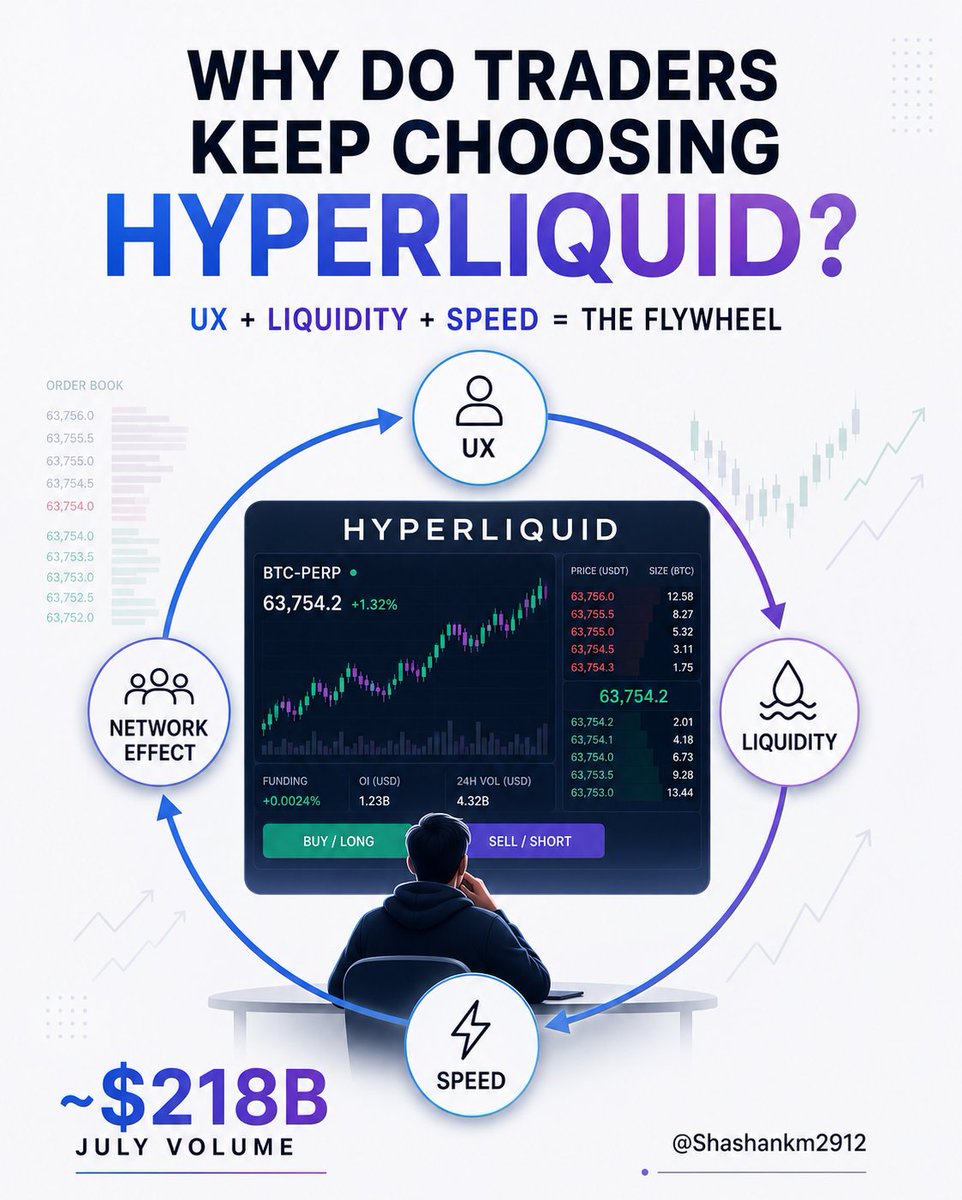
Hyperliquid vs everyone else 👀
July trading volume reportedly hit ~$218B more than the next 7 perp DEXs combined.
But I don't think traders keep choosing Hyperliquid simply because it's already the biggest.
I think it's the flywheel:
1. UX
The trading experience feels familiar.
For an active trader, small things matter: finding a market quickly, checking positions, placing orders and managing them without fighting the interface.
Good UX reduces friction.
2. Liquidity
This is probably the biggest advantage.
More traders create more liquidity.
More liquidity means better execution and less concern about slippage, especially when position sizes get larger.
And better execution attracts even more traders.
3. Speed
Perps aren't a “place an order and forget it” market.
Prices move fast. Liquidations happen fast. Opportunities disappear fast.
So execution speed and a responsive trading experience aren't nice-to-have features they're part of the product.
4. Network effect
This is where everything connects:
More traders
→ more liquidity
→ better execution
→ better experience
→ more traders
Once that loop gets strong enough, competing purely on features becomes difficult.
Community and hype can bring traders through the door.
But I think execution is what makes them stay.
That's why my answer to “Why Hyperliquid?” isn't one feature.
It's the combination of UX + liquidity + speed + network effects.
The real question now:
Can another perp DEX build a better flywheel, or has Hyperliquid already created too much of a liquidity advantage?
Curious what you think.
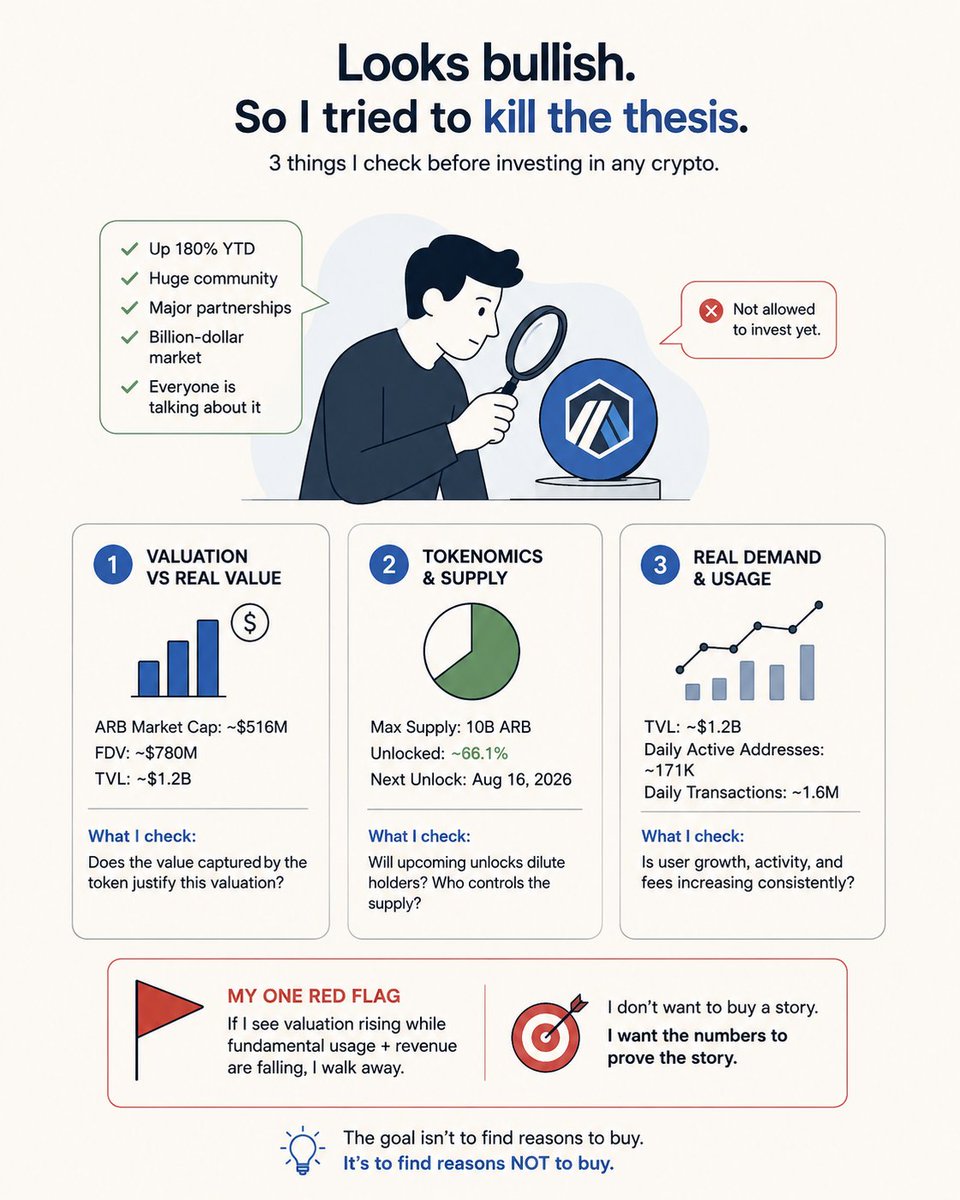
Looks bullish. So I tried to kill the thesis.
Let’s take $ARB as an example.
Arbitrum has ~$1.2B TVL and ~$516M market cap. Sounds attractive.
But before buying, I’d check 3 things:
1️⃣ Valuation vs real value
TVL alone doesn't mean the token is undervalued.
I’d compare ARB’s market cap with the actual fees/revenue the network captures.
Arbitrum generates meaningful activity, but the gap between ecosystem activity and value actually accruing to the token matters.
2️⃣ Token supply
This is where my eyebrows go up.
ARB has a 10B max supply, with ~66.1% currently unlocked.
And another unlock is scheduled for Aug 16.
More supply isn't automatically bearish but if new supply keeps arriving faster than demand grows, holders can face dilution.
3️⃣ Is usage actually growing?
I’d track TVL, active addresses, transactions, DEX/perps volume and fees over time.
Because one good day of activity doesn't prove a lasting investment thesis.
🚩 My ONE instant red flag:
If I see valuation rising while fundamental usage + revenue are falling, I walk away.
I don't want to buy a story.
I want the numbers to eventually prove the story.
That's the 5-minute crypto background check I'd do before putting my money in.
Not financial advice. Just how I’d investigate before buying.
Robinhood’s crypto numbers tell a weird story.
Crypto transaction revenue fell 43.2% in H1 2026.
And yet Robinhood is going deeper into crypto.
That sounds contradictory.
I think it actually reveals where retail investing is heading. 🧵
Robinhood is building around:
• Stocks & options
• Crypto
• Prediction markets
• AI-powered market tools
• Tokenized assets
• Robinhood Chain
• DeFi
• Agentic trading
So I don’t think Robinhood is trying to become “another crypto exchange.”
It’s trying to make crypto part of a much bigger financial experience.
And that distinction matters.
Think about how most people invest today.
Stocks are in one place.
Crypto somewhere else.
Prediction markets somewhere else.
DeFi is still mostly a separate world.
Robinhood’s bet seems to be:
“What if the user never has to care which category an asset belongs to?”
They just open one app and invest.
That’s a much bigger ambition than simply selling Bitcoin.
And the numbers show why this strategy makes sense.
In Q2, Robinhood’s transaction-based revenue jumped 44% YoY to $776M.
Crypto contributed $100M, down 38% YoY.
But equities, options and event contracts helped offset the weakness.
That tells me something important:
Crypto doesn’t have to be Robinhood’s biggest product for crypto to matter.
It can become the infrastructure connecting everything else.
Tokenized stocks are a good example.
If traditional assets can eventually move onchain, then the boundary between “traditional finance” and “crypto” starts becoming less important.
The user may not even think:
“I’m using blockchain.”
They’ll simply think:
“I’m buying an asset.”
And that could be crypto’s biggest mainstreaming moment.
Not millions of people suddenly becoming crypto experts.
But millions of people using onchain infrastructure without caring that it’s onchain.
That’s why I’m more interested in Robinhood’s strategy than its crypto revenue alone.
The real competition may not be:
Robinhood vs Coinbase.
It may be:
Who can build the easiest financial interface for the next generation of investors?
Crypto-native platforms have the technology, culture and liquidity.
Robinhood has something different:
A massive retail-investing distribution layer.
If Robinhood can combine that distribution with onchain rails, tokenization, prediction markets and AI…
the “crypto app” might not look like a crypto app anymore.
It might look like a normal investing app.
And honestly, I think that’s the more interesting future.
My prediction:
The next wave of crypto adoption won’t necessarily come from people choosing crypto over stocks.
It will come from people owning stocks, crypto, prediction contracts and tokenized assets in the same place without thinking about the underlying infrastructure.
Crypto may not become the entire financial system.
It may become the layer quietly running underneath it.
That’s the Robinhood bet I’m watching.
What do you think?
Kill the 9-to-4? Maybe. Kill the off-switch? Absolutely not.
Markets going 24/7 sounds like freedom.
I actually think it could be a huge upgrade.
Imagine waking up in India and reacting to a US market move immediately instead of waiting for the opening bell. Global investors get access when they need it, not when a timezone says so.
And the shift is already happening: NYSE is building toward 24/7 tokenized markets, while the LSE plans a new overnight venue in 2027. Crypto-style stock perps are already trading around the clock.
But here's my concern:
24/7 access can easily become 24/7 temptation.
More screen time.
More impulsive trades.
More leverage.
More “let me just check the market once” at 2 AM.
So I don't think the goal should be:
“Markets never sleep.”
It should be:
“Markets are always accessible, so investors don't have to be.”
Give people the infrastructure to trade anytime.
But don't turn investing into a job that never clocks out.
That's the real financial freedom I'd want.
@officialmudrex
Everyone is watching ETF flows to figure out what’s moving crypto.
But I think we’re looking at the wrong layer.
If I had to pick ONE force driving crypto right now:
Liquidity.
BTC is hovering around $63K.
At the same time, recent U.S. spot Bitcoin ETF flows have been under pressure, with roughly $390M in weekly outflows reported. Yet BTC is still holding around the $63K area instead of completely breaking down.
That tells me something.
ETF flows matter.
Institutions matter.
Retail matters.
Regulation matters.
But they are all connected to a bigger question:
How much liquidity and risk appetite is actually available?
Think of it like this:
Fed policy
↓
Liquidity & financial conditions
↓
Risk appetite
↓
Institutional allocation
↓
ETF flows
↓
Crypto prices
This is why I don't see ETF flows as the ultimate driver.
They are more like the dashboard showing us where capital is going.
Liquidity is closer to the engine.
Look at what's happening now.
Bitcoin has been reacting alongside broader risk assets, while investors wait for clearer signals on rates. Even today's move higher was linked partly to changing expectations around U.S. rate policy.
And that's the part I find interesting.
If crypto were completely driven by ETFs, weak ETF flows should tell the entire story.
But they don't.
The bigger story is whether investors are becoming more willing to take risk.
When liquidity improves:
→ Institutions have more room to allocate
→ ETF demand can increase
→ Retail confidence usually follows
→ Higher-beta crypto starts attracting attention
→ Prices can reinforce the cycle
When liquidity tightens, the reverse can happen.
Institutions become selective.
ETF inflows slow.
Retail becomes cautious.
And suddenly even strong crypto narratives struggle to get capital.
That's also why I'm paying attention to the Fed and financial conditions rather than obsessing over one day's ETF number.
And regulation?
The stalled CLARITY Act matters because regulatory clarity can influence how comfortable institutions and businesses are with crypto.
But again, regulation can change the ability and willingness to deploy capital.
Liquidity determines whether that capital actually wants to move.
So my ranking right now would be:
1. Liquidity / interest rates
2. Institutional positioning
3. ETF flows
4. Regulation
5. Retail
Not because the others don't matter.
They absolutely do.
But I think we're confusing the pipes with the water.
ETFs are a pipe.
Institutions are a pipe.
Retail is a pipe.
Liquidity is the water flowing through the system.
That's why my biggest question isn't:
“Are ETF inflows coming back?”
It's:
“Are financial conditions becoming supportive enough for capital to take risk again?”
If the answer turns bullish, ETF flows may follow.
If the answer stays bearish, even the best crypto narratives may struggle.
So my takeaway is simple:
Don't just follow the money.
Follow what makes the money move.
What do you think is actually driving crypto right now?
@officialmudrex
AI can analyze markets in seconds.
But should it make the final call?
The future isn’t AI vs humans.
It’s AI + humans.
🤖 AI analyzes.
🧠 Humans decide.
AI = Co-pilot.
Human = Pilot.
Use AI for the edge. Keep control.
@officialmudrex
Before buying $SOL don’t just follow the hype.
Here are 3 things I had check first—token supply, valuation vs. value, and real network usage.
And one red flag that would make me walk away immediately.
Research > hype.
@officialmudrex
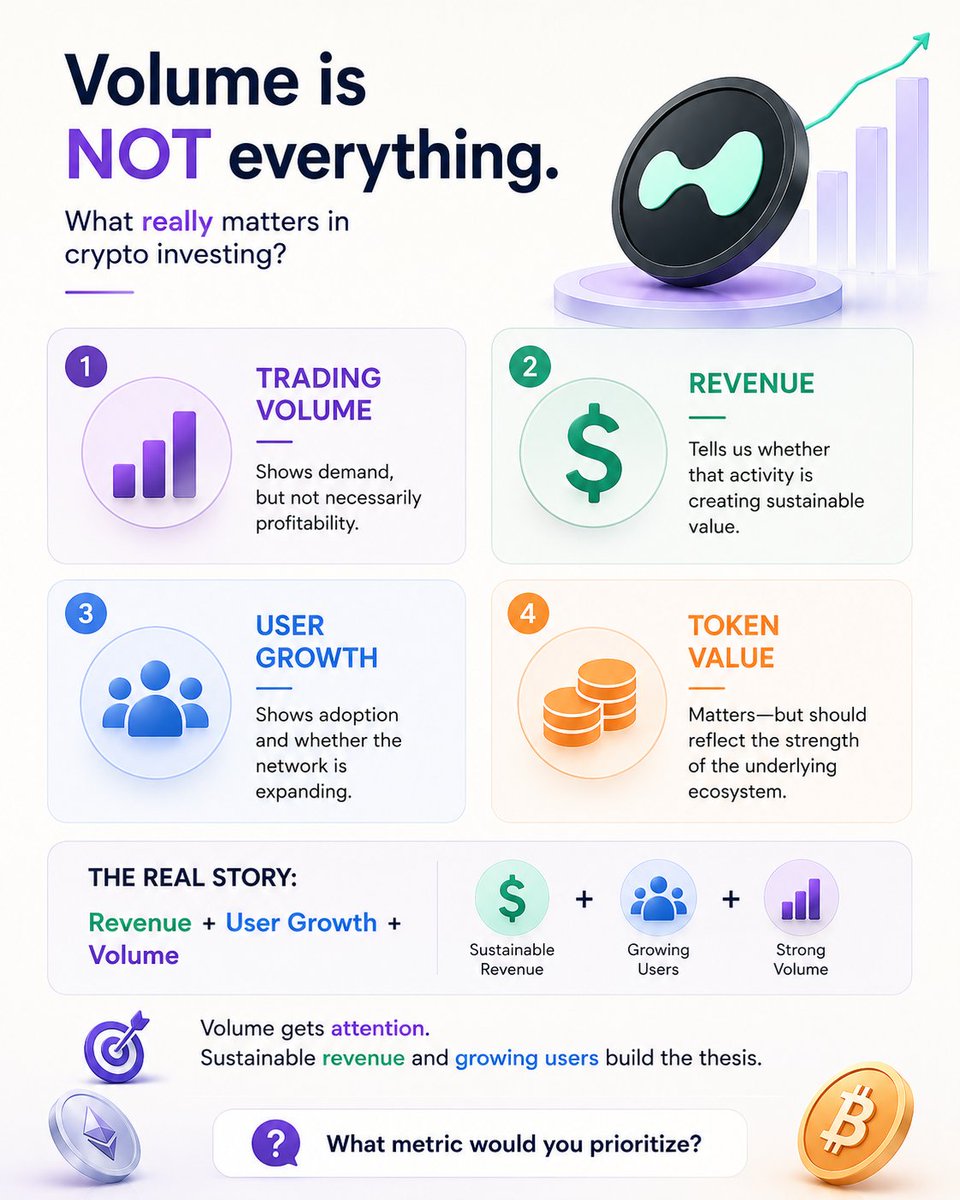
Hyperliquid is breaking volume records—but is volume enough?
For me, revenue + user growth matter most.
Volume shows activity, but sustainable revenue shows whether that activity creates real value.
Volume attracts attention.
Which metric would you prioritize?
@officialmudrex
Before investing ₹10L in any crypto, I ignore the price. I check the team, tokenomics, revenue, on-chain activity, community, security, competition, and roadmap. If the fundamentals aren't strong, I don't invest. Research > FOMO.
#Crypto#DYOR#Web3@officialmudrex
Day 11/11 - It’s Ethereum’s Birthday! 🎉
Today's challenge:
Wish Ethereum a happy birthday in the most creative way possible! 🎉
Share a birthday card, GIF, meme, poem, AI-generated image, song, video, cake design, letter, or anything else you can think of.
The more creative, the better! 💜
The top 5 birthday wishes will win ₹1,111 in ETH in their Mudrex wallet.
Before you participate:
✅ Follow the Mudrex account
✅ Buy ETH worth ₹1,111 on Mudrex
✅ Comment your birthday wish before 11:11 PM today ⏰
📖 Read the T&Cs: https://t.co/zv6JOTjCZh