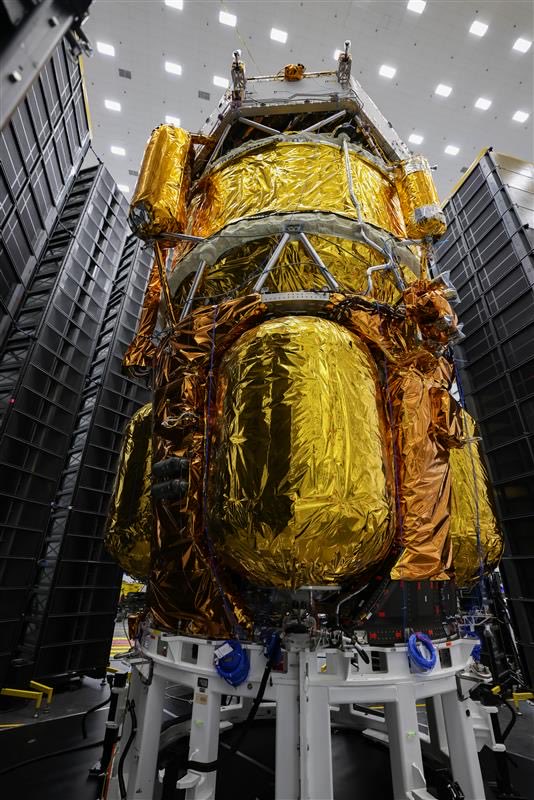
This week we completed direct field acoustic testing on our Blue Moon MK1 lunar lander, a major flight‑qualification milestone.
We surrounded the fully integrated lander with a ring of 34‑ft speaker towers to generate a near‑diffuse acoustic field, matching the New Glenn payload fairing environment at over 138 decibels overall sound pressure level. MK1 ran in a flight-like configuration: tanks pressurized with helium and nitrogen, batteries powering the vehicle, with all critical avionics and guidance systems operating.
43 triaxial accelerometers measured response during a two‑minute exposure at protoqualification levels. Because the lander's vibration environment is driven by acoustic loads, this test replaces traditional shaker-based vibration testing and more accurately represents ascent conditions.
Next stop: @NASA_Johnson for thermal vacuum chamber testing.
Good overview of the landing. We nominally target a few hundred feet away from Jacklyn to avoid a severe impact if engines fail to start or start slowly. We’ll incrementally reduce that conservatism over time. We are all excited and grateful for yesterday. Amazing performance by the team! Gradatim Ferociter.
Love seeing New Glenn's seven BE-4 engines come alive! Congratulations to Team Blue on today's hotfire. We extended the hotfire duration this time to simulate the landing burn sequence by shutting down the non-gimballed engines after ramping down to 50 percent thrust, then shutting down the outboard gimballed engines while ramping the center engine to 80 percent thrust. This helps us understand fluid interactions between active and inactive engine feedlines during landing. Next, we will mate @NASA's ESCAPADE payload to the launch vehicle and enter final preparations for launch.
🚨Coming soon! 🔜
🚧The Picklr Fremont is underway! 🚧
It’s cleared out and we are getting ready for the next phase!
📢Stay tuned for more updates
✍🏻Sign up at https://t.co/1tUy3E0gjH #thepicklr#thepicklrfremont#pickleball