Just one day after ending "The Late Show" on CBS, Stephen Colbert returned to TV — to host a public access show with rocker Jack White in Monroe, Michigan.
Appearances by Jeff Daniels, Eminem and Steve Buscemi.
FSD Supervised is now available in:
- United States
- Canada
- Mexico
- Puerto Rico
- China
- Australia
- New Zealand
- South Korea
- The Netherlands
- Lithuania
Elon says FSD 14.3 is coming.
But if you’ve been following along, it was also “two weeks away” a few months ago. That’s drawn a lot of criticism, understandably.
Let’s step back and talk about what’s actually going on: engineering reality.
I’ve spent years running engineering teams at Apple and Rivian, and what you’re seeing here is not unusual. Not even a little.
I’m not here to defend Elon or say communication couldn’t be better. It could. But what’s happening behind the scenes is far more ordinary than people think.
First, understand what kind of company Tesla is. Tesla exposes more of its internal process than most companies— you’re watching how the sausage is made, often in real time.
Compare that to Apple. Products appear at a moment in time, fully formed. What you don’t see are the features that slipped, were cut, or quietly postponed to make the deadline.
Most companies communicate through layers of marketing at discrete events (e.g., NVIDIA GTC). That may include a CEO keynote—but it’s still tightly controlled. Tesla, largely via Elon, doesn’t. And that creates friction.
Most people are used to being in the dining room. With Tesla, you’re watching the sausage get made whether you like it or not. If that makes you uncomfortable, this model will drive you crazy no matter how it’s explained.
Now, about FSD 14.3— the so-called “reasoning” release.
My view: when Elon originally referenced it, it was real. It was on a roadmap with a timeline. But then reality hit.
Somewhere along the way, engineering discussions likely exposed a fork: ship what’s partially there, or go deeper and "do it right".
That kind of shift happens constantly. Plans change. Timelines slip. This is normal engineering behavior, not dysfunction.
The difference is: you’re seeing it.
At companies like Apple, those decisions are invisible. Deadlines are protected by cutting scope. At Tesla, you’re watching the scope evolve in real time.
On the technical side, 14.1 and 14.2 were already producing “reasoning tokens,” as Ashok (Tesla AI VP) noted. But producing tokens isn’t the same as using them effectively.
14.3 appears to be where those tokens actually start driving behavior, more human-like decision-making in edge cases.
My guess is this is where things got more complicated. The work likely started to overlap with what xAI is doing. At that point, the question becomes: do you ship an interim solution, or integrate a more capable reasoning layer?
That’s not a small decision. And it likely has downstream impact— potentially even on Robotaxi timelines— because these same reasoning challenges show up there too.
So the team probably made a call: go deeper, even if it costs time.
And here’s the part people underestimate: great engineering teams often convince themselves the extra work is worth it… and that it won’t take that much longer.
They’re usually wrong on the timeline. But often right on the outcome.
At this stage, FSD isn’t about raw safety (it seems to have nailed that)— it’s about behavior. Making decisions feel natural, human, predictable in edge cases.
That’s a much harder problem.
So if you’re following Tesla closely, the best thing you can do is understand the process and accept the messiness that comes with it.
If you want tightly controlled messaging and polished delivery, companies like Apple exist for that.
Tesla is something else entirely.
Fire away.
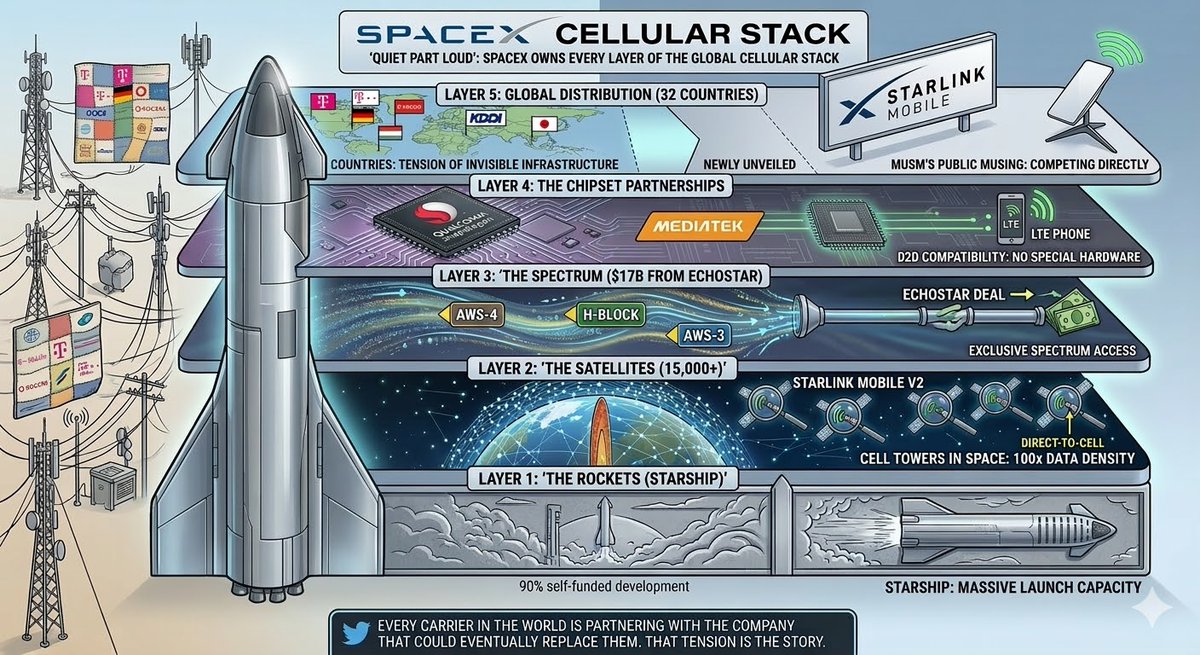
Quiet part loud: SpaceX now owns every layer of the stack needed to be a global cellular carrier. And now has a plan to beam it direct to your cell phone.
Starlink Mobile v2 sits on top of:
- The rockets (Starship)
- The satellites (15,000 approved)
- The spectrum ($17B from EchoStar)
- The chipset partnerships (Qualcomm, MediaTek)
- Carrier deals across 32 countries on six continents
They're currently partnering with T-Mobile and a dozen more carriers serving as invisible infrastructure underneath.
But Elon has publicly talked about competing directly with carriers. Just last week they laid out their plan launch 1,200 satellites in six months starting mid 2027
50 per Starship. Each satellite carrying antennas five times larger than the current fleet. Hundred-foot solar arrays. Custom SpaceX silicon. 20 times the throughput of what's in orbit today. 100x data density of V1
The result: 150 Mbps download speeds beamed directly from low Earth orbit to the phone in your pocket anywhere on earth
70% of the planet has no service. Starlink will make that 0% and now every carrier in the world is forced to partner with the company that could eventually replace them
Digital Optimus, Optimus, and FSD
What’s going on here? A lot.
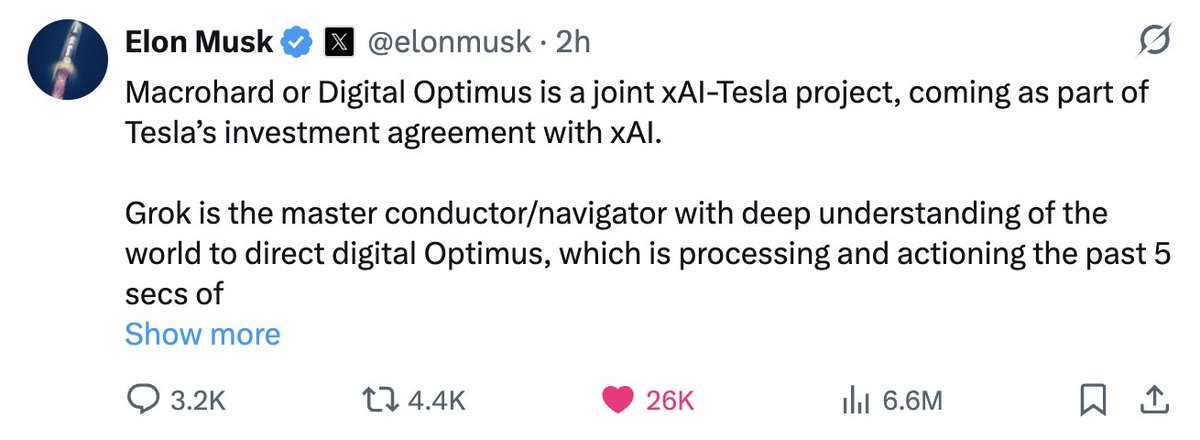
xAI and Tesla’s AI team have been working on complementary, partially overlapping AI systems. Tesla AI has focused on vision-based intelligence for both FSD and Optimus, while xAI has focused on building a frontier model (an LLM) aimed at general intelligence.
More recently, xAI has pushed deeper into what has been called Macrohard (aka Digital Optimus). Macrohard applies xAI’s intelligence layer, Grok, to human activity in the digital world, essentially operating computers the way a human would. The idea is that the AI can move through existing software environments and perform tasks that previously required direct human interaction.
But Macrohard goes beyond simply navigating pixels. It is also about generating outcomes within those environments— producing results (pixels), not just interacting with interfaces. In that sense, Macrohard becomes a quasi vision-based AI system as well.
Elon, effectively the technology head of both companies, sees the convergence. The decision now appears to be to combine efforts and focus each team on its relative strengths. Tesla’s vision-based AI team becomes central in integrating this perception stack with xAI’s “pure” intelligence model.
The benefits are substantial.
First, xAI advances its Digital Optimus concept— an AI capable of driving productivity directly in the digital world. At the same time, Tesla gains a powerful intelligence backbone: a reasoning engine layered on top of its vision systems.
For Optimus, the implications are colossal. The robot is no longer just a physical-world machine driven by perception and action loops; it becomes a reasoning system as well. In other words, Optimus gains both embodiment and intelligence.
That combination directly addresses the data patterns I discussed in my article this week. And that is a big deal.
Of course, the impact extends to FSD as well. Many of the “last mile” problems in vehicle autonomy involve nuanced human intent and interaction. A reasoning layer makes those scenarios far more tractable. Talking to your car and having it genuinely understand what you want it to do becomes realistic.
Further, Elon has suggested that this combined approach fits within an AI4 inference framework—delivering more intelligence per watt and reducing the need to wait for AI5-scale hardware to solve these larger problems.
All in all, this is significant news. It may shift some timelines, and I suspect it may also explain why version 14.3 (the rumored “reasoning edition”) has not yet appeared. It may now be part of this broader combined effort.
There’s no better feeling than hearing the flutter of little footsteps behind you, reaching a hand out into open space, and feeling the universe’s most beautiful docking procedure of a tiny hand finding yours.
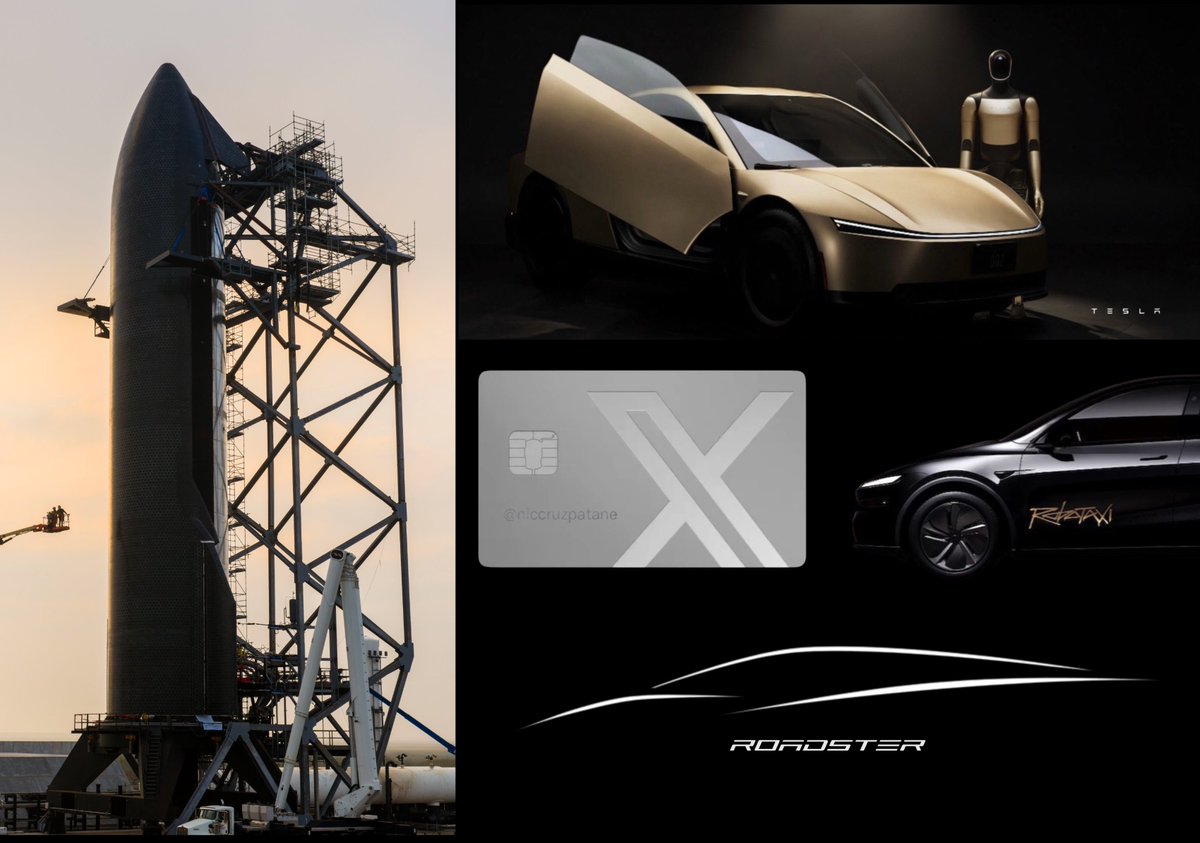
The next couple of months are going to be EPIC.
• Tesla Optimus V3 Unveil
• Cybercab production ramp begins.
• Starship V3 first flight
• Tesla Roadster Unveil & Demo
• 1/2 of Cortex 2 Datacenter goes online.
• 𝕏 Money early public access
• Robotaxi Expansion
I have often wondered what “self-actualization” looks like.
this is it.
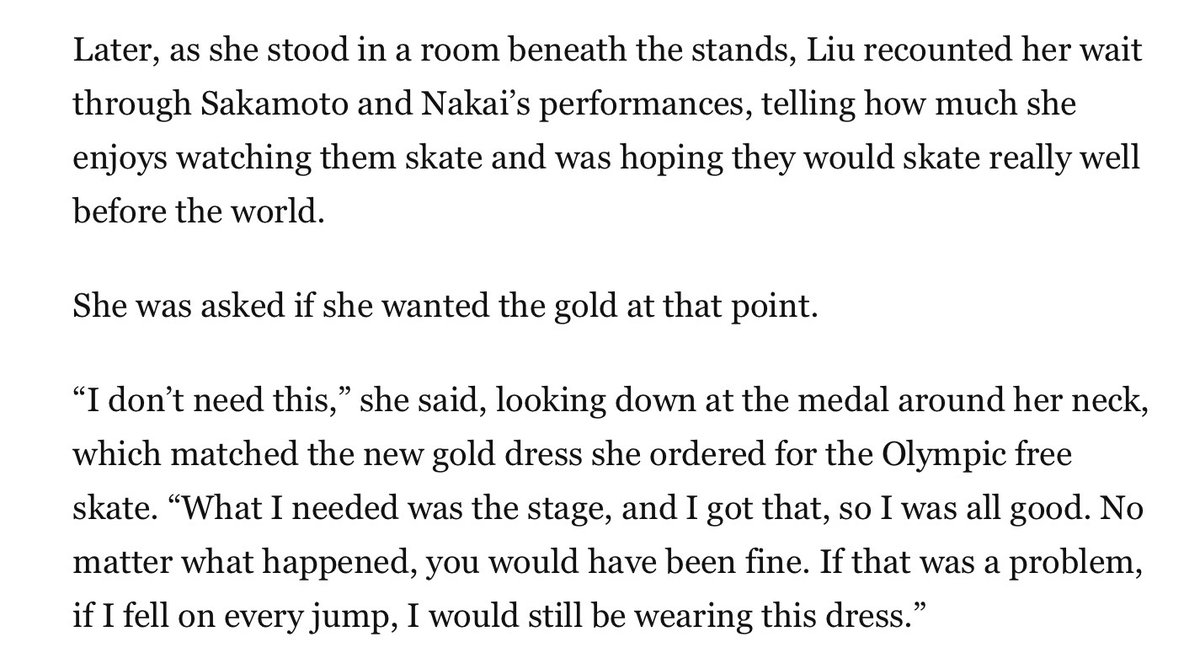
And keep in mind how amazing sports photographers are. The look on Alysia Liu’s face.…
https://t.co/19mgjH3Gj8