We've been able to trigger CVE-2023-21554 AKA #QueueJumper, a recently patched RCE in Microsoft’s Message Queueing Service reported by @_CPResearch_. We can confirm it appears exploitable. IOCs and more: https://t.co/NxMiZIAb9P
In collaboration with @FabiusArtrel and @aaronportnoy we conducted a post mortem of the QueueJumper MSMQ RCE patch. We do an in depth RCA, identify variants, create exploit primitives, evaluate exploitability, and make some interesting new discoveries!
https://t.co/2BLq5W1d06
OpenSSL released details for CVE-2022-3602 & CVE-2022-3786. Due to the mitigating factors outlined in our post we do not believe these will be exploited for remote code execution in real-world scenarios: https://t.co/NMoD0D3sFW
We have validated Rapid7’s analysis on CVE-2022-26134, an RCE in Atlassian Confluence. Randori recommends assuming compromise and investigating accordingly. Vendor guidance is available here: https://t.co/FpLOpRTUxh
The Randori Attack Team developed a working exploit for #f5 BIG-IP CVE-2022-1388. To help the #infosec community assess their risk, we published our technical analysis and a bash one-liner that organizations can run to test exploitability. Details here: https://t.co/4ovFJhUvuz
CVE-2022-22965 has been assigned to the #SpringShell vulnerability. Spring framework 5.3.18 and 5.2.20 have been released to address the issue: https://t.co/bKIGDfFdp4
The following non-malicious request can be used to test susceptibility to the @springframework 0day RCE. An HTTP 400 return code indicates vulnerability.
$ curl host:port/path?class.module.classLoader.URLs%5B0%5D=0
#SpringShell#Spring4Shell#infosec
New high severity DoS in OpenSSL just released: https://t.co/3ZoLlRIlQB CVE-2022-0778 was reported by @taviso and appears to affect systems that parse user-supplied certificates.
Not able to attend our webinar on #Log4j with @GreyNoiseIO? Click to watch the recording and get expert insights into researching and remediating Log4Shell, with @HexadeciMoose @aaronportnoy@Andrew___Morris, and Remi.
https://t.co/xzQb9EymX9
10 #Log4Shell Facts vs Fiction: a 🧵
1. 1.x is NOT vuln to this RCE. While it doesn't have another RCE, it requires access to send serialized data to a listener ON the log server. This is much MUCH harder to exploit and kind of rare for a Log4j server to be running.
#log4J info stealing method:
Just saw an info stealer payload that uses System.getenv(); to grab ALL variables and then send them back to the attacker.
That's all it does.
This means attackers do not have to know what env variables to guess in order to steal them.
The Randori Attack Team can confirm the exploitability of unpatched Jamf Pro on-prem via "Log4Shell". Due to the severity of impact, we recommend organizations patch immediately. See: https://t.co/GXE717yPFr
If impacted: 1. assume compromise and review logs for signs of malicious activity. 2. Configure firewalls to prevent outbound connections. 3. Look for updates from VMware on release of patches. 4. Read updated Log4Shell blog and follow @RandoriAttack for updates. 3/3
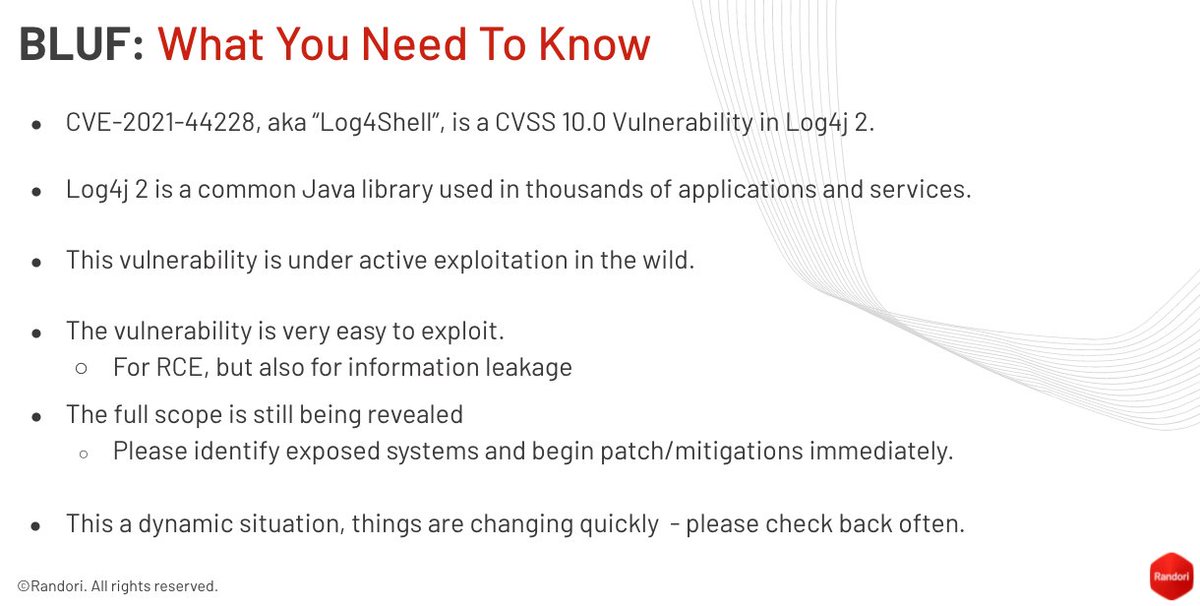
The Randori Attack Team can confirm exploitability of VMWare products in live environments (VMSA-2021-0028) via Log4j (CVE-2021-44228) aka "Log4Shell". This is a critical vulnerability. Follow @RandoriAttack for updates: https://t.co/3V12TcuK27 1/3
We have validated exploitability with a working exploit, and anticipate widespread exploitation by threat actors imminently. Randori has been in contact with the VMWare team to assist their development of mitigations. 2/3
We have been monitoring activity and neither Palo Alto Networks nor Randori’s threat intelligence sources have identified attempted exploitation. We hope to give defenders extra time through the end of the year to apply mitigations.
We have been collaborating with Palo Alto on CVE-2021-3064 and have jointly decided to delay release of technical details as many customers have yet to apply protections due to the COVID-19 pandemic.