There are places where the sun doesn't set or rise for months.
Imagine being in the dark for months and also no darkness for months. https://t.co/hkVbVbAyUV
You can't make people grateful by giving them more of what they already don't appreciate.
To keep helping ungrateful people you have become a great fool.
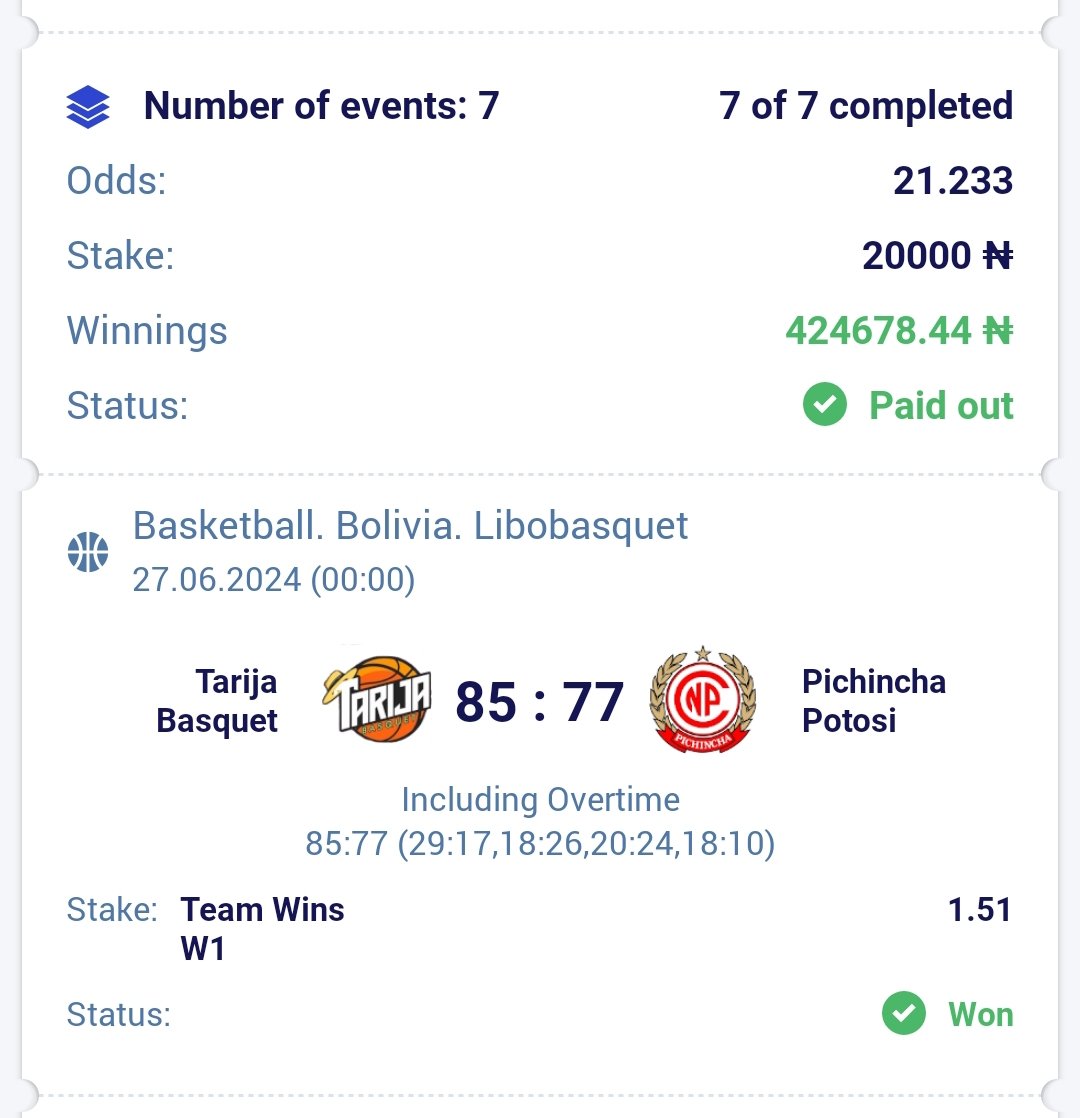
Who needs 20k?
21 Odds Boooooooom 🔥 🔥 💥
424k won ✅ ✅ ✅
Congrats if you played...
Don't have a Paripesa Account?
Register using this link
Use the Promo code: LOVEB3RD
https://t.co/ULkAngGfEe
Arweave's AO sees $260 million pre-bridged in 4 days
AO, a hyper-parallel computer, saw an influx of $260 million stETH pre-bridged to its platform, propelling it to become the 28th largest decentralized finance (DeFi) economy over the past four days, Arweave and AO founder Sam Williams(@samecwilliams) noted in a post on X June 22.
According to Williams, AO’s Total Value Locked (TVL) now matches that of Cardano ($209.43 million), surpassing notable blockchain projects such as #zkSync, #Fantom, #Scroll, #Algorand, #Filecoin, and $ICP.
Understanding AO and Arweave
AO(@aoTheComputer) uses a decentralized computational model to enable parallel processing of applications, including artificial intelligence (AI) apps. It is based on Arweave, which provides permanent data storage solutions.
Hyper-parallel computing involves utilizing a vast number of processors simultaneously to perform numerous computations, dramatically increasing efficiency and speed. This makes #AO particularly well-suited for tasks that demand significant computational resources, such as large-scale simulations, complex data analysis, and AI model training.
According to research on hyper-parallel computing, this method leverages the power of distributed processing to tackle problems that traditional systems find challenging to handle efficiently.
Arweave(@ArweaveEco), on the other hand, utilizes a blockchain-like structure called “blockweave” to store data permanently, ensuring that once data is written, it cannot be altered or deleted.
This immutability of data has significant implications for data integrity and security, making Arweave an attractive option for developers seeking reliable, long-term data storage solutions.
The Fair Launch of AO
A critical aspect of AO’s introduction to the market was the fair launch of its token. In the context of blockchain and cryptocurrency, a fair launch means that the project’s tokens were distributed without any preferential treatment or pre-sale to insiders.
In other words, 100% of the minted tokens are available to the entire community. This approach fosters a more decentralized and equitable distribution of tokens, encouraging broader participation and reducing the risk of market manipulation.
The AO network was launched in February, but the token issuance took place on June 13. For AO, the fair launch involved the issuance of 21 million tokens, with a halving schedule set for every four years. This mechanism, similar to Bitcoin’s halving process, reduces the reward for mining new blocks, thereby controlling the rate at which new tokens are introduced into circulation.
According to a report on cryptocurrency fair launches, this not only helps control inflation but also introduces a deflationary aspect over time, potentially increasing the value of the tokens as their scarcity grows.
The Future of AO and Hyper-Parallel Computing in DeFi
The rapid growth of AO highlights a significant trend in the blockchain and DeFi space: the increasing demand for high-performance computing solutions amid the conventional computational limitations of blockchains. As more projects and applications require substantial computational resources, the appeal of hyper-parallel computing platforms like AO will continue to rise.
#stETH #zkSync #AO #blockweave
Credit: CryptoSlate
Base Sepolia Testnet To Launch Fault Proofs In July, Here’s All
In mid-July, Base is set to introduce fault proofs on the Sepolia testnet, marking a significant milestone in its journey towards decentralization. This crucial development aims to enhance the network’s security and reliability by ensuring the integrity of transactions. As Base continues to evolve, understanding the implications of this advancement is essential. Here’s everything you need to know about this pivotal update.
Base Sepolia Testnet and Fault Proofs
Fault proofs are a crucial step towards decentralizing Layer 2 (L2) networks. They’re set to launch on Base Sepolia, the testnet, in mid-July. This change will allow anyone to propose and challenge claims about the L2’s state, reducing reliance on central authorities. It’s a big shift that’ll make the network more open and secure.
The introduction of fault proofs will significantly alter how withdrawals work on the testnet. Instead of being instant, they’ll now take at least seven days to complete. This longer timeframe is necessary for the new proving and finalizing process. The system will also switch from using the “L2OutputOracle” to the “DisputeGameFactory” for proposing output root claims.
For users currently withdrawing funds, it’s important to note the timing. Withdrawals initiated before the mid-July upgrade will still be processed instantly. However, any withdrawals started during or after the upgrade will be subject to the new seven-day minimum wait time. If a withdrawal happens to coincide with the upgrade, users will need to resubmit their request.
Base Growth and Preparations for Teams on Base Sepolia
Coinbase’s Base has witnessed strong growth in transaction volumes and fees amid a large number of project listings happening on the platform this year in 2024. The demand for this Layer 2 network is so high that Base also faced a situation of network congestion a few months ago.
However, this surge in the gas fee has led to strong earnings for Coinbase. Coinbase’s Layer 2 network, Base, has seen increasing numbers as its total value locked (TVL) hit an all-time high. At press time, Base TVL stands above $1.58 billion.
Teams operating bridges on Base Sepolia need to take several steps to prepare. They should update their user interfaces to inform users about the upcoming changes, especially the new withdrawal timeframe. It’s also crucial that they review and update their bridging logic to work with the new L1 contracts. The upgrade itself will be done in a single transaction, requiring no action from node operators.
#Base #Onchainsummer #Ethereum #Faultproof
Credit: Coingape
Grayscale Ethereum Trust Discount Shrinks to 1%
As noted by ETF analyst Nate Geraci (@NateGeraci), the Grayscale Ethereum Trust discount has plunged to 1.45% from a peak of nearly 50% within a year.
Such a stunning development is due to the approval of a slew of Ethereum exchange-traded funds.
Just a month ago, the fund was trading at a more than a 20% discount to net asset value (NAV). However, the U.S. Securities and Exchange Commission made a sharp U-turn by approving several 19b-4 forms. The sudden reversal shocked seasoned market observers who expected the SEC to shoot down spot Ether ETF filings and paved the way for a significant price rally in May.
However, it is worth noting that these products are yet to start trading since their approval is a two-step process. Now, the SEC has to green-light numerous S-1 registration forms. As reported by https://t.co/cUKTXIcSM4, SEC Chair Gary Gensler said that he expected the products to launch this summer without giving a more precise time frame.
Geraci recently suggested that the final approval of Bitcoin ETF products could take place as soon as next week.
Earlier this week, prospective ETF issuers, including BlackRock, Fidelity and Grayscale, submitted their updated filings.
Will Grayscale drop fees?
Grayscale's GBTC found it hard to compete with other ETFs from such heavyweights as BlackRock and Fidelity due to its exorbitant fees that are five times higher than the average fee for the other products (0.3%). Grayscale refused to lower fees for its crown jewel despite facing massive outflows.
While some believe that Grayscale might now move to lower fees in order to record horrendous outflows, Geraci does not believe that this will be the case. The analyst has predicted that Grayscale will conduct the fee war via the Ethereum Mini Trust.
Moreover, Geraci does not expect Grayscale's Ether ETF to record massive outflows: "My guess is decent outflows, but not as bad as we saw w/ GBTC."
#ETHE #Ethereum
Credit: UToday
EigenLayer enhances EigenDA security to combat Sybil attacks
With the additional security feature, EigenLayer aims to protect the service it offers while guaranteeing its availability to all clients.
EigenLayer has implemented an additional security feature for its EigenDA(@eigen_da) data availability service on the Ethereum mainnet to prevent Sybil and distributed denial of service attacks.
According to an X post from EigenDA(@eigen_da), the whitelist security measure utilizes either an internet protocol address or Ethereum's elliptic curve digital signature algorithm (ECDSA) authentication to ensure enhanced protection and secure access to the service.
ECDSA authentication is a cryptographic method for verifying the identity of a user, device or system. It is based on the principles of public-key cryptography and uses elliptic curve cryptography to ensure secure authentication.
The security feature
With the additional security feature, EigenLayer(@eigencloud) aims to protect the service it offers while guaranteeing its availability to all clients.
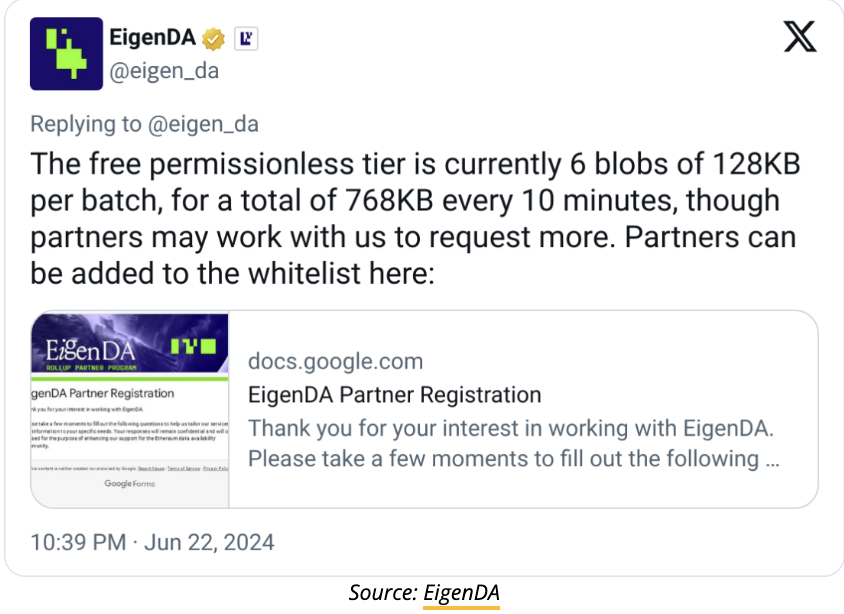
EigenDA’s free tier offers a throughput of up to 768 kilobytes per 10-minute window, far exceeding the needs of even the busiest rollups on Ethereum. For instance, Base uses fewer than two blobs every 10 minutes.
Additionally, EigenDA allows partners to request increased throughput beyond the free tier, providing a flexible solution for high-demand use cases.
Through its partner registration page, interested parties can collaborate with EigenDA to tailor solutions for their data needs, supporting a wide range of applications and innovations requiring high-throughput capabilities.
EigenDA generates synthetic loads of 0.6 megabytes per second and achieves peak throughputs of up to 10 MB per second on the mainnet.
EigenLayer(@eigencloud) is also working on implementing permissionless payments for blob throughput on EigenDA, which is planned to be released by the end of 2024. This feature will enable users to reserve bandwidth at a fixed rate to support high throughput demands.
Eigen’s token distribution
In May, EigenLayer completed the second phase of its EIGEN token airdrop, marking the end of its Season 1 and contributing to the total distribution of 113 million EIGEN tokens, amounting to 6.7% of the allocated supply for airdrops.
Once claimed, tokens will be temporarily locked until the end of the third quarter of 2024. However, users can still engage in staking and delegation activities with EigenDA(@eigen_da) operators through the EigenLayer web portal.
EigenLayer, which went live on the Ethereum mainnet in April 2024, has already gathered more than $12 billion in deposits. The platform opens up new proof-of-stake projects by using a wider trust network, thus omitting the necessity for separate security solutions.
#Eigen #Eigenlayer #EigenDA
Credit: Cointelegraph