People see a Nobel laureate leave Google for Anthropic and call it a loss for Google.
Google owns ~14% of Anthropic.
not saying it's a plan. just saying it's not exactly a loss either.
@FlavioBolsonaro Sinceramente, a nossa sorte é que vocês são muito burr0s. Me dá um frio na espinha imaginar um Brasil no qual você e seus irmãos tivessem um QI, sei lá, igual a 100
@fortelabs I dream about having a full Markdown, offline version of @CapacitiesHQ. I should build something similar from scratch with AI (taking note 📝)
@itsaflecha Fiz a mesma coisa,tanto no laptop como no PC de casa, ambos com Linux Mint. Só uso Windows hoje no computador do trabalho, porque não é escolha minha.
Things Americans believe about Brazil that are completely wrong:
"Brazil is dangerous."
São Paulo's murder rate is approximately 6 per 100,000. St. Louis, Baltimore, New Orleans, and Detroit all exceed 40. Latin America's largest city (the place most Americans picture when they think "dangerous Brazil") is safer per capita than St. Louis, Baltimore, New Orleans, Detroit, Memphis, and Cleveland.
"Brazil is poor."
8th largest economy on earth. 7th by purchasing power. GDP larger than Italy's. Unemployment at 5.3% (the lowest since 2012). 108.2 million tonnes of soybeans exported in 2025 ($43.5 billion). $18 billion in beef exports. $86 billion in revenue from a single meat company (JBS). $7.6 billion from a single airplane manufacturer (Embraer).
"Brazil only exports raw materials."
Embraer is the third-largest aircraft manufacturer on earth. Half the regional jets in America are Brazilian. WEG is a $40 billion industrial manufacturer that exports to 135+ countries. Nubank serves 110 million customers and is worth $85 billion. The Manaus Free Trade Zone assembles Samsung phones, Honda motorcycles, and LG electronics inside the Amazon.
"Brazil's financial system is backwards."
Pix processes 6-7 billion transactions per month. 170 million users. 93% of the adult population. The Fed launched FedNow nearly three years after Pix. Adoption: minimal. Brazil has Open Finance with 60+ million active consents. The US does not. Brazil has an active CBDC pilot (Drex). The US does not.
"The currency is unstable."
Brazil's Central Bank raised rates to 13.75% before the Fed started hiking. It fought inflation faster and harder than most major central banks in the 2021-2023 cycle. BCB independence was formalized by law in 2021 with fixed four-year terms. The dollar touched R$5.00 for the first time in two years. The Ibovespa hit 16 all-time records in 2026 and is up 22% YTD.
"Nobody invests in Brazil."
Chinese FDI grew 113% in 2024. The US committed $565 million to critical minerals. The EU just signed its largest trade deal ever (720 million consumers, 90%+ tariffs eliminated). BTG Pactual reported "enormous increase in interest from large pension funds and sovereign funds." The Ibovespa gained 30%+ in dollar terms in 2025.
"The Amazon is being destroyed."
Brazil still holds 60% of the Amazon rainforest. It has a higher share of renewable electricity than any major economy on earth (87%). The EU-Mercosul deal requires deforestation-free certification for all agricultural exports starting late 2026. Brazil powers itself with water while exporting oil. Very few countries on earth can say the same.
The gap between what Americans think they know about Brazil and what is actually true is wider than any valuation gap in financial markets.
That gap is the opportunity.
Next time someone tells you Brazil is "risky," ask them what they actually know about it.
Most of the time, the answer is nothing.
LLM Knowledge Bases
Something I'm finding very useful recently: using LLMs to build personal knowledge bases for various topics of research interest. In this way, a large fraction of my recent token throughput is going less into manipulating code, and more into manipulating knowledge (stored as markdown and images). The latest LLMs are quite good at it. So:
Data ingest:
I index source documents (articles, papers, repos, datasets, images, etc.) into a raw/ directory, then I use an LLM to incrementally "compile" a wiki, which is just a collection of .md files in a directory structure. The wiki includes summaries of all the data in raw/, backlinks, and then it categorizes data into concepts, writes articles for them, and links them all. To convert web articles into .md files I like to use the Obsidian Web Clipper extension, and then I also use a hotkey to download all the related images to local so that my LLM can easily reference them.
IDE:
I use Obsidian as the IDE "frontend" where I can view the raw data, the the compiled wiki, and the derived visualizations. Important to note that the LLM writes and maintains all of the data of the wiki, I rarely touch it directly. I've played with a few Obsidian plugins to render and view data in other ways (e.g. Marp for slides).
Q&A:
Where things get interesting is that once your wiki is big enough (e.g. mine on some recent research is ~100 articles and ~400K words), you can ask your LLM agent all kinds of complex questions against the wiki, and it will go off, research the answers, etc. I thought I had to reach for fancy RAG, but the LLM has been pretty good about auto-maintaining index files and brief summaries of all the documents and it reads all the important related data fairly easily at this ~small scale.
Output:
Instead of getting answers in text/terminal, I like to have it render markdown files for me, or slide shows (Marp format), or matplotlib images, all of which I then view again in Obsidian. You can imagine many other visual output formats depending on the query. Often, I end up "filing" the outputs back into the wiki to enhance it for further queries. So my own explorations and queries always "add up" in the knowledge base.
Linting:
I've run some LLM "health checks" over the wiki to e.g. find inconsistent data, impute missing data (with web searchers), find interesting connections for new article candidates, etc., to incrementally clean up the wiki and enhance its overall data integrity. The LLMs are quite good at suggesting further questions to ask and look into.
Extra tools:
I find myself developing additional tools to process the data, e.g. I vibe coded a small and naive search engine over the wiki, which I both use directly (in a web ui), but more often I want to hand it off to an LLM via CLI as a tool for larger queries.
Further explorations:
As the repo grows, the natural desire is to also think about synthetic data generation + finetuning to have your LLM "know" the data in its weights instead of just context windows.
TLDR: raw data from a given number of sources is collected, then compiled by an LLM into a .md wiki, then operated on by various CLIs by the LLM to do Q&A and to incrementally enhance the wiki, and all of it viewable in Obsidian. You rarely ever write or edit the wiki manually, it's the domain of the LLM. I think there is room here for an incredible new product instead of a hacky collection of scripts.
Its not Simcity, but business school students who were good at Civ V also turn out to be better planners, organizers, and problem-solvers in this small experiment.
Como professor, em uma certa época eu autorizava que meus alunos colassem, mas apenas em um pedaço de papel padrão, do mesmo tamanho para todos e com minha rubrica. Para usá-lo, acabavam resumindo a matéria toda. Ou seja, tinham que ESTUDAR 😂
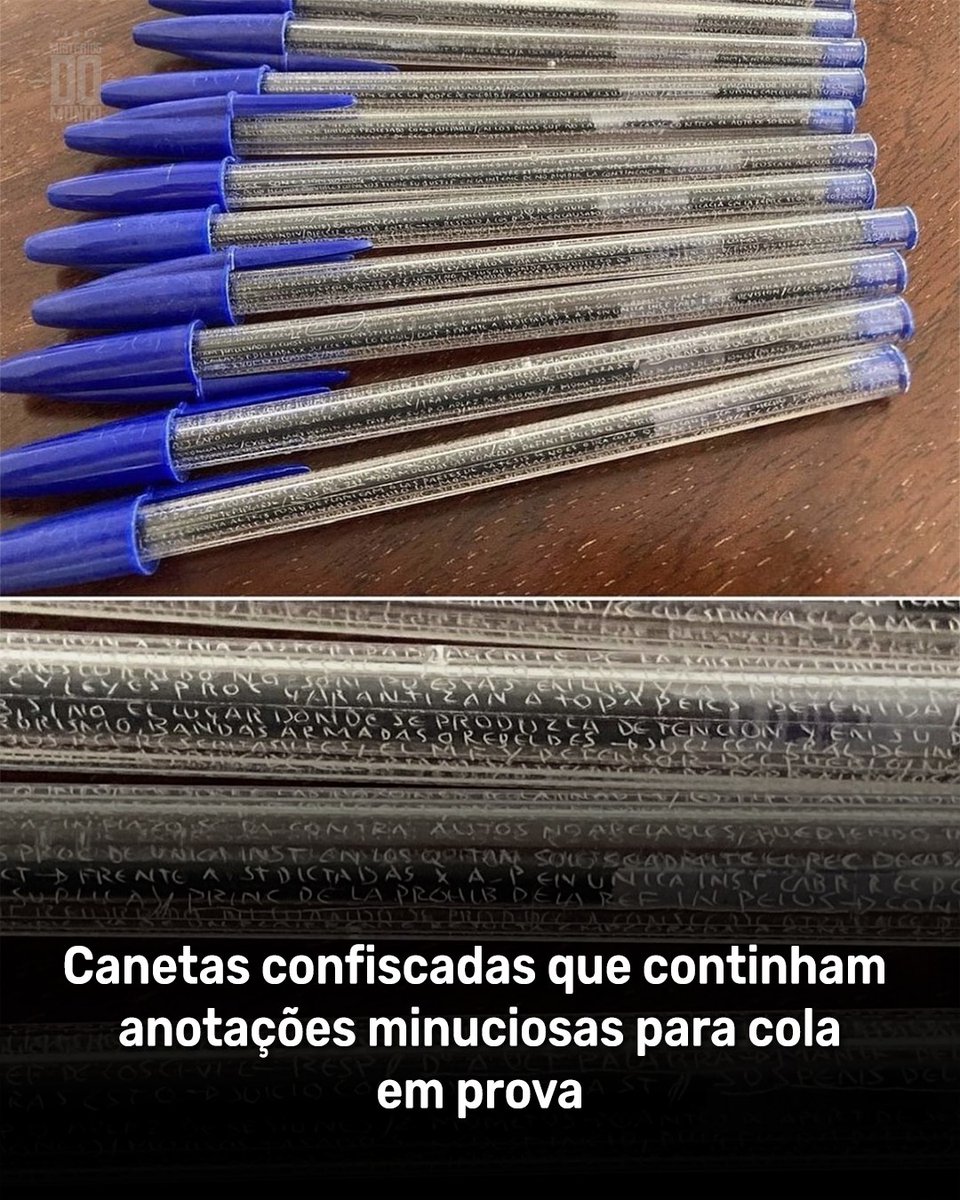
Um episódio registrado em 2022 na Universidade de Málaga, na Espanha, ganhou repercussão após a descoberta de um método inusitado de trapaça em exames. Um estudante foi flagrado usando canetas modificadas para esconder informações.
À primeira vista, tratava-se de itens comuns. Porém, no interior dos corpos transparentes, havia uma série de anotações extremamente pequenas, gravadas com precisão.
O espaço interno foi totalmente aproveitado com conteúdos resumidos e fórmulas essenciais. A criatividade na adaptação do objeto transformou simples canetas em um mecanismo discreto para tentar obter vantagem nas provas.