At Rappsilber Lab, we believe in innovation not only in science but also in how we care for our planet. 📷 By aligning with the My Green Lab standards, we’re committed to reducing our environmental footprint and creating a “greener” future for research and development.
https://t.co/skBLsihGnA
We’re thrilled to share that we’ve officially begun the My Green Lab Certification process! 📷 This marks an important step toward making our laboratory operations more sustainable and environmentally conscious.
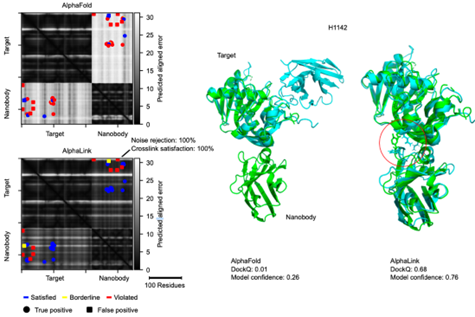
The AlphaLink2 paper is now online! It’s joint work with @rbolab and @JorgStulke. AlphaLink2 integrates crosslinking MS data into AlphaFold-Multimer. AlphaLink2 really shines for challenging targets like antigen-antibody complexes. https://t.co/G922oFtlCe
We got an ERC synergy grant to work on and understand with Julia Mahamid (EMBL), Jan Kosinsky (EMBL), and Rachel Green (Johns Hopkins University, USA) ribosomes inside their cellular context and develop tools to study molecular processes inside cells at atomic resolution.
With AlphaLink2 we can now start visualizing protein-protein interactions inside cells at pseudo-atomic resolution by leveraging the very scarce data of whole-cell crosslinking MS. We thank @deepmind and Uni-Fold (@guolin_ke, @LiZiyao11) for providing excellent open-source tools
In collaboration with the @rbolab, we are pleased to present AlphaLink2 - a modified version of AlphaFold-Multimer that is capable of directly incorporating experimental residue-residue contact data from crosslinking MS (and potentially other techniques as well). (1/7)
AlphaLink can represent crosslinking MS restraints as distograms which generalise to arbitrary distance restraints and allows mixing different types of (experimental) distance restraints. We thank @deepmind, @MoAlQuraishi and OpenFold for providing such excellent tools!
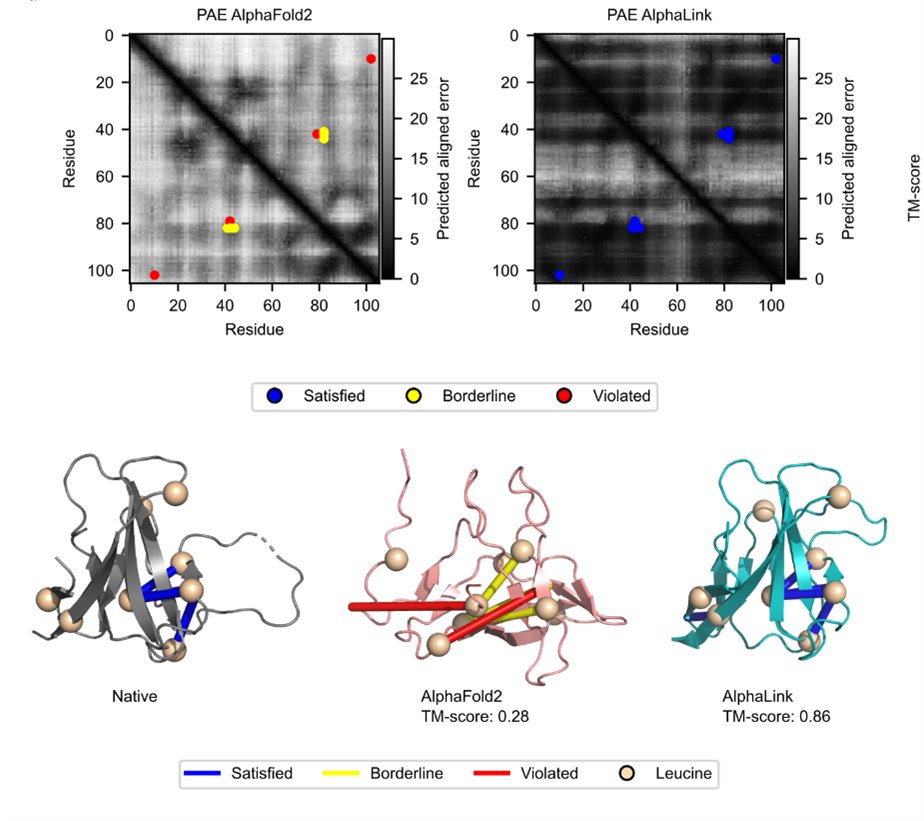
We and the @rbolab are excited to present AlphaLink https://t.co/RuZvaIehxd a modified version of the AlphaFold2 protein structure prediction algorithm that can directly incorporate experimental residue-residue contact data from crosslinking MS (and potentially other techniques)!
A few crosslinking MS restraints could act as “anchor points” to predict different conformational states of the kinase Cdk2 or fold-switching proteins. This has the potential to open up predictions of in-cell conformations of proteins from sparse restraints. (8/9)