To be clear, our sale of $GOOG was not a bet against the company. We are very bullish long term on Alphabet. But at current valuations and in light of our finite capital base, we used $GOOG as a source of funds for $MSFT.
As two of the largest forces in equity markets -- growing index ownership and increasing amounts of capital controlled by extremely short-term-oriented, leveraged, volatility-intolerant investors -- converge, we have found occasional opportunities to acquire some of the most dominant long-term compounding franchises at attractive valuations.
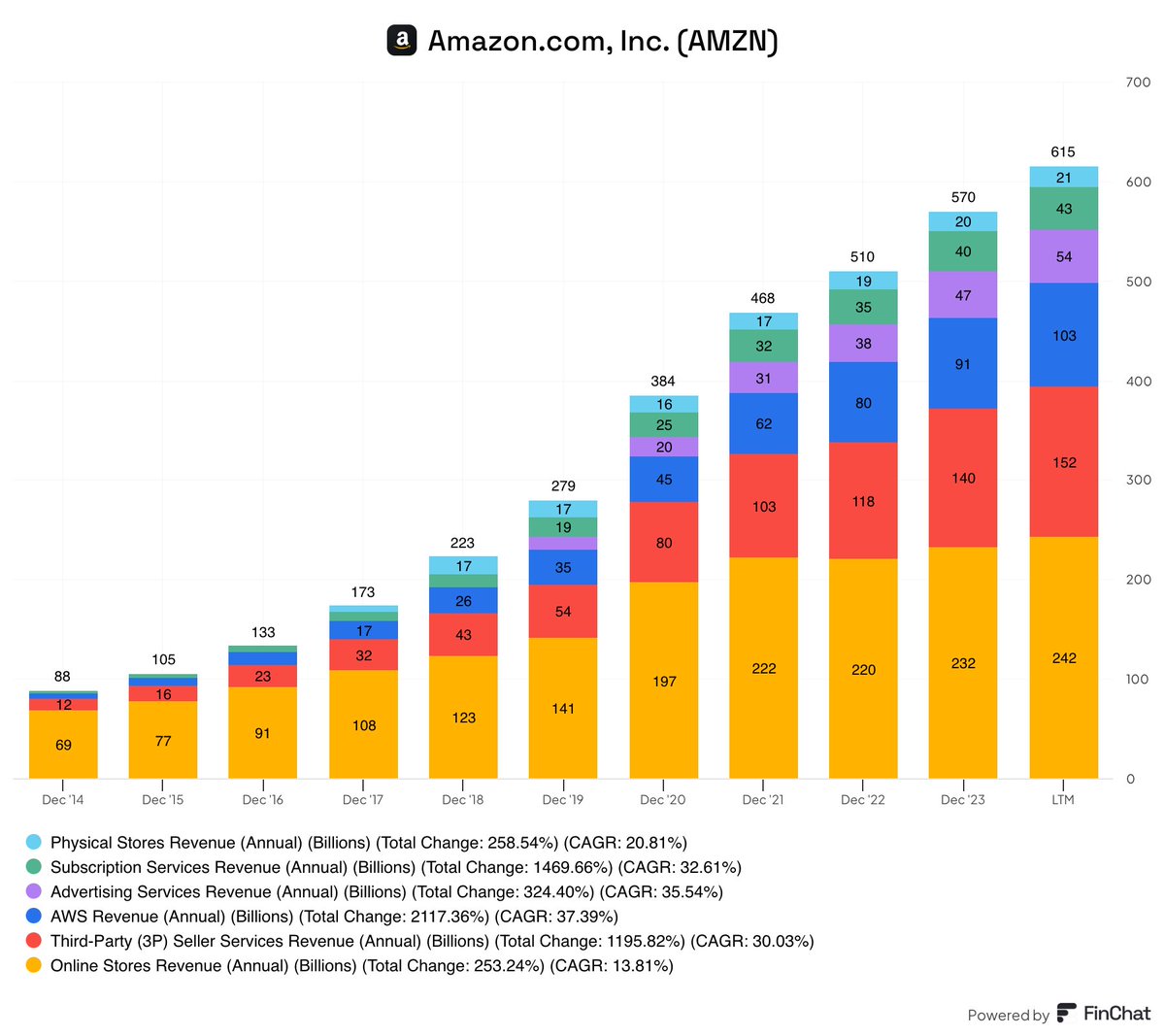
For example, we acquired Alphabet $GOOG when the stock declined substantially on the release of ChatGPT in late 2022, Amazon $AMZN in the weeks following Liberation Day, and $META more recently on the market's response to the company's unexpectedly large cap ex guidance and expenditures.
In our 13F which we will file later today, we will disclose a new position in Microsoft, a company we have followed for many years now offered at a highly compelling valuation. While $PSUS will not be filing a 13F tomorrow, it has also recently made $MFST a core holding.
Microsoft operates two of the most valuable franchises in enterprise technology, which account for approximately 70% of the company's overall profits: M365 and Azure.
M365, the company's productivity suite, is the dominant operating platform for knowledge work, with over 450 million workers using Word, Excel, PowerPoint, Outlook, and Teams on a daily basis.
Azure is the world's second-largest hyperscaler cloud platform and, like AWS in our Amazon investment, is a direct beneficiary of the multi-decade migration of enterprise IT workloads to the cloud, which is now further accelerated by surging demand for AI inference workloads.
Both M365 and Azure are underpinned by Microsoft's unparalleled enterprise distribution and the security, compliance, and identity infrastructure it has built and refined over decades.
Beyond these core franchises, Microsoft also owns a portfolio of other leading businesses, including LinkedIn (the world's largest professional network with 1.3 billion members), its gaming platform (Xbox and Activision Blizzard), and search and news advertising (Bing and the Edge browser).
We began building our position in MSFT in February following a meaningful share price decline after the company reported its fiscal Q2 2026 results. We were able to establish our position at a valuation of 21 times forward earnings, broadly in line with the market multiple and well below Microsoft's trading average over the last few years.
Notably, MSFT's headline multiple does not reflect the value of Microsoft's approximately 27% economic interest in OpenAI, which would represent approximately $200 billion, or 7% of Microsoft's market capitalization, at OpenAI's most recent funding round valuation.
We believe Microsoft's recent share price decline has been principally driven by investor concerns around two key issues: i) the competitive positioning of M365 against increasingly capable AI lab offerings (notably Anthropic's Claude Cowork), and ii) the durability of Azure's growth, especially in light of Microsoft's evolving relationship with OpenAI.
In our view, investors underestimate the resilience of the M365 franchise given its deeply embedded role across enterprises and highly attractive price-value proposition. Unlike point software solutions, which may be vulnerable to disintermediation by better-performing AI alternatives, M365 is tightly integrated into the daily workflow of nearly every large enterprise and is supported by Microsoft's identity, security, compliance, and data governance infrastructure, which would be nearly impossible to replicate.
Attractive bundle economics further reinforce Microsoft's advantage, with monthly average revenue per user on the M365 suite at approximately $20, less than half of what customers would pay to purchase the underlying applications individually from different vendors.
Moreover, we are encouraged to see Microsoft prioritizing its R&D efforts and investment in Copilot, its own AI agent embedded across M365, with direct involvement from CEO Satya Nadella. We believe these efforts will translate into improved product velocity and greater customer adoption over time.
Alongside Copilot's rollout, the company has also begun shifting its pricing model from pure per-seat licensing to a hybrid model of seats plus metered consumption, which helps expand the company’s revenue opportunity as AI agents drive incremental usage that a seat-only structure would not capture. These initiatives should help sustain M365’s strong underlying growth momentum, which was already evident in the business unit’s 15% revenue growth (in constant currency) last quarter.
We believe concerns regarding Azure's growth trajectory are similarly misplaced, particularly in light of the franchise's exceptional recent performance. Azure revenue grew 39% in constant currency last quarter, with company guiding to modest acceleration through the second half of the year.
We view Microsoft's recent decision to restructure its OpenAI partnership not as a concession but as part of a deliberate pivot toward a more open, multi-model architecture that better serves enterprise customers, who increasingly seek optionality across model providers.
Microsoft recently disclosed that over 10,000 enterprise customers have used more than one model on Azure Foundry, the company’s modular AI model marketplace. This model-agnostic approach also strengthens Copilot, which can auto-route queries across multiple models to deliver the optimal output for a given task.
To support Azure's rapid growth amid persistent supply constraints, Microsoft has raised its calendar year 2026 capex budget to approximately $190 billion. Consistent with what we have observed at hyperscaler peers Amazon and Google, we view this spend as growth capex that should drive future revenue generation. This is particularly true for Microsoft, given that roughly two-thirds of its capex budget is allocated to server and networking equipment that correlates directly with near-term revenue.
Like our purchases of $GOOG, $AMZN, and $META, we believe that $MSFT offers analogous and compelling long-term value at today's valuation.
After being in the investing game for 30 years , you know that opportunities like $UNH don’t come along very often … high quality businesses that are significantly undervalued. These are rare no brainer buys , like $META at $80 and $GOOGL at $100
This is when all those with half a brain will buy like crazy
-Warren Buffett buys 5.03 million shares.
-Dodge & Cox buys 4.73 million shares.
-David Tepper buys 2.27 million shares.
-Renaissance buys 1.35 million shares.
-Michael Burry buys calls.
-Saudi Arabia's Public Investment Fund (PIF) buys calls.
Sharing my favourite 30 highlights of Berkshire Hathaway’s 2025 Annual Shareholder Meeting:
1 | Steve Jobs created Apple, Tim Cook developed Apple, Tim Cook made more money for Berkshire than Buffett did
But Steve picked out Tim to succeed him, and he really made the right decision. Steve dies young, as you know. And nobody but Steve could have created Apple, but nobody could -- but Tim could have developed it like it has. So on behalf of all of Berkshire, thank you.
I'm somewhat embarrassed to say that Tim Cook has made Berkshire a lot more money than I've ever made Berkshire Hathaway.
2 | Trade wars are bad, trade should not be used as a weapon
And there's no question that trade can be an active war, and I think it's led to bad things… I do not think it's a great idea to try and design a world where a few countries say, "Ha, ha, ha. We won," and other countries are envious…But the main thing to do is not -- trade should not be a weapon… And I don't think it's right, and I don't think it's wise. I do think that the more prosperous the rest of the world becomes, it won't be at our expense, the more prosperous it will become and within the safer it will feel and your children will feel someday.
3 | Does not want to do DOGE, but it has to be done
So I wouldn't want the job of trying to correct what's going on in revenue and expenditures in the United States with roughly a 7% gap when probably a 3% gap is sustainable. And then the further away you get from that, the more you get to where the uncontrollable begins. And I think that it's a job I don't want, but it's a job I think should be done.
4 | The recent market declines are really nothing, always remained focused on the business, not the price
What has happened in the last 30, 45 days, 100 days, whatever you want to pick up, whatever this period has been. It's really nothing. There's been 3 times since we acquired Berkshire that Berkshire has gone down 50% in a fairly short period of time, 3 different times. Nothing was fundamentally wrong with the company at any time. But this is not a huge move… This has not been a dramatic bear market or anything of the sort…There's been plenty of periods that just are dramatically different than this.
5 | If one cannot withstand the price declines, and get frightened during declines and excited when they go up, one needs to check their emotions at the door when they invest
But if it makes a difference to you whether your stocks are down 15% or not, you need to get a somewhat di erent investment philosophy because the world is not going to adapt to you, you're going to have to adapt to the world….That's just -- that's part of the stock market. And that's what makes it a good place to focus your efforts if you got the proper temperament for it and a terrible place to get involved if you get frightened by markets that decline and get excited when stock markets go up. I don't mean to sound particularly critical. I mean I know people have emotions, but you got to check them at the door when you invest.
6 | Real estate being much harder than stocks to negotiate, time spent, and involving more parties
Well, in respect to real estate, it's so much harder than stocks in terms of negotiation of deals, time spent, the involvement of multiple parties. And the ownership, usually when real estate gets in trouble, you find out you're dealing with more than an equity holder….I mean, in a real estate deal, every sentence is as important as a person. And in stocks, if somebody needs to sell 20,000 shares of Berkshire or something and they call us that the price is right, it's done in 5 seconds… So for a guy at 94, it's not the most interesting thing to get involved in something where the negotiations could take years.
7 | AI is going to be a real game changer that will change the way risk is assessed, priced, sold and how claims are paid, more wait and see approach, will not trade AI for Ajit
Well, there is no question in my mind that AI is going to be a real game changer, and it's going to change the way we assess risk, we price risk, we sell the risk and then the way we end up paying claims. Having said that, I certainly also feel that people end up spending enormous amount of money trying to chase the next new fashionable thing. We are not very good in terms of being the fastest or the rst mover. Our approach is more to wait and see until the opportunity crystallizes, and we have a better point of view in terms of risk of failure, upside, downside. So right now, the individual insurance operations do dabble in AI and try and figure out what is the best way to exploit it. But we have not yet made a conscious big time effort in terms of pouring a lot of money into this opportunity. And my guess is we will be in a state of readiness. And should that opportunity pop up, we'll be in a state where we'll jump in promptly. Yes. And I would just add, I wouldn't trade everything that's developed in AI in the next 10 years for Ajit.
8 | Self-driving autonomous cars will change the landscape of motor insurance, substituted by product liability
Yes. There's no question that insurance for automobiles is going to change dramatically once self-driving cars become a reality. The big change that we will see is what you identi ed. Most of the insurance that is sold and bought revolves around operator errors and how often they happen, how severe they are and therefore, what premium we ought to charge. To the extent these new self-driving cars are most safe and are involved in fewer accidents, that insurance will be less required. Instead, it will be substituted by, as you mentioned, product liability. So we at GEICO and elsewhere are certainly trying to get ready for that switch where we move from providing insurance for operator errors and be more ready to provide protection for product and errors and emissions in the construction of these automobiles.
9 | But while accident probabilities could decline, outcomes / repair costs become more costly, and how they offset each other remains unclear
The only thing I want to add is, in addition to that shift, I think what we'll see is a major shift where the number of accidents that take place and need to be provided for will drop dramatically because of automatic driving. But on the other hand, the cost per repair, every time there's an accident, the cost of repairing and bringing everything back to where it used to be would go up very significantly because of the amount of technology that's going into the car. How those two variables interact with each other in terms of the total cost of providing insurance, I think, is still an open issue.
10 | Paid $50m for half of GEICO, now has $1bn profits and provides $39bn float
We paid $50 million for half of GEICO in 1976, what turned out to be half of GEICO, $50 million. We now own 100%, but 50% of $2 billion that we earned in the first quarter is $1 billion, which on a $50 million investment… The only thing I'd like to add is in addition to the underwriting profit, GEICO provides $39 billion of float.
11 | Berkshire’s insurance float is negative 2.2%, like people paying them to leave money with them
Yes. So that is money that as long as we're writing at an underwriting profit is absolutely free money….Yes. So I think if you look at the entire range, including life insurance, our cost of float is 2.2% negative. That means we've got the float plus somebody has given us 2.2% of that of cash to...Yes, it's like running a bank, where people leave their money with you and you pay a minus 2.2%, and you don't have any check clearing or anything else to do that's included that.
12 | Focus more on balance sheets than income statements
Yes. That's one thing we've never talked about here, but I spend more time looking at balance sheets than I do income statements. And Wall Street really doesn't pay much attention to balance sheets. But I like to look at the balance sheets over an 8 or 10year period before I even look at the income account. Because there are certain things that's harder to hide or play games with on the balance sheet than you can with the income statement. And I mean, neither one gives you the total answer on anything, but you still ought to understand what the gures are saying and what they don't say and what they can't say and what the management would like them to say that the auditors wouldn't like them to say. I mean there's just a lot to be learned. And you do learn more. You learn more from balance sheets, in my view, than most people give them credit for.
13 | Stocks are part ownership of a business, its cash flows, its balance sheet
And then there's the opportunity to own pieces of companies through the equity. But as Warren has always highlighted, and again, this will be our approach to how we think around those companies, though -- we own a piece of a company, we own a piece of that cash flow, we own a piece of their balance sheet. It's not just a share certificate. And as we approach that -- and really, we'll approach it with the thought that we're going to own this company for the long term.
14 | Two questions he will ask any CEO, get them talking about their competitors, and keep quiet and listen
They weren't getting calls like that. And I would ask them 2 questions….You just ask them one question that if they were to be stuck on a desert island and they had to own only one of their competitor's stock during the 10 years they were going to be on that island, which one would it be and why? And then I have to give you that answer, you said the same thing. And if you were going to short your net worth while you're on that island, which would it be and why? Because every manager likes to talk about their competitors… I kept my own mouth shut in those days. That's a lesson I've lost somewhere along the line.
15 | Having problems are good.
And I don't know any good way to solve that problem. But Charlie always told me that having a few problems was good for me. I never quite understood that. But if you listen to them moralized, you would understand.
16 | Things are never orderly and linear.
And the one problem with the investment business is that things don't come along in an orderly fashion, and they never will. I mean, it isn't like every day.
17 | Everybody gets setbacks, it’s not fun, but it’s part of life, focus on the good things rather than the bad things, and you realise you had a wonderful life
Well, everybody gets setbacks. And some people have particularly bad luck in that respect and others get through with fairly minors. But Charlie, he had setbacks, I had setbacks. I mean it's part of life, and they're not fun. I don't have any great advice for you about having time of your life while you're having some major setback. But it comes with lifetime. You certainly have a setback when you die. So everybody's got that setback guaranteed to them…But you're just going to have it… So I would focus on the things that have been good in your life rather than the bad things that happened because bad things do happen. But it's it can often be a wonderful life.
18 | Trying to be a better market timer
And we have made a lot of money by not wanting to be fully invested at all times. And we don't think it's improper actually for people who are passive investors just to make a few simple investments and sit for their life in them. But we've made the decision to be in the business. So we think we can do a little better than that by behaving in a very irregular manner.
19 | Long-term trend is still up, but no one knows when there will selloffs
Things get extraordinarily attractive very occasionally. The long-term trend is up. Nobody knows, and I certainly don't know. Greg doesn't know. Ajit doesn't know. Nobody knows what the market is going to do tomorrow, next week, next month. Nobody knows what business is going to do tomorrow, next week or next month. But they spend all their time talking about it because it's easy to talk about. And -- but it has no value.
20 | Times when one have to act fast, but one needs to be patient and prepared
And there are times when you have to act fast. In fact, we made a great deal of money because we're willing to act faster than anybody around.
And as you touched on, we want to act quickly. But while we're being patient, never underestimate the amount of reading and work that's being done to be prepared to act quickly.
21 | Cannot have self-doubt, need to be able to say yes or no after 5 seconds
And the main thing you have to do is you have to be willing to hang up after 5 seconds, and you have to be willing to say yes after 5 seconds. And you can't be lled with self-doubt in the business.
22 | Don’t get fearful especially when everyone else around you is, see it as fantastic opportunities instead, don’t have emotions about stock prices
But I don't get fearful by things that other people are afraid of in a financial way. The idea that if Berkshire went -- let's say, Berkshire went down 50% next week, I would regard that as fantastic opportunity. And it wouldn't bother me in the least. And most people aren't. They just react di erently. And so it's not that I don't have emotions, but I don't have emotions about the prices of stocks. I mean, I actually -- those decisions get all the way to my brain, whereas emotions can get bogged down in some other place.
23 | Important to have people to trust you
I mean, one of the great pleasures, it is the great pleasure actually in this business is having people trust you…both Charlie and I we just enjoyed the fact that people trusted us and they trusted us 60 years ago or 70 years ago in partnerships we had. And we never sought out professional investors to join our partnerships. Among all of my partners, I never had a single institution. I never wanted an institution. I wanted people.
24 | In investment management, alignment of interest is crucial, avoid those that do not put all their own money alongside you
But investment management is a very good game because other people put up the capital and you charge them for the capital whether they do well or not and then you charge them a lot more if they do well….The trick in life is to get somebody else's capital and get an override on it…We were just -- it just didn't appeal to us after a while. I did it for 12 years though or something like, not really -- the one difference that Charlie and I did from other people is we put all our own money in and do it. So we did share the losses with our own capital, but we got an override on other people's capital. And that's been -- people have made advances where they get the override on other people's capital without putting up any of their own capital to speak of, and that's a very good business, but it can lead to a lot of abuse.
25 | Choose and build a network of people that make you want to be better than you are, you feel are better than you are
but you are going to go into -- you're going to have your life progress in the general direction of the people that you work with, that you admire, that become your friends. I mentioned a few fellows that have died in the last couple of years. Well, all of those people were people that if we were working together on something one 10,000 the size of Berkshire, I mean, they'd be the kind of people you choose. You just -- there are people that make you want to be better than you are. And you want to hang out with people that are better than you are and that you feel are better than you are because you're going to go in the direction of the people that you associate with…
26 | When you find them, treasure them, don’t give up looking for them, and if they are helpful to you, try and be helpful to them in return, good intentions and behaviour compounds
And they also every one of those ones I named, they always did more than their share, and they never sought more than their share of the credit. They just behaved the way you like anybody you work with. And when you find them, you treasure them. And when you don't find them, you still keep doing whatever causes you to eat or enables you to eat. But you don't give up on looking around. And you'll find people do wonderful things for you. And of course, if somebody is going to be helpful to you, you want to try to figure out ways to be helpful to them. So you get a compounding of good intentions and good behavior.
27 | Do things in life that you enjoy doing and are damn good at it, you will be happier and more successful
Greg doesn't need the money or he doesn't need the money remotely. And they -- but they enjoy what they do and they're so damn good at it. It's just -- well, I've had the advantage of seeing how that works over time. The best manager I ever knew, and there's a lot of contention for who that would be. But actually it was Tom Murphy senior that who lived the almost 98…And I'm not saying that's the only way to succeed, but I think it's the most pleasant way to succeed for sure…. you'll learn all the time, but you'll not only learn how to be successful in business, you learn how to be successful at life... But I think a happy person lives longer than somebody that's doing some things that they don't really admire that much in life.
28 | Work hard, stay curious and read a lot
you're going to have to work hard. And I think hard work takes all of us a long ways in life. And I would never diminish that there's a lot of things that matter in life, but if you start with a great work ethic and have that attitude that you want to contribute, you're going to go a long ways in life. And you'll find great enjoyment because, as Warren said, you'll then -- if you work hard, you're going to nd the things you love in life, and it will lead to that….Keep a lot of curiosity and read a lot, as Charlie would say.
29 | Everyone is different and has different interests and strengths, find what fascinates you, and find the best teachers
I think there was that book that talked about spending 10,000 hours or something. I could spend 10,000 hours at tap dancing and you'd throw up if you watched me. But if I spent 10 hours reading Ben Graham, I would be damn smart when I got through. So minds are really, really different….I'm not sure that all of mine are ashing bright lights, but you are different than anybody else. That's my dad always used to tell me that essentially that you're something different. You may not be good at the moment. But you find your own path…So I would look around to do what really fascinates you. I wouldn't try and be somebody else.
And then I would -- you'll find the teachers out of school, and you'll nd some outstanding people that are teachers. I've had at least 10 people that have had huge impacts on my life. And every one of them was positive because I got to select in a sense. And a number of people really like it, helping younger people.
30 | Warren Buffett passing the CEO baton to Greg Abel by year end, will still hang around, confident that prospects of Berkshire will be even better under Greg
Tomorrow, we're having a Board meeting of Berkshire, and we have 11 directors, 2 of the directors who are my children, Howie and Susie know what I'm going to talk about there. The rest of them, this will come as news too. But I think it's -- the time has arrived where Greg, should become the Chief Executive Officer of the company at year-end. And I want to spring that on the directors effectively and give that as my recommendation. Let them have the time to think about what questions or what structures or anything they wanted. And then there's a meeting following that, which will come in a few months. We'll take action on whatever the view is of the 11 directors, I think they'll be unanimously in favor of it. And that would mean that at year-end, Greg, would be the Chief Executive Officer of Berkshire. And I would still hang around and could conceivably be useful in a few cases, but the final word would be what Greg said, in operations, in capital deployment, whatever it might be. I could be helpful, I believe, in that in certain respects, if we ran into periods of great opportunity or anything.
But he would be the Chief Executive, period. And like I say, the plan is to-- and Greg doesn't know anything about this until what he's hearing right now…But I will not -- I have no intention, zero, of selling one share of Berkshire Hathaway, it will get given away. I would say -- I would add this, the decision to keep every share is an economic decision because I think the prospects of Berkshire will be better under Greg's management than mine…And if that time comes, I think it may be helpful with the Board, the fact that they know I've got all my money in the company and I think it's smart. And I've seen what Greg has done.
United Health shows how broken the helath insurance industry is.
Close to 1/3 claim denial rate is glaring but on the other than, Oscar $OSCR is an outlier here with below average denial rate. We added OSCR in NDI eToro portfolio since inception.
A great heuristic to invest in new tech is to invest in ones who are taking the tedious hard work of using tech to transform and provide high NPS services. In an industry where customers are screwed up and milked by legacy incumbents.
Several great examples:
Carvana $CVNA
Palantir $PLTR
Opendoor $OPEN
Nubank $NU
Affirm $AFRM
SoFi $SOFI
Snowflake $SNOW
SpaceX
Anduril
The S&P was up 1.7% this past week despite:
1) Russia lowering the bar to use nuclear weapons
2) $NVDA (down 2.7% since reporting on Wednesday) guidance only 1-2% better on revenues and earnings relative to consensus.
This market strength despite Russia’s nuclear stance and Nvidia guidance supports my belief that markets remain strong through year-end & into early 2025 driven by:
1. Trump’s re-election: 1st term S&P CAGR was 14%
a. Expectations for tax cuts & less regulation
b. Deficit will initially go up from an already high 7-8%
(largest for non-war time & non recessionary period)
2. Don’t Fight the Fed
a. Fed started cutting w/ 50 bps w/ more cuts in 2025
b. Other Central banks are also cutting aggressively
3. There is no recession on the near-term horizon
a. GDP growth is ~3%
b. Unemployment is near 4%
4. AI is deflationary (technology substitution for labor)
5. China is finally trying to stimulate their economy
6. Seasonality: Stocks are in best 3 months of the year
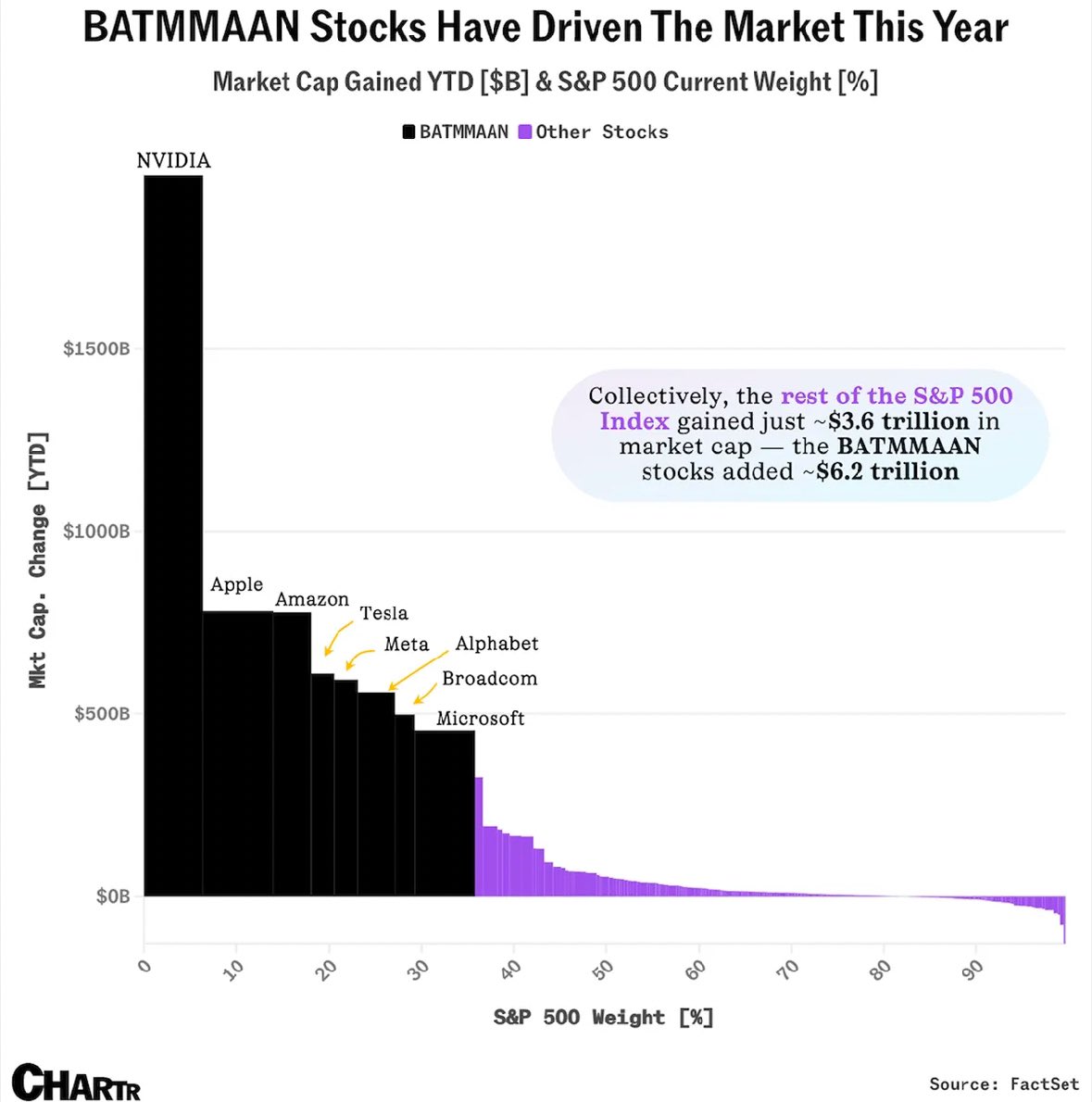
I continue to believe that an equal weighted basket of stocks is a great risk adjusted way of capturing this potential upside. In 2016, following the election of President Trump, the S&P gained 5% through year (11/7-12/31/2016) but this was led by the subsectors of Financials, Industrials and Energy (+11% on average) and small caps (Russell 2K +14%.) The information technology sector only gained 2% through year end following the election versus being up 10% (S&P up 4%) year-to-date till the election in 2016.
So far in 2024 following the election, the S&P is up 4% with Financials, Industrials and Energy up 8% along with the Russell 2K. Less regulation and more domestic manufacturing is good for these non-tech sectors. The information technology sector is up 4% but the Magnificent 7 are up only 1% on average since the election (11/4-11/22/2024) if you exclude the 45% surge in $TSLA given the relationship @elonmusk has with @realDonaldTrump.
For Nvidia, while I believe the AI buildout will continue over several more years and that NVDA revenues can double again over that time, I also believe there will be an AI digestion phase in the first half of 2025:
1) Near-term (next 3-6 months) I am trying to be flexible
a. Supply constraints leading to Nvidia customers over-ordering combined with positive seasonality may lead investors to remain bullish
b. Only 1-2% upside to forward revenue & EPS estimates for Nvidia after reporting Q3 results may result in investors being more cautious given industry concerns about “having hit a wall in AI scaling laws”
2) Mid-term I am bearish given supply constraints should end by mid-year 2025 leading to an AI capex digestion phase
3) Long-term (over the next several years) I am bullish given I think revenues will double from current levels as the AI buildout continues
a. $CSCO revenues went up 15.5x over six years from the introduction of the first mass internet web-browser in late 1994, NetScape Navigator, till the peak of the internet infrastructure buildout. Cisco became the most valuable company in the world during this time.
b. Nvidia revenues are up 5.9x over the past two years of the AI infrastructure buildout since the launch of ChatGPT in late 2022. For comparison, Cisco’s revenues were up 3.3x over its first two years of the internet infrastructure buildout. Nvidia has become the most valuable company in the world currently.
My bias is that investors in the near-term want to focus on the positive statements made by Nvidia including:
1) Both Hopper and Blackwell systems having certain supply constraints which are tempering revenues
2) Blackwell shipping in CQ4:24 and demand being ‘staggering
3) Initial Blackwell revenues exceeding previous expectations of several billion dollars
4) The demand for Blackwell to exceed supply for several quarters in calendar 2025
5) Refuting scaling concerns & seeing demand for:
a) pre-training scaling continuing
b) post training scaling which is newer
c) inference time scaling which is newer
My concern is as the $MSFT CEO said at their Ignite conference on AI on 11/19: “Just in the last multiple weeks, there’s a lot of debate of have we hit the wall with scaling laws.” While I am optimistic over the next several years on the AI buildout, I have also been thinking there will be a temporary AI digestion phase for the industry in the first half of 2025 due to ROI concerns. It is worth remembering that Microsoft has guided revenues for the following quarter slightly below consensus when they reported both their June quarter and September quarter. Microsoft and $AMZN are the two biggest spenders on AI infrastructure in the world and are roughly 50% bigger spenders than $GOOGL and $META which are in 3rd and 4th place. The statement above by Microsoft makes me wonder if the digestion phase will be on the earlier side given Microsoft’s close relationship with OpenAI, the creator of ChatGPT.
AI capex for the largest players is up nearly 60% in 2024 and this may slow to the 10-20% range in 2025 unless the ROI on the past 2 years of investment improves. Nvidia revenues were up 102% last year and are estimated to be up 123% this year and the street estimates are for up roughly 50% in 2025. If AI industry capex, does indeed slow to closer to 10-20%, I believe Nvidia will have a hard time achieving those forecasts unless the ROI improves on current investments by their largest customers.
From a macro perspective, one thing I have been watching closely is the surge in 10-year treasury yields. This occurred following 1) the initial 50 bps cut by the Fed on 9/18 and 2) the articulation of inflationary policies by both US Presidential candidates. The 10 year treasury yields surged following the initial 50 bps cut by the Fed from 3.65% on 9/17 to an intra-day high of 4.50% on 11/15 following the election. The stock market and treasury yields surged while credit spreads dropped to a one-year low on 11/12 of 1.05% versus a one-year average of 1.27%. This implies investors believe growth prospects are improving versus fears of inflation picking up.
In summary, with Central banks cutting aggressively and governments stimulating even more, I think stock markets remain strong through the first half of 2025. I continue to believe an equal weighted basket of stocks is the best risk adjusted way to participate in this bullish trend.
As always, the key will be to remain intellectually flexible and data dependent. As Niels Bohr, the Nobel laureate in Physics, said: “Prediction is very difficult, especially if it's about the future!”
Quick Reference Chart for Saty ATR Levels and Level-to-Level Probabilities.
Probabilities analyzed and provided by @tesrak based on historical data. If you like this data, you should give him a follow.
2024 Q1 and Q2, Buffett has trimmed more than 500M shares (~$90B) of Apple stocks. Now, he has ~25% Apple in his portfolio. Without considering macro economics, Apple seems to be richly valued. $AAPL $BRK.A $BRK.B
In 2023 Q4, Buffett sold 10M shares (~$2B) of Apple. That was only about 1% of its stake, but it is a big deal since he has been buying shares. Last buy was 20M shares on 2023 Q1. $AAPL $BRK.A $BRK.B
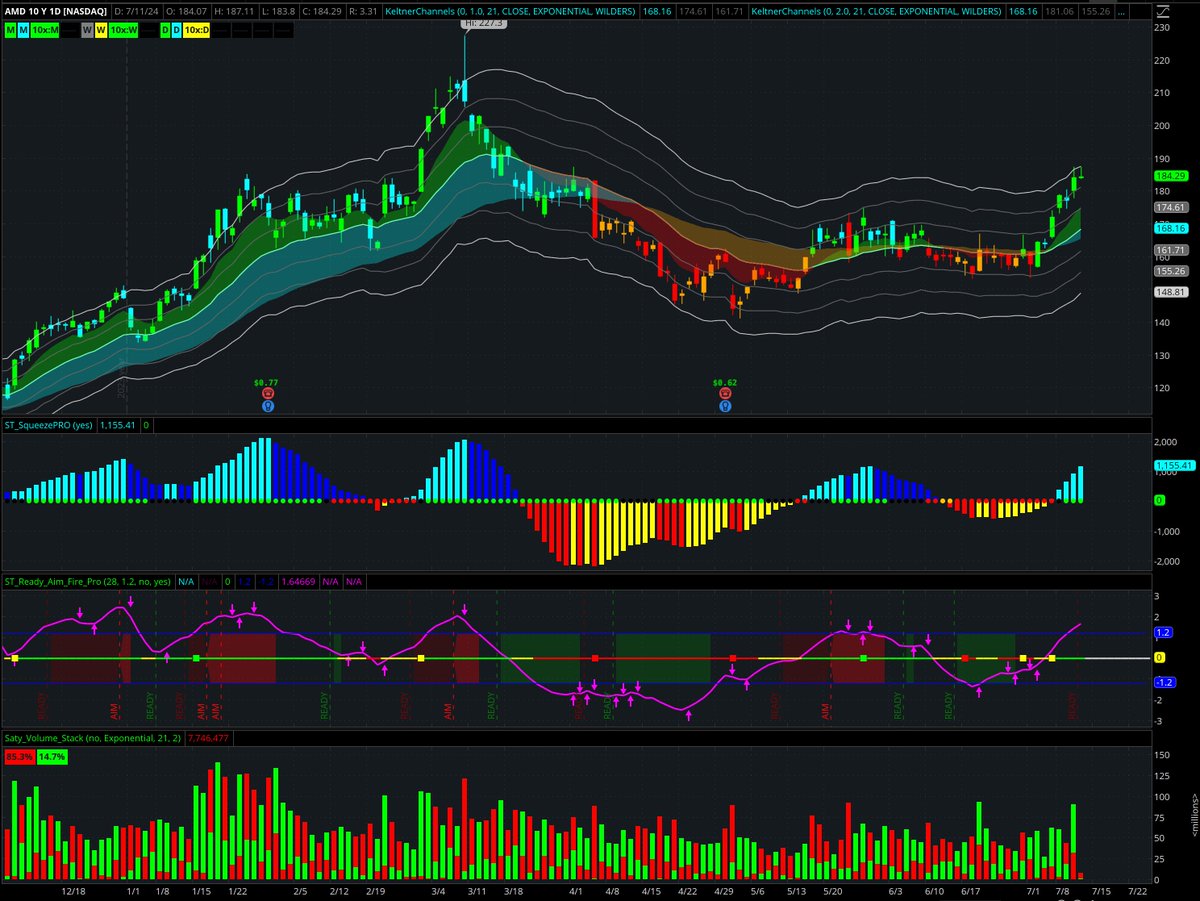
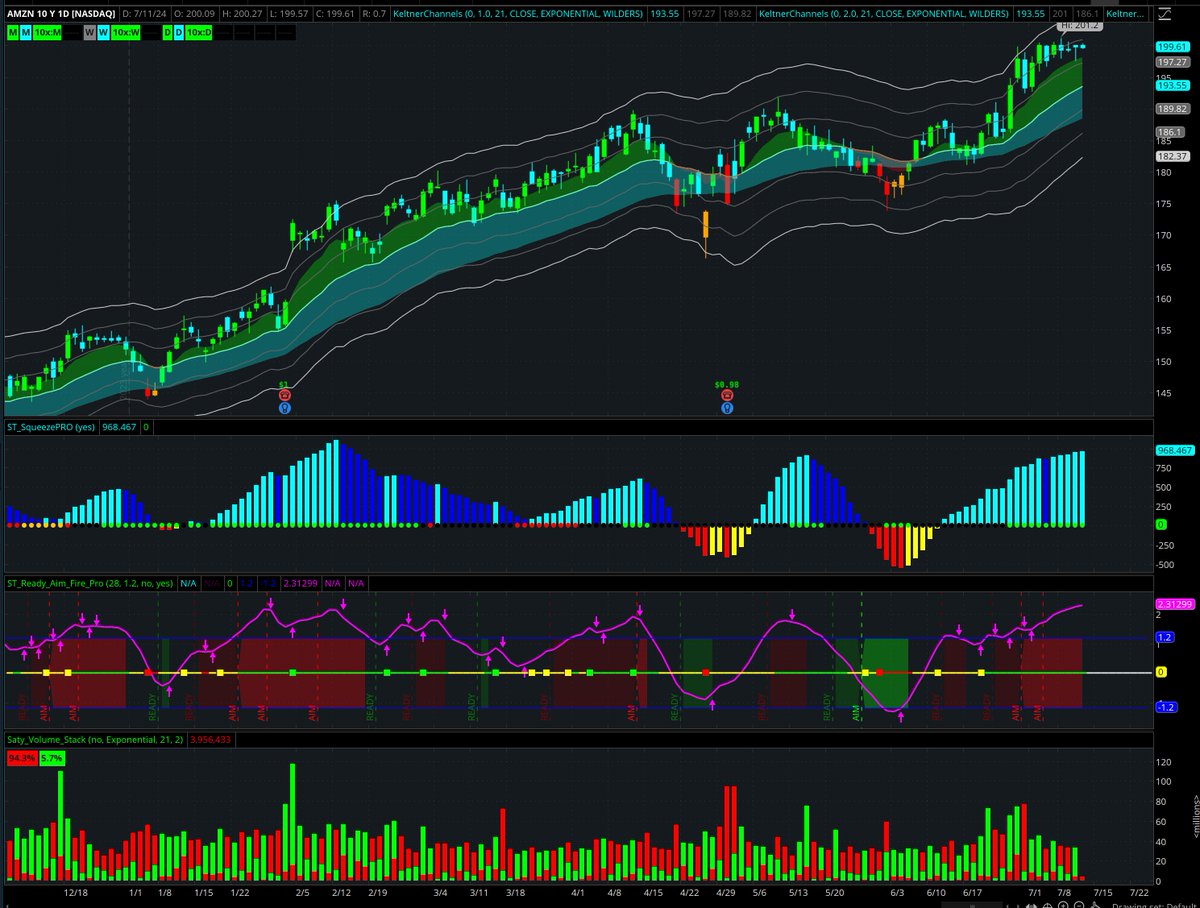
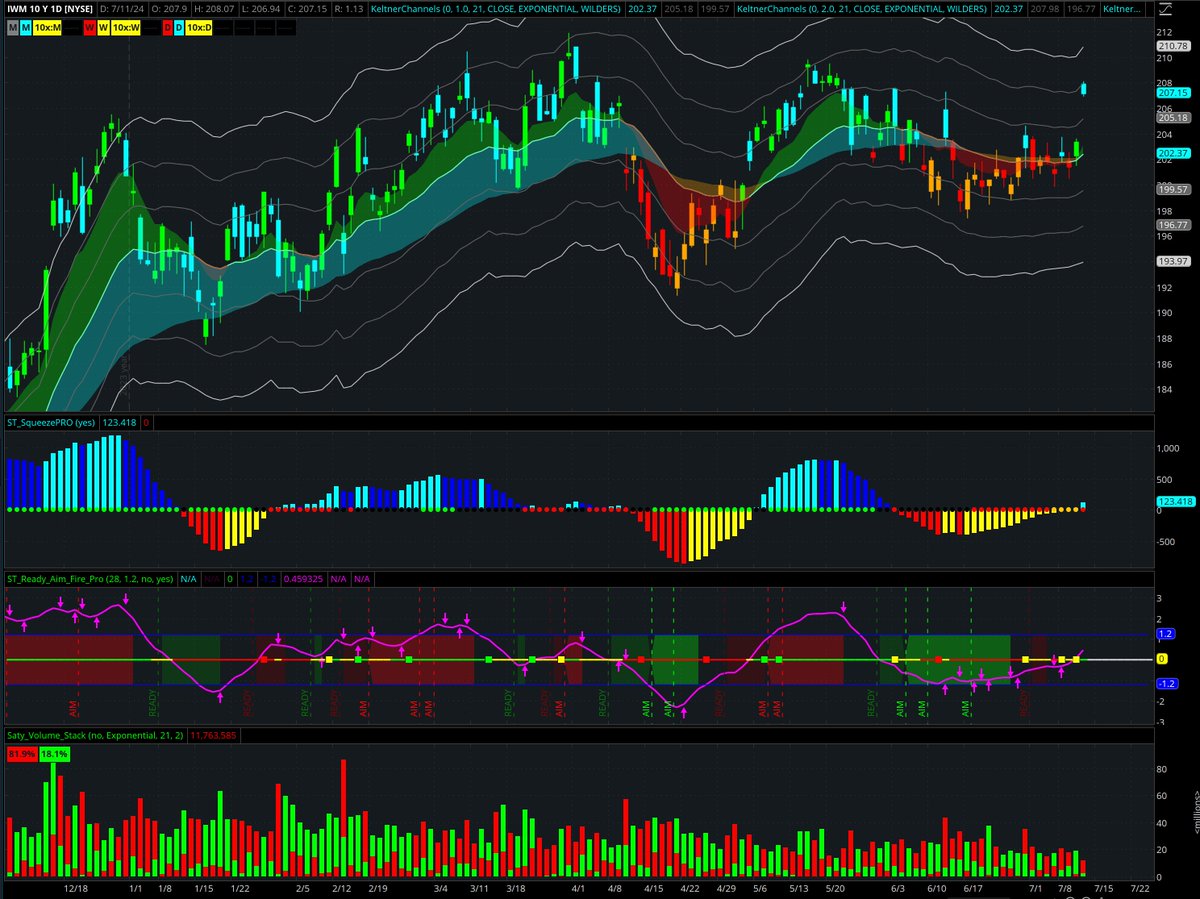
Shout out to @johnfcarter! The Squeeze is by far the best swing setup. Appreciate you maestro! 🙏
Caught a piece of $TSLA, $AMZN, $AMD, and $IWM in the last 4 weeks. Dailly squeezes. All 🚀