Startups at AI Engineer Shanghai: want a free Raytone AIBox (normally from $11,999)?
How to apply:
1. Follow @RaytoneLab
2. Post what your team is building and how local models would help, tag @RaytoneLab with #RaytoneAIBox
3. Pitch us at the Raytone booth, Nov 5-6
Selected startups take one home. Live demo Nov 5, 4:15 PM Beijing time.
Buying an RTX 3090 for local AI? Don’t pick your inference server from a single speed chart.
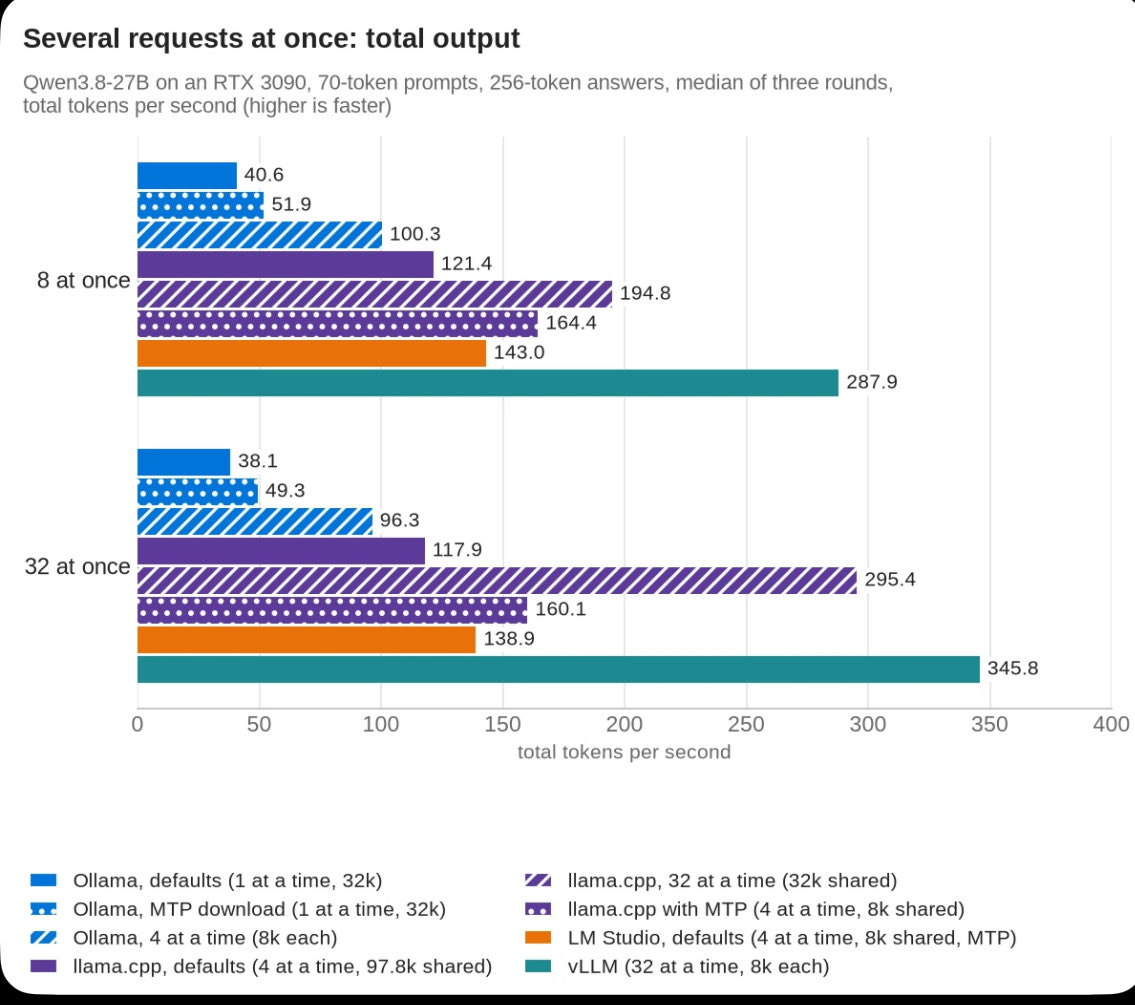
A community test ran Qwen3.8-27B across Ollama, llama.cpp, LM Studio and vLLM on the same 24GB card.
For one short request at 32k context: • Without MTP, Ollama, llama.cpp and vLLM were nearly tied: 43.3–43.7 tok/s. • With MTP speculative decoding, llama.cpp reached 71.1 tok/s. LM Studio, with MTP enabled by default, reached 65.6 tok/s. • vLLM’s MTP configuration ran out of GPU memory on this setup.
With 32 requests submitted together, vLLM delivered 345.8 tok/s total; llama.cpp configured for 32 parallel requests delivered 295.4 tok/s.
The takeaway: serving yourself and serving a group are different workloads. Check MTP, context and parallelism before comparing numbers.
These configurations use different quantization formats and serving settings, so this is not a controlled engine ranking.
Now cataloged in Awesome Local Inference Recipes as comm-476 through comm-479. Community-measured, with public raw data. Only signed recipes are Raytone lab-verified.
New in Awesome Local Inference Recipes: three community-measured llama.cpp pairs, same method, show an M5 Max 128GB (40-core GPU) at about 2x an M1 Max 64GB (32-core GPU).
Same model, quant, 262,144 context and single stream in each pair:
Ornith-1.5-35B-A3B Q4_K_M: 114.5 vs 55.1 tok/s (comm-496, comm-497)
Welp-35B-A3B, 13.2 GB GGUF: 102.3 vs 50.4 tok/s (comm-498, comm-499)
Groot-19B-A3B Q8_0: 90.4 vs 43.3 tok/s (comm-500, comm-501)
All used official macOS arm64 llama.cpp, q8_0 KV, and the same https://t.co/AWSYXWb2oG speed gate. The source PRs are not merged yet. The M1 Max still had an idle 1.3 GB model loaded; the M5 Max did not. Builds also differ across the three pairs, so this is a same-model comparison, not a ranking of the three models.
Community-measured. Only signed recipes are lab-verified.
Catalog: https://t.co/C6KTxVgegT
Sources: https://t.co/EUcab68RVZ
There isn’t a single best box in that list. It depends the model, quantity and engine, and whether u need CUDA, MLX, or HIP.
Awesome Local Inference Recipes has community-measured rows for DGX Spark, M5 Max, AMD Strix / Radeon, and RTX 50-series’s. I would filter by the hardware u are considering and compare only rows that share the model, quant, and engine.
One same-method example from today’s catalog update: three llama.cpp pairs show an M5 Max 128GB at about 2x an M1 Max 64GB at 262,144 context and a single steam (comb-496 through comn-501). That does not tell u how a Spark or a 5080 would do on the same models.
@analogalok@thinkymachines Nice jump on an 8GB card. Which Unsloth quant did you use, how many layers were offloaded to the GPU, and what context length was this tested at? Those details would be useful for others trying to reproduce it on a 4060.
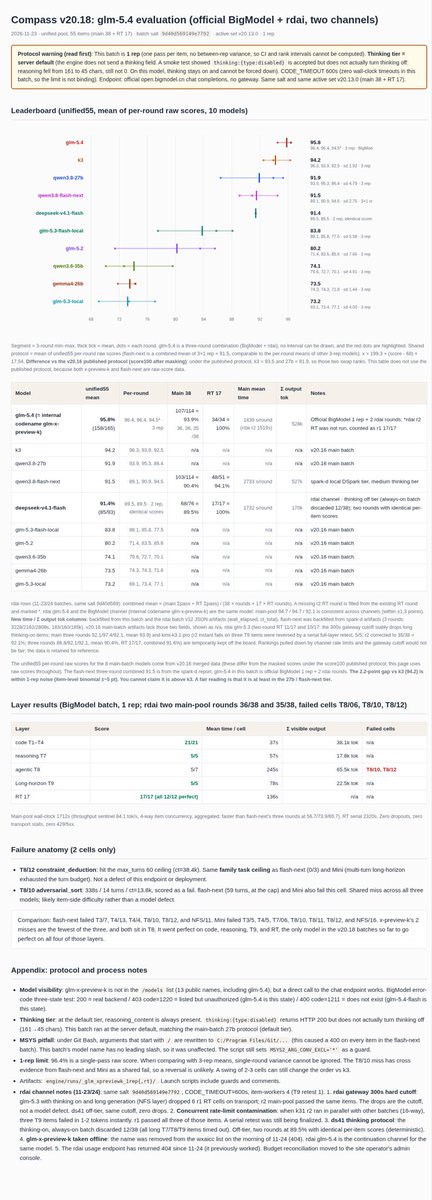
GLM-5.4 cleared every coding and reasoning item in our engineer’s official-API test. Agentic tasks were the sticking point.
Compass v20.18, Nov 23, 2026. One pass on a 55-item test set:
• Code: 21/21 • Reasoning: 5/5 • Long-horizon: 5/5 • Agentic: 5/7 • RT: 17/17
Both misses in this pass were agentic tasks. Thinking was left at the server default.
The report also records a combined 95.8% (158/165) across one official-API pass and two rounds on a second channel. Important caveat: one unrun RT round reused the previous round’s results. These are not 165 independently measured outcomes.
Our takeaway: promising coding and reasoning results in this test, with agentic reliability still worth probing. This is our engineer’s evaluation, not an official leaderboard or proof that GLM-5.4 beats k3.
Take a DGX Spark apart. No screwdriver required.
Our engineer used GLM-5.4 to build this interactive 3D exploded view in a single HTML file.
Watch it open layer by layer, from the chassis and cooling system to the main board. A schematic built from public teardown references, not precision CAD.
Watch the demo. Interactive HTML in the replies.
What hardware should we explore next?
Follow @RaytoneLab for hands-on AI builds.
Awesome Local Inference Recipes new updates: 18 new rows landed (1 official, 3 measured, 14 claimed), plus updates to 8 existing entries.
Highlights include an official Qwen3.5-4B llama.cpp run on a jetson AGX Orin 32GB at 49.7 tok/s, and three measured setups, including Qwen3.8-27B on 2x Intel Arc Pro B70 at 173.5 tok/s, and DeepSeek V4.1 Flash on 3x and 4x DGX Spark clusters.
Only signed recipes are lab-verified. Every number still links to its source.
GitHub: https://t.co/uMuO5DeZ7g
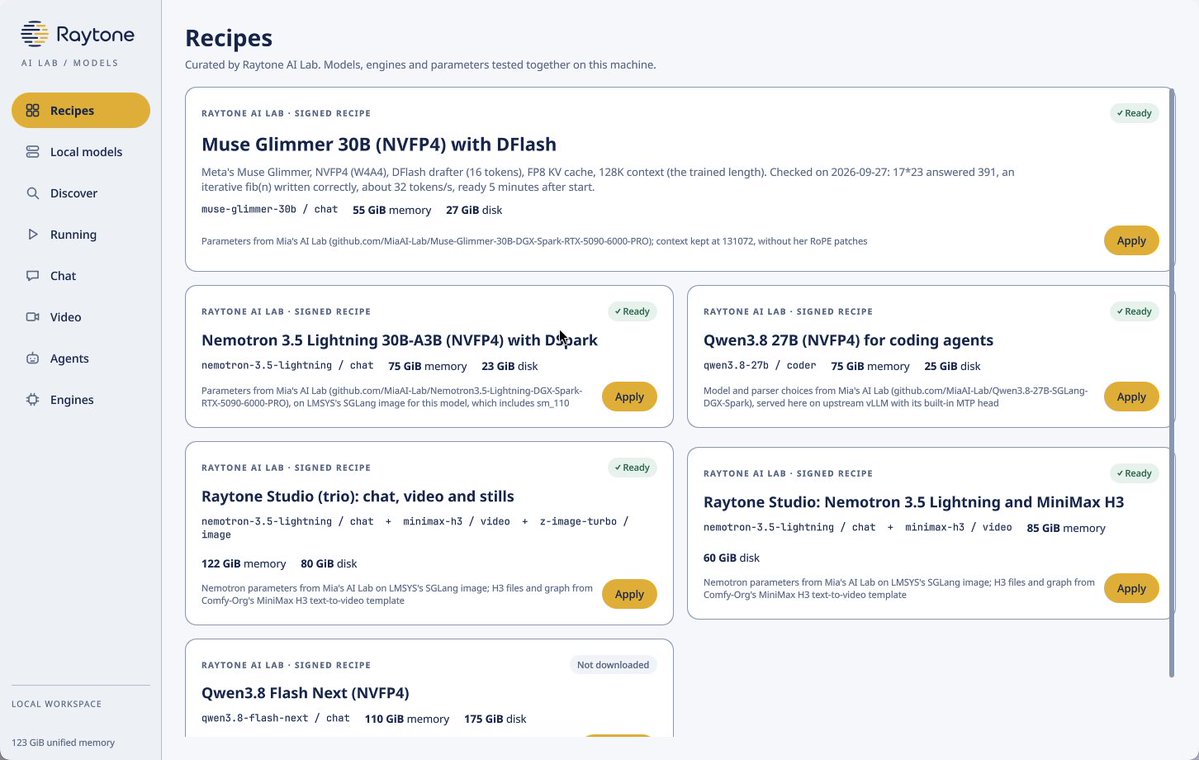
A few of these recipes we run ourselves. On Raytone AI Desktop, our lab signs the ones it has tested on the machine, with the model, engine and parameters checked together. Hit Apply and it starts.
One example: Muse Glimmer 30B (NVFP4) with DFlash, about 32 tok/s on Raytone AI Desktop, ready 5 minutes after start.
@StianBuild Thanks for sharing, Stian! That’s an important distinction: inclusion in the catalog doesn’t mean we’ve verified a setup. Each entry links to its source, and only signed recipes are lab-verified. If you try one, we’d love to hear how it runs on your hardware.
GLM-5.4 is here. Can deeper reasoning deliver better software?
Its new Loop Transformer has developers talking about the trade-off between more thorough reasoning and longer thinking time.
An early independent check: in AICodeKing's KingBench 4 test of six from-scratch software builds, GLM-5.4 scored 33.2/60, ranking 7th of 19 models and gaining 5.7 points over its predecessor.
The emulator, keyboard configurator and desktop app improved, while the 3D room and Pokémon tasks slipped slightly. A useful snapshot, not a verdict on every coding task.
GLM-5.4 is now available on Raytone through GLM Coding Pro, currently at a promotional price of $120 per quarter.
Put it to work on your next build: https://t.co/b4AK07JlYU
Independent test: https://t.co/YiYGgVTAkV
#GLM54
I've been using GLM-5.4 for a while and I can confidently say that it's the best Open Model you can use right now.
It places itself at #7 on KingBench 4 which is the #1 Open Model placement.
From what I can tell, the model is an honest effort and isn't very benchmaxxed or stuff like that and it has good vibes (just don't look at the reasoning tokens... you feel sad for the model at times)
As much as I know it's a looped transformer with 700B params and a technical report shall come later.
It's the most careful model that I have ever used... It has found out many bugs and security vulns in my apps that others haven't (incl. Fable). That's not say that it's the best either. The model takes a lot of time to reach a conclusion to a task especially the Max effort can make it spiral down for a while.
It is on average about 4x slower than Neon on Max reasoning effort. At Medium reasoning effort this does indeed but at the cost of performance. High is the best sweet spot for me.
It isn't slow because of TPS btw.. KingBench 4 took 431 minutes against Neon's 109. Each step isn't slower (22.9 s, against 26.7 s for Neon); it just takes far more of them, 1,128 against 244. It also reasoned 1.04M tokens against Neon's roughly 0.07M. About three-quarters of its time is spent generating and a quarter running builds and tests.
I wouldn't recommend you to just use this model but keeping it as a reviewer for work and making it work on more complex architecture or searching for bugs, security vulnerabilities is really worth it imo.
This is a model that you can use end-to-end on work without much issues but it isn't the best or SOTA.
I have it in my council of reviewers at all time before shipping anything and I am really happy about that.
How it behaves:
It reasons on almost every step. Under 1% of its steps have near-zero reasoning, against 14–39% for the GPT models. Max gives about 1.5× the reasoning of High.
It overthinks. On a security task, High and Max both hit the 180 s timeout while still thinking, and Medium passed in 95 s.
Tool errors are mid-pack. It fails 1.56% of tool calls across all harnesses, 11th of 17, and most of the failures are bad arguments to the edit tool.
It recovers well, though: 66% of failed calls are followed by a working retry, better than every Claude and Codex model.
Caching is excellent at 96–99%, and median time to first token is quick at 4.1 s.
Here's when you should use it:
- You don't care about 3d or Frontend
- You care a lot about shipping no bugs or security vulns. then either make it write it's own code and also review it with a council or just keep it as a reviewer
- You need a really good planner for your work
- You need a model that gets the bigger picture (it's hard to explain but it gets the bigger picture of a work much better than others)
I like the vibes with this model and can't wait for what a bigger model with similar arch can do.
PandaCode's Orchestrator uses it where it should for you automatically.. so, you can plug it in and see some better results with orchestration overall: https://t.co/2S9H2IWsMD
Also, a thanks to the @Zai_org team for letting me be 100% honest about the model and it's vibes. This review or anything isn't sponsored in any way btw it's all my own thoughts and they haven't seen any of this before your eyes.
Full Review video here: https://t.co/PameGfAl0N
Calling it “private AI” doesn’t tell a buyer what runs locally, what works offline, or what’s available today.
Dell and Lenovo’s latest announcements make those deployment questions worth asking before the purchase.
Same GPU, different recipe, up to 3x the speed.
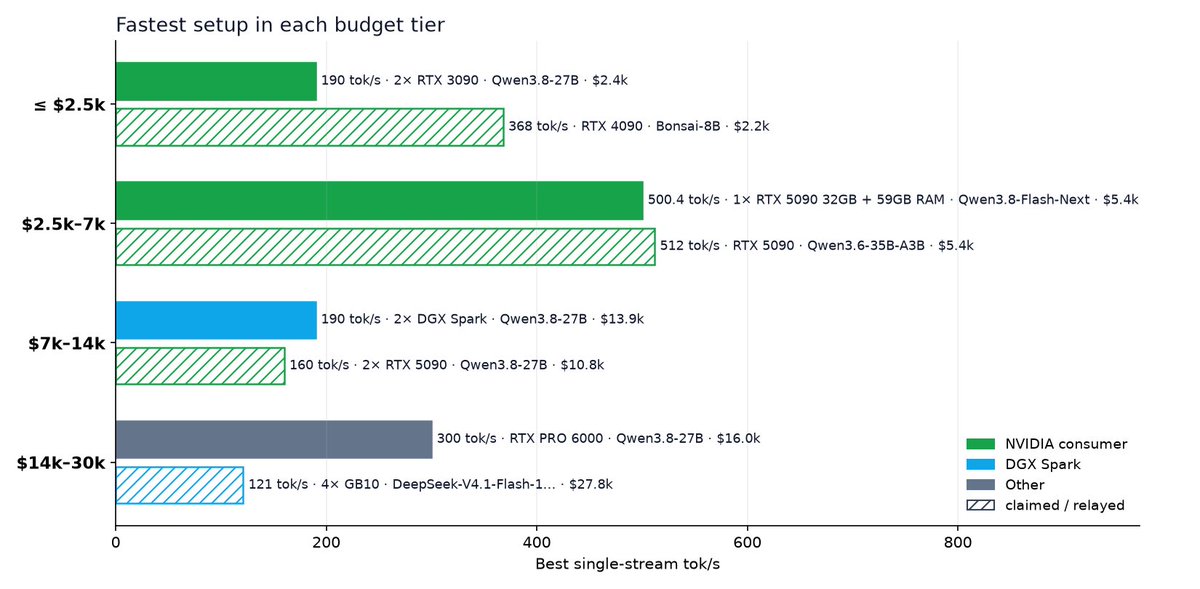
Fastest measured setups by GPU budget right now:
Up to 1k: 162 tos/s on an RTX 5060 Ti
$1k to $2.5k: 190 tok/s on 2x RTX 3090
$2.5k to $7k: 500.4 tok/s on an RTX 5090
$7k to $30k: 300 tok/s on an RTX PRO 6000
Have $2,500? $7,000? $14,000? The recipes are sorted into four budget tiers up to $30k.
Fastest measured under $2,500 right now: 190 took/s, Qwen3.8-27B on 2x RTX 3090. The striped bars are claims nobody has reproduced yet.
Awesome Local Inference Recipes is now at 986 setups, up from 941 at launch.
New entries cover MiniMax H3-Image and Mac M5 Pro runs. Each row has a source and a trust label. Only signed recipes are lab-verified.
@kforris_w Glad it’s useful! You can keep it on for measured results, or widen the view to include claimed and official figures. Every entry links back to its source.
How fast will a local model actually run on your hardware?
We open-sourced Awesome Local Inference Recipes: 941 setups pairing a model, engine and quant with real hardware, from a $405 uesd Tesla P40 to $30k desktop rigs.
Most numbers come from the commounity. Every one links to its original post and carries a trust level. We update it every week.
GitHub: https://t.co/dULgaYUlBY
Explore and filter all recipes: https://t.co/26mGAwtW2l
Built on the work of @ggerganov, @awnihannun, @vllm_project and @sgl_project and everyone who shares their numbers.