I think power and permits will slow AI down more than chips. In the US, getting a new data center hooked up to the grid can reportedly take 3–4 years.
If that holds, what can run on machines people already have gets a lot more interesting.
https://t.co/I4zWkNDvXi
575 active data center restrictions across 46 U.S. states. Grid hookups that can take 3–4 years.
AI’s need for compute keeps growing, but in the U.S., power and permitting are becoming the bottleneck.
Bitzero already has 40 MW of hydropower running in Norway and is targeting 110 MW by end of 2027, giving that demand a place to go.
Read the Nov. 9 press release for more: https://t.co/FTzxLNS3FR
#NASDAQ: $AIBZ #CSE: $AIBZ.U #FSE: 000
#AIBZ #Bitzero #DataCenter #AI #HPC
I think a lot of the AI bill goes to sending small jobs to the most expensive model.
Fixing a typo doesn't need the same thing as a long analysis. That's why I'm looking at setups with one strong model and several small ones handling the simple stuff.
What if the most important setting in an AI tool is the field for your own endpoint?
More tools let you point them at a model on your own machine, through Ollama and llama.cpp among others. Then your text goes to your machine, not a provider.
https://t.co/sFc35P0Qoq
Simon Willison's datasette-llm now supports OpenAI-compatible endpoints. Look for that option in any AI tool you use. It means you can point the tool at a local model in LM Studio, Ollama or llama.cpp, so prompts go to your own machine, not to a provider.
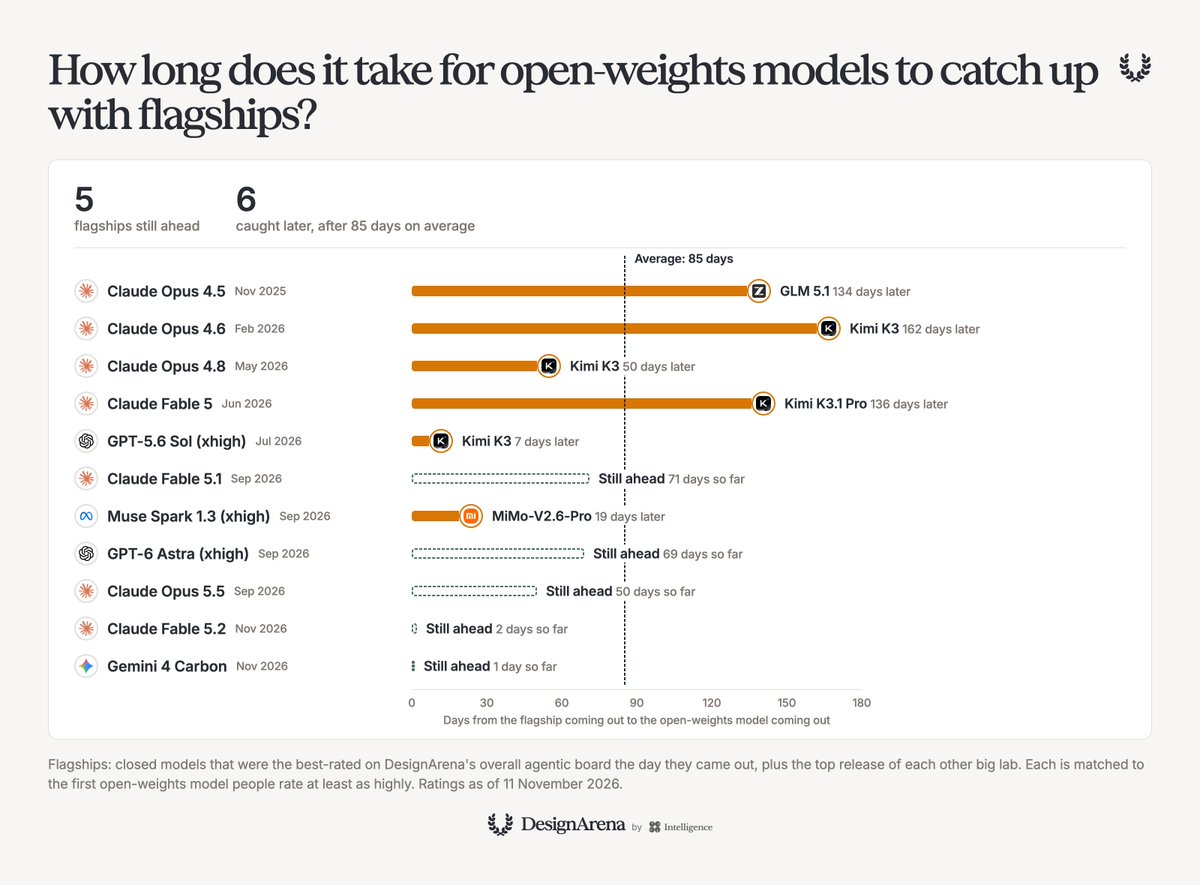
How far behind are open models? DesignArena found 6 of 11 flagship releases were caught by an open-weights model, after 85 days on average.
Haven't checked the method. That gap is the number I watch, more than who tops the board today.
https://t.co/RmzCQ0MeCK
We found how long open weight models take to catch up to the frontier.
On DesignArena's overall agentic board, 6 of 11 flagship releases have been caught by an open-weights model, after 85 days on average. The other 5 are still ahead.
Open list of 900+ local AI setups: model, engine and quantization on real hardware.
Most numbers are user-reported and I haven't checked them. Still a better place to start than a shopping cart.
https://t.co/pE1Ed8UtIh
How fast will a local model actually run on your hardware?
We open-sourced Awesome Local Inference Recipes: 941 setups pairing a model, engine and quant with real hardware, from a $405 uesd Tesla P40 to $30k desktop rigs.
Most numbers come from the commounity. Every one links to its original post and carries a trust level. We update it every week.
What if, in five years, businesses with tasks that need a bit of computing power, like CAD, drawing and video editing, have local compute set up as a supplement to their cloud agents?
I'm putting it a bit sharply. The cloud still does the heavy lifting.
Test on my 16 GB laptop, CPU only: qwen2.5:7b and llama3.1:8b through Ollama, with one simple tool call.
Qwen took 21.8 seconds cold and 4.2 seconds once the model was loaded. Llama took 25.0 seconds cold.
Superfluid from Base Compute puts several machines behind one endpoint. Haven't tried it.
It doesn't split one big model, each machine runs its own copy. Less revolutionary than I thought, but useful when several jobs run at once.
https://t.co/25rparDdiV
Base Compute: Superfluid, a local LLM server that puts the person ahead of the agents
Base Compute in Melbourne released Superfluid, an open-source server that runs llama.cpp, MLX and their own BaseRT runtime behind one scheduler and can pool mixed machines into one endpoint. Their fleet tests included two NVIDIA GB10 systems, the chip in the DGX Spark.
My take: The single-device result is the useful one for anyone running agents locally. With eight agents busy on Qwen3.8-27B at 4 bits, a chat request got its first token in 1.47 seconds through Superfluid on llama.cpp, against 291 seconds on llama-server, 380 on Ollama and 612 on mlx_lm.server. Interactive requests preempt agent work, and every token is fsynced to a log before the client sees it, so a killed worker comes back and the session carries on. On six machines from three chip vendors running Qwen3-4B for an hour with 64 simulated users, it answered all 5,041 requests while machines joined one at a time and one was killed, and throughput went from 112 to 534 tokens per second.
It copies the model to every node instead of splitting it, so each box needs a full copy and a model too big for one machine gets nothing. A session that moves recomputes its prompt, the server has no TLS, and the authors built one of the runtimes they test. The priority classes are what a box running agents most of the day needs when a person asks it something.
https://t.co/7tSKJrZTeh
Doing all five at once is a bit faster per business than doing them one at a time. At a hypothetical rate of NOK 1,000 an hour, that's about NOK 5,000 per test.
The first day the automatic script ran, the check of five businesses took 16 seconds per business on average, plus answers from AI systems. By hand, one business takes me about five hours.
The five hours is my own estimate. Around one hour goes to searching, and around four hours to the report, sources and matrix when the templates are in place.
What if power becomes the real bottleneck for AI?
Data centers pull a lot of power into one place, and new capacity takes a long time to get. The faster we put AI to work, the more I think that's where it stops.
Inkling 2 Small can be tried on OpenRouter now. The weights aren't out yet. They've said open weights will come after a safety test.
I'll wait until the files are there.
https://t.co/dW0IqZU9ef
Small business: one librarian that fetches information and another that puts it away, drafting replies, sorting invoices and receipts, summarising meetings.
The big reasoning models stay in the cloud.
Tasks I think could run locally, among others:
At home: shopping lists, meal plans, keeping the calendar going, sorting email, organising photos and documents.
I think the license is the first thing a small business should read before using an open model.
A model can fit perfectly on the machine and still be closed for commercial use.
My bots ran speech-to-text locally on a regular CPU, no cloud. Smallest model, a clear 7-second English clip.
The model loaded in 0.59 seconds and the transcript took 0.45. Longer recordings and messy speech weren't tested.
What if part of the answer to the AI bottleneck is the hardware that's already out there?
Machines with enough VRAM or unified memory, running good-enough models on specific tasks. In small businesses and at home.
The cloud still does the heavy lifting. Local comes on top.