I am making these tweets to explain in one place some analysis that was done last night.
1 - I was asked offline about doing Benford's on election data. I explained that this is common and a useful way to detect anomalies in data that are driven by artificial process (e.g. fraud)
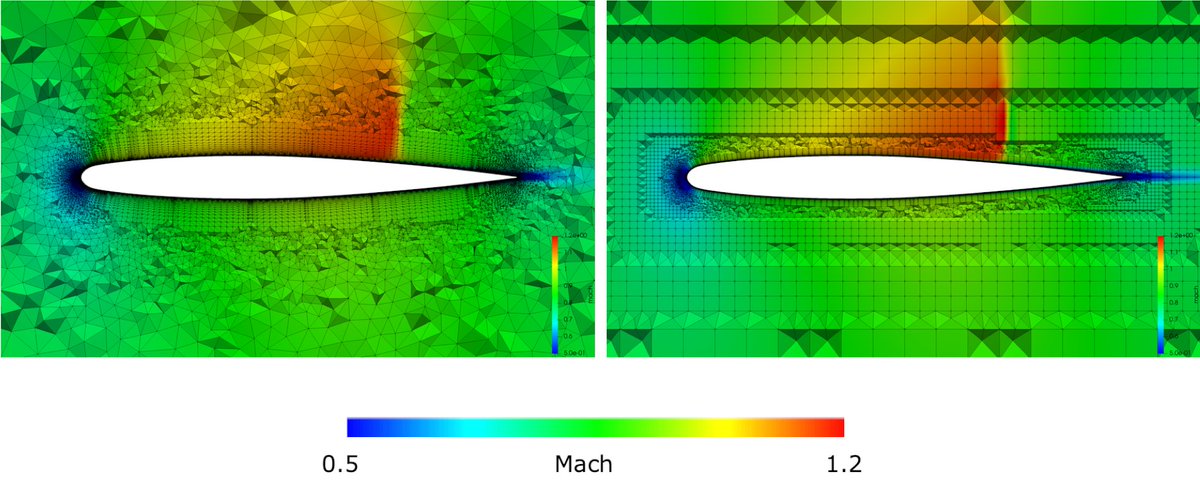
As an addendum: Why you should prefer hexahedra, rather than tetrahedra if the geometry you’re meshing permits… #SimulationFriday (Throwback) #ApologiesForTheBadColorbar https://t.co/IRD61d0eKn
I’m pretty sure we explored this with the ONERA M6 wing with structured, mixed element unstructured, and a voxel mesh stitched to a boundary layer resolved T-Rex nearbody mesh. Tetrahedra showed more dissipation of flow features like shocks and wakes. Not surprised.
I’m pretty sure we explored this with the ONERA M6 wing with structured, mixed element unstructured, and a voxel mesh stitched to a boundary layer resolved T-Rex nearbody mesh. Tetrahedra showed more dissipation of flow features like shocks and wakes. Not surprised.
Who else is surprised by the overwhelming popularity of block structured grids? Thoughts on why? Mesh Type Survey Results, Part 1 https://t.co/OHYL9kWeyc
@JJDreese Interesting. I heard that insurance companies will move to increase the number of those employed in their claim denials department by an equal amount, providers will still struggle to get paid, and health care costs will continue to rise for all…
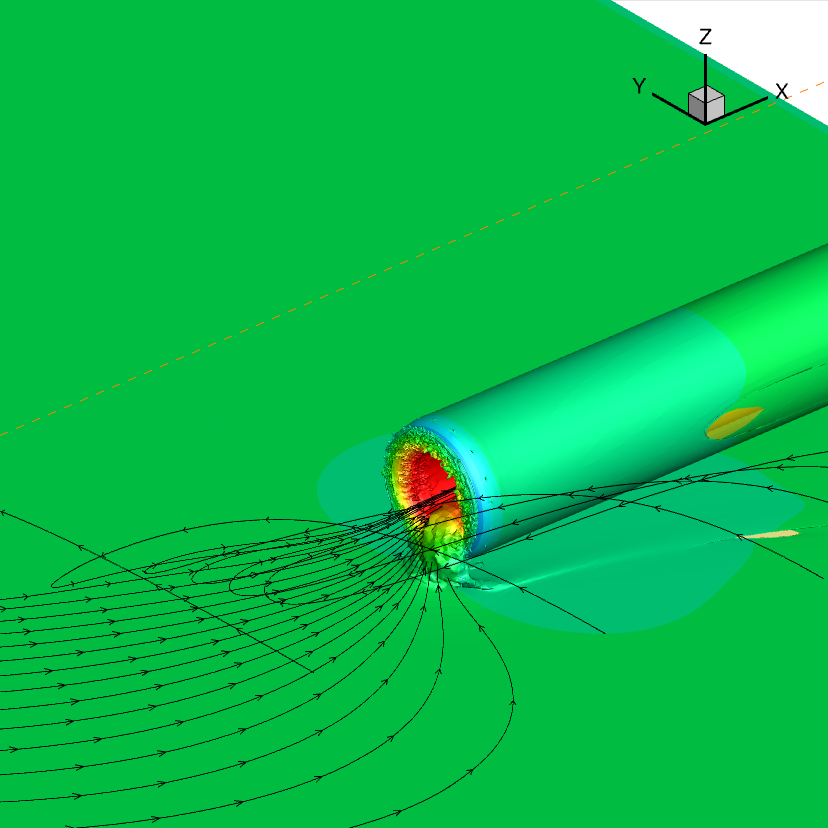
Jet engine designers are moving towards higher bypass ratio designs to help reduce noise around airports. This leads to larger intake diameters; thereby, reducing ground clearance and increasing the likelihood of vortex and debris ingestion as simulated here. @aiaa#PAW05
Intake ground vortex ingestion simulated using @NASAaero’s FUN3D flow solver as part of @aiaa’s 5th Propulsion Aerodynamics Workshop #PAW05#SimulationFriday