How’s the “entrepreneurial state” actually panning out for Britain? How much failure of this state-led model of growth will it take for Mazzucato and her acolytes to admit failure?
She’s had a role advising government since the 2010s, starting with Business Secretary Vince Cable followed by Prime Minister Theresa May’s industrial strategy and now the key inspiration of Keir Starmer’s ill-fated “missions”.
Her policy prescriptions have failed to stimulate innovation, entrepreneurialism or, ultimately, growth. The problem Britain failed is not a lack of intervention by central government, but rather, businesses that are handicapped by red tape and record-high taxes that drive away investment.
Well done, @JohnHealey_MP. We prioritise disability benefits over drones. The MoD can’t get the £28 billion which it needs to keep us safe, yet the welfare budget is set to rise by £42 billion.
We spend more than 5️⃣ times as much on social security as on actual security.
Britain is losing faith in capitalism.
Consecutive governments have presided over more than a decade of stagnant growth - and its defenders have gone largely silent.
But has anyone actually made the moral case for free markets? A new book sets out to do exactly that... 🧵
Gordon Wood was the great historian of the American Revolution - the first person you’d go to for the authoritative overview of it - and didn’t deserve to be smeared in this way - just for once upon a time criticising a journalist’s errors, when asked!
On that gloomy morning of February 24, 2022, with missile strikes thundering from every direction in Kyiv, I would never have believed that Russia’s invasion would last longer than either the entire Eastern Front of World War II or the whole of World War I.
And I certainly would not have believed that, after a span of time equal to the entire Great War, Ukraine would still be fighting with great valor on equal terms against the full might of Russia and its totalitarian allies -- and, moreover, would be launching devastating daily and nightly missile and drone strikes across the European part of Russia.
What we have gotten used to in the news on the daily basis is actually historic, revolutionary, outstanding, mindblowing, and it will take us a lot of time to truly ascertain this.
As time has shown, Ukrainian heroism turned everything upside down and changed the course of history at a moment when almost no one believed in Ukraine.
Today, Russia's full-scale invasion of Ukraine has become as long as the entirety of World War I.
And Russia is still no more capable of defeating Ukraine than it was in 2022, 2023, 2024, or 2025,
And it never will be. That question has already been settled.
The best way to increase food security is to ensure that we have access to food from as many places as possible.
We need free trade in food by abolishing all agricultural tariffs, quotas, and subsidies as well as lifting the ban on chlorinated chicken and hormone treated beef.
I'm on sabbatical this fall. One of my side projects is trying to do a bit more public-facing writing. Because of that, I've started Substack. I hope you'll check it out.
The first post is a Hayekian case against pragmatism. Link below - I hope you'll read and subscribe!
When wage compression squeezes the gap between low and average earners, it reduces the financial incentive for workers to take on extra responsibilities, pursue promotions, or invest in training. This lack of upward motivation ultimately drags down overall economic productivity.
A few months ago, a high profile paper in Science claimed to find that researchers' ideology produced biased results in favour of immigration.
A reanalysis of the data finds that result came from a coding error, which once corrected, shows no effect.
Will people who shared that original finding update their views?
https://t.co/pSuAZ26pqe
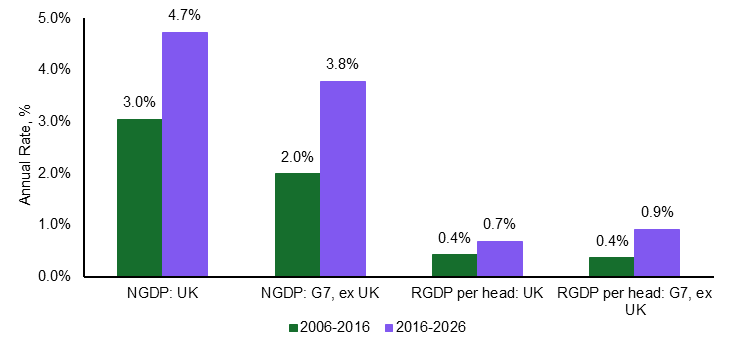
Unfortunately, this analysis doesn't hold up to scrutiny. The UK retained its NGDP lead over the wider set of benchmark economies in the decade since Brexit. Where it lost ground was on RGDP per head - where inflation (as a result of a disastrous domestic energy policy, and incomes policies - egged on by left-wing economists) has created the clearest damage. Brexit added further inflationary friction, but about half as relevant as these other policy failures
I have long advocated for robust military support to Ukraine, to accelerate the liberation of its entire territory, including Crimea, and have lambasted the ridiculous waffling of European capitals which claim one day that Ukraine's struggle is one for the soul of the European idea, and the next fret whether this or that weapons system will be perceived as 'escalation' by the thuggish Moscow regime.
That said, advancing a state which is in the midst of the largest land war in Europe since 1945, and another which also has c. 12% of its territory under de facto Russian occupation, towards EU membership talks while Brussels has yet to even grant candidacy status to Kosovo, or to begin negotiations with Bosnia - which applied for candidate status nearly a decade before Ukraine or Moldova - is ridiculous.
Because only two conclusions follow.
Either Ukraine and Moldova are being waved through because Brussels and the capitals are desperate for another round of virtue signaling, knowing full-well that membership is nowhere on the immediate horizon. And/or despite all chatter of imminent enlargement (i.e. Montenegro), the pieces are being put into place to i. scuttle Podgorica's accession but then ii. manage the blowback by still telling the Western Balkans that their European perspective remains open because, look, Ukraine and Moldova are making progress.
Otherwise, we are forced to conclude that Russia's murderous aggression against Ukraine and Moldova has somehow better prepared these countries for EU membership than 23 years of EU primacy in the Western Balkans has. Or just that the entire 'accession process' is political make-believe. https://t.co/QQULPY5wiz
Jenrick is truly a disgraceful individual. When he was in Cabinet, he was tweeting out pro-BLM stuff. Didn’t say peep. Community cohesion his policy drew. KB did but Jenrick didn’t say much. And was DMing his woke author friend about how he loved his book on Empire. This was 2021
When it comes to building stuff, we shouldn't make the perfect the enemy of the good.
This is fine. It won't win an architecture prize, and you wouldn't put it on a postcard, but there's nothing wrong with it. We should build millions more of those.
It kinda seems like the credibility revolution is dying a slow and painful death nowadays for all the theoretic reasons Mises wrote about in “theory and history” long before ppl were even doing sophisticated econometrics
This argument against building more housing -- "Where does it all stop?" -- sounds like it makes sense when you first hear it, but when you think about it, you realize it doesn't.
First of all, if you simply apply the logic in reverse, you end up with no housing at all! Suppose no one has a place to live, and people propose building just a few houses. Would it make sense to say: "We shouldn't do that, because where would it stop?" No, it would not.
YIMBY is not a program designed to reach an ideal, optimal, imagined level of density for a city. It's a program designed to MAKE HOUSING MORE AFFORDABLE. If you build more housing, rents go down -- not just in the city where you build the housing, but elsewhere as well!
"Rent is too high, let's build more supply" is the core of YIMBYism. If you aren't so worried about rent, then sure, be NIMBY. But right now tons of places ARE worried about rent!
And one more point: Yes, a city might decide that it values quiet streets and scenic views more than low rents. But WHAT IS THE UNIT at which such democratic decisions should happen? At the block level? The neighborhood level? The state level? The county level? What about just me deciding to build an apartment building on my own property?
NIMBYism seems to assume we should allocate decision making power to the geographical unit that's the LEAST LIKELY to build housing -- implying that it should be a goal of policy to maximize veto power. To me that sounds like a quick and easy recipe for massive economic and political dysfunction.
So no, "Where does it all stop?" is not a good argument against YIMBYism. Building more housing is not a slippery slope.