A superintelligence that could reliably forecast the future would prove history is deterministic, not agency-driven. Whether it’s buildable isn’t a tech question — it decides: technocracy or open society.
What comes next:
The govt will rollout an emergency citizenship program for any foreign-born employee working in a lab contingent on them immediately moving to the U.S.
Everyone will be heavily vetted via the same screening construct already utilized by the defense primes.
Google will have to move the entirety of DeepMind to the U.S. and fire whoever refuses to relocate.
People will gleefully assume Demis will just start his own UK lab instead before realizing the next step is the US is about to gut foreign “unmonitored” access to compute.
You can pull a LeCun but you won’t have sufficient compute to do shit.
Greencards will be given to family members too.
Foreign govts will freak out when they realize what is happening. We are gatekeeping and hoarding intelligence preemptively.
Why? Because by GPT 7 France will be like “oh you just destroyed our services sector we are going to tax the labs to pay for the necessary benefits to prevent riots” and it’s a lot easier to do that if labs have critical employees based in Paris. Ditto for every other foreign nation.
Anyone acting like this is surprising is simply incapable of thinking four steps ahead.
We are going to see industries nuked over night. There will be civil unrest. The only way to navigate that is to tax and gatekeep. The only way you can tax something is if it lives in your borders. We are repatriating exposure points preemptively.
Compute gatekeeping comes next.
🫡
Redpoint's @loganbartlett says AI has completely changed hiring—favoring people with unique backgrounds:
"Agency might be the only thing that matters."
"That's the thing that we are trying to figure out—where do you find pockets of people who still want to do the job talent-wise, or have the capability to do the job, but also have agency?"
Here’s the truth: we’ve already reached AGI — we just haven’t implemented it broadly.
Millions of jobs are being lost as we speak.
Entire careers will be retired.
The rich and powerful investors and founders who implement AGI will get bizarrely rich beyond what makes sense. It will break people's brains on both sides.
It’s gonna suck for a lot of our friends and family, who aren’t obsessed with their careers, because things are moving so fast they won’t have even left the starting gate by the time the awards are handed out.
We’re gonna have to solve for a lot of second- and third-order effects, some of which will suck (job loss) and some of which will be awesome.
AI will create free/cheap energy, free education, cheaper and better food, homes that build themselves and medicine that makes you as healthy as a 30-year-old when you’re 100.
… change is hard, but humans are the most adaptable species nature has ever created.
We can figure it out.
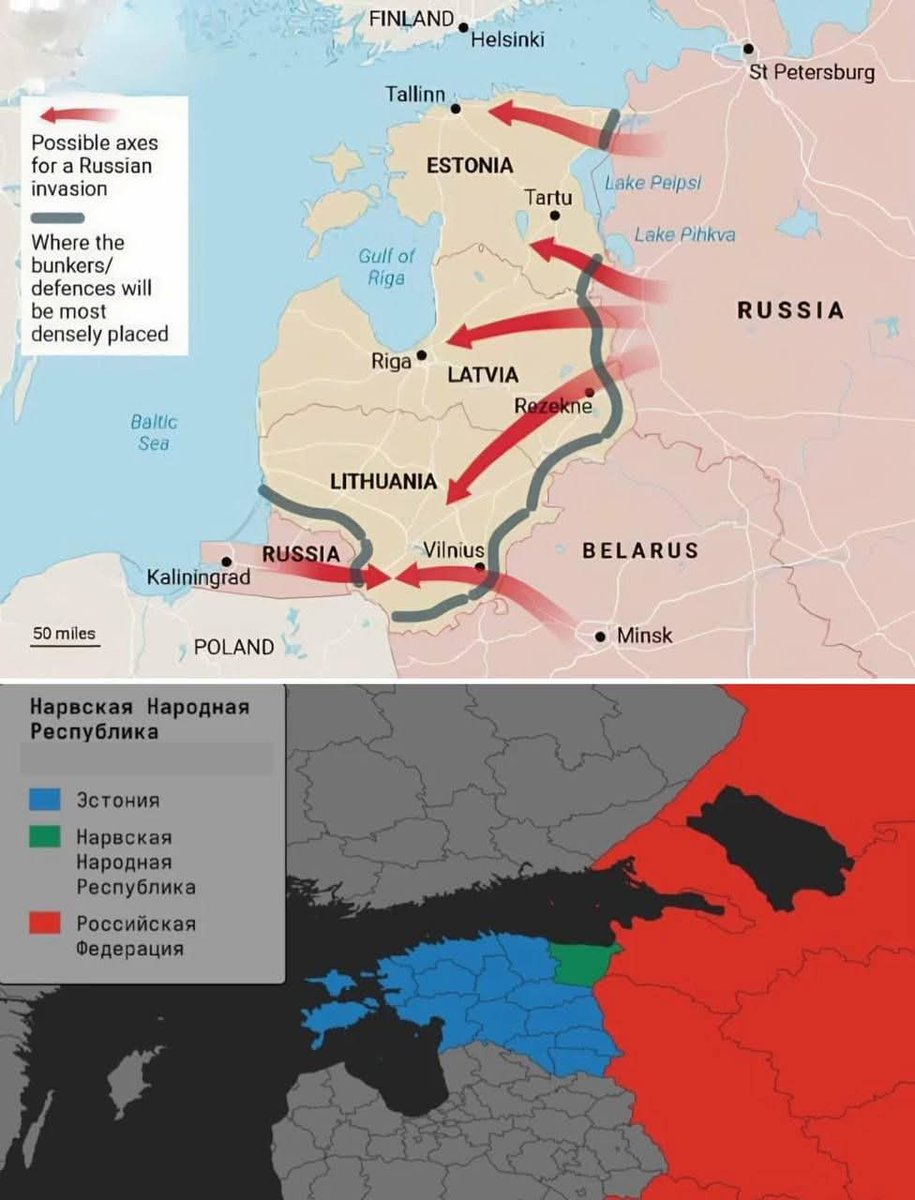
There are growing concerns that Russia could attack the Baltic states within the next 1–2 months. Preparations for a potential invasion of Latvia, Lithuania, and Estonia are reportedly in their final stages.
A scenario similar to Ukraine in 2014 is also being discussed — starting with information operations and internal destabilization, followed by possible military action.
We already understand that Russia is preparing for escalation. But here’s what’s happening inside the potential target countries:
• Social media groups have appeared calling for autonomy in Estonia’s Narva region and the broader Ida-Viru area.
• They are sharing a “flag,” a “national anthem,” and even mock plans for a “militia.”
• Many posts frame this as “protecting Russian identity.”
• Authorities have warned that participation in such activities could lead to criminal charges.
Meanwhile, amid growing public concern, Latvia’s State Security Service chief, Normunds Mežviets, made a stark statement: “They will kill us all.”
❗️Some analysts warn that a Russian offensive against the Baltic states could come as early as May 2026 — echoing what happened in Ukraine in 2022. Notably, similar warnings were published in late 2021, shortly before Russia launched its full-scale invasion of Ukraine.
At that time, reports that Russia planned to seize large parts of Ukraine — including Kyiv — were widely dismissed. In hindsight, those warnings proved accurate.
Now, similar projections are being made again — this time focused on the Baltic region.
Whether this is coincidence or a troubling pattern remains to be seen. But one piece of advice for people in these countries is simple: stay alert and be prepared with basic emergency supplies.
There are also signs of tightening control inside Russia. Restrictions on mobile internet and platforms like Telegram are increasing. For years, little was done — but now controls are being actively strengthened.
This is unlikely about preventing protests — there is little organized opposition left. Instead, it may be part of broader internal preparation.
For example, Russia re-established the Moscow and Leningrad military districts in early 2024 — likely to improve mobilization and military administration.
Preparation appears to be ongoing and serious. And unfortunately, Ukraine alone may not be able to significantly disrupt it.
When a regime feels cornered, its actions can become less predictable — and more dangerous.
Yes, the media can sometimes exaggerate threats. But given recent developments, this no longer looks like simple fearmongering.
Whether these forecasts come true remains to be seen. But the risk is real.
History may one day define this period as the beginning of something much larger.
It’s better to be prepared than surprised.
this has been an open secret in tech for years and if you’ve been following my threads you already know where I stand on this
I genuinely believe Palantir was never just a government contractor it was always designed from day 1 to embed itself so deep inside the intelligence & defense apparatus that ripping it out would be like trying to remove the nervous system from a living body
you need to understand how this works on a technical level to really grasp the scale of what I’m describing
Gotham & foundry are data integration platforms that plug into every single information source an organization has, internal databases, intelligence feeds, comms, satellite data, financial transactions, social media…everything gets funneled into a single ontological knowledge graph and here’s the key, once you’ve connected 5y of an intelligence agency’s data or a defense ministry’s operations into Palantir’s architecture you’ve created a technological dependency that is virtually impossible to reverse bc migrating that graph to another system would mean rebuilding the ENTIRE institutional memory of the organization from scratch
I’m telling you this is vendor lock-in at the scale of a nation state & I’m personally convinced it was designed to work exactly this way from the beginning
by the way palantir is just the most visible case, you should know that the same exact playbook is running across the entire deftech ecosystem right now, companies building AI systems for surveillance targeting & predictive intelligence are quietly rotating former employees into regulatory agencies & defense departments
the revolving door between silicon valley & the pentagon has literally become a conveyor belt at this point & I think the boundary between private tech infrastructure and state power is dissolving way faster than anyone wants to acknowledge
and I’ll add something that I believe makes it even more concerning these systems are increasingly autonomous meaning the AI layer is making recommendations that humans inside gvt are rubber stamping without fully understanding the underlying logic
I’m deeply convinced that the most important power shift of this decade is happening in complete silence and I think most people have absolutely no idea, this is the moment where the companies building the tools of governance become indistinguishable from governance itself & believe me by the time the general public figures out what happened the integration will be too deep too complex & too classified to ever be unwound
It is a great paradox that individually we are simultaneously everything and nothing. Through our own eyes, we are everything--e.g., when we die, the whole world disappears. So to most people (and to other species) dying is the worst thing possible, and it is of paramount importance that we have the best life possible. However, when we look down on ourselves through the eyes of nature we are of absolutely no significance. It is a reality that each one of us is only one of about seven billion of our species alive today and that our species is only one of about ten million species on our planet. Earth is just one of about 100 billion planets in our galaxy, which is just one of about two trillion galaxies in the universe. And our lifetimes are only about 1/3,000 of humanity's existence, which itself is only 1/20,000 of the Earth's existence. In other words, we are unbelievably tiny and short-lived and no matter what we accomplish, our impact will be insignificant. At the same time, we instinctually want to matter and to evolve, and we can matter a tiny bit--and it's all those tiny bits that add up to drive the evolution of the universe. #principleoftheday
Great men of history had little to no introspection.
The personality that builds empires is not the same personality that sits around quietly questioning itself.
@pmarca and I discuss what we both noticed but no one talks about:
David: You don't have any levels of introspection?
Marc: Yes, zero. As little as possible.
David: Why?
Marc: Move forward. Go!
I found people who dwell in the past get stuck in the past. It's a real problem and it's a problem at work and it's a problem at home.
David: So I've read 400 biographies of history’s greatest entrepreneurs and someone asked me what the most surprising thing I’ve learned from this was [and I answered] they have little or zero introspection.
Sam Walton didn't wake up thinking about his internal self.
He just woke up and was like:
I like building Walmart. I'm going to keep building Walmart. I'm going to make more Walmarts. And he just kept doing it over and over again.
Marc: If you go back 400 years ago it never would've occurred to anybody to be introspective.
All of the modern conceptions around introspection and therapy, and all the things that kind of result from that are, a kind of a manufacture of the 1910s, 1920s.
Great men of history didn't sit around doing this stuff.
The individual runs and does all these things and builds things and builds empires and builds companies and builds technology.
And then this kind of this kind of guilt based whammy kind of showed up from Europe. A lot of it from Vienna in 1910, 1920s, Freud and all that entire movement. And kind of turned all that inward and basically said, okay, now we need to basically second guess the individual.
We need to criticize the individual.
The individual needs to self criticize.
The individual needs to feel guilt, needs to look backwards, needs to dwell in the past.
It never resonated with me.
The combination of AI and prediction markets creates the incentive for humans to help AI become better and better at predicting more and more localised events, that are in turn increasingly adjudicated by AI, until…
Incoming: prediction markets on the safe passage of ships through the Strait of Hormuz. Next: the displacement of Lloyd’s of London by prediction markets.
BREAKING: Donald Trump says the U.S. government will offer insurance to ships using the Strait of Hormuz and, if necessary, the U.S. navy will escort tankers through the Strait.
Iran has vowed to attack ships using the shipping lane. It handles a fifth of the world's oil trade.