Former NY Times columnist Paul Krugman: “We really need to do a thorough purging of the United States...We need a deMAGAfication…similar to de-Nazification." Nothing like a good cleansing of the populace to make things right for America's new Jacobins. https://t.co/13R005OVC7
🚨 This is a prime example of fraud and waste inside California's homeless industrial complex
California bought this hotel for $8 million in 2020 and now wants $20 million to fix it. That is $625,000 per homeless person.
6 years later and NOTHING to show.
EXPOSE IT ALL.
If they didn’t put 60 Minutes on immediately after NFL games, how many people would watch? Almost none. Could any 60 Minutes employees make a living off the show independently in media? I don’t think so. It’s astounding to me how entitled & cocky these “journalists” are.
She also did a ridiculous hit piece during covid on Florida and our top supermarket chain, Publix, that even Democrats denounced as a lie.
In a field overflowing with agenda-driven, factually-challenged “reporters,” she was conspicuous for her partisanship and aversion to the truth.
Almost 5 years to the day I had been working in a New York City Hospital
Took care of loads of patients that day, some of whom had COVID
I was healthy and testing my own COVID antibody levels [HIGH]
Had no interest in COVID vax, declined
Stepped outside end of long shift
Denied entry into two restaurants to eat because I didn’t have my “vaccine card”
Super hungry, had to walk almost half a mile to a convenience store to get some chips and candy to eat (literally the only thing!)
Y’all might be able to forget how crazy the world got. But I will never
And I’ll always have my guard up because it was the first time in my life I realized a supposedly advanced country with educated people was capable of extreme stupidity and crazy level rule-following
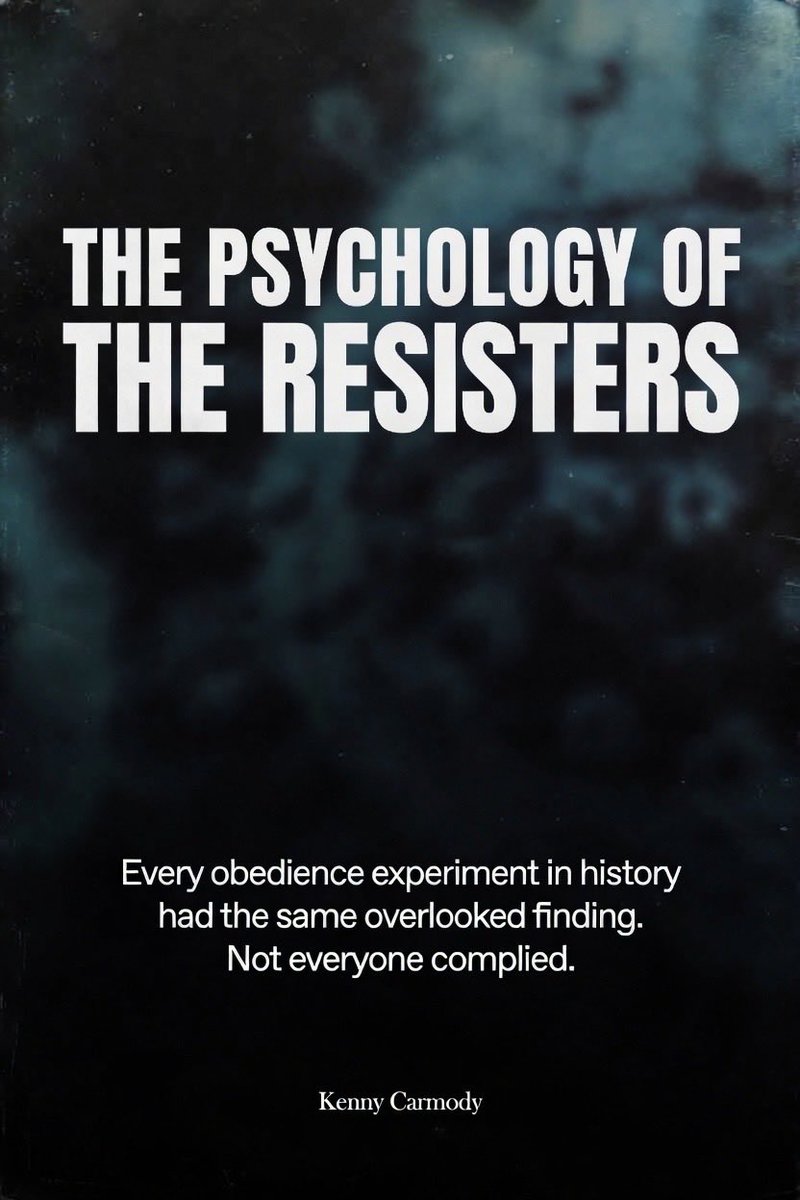
Every obedience experiment in history had the same overlooked finding.
Not everyone complied.
In Milgram’s lab, 35% refused to deliver the final shock. In Asch’s line experiments, 25% never conformed, not once, across any trial. In Zimbardo’s prison, at least one guard refused to dehumanize. One prisoner demanded a lawyer instead of a doctor and broke the psychological frame entirely.
We spent decades studying the ones who obeyed.
We barely asked what made the others different.
That question matters more now than it ever has.
The resisters in the COVID era were not difficult to find. Physicians who filed exemptions and lost their licenses. Nurses who walked away from careers rather than mandate patients into decisions they hadn’t genuinely chosen. Scientists who published contrary data knowing what it would cost them. Parents who stood alone at school board meetings. Ordinary people who simply said, quietly, without drama , no.
What made them different?
Research consistently identifies a cluster of factors. Not personality traits you either have or don’t. Situational and cognitive patterns that can be cultivated.
First: prior reflection on authority. The resisters had usually thought, before the crisis, about the limits of institutional trust. They weren’t cynics. They were people who had already asked the question “under what conditions would I refuse?” before anyone was asking them to comply.
Second: a concrete reference point outside the consensus. A value, a principle, an oath, a relationship that existed independently of the institutional structure demanding compliance. Something the system couldn’t reach.
Third: at least one other person. Milgram found that a single dissenting confederate reduced compliance dramatically. The resisters rarely stood entirely alone. They found each other. Sustained each other. Gave each other permission.
Fourth: the willingness to tolerate social pain. Not immunity to it. Tolerance of it. They felt the pressure. They felt the exclusion. They chose the discomfort of integrity over the comfort of belonging.
None of this is innate. All of it is learnable.
The most important thing Milgram, Asch, and Zimbardo taught us is not how fragile conscience is.
It’s that conscience can hold, if you’ve trained it, named its limits, and found even one other person willing to hold theirs beside you.
Build that now. Because the experiment is always running.
Until then stay humble.
UC faculty push for SAT/ACT math testing for STEM majors: “Testing is not an obstacle to equity; it is a prerequisite for it. Failing to measure preparation gaps doesn’t remove barriers; it moves them in the classroom, where they are harder to overcome.” https://t.co/0cHz7g0Bir
Our state and local elected representatives are collectively gross failures at the most basic element of government. Our infrastructure is failing because they all focus on reelection not governing. Without political competition, their malfeasance continues without accountability
We have reached a strange place, where you can drain a river, poison a coastline, and lean on people with no rights, and still be thanked for saving the planet, so long as the damage happens somewhere you will never have to look. Follow the virtuous plate home, one item at a time, and watch the halo slip off it.
The avocado came from Michoacán, where the cartels run the orchards, divert the rivers, and murder the people who object.
The almonds in the milk came from California, drawn out of a drought and an emptying aquifer, pollinated by bees trucked three thousand miles across a continent and worked to exhaustion in a fortnight.
The salad was grown under a sea of plastic in Almería, by migrant workers on thirty euros a day in forty-five-degree heat, on groundwater so poisoned the region now has to import its own.
The peppers were grown beside a Spanish lagoon that has died so many times they had to give it the legal rights of a person just to defend it in court.
The cashews were shelled by hand by people whose fingers were burned by the acid in the husk.
The cotton bag it all came home in helped drain the fourth largest lake on earth into a salt desert.
Every item crossed thousands of miles, from somewhere left drier, poorer, and more poisoned for having grown it.
And the person carrying that bag home walks past a field ten miles up the road, where a cow stands in the rain turning grass nobody can eat into food, dropping dung that feeds the soil it stands on, on land that has looked more or less the same for a thousand years, and thinks, with total sincerity: there it is. The thing destroying the planet. A cow. Burping in a meadow.
It is one of the strangest acts of misdirection of the age. We built a supply chain that strips deserts, drains rivers, flattens forests and runs on people with no rights, and we taught ourselves to feel virtuous about it, purely because the alternative was an animal we could see, standing in a field we could walk to.
The cow you can point at gets the blame. The catastrophe you cannot see gets a halo and a sticker that says plant-based.
Heal the planet, they say, with the asparagus flown in from a drought.