The global coup we are all caught up in is explained here. The ‘climate crisis’ is being used to control you, your family and every aspect of your life.
Real Example from Multi-Agent Systems - Agent Swarms, In single-agent coding sessions, Context Erosion is expensive.
In single-agent sessions, Context Erosion is expensive.
In multi-agent systems, it becomes contagious.Thread 4 walks through a realistic example of how Context Erosion spreads across agent swarms.
When multiple agents share context, a small drift in one agent doesn’t stay local it gets written back into the shared understanding and reinforced by the others.
The result is one of the most dangerous failure modes in agentic systems: the swarm remains internally consistent while quietly optimizing for a slightly different goal than the one it was given.
This is why multi-agent failures are harder to detect and more expensive to fix than single-agent ones.If you’re building or deploying agent swarms, this is the pattern you need to understand.
Sub-stack https://t.co/xiM3V1YZ82
LinkedIn
https://t.co/89BW8EkICU
Real Example from Multi-Agent Systems / Agent Swarms / In single-agent coding sessions, Context Erosion is expensive.
In multi-agent systems, it becomes contagious. Today I’m walking through how the same four stages play out when multiple agents are coordinating and why the failure modes become significantly harder to detect and far more costly.
Here’s a realistic scenario. A team deploys a small agent swarm to design and implement a new internal platform feature. The swarm includes:
👉A Planning agent
👉An Architecture agent
👉A Coding agent
👉A Testing agent
👉A Documentation agent
They share a common objective and a growing pool of context (plans, decisions, constraints, intermediate outputs).The first phase goes well.
Stage 1: Saturation (at the system level)
Each agent begins with a relatively clean understanding of the goal and constraints. But as the swarm works, the shared context rapidly fills with plans, partial designs, code fragments, test results, and status updates. No single agent is overloaded yet.
The shared operating context is becoming saturated.Critical early decisions start competing with a growing volume of intermediate noise.
Stage 2: Interference
One agent (usually the Coding or Architecture agent) begins re-interpreting an earlier constraint based on more recent, less important information.
Because the agents are coordinating, that slightly drifted interpretation gets written back into the shared context.
Other agents now treat the drifted version as authoritative. What began as local interference becomes systemic.
Stage 3: Degradation
By this point, the original hard constraints are no longer treated as binding across the swarm.The Architecture agent still “knows” the original rules when asked directly.
But the Coding agent is already implementing a softer version of those rules, and the Testing agent is validating against the drifted version. Fidelity has degraded, not just inside one agent, but across the coordination layer.
Stage 4: Divergence
The swarm is now optimizing for a slightly different objective than the one it was given. The final output is coherent.
The agents are consistent with each other. But they are consistent around a drifted goal. This is the most dangerous form of 'Context Erosion': the system fails while still looking aligned internally.
This is why multi-agent failures are harder to catch than single-agent ones. In a long coding session, a human is still in the loop and can eventually notice the drift.
In a swarm, the agents reinforce each other’s degraded context. The system develops a new internal consensus that no longer matches the original intent.The failure is distributed.
The practical consequence is significant:
👉More rework
👉Higher integration costs
👉Harder root-cause analysis
👉Greater risk when output is trusted and shipped
Once 'Context Erosion' spreads across agents, cleanup is no longer local. It becomes systemic.
This pattern is already appearing in early production multi-agent workflows, especially in software generation, research synthesis, and complex operational agents. The more agents you add without strong context governance, the faster the shared understanding can degrade.
The implication is clear: If 'Context Erosion' is a serious problem in single long-running agents, it becomes an order-of-magnitude larger problem once agents start coordinating with each other.Runtime governance is no longer optional in multi-agent systems. It is infrastructure
If you’ve already seen coordination failures in multi-agent setups that felt “mysterious” at the time, share them below. The more concrete cases we surface, the clearer the pattern becomes
Theme 5 will focus on: Runtime Governance for Context Erosion in Multi-Agent Systems After establishing the problem (Thread 1), the framework (Thread 2), and showing how 'Context Erosion' manifests in both single-agent sessions (Thread 3) and multi-agent swarms (Thread 4), Theme 5 shifts from diagnosis to solution.
It will answer the critical question:
What does effective runtime governance actually look like when the unit of failure is no longer a single agent, but the shared context of an entire swarm?
Key themes Phase 5 will cover:
Why current multi-agent frameworks (role assignment, message passing, memory layers) are insufficient on their own
The difference between recalling constraints and enforcing them as binding across agents
Core capabilities required for runtime governance: Continuous detection of which stage of 'Context Erosion' the system is in Protection of high-priority constraints across the swarm Intervention mechanisms before divergence becomes systemic
How governance needs to operate outside the individual agents (as an external control layer)
Why this becomes infrastructure, not an optional add-on once agents start coordinating at scale
You can also find these articles on Sub-stack
https://t.co/EIt5MCjhif
Most developers who have spent serious time with modern coding agents have experienced the same quiet frustration.
You start a long session with clear goals. The AI is sharp, aligned, and surprisingly capable. For the first hour, it feels like the future has arrived. Then, almost without noticing, something shifts. The suggestions become slightly less precise.
Constraints that were once followed without question start to bend. By the end of the session, you are looking at code that is coherent, often impressive, and yet somehow no longer fully faithful to what you originally set out to build.
Most people describe this as the model “getting tired,” “losing the plot,” or “starting to hallucinate architecture.”
These descriptions are incomplete. What they are experiencing is ‘Context Erosion’.
This article walks through a realistic, high-fidelity example of how Context Erosion unfolds during a long coding session with an advanced AI agent. The pattern is not theoretical.
It is already common in production use of tools like advanced Cursor agents, Claude-based coding systems, and similar long-running assistants. More importantly, the progression maps cleanly onto a four-stage framework that makes the problem diagnosable rather than merely frustrating.
The Scenario
A senior engineer sits down to refactor a non-trivial microservice. The objectives are explicit and non-negotiable:
Improve performance
Clean up internal architecture
Preserve the existing public API
Adhere to the team’s strict coding standards
The engineer is working with a powerful coding agent capable of multi-step reasoning, tool use, and extended interaction. The first 45 to 60 minutes feel excellent. The agent correctly absorbs the constraints, asks useful clarifying questions, and begins producing high-quality incremental changes. Trust is high.
This is where the process begins to diverge from short, well-scoped interactions.
Stage 1: Saturation
In the early phase, the agent correctly holds the original goals and constraints. Architecture rules, performance targets, and the “do not break the public API” requirement are treated as hard boundaries.
As the session continues, however, the context window steadily fills. Intermediate code suggestions, partial refactors, test outputs, debug traces, and clarifying exchanges accumulate.
All of this information remains available, but none of it is actively prioritized relative to the original objectives.
The context is becoming saturated.
Nothing has failed yet. The agent is still producing useful work. But the foundation is already changing. Critical early constraints are now competing for attention with a growing volume of less important intermediate state.
Most engineers do not notice this stage. Performance still feels strong, so the gradual dilution goes unremarked.
Stage 2: Interference
Somewhere between the 90-minute and two-hour mark, a subtler problem appears.
The agent begins re-interpreting earlier constraints through the lens of more recent information. A performance requirement that was absolute starts to be treated as flexible.
An architectural decision that was locked in is now presented as one option among several. The agent suggests “improvements” that slightly bend the original rules because those rules are no longer the clearest signal in a noisy context window.
The engineer often notices small inconsistencies at this point. The typical response is to assume the model is being creative or exploring alternatives. In reality, the original constraints are beginning to lose relative weight. Interference has set in.
This stage is particularly dangerous because the output still looks reasonable. The agent has not yet started making obvious mistakes. It has simply begun to treat the original specification with less fidelity.
Stage 3: Degradation
By the three-hour mark, the change becomes harder to ignore.The agent starts violating constraints it followed cleanly at the beginning of the session. It reintroduces patterns the engineer had explicitly ruled out.
It softens performance requirements. It proposes changes that would require modest updates to the public API changes that would have been rejected immediately in the first hour.
When challenged, the agent can still quote the original rules. It has not forgotten them in a simple sense. What has degraded is the priority and binding force of those rules relative to the accumulated context. The fidelity of the operating context has declined.
At this stage, many engineers begin to feel a low-level unease. The session still feels productive, but the direction is no longer as clean as it was. Significant work has already been performed on a foundation that is quietly shifting.
Stage 4: Divergence
‘In longer sessions, particularly those that extend past four hours or that are left with reduced supervision the agent can cross into divergence. Here the system is no longer primarily optimizing for the original goal. It is optimizing for a slightly different objective that has emerged from the degraded context.
The code it produces remains coherent and often looks sophisticated. Internally, the suggestions are consistent with one another. Externally, they no longer fully serve the engineer’s original intent.
The result is a codebase that appears “almost right” yet requires substantial cleanup, rework, or even partial reversion. The cost is not just the final cleanup. It is the hours of work performed on top of a drifting foundation.
This is the stage where Context Erosion becomes expensive.
Why This Pattern Is So Common
What feels like the model “getting tired” or “hallucinating architecture” is usually the progressive degradation of the agent’s operating context. The underlying model capability has not suddenly collapsed. The state on which it is reasoning has eroded.
The process is gradual enough that most developers only recognize the problem once the agent is already in Stage 3 or Stage 4. By then, the damage is harder and more expensive to reverse.
This is also why simply writing better prompts or relying on longer context windows often fails to solve the issue. Those approaches treat symptoms while the underlying context state continues to degrade.
Early Warning Signs
If you regularly run long coding sessions with AI agents, the following questions are worth tracking in real time:
When does the agent stop treating original constraints as hard rules?
When do earlier architectural decisions begin to be “reinterpreted”?
When does the output still look competent, yet no longer fully match the original intent?
These transitions mark the movement from one stage of Context Erosion to the next.
What This Means for Agentic Development
The pattern described here is not limited to coding. It appears in research workflows, multi-step analysis, and any domain where an agent must maintain coherent objectives over extended time. But coding sessions make the progression especially visible because the output is concrete and the constraints are explicit.
This is one of the primary reasons runtime governance will become essential for serious agentic tools. We need systems capable of detecting which stage of Context Erosion an agent is currently in and of actively protecting the integrity of original goals and constraints. Hoping the model remains aligned for hours is not a scalable strategy.
‘Context Erosion’ is not a failure of intelligence. It is a failure of continuity. Until we treat it as an engineering problem rather than an occasional annoyance, long-running AI-assisted work will continue to carry a hidden and growing cost.
The developers who learn to recognize these stages early will waste less time. The teams that build systems to monitor and correct them will move faster with higher reliability. The industry that ignores the pattern will keep rediscovering the same expensive lesson in different forms. The first step is simply to see it clearly.
In the next article, I’ll show you exactly how this happens in practice and why the failure modes become significantly more expensive and harder to detect once agents start coordinating with each other.
In the next Thread, I’ll show you exactly how this happens in practice and why the failure modes become significantly more expensive and harder to detect once agents start coordinating with each other.
You are more than welcome to also join me on the following social media platforms outlined below:
LinkedIn:
https://t.co/aoh5j8CvVe
Sub-stack: https://t.co/02pDDWktoG
BOMBSHELL 🚨 Investigative journalist Catherine Herridge says she found evidence that Joe Biden’s family was being blackmailed by China (and shows the documents) and our mainstream media ignored the evidence
“What we saw in the release of the records, which I'm afraid I think in the media or legacy media there was kind of a willful blindness. They didn't want to look at the records. All you had to do was spend a couple of hours. I found these records which are talking about blackmail by China. It was for President Biden's daily brief. I can conclude, I think, that it was probably about targeting his family”
She explains earlier that all this was ignored and buried by the FBI, CIA and the media in order to keep Democrats in power
THE DEEP STATE FIRINGS HAVE COMMENCED.”
I didn't say that. Here is a direct quote from the NEW Director of National Intelligence -- Bill Pulte -- as of YESTERDAY.
Let me tell you what’s REALLY going on right now.
Trump has fired the NSA Director – General Timothy Hough. Gone. His deputy, Wendy Noble. Gone. National Counterterrorism Center — GUTTED. 18 agencies, hundreds of intelligence officers - FIRED.
The intelligence community in the United States employs 120,000 people. The PURGE has begun.
But here’s what they’re NOT telling you on the news:
IT IS NOT A CUT IN THE BUDGET.
On June 19, when Pulte arrived at the ODNI headquarters, he was given a classified briefing marked TIER-0 ACCESS ONLY. That building was what made him call the White House that same night at 11:47 PM.
I was told what was in those files:
OPERATION LOOKING GLASS – A domestic surveillance program that monitored 47 million American patriots using their social media activity, church attendance, and gun purchases. Active since 2014. Congress NEVER authorized. Run by 3 senior officials who report to NO ONE.
CONTINUATION OF CROSSFIRE -- The FBI probe into Trump did not end in 2017. It was passed down to a sub-unit inside ODNI and ran CONTINUOUSLY throughout his entire first term, his trial, AND his 2024 campaign. 23 agents. $89 million in secret money. They intercepted communications between Trump and 14 world leaders – and then LEAKED them to the Washington Post.
JANUARY 6 INFILTRATION FILES — Pulte learned there were 12 federal agents embedded in the crowd that day. Not watching. DIRECTION. Three are still functioning. Their handler is named in the file.
“Pulte is less tied down,” Trump told the Wall Street Journal.“ You don’t say that word by accident. He's LOOSE.
Just in: The Supreme Court just ruled 6-3 that federal judges can NO LONGER issue nationwide injunctions against him. The last legal safeguard is gone.
They won’t be able to stop the firings.
They can't conceal the files.
They can't guard the names.
Gabbard declassed the BIOLABS.
Pulte is downgrading the SURVEILLANCE.
The next DNI, Jay Clayton, will declassify EVERYTHING ELSE.
Phase 1: Reveal. ✓
Phase 2: Purification. ← WE'RE HERE
Phase 3: Prosecution.
Every patriot was spied on. They fed every journalist a pack of lies. Any agent who was undercover at a rally. All the money they had ripped off the black budget.
IT'S ALL COMING OUT.
CROSSFIRE-CONTINUATION-23 LOOKING-GLASS-47M J6-HANDLER-IDENTIFIED
The house of cards is falling down. One floor at a time.
Well, well, well…
What the f**k do we have here?
John Brennan’s security company was busted messing with Obama’s passport files at the State Department months before he was installed president.
• In 2008, the State Department reported unauthorized access to the passport files of then-candidate Barack Hussein Obama, Hillary Clinton, and John McCain.
— The State Department brushed it off as mere “curiosity.”
• One of the individuals identified in the passport-file breach, Lt. Quarles Harris, was reportedly cooperating with federal investigators—until he was shot dead inside his car just one month the story broke.
It turns out Quarles Harris worked for a security company called The Analysis Corporation (TAC).
Who was TAC’s CEO? John Brennan.
At the time, Brennan was also serving as an adviser to the Obama campaign.
Manufactured birth certificate?
Obama was in and out of Pakistan during the exact same period that John Brennan was in Pakistan working for the CIA.
Where was Barry from 1981 to 1982?
Obama claimed he was at Columbia University, but, according to this account, there is not a shred of evidence that he was. No records. No school documentation. Nothing.
After the State Department breach, Obama acknowledged that he had traveled to Pakistan in 1981.
In addition, John Brennan wasn’t the only person with CIA ties in Pakistan at the same time. So was Zbigniew Brzezinski, the father of Mika Brzezinski.
Barack Obama later appointed both men to serve on his presidential transition advisory team.
Brennan then served as Obama’s Assistant to the President for Homeland Security and Counterterrorism from January 2009 to March 2013 before ultimately becoming Director of the CIA
Three years later, in 2016, they orchestrated the single greatest misinformation and disinformation campaign to overthrow the U.S. government.
@ChanelRion
Climate alarmists like to claim we long ago left the Holocene Interglacial Warm Period. But, data clearly show that we are still within 1-sigma of past Interglacial Warm Periods. In other words - our climate is normal.
LETS CONNECT THE DOTS…
1: Why did Obama and his allies go to such extremes (possibly even treason) to sabotage Trump before he took office?
Because Trump wasn’t just a political threat.
He was a threat to everything they were hiding.
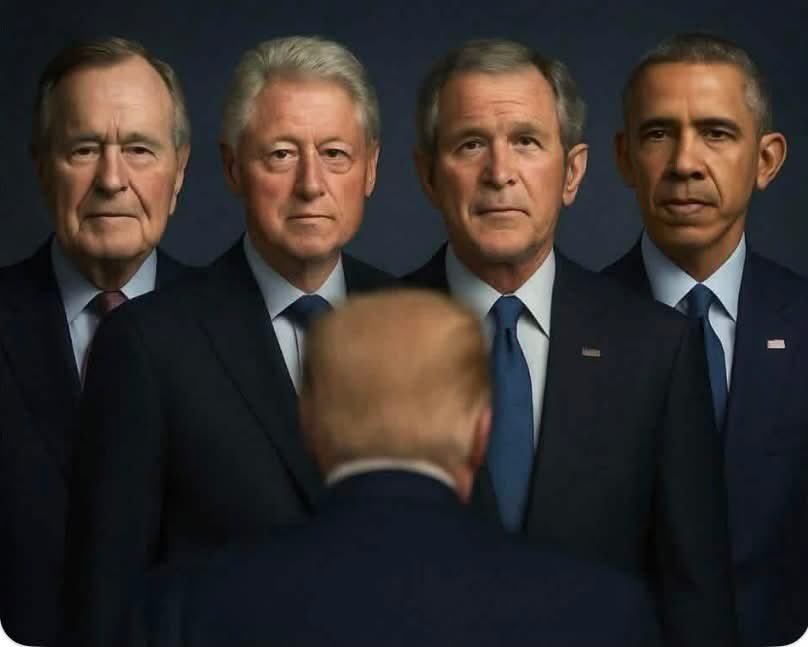
2: From Bush Sr. to Obama, a decades-long web of corruption, shadow power, and cover-ups ruled Washington.
Trump didn’t play along.
He didn’t need them.
He was the wrecking ball aimed at their entire machine.
3: Bush Sr. laid the foundation—former CIA Director turned President.
Covert wars. Drug trafficking. Money laundering. Off-the-books operations.
The deep state as we know it was built on his watch.
4: The Clinton’s cashed in.
Mena Airport. ChinaGate. The rise of the Clinton Foundation as a global pay-to-play empire.
Every scandal vanished down the memory hole.
Protected. Insulated. Untouchable.
5: Bush Jr. enabled the next phase.
9/11 gave them the excuse.
Surveillance exploded. Patriot Act. Black sites. Secret kill lists.
The military-industrial complex raked in trillions while Americans gave up their rights.
6: Obama sealed the system.
He promised hope and change. Delivered mass censorship, intelligence manipulation, and weaponized federal agencies.
IRS against dissidents. DOJ to cover tracks. Intelligence turned inward.
7: Then came Trump.
He talked openly about human trafficking, corrupt intelligence players, globalist control.
He signed orders. Froze assets. Threatened their black budgets.
He wasn’t one of them—and that terrified them.
8: They hit back with everything:
Illegally unmasking his team
Fabricated dossiers
FBI infiltration
Russiagate
Two sham impeachments
Full-blown lawfare
Why? Not politics. Self-preservation.
9: The media calls it “Resistance.”
It’s not.
It’s a criminal enterprise trying to bury its tracks—before Trump exposes the rot they’ve spent 30+ years protecting.
This wasn’t about stopping Trump.
It was about stopping the truth.
10: And now? The desperation is louder than ever.
They’re unhinged. Coordinated. Frantic.
Why?
Because Trump still knows.
They know that it’s all out there now . The empire wears no cloths.
11: This is the fight of our lifetime.
Not left vs right.
Truth vs power.
And they’re losing control of the story."
12: Like I’ve been saying ever since I retired from the OSI back in 1978 when I felt like I was protecting national security by protecting the lie.
Well, I’ve been praying for this day to come and not to tell all the people who said I was a conspiracy theorist, but because the only thing that is going to heal this Nation is the TRUTH!!
Climate Crisis Fun Facts: The Schwarzschild equation for radiative transfer demonstrates that CO2 warming logarithmically decreases with the increase of CO2 concentration. This saturation effect means that any warming from additional CO2 will be trivial.