$BE $ORCL $OWL
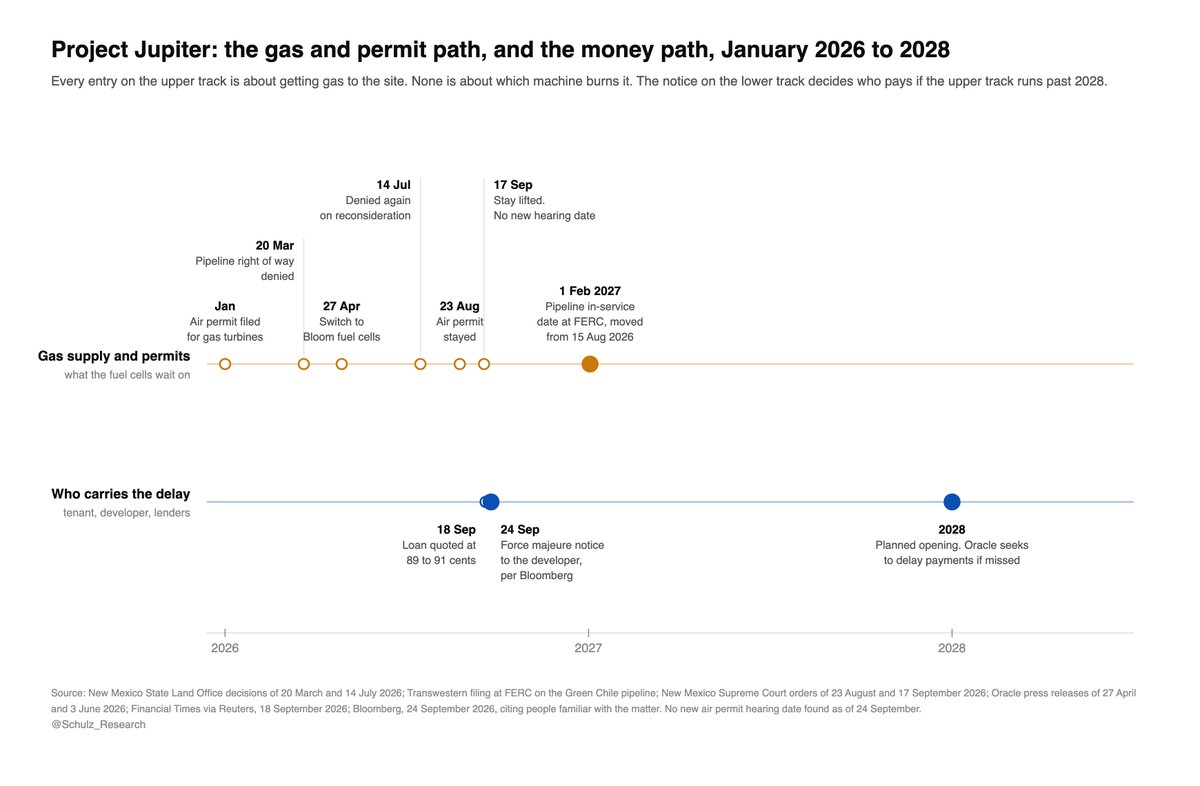
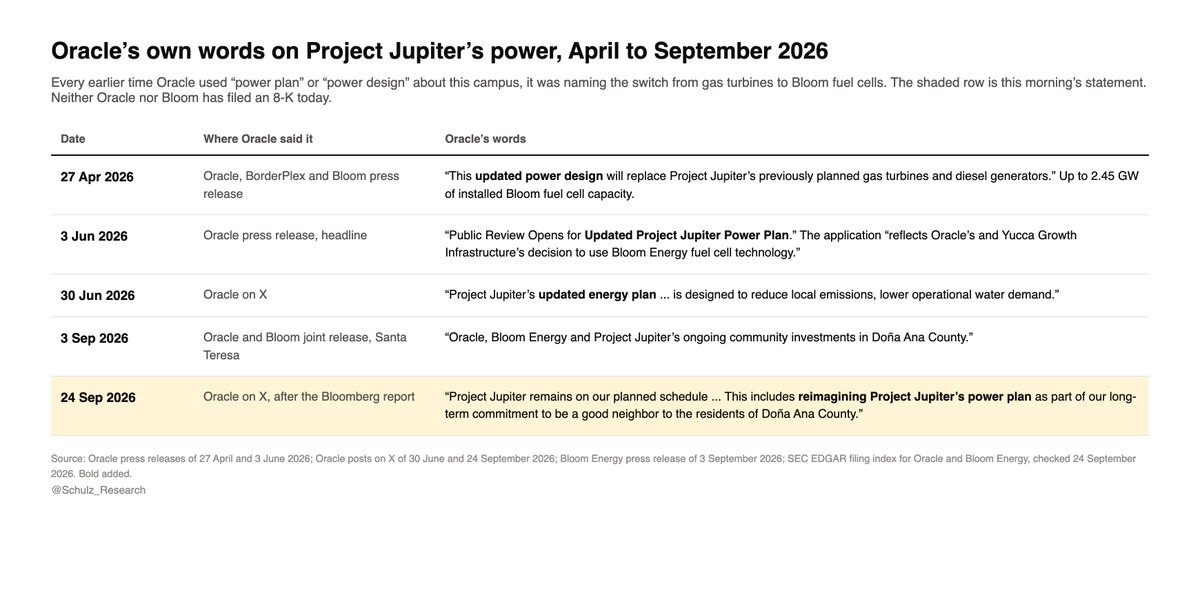
Bloom Energy is down 6.3% before the open because Oracle sent a force majeure notice on Project Jupiter. Oracle's reply this morning says it is "reimagining Project Jupiter's power plan." In Oracle's own releases from April and June, the power plan is the Bloom fuel cells. The part that is late is a gas pipeline, now dated 1 February 2027.
Bloomberg reported that Oracle sent the notice to the developer, a Blue Owl unit, so it can put off payments if the campus misses its 2028 opening. Oracle answered on X that Jupiter "remains on our planned schedule." Both can be true. A notice like this protects the tenant's position before any date has been missed.
The line the market is reading as a threat to Bloom comes next: "This includes reimagining Project Jupiter's power plan as part of our long-term commitment to be a good neighbor." So I went back through everything Oracle has said about Jupiter's power since April. On 27 April it called the move from gas turbines and diesel generators to up to 2.45GW of Bloom fuel cells an "updated power design." On 3 June its headline was "Updated Project Jupiter Power Plan," again about the Bloom decision. On 3 September Oracle and Bloom put out a joint release in Santa Teresa on their community spending around the project. Every time Oracle has used this vocabulary, it meant the fuel cells. Read against that record, today's line describes a decision Oracle made in April. Neither company has filed an 8-K today.
What is actually late is gas. The Green Chile pipeline has to cross 0.63 miles of state trust land, and the land commissioner turned it down on 20 March and again on 14 July. Transwestern moved the in-service date at FERC from 15 August 2026 to 1 February 2027. The air permit was stayed on 23 August, the stay was lifted on 17 September, and I haven't found a new hearing date. Fuel cells burn natural gas, so Bloom's units wait on the same pipe as everything else on the site.
Last week I wrote that the $18bn loan behind this campus was quoted at 89 to 91 cents, and that every month the permits slip pushes back the rent that repays it. Today's notice is Oracle lining up to hold that rent back if 2028 slips. That is about the clearest reason a lender could have to want a discount.
For $BE this is the timing risk I described last week, and now there is a document saying who pays for it. Bloom's filings don't name Jupiter, management has said units can be redeployed to other sites, and how much of the 1.2GW already contracted with Oracle is for this campus has never been disclosed. Premarket at 09:25 New York time: $BE $257.80 (-6.3%), $ORCL $137.35 (-5.0%), $OWL $9.28 (-3.3%).
What would change my mind: a new air permit application for Jupiter naming a different generating technology, or Oracle describing the "reimagined" plan in terms that leave out fuel cells. Either would turn this from a timing problem into a volume problem for Bloom. Until one of those shows up, the thing to watch is the pipeline.
The "capex is destroying cloud unit economics" argument just officially died.
Google Cloud and AWS have driven dramatic operating margin expansion over the last 12 months, converging alongside Microsoft Intelligent Cloud into a highly lucrative 36% to 41% margin corridor in 2Q26.
GCP’s operational trajectory is particularly striking—exploding from sub 10% margins in early 2024 to 36% as capacity utilization maxed out.
The hyperscalers aren't burning cash on bad assets as the bears like to frame it…high density compute capacity is monetizing almost immediately upon coming online, holding industry wide margins near 40% through late 2027.
If you’re an AI bear, idk how you stay a bear after you watch this…Gray of blackstone reveals that his companies grew their Anthropic spend 21x in a single year to a $525 million run rate “We had, amongst these 1,400 companies, $25 million of run-rate revenue in September of '25. That number is up 21-fold, annualized run-rate revenue, to $525 million of spend with Anthropic."
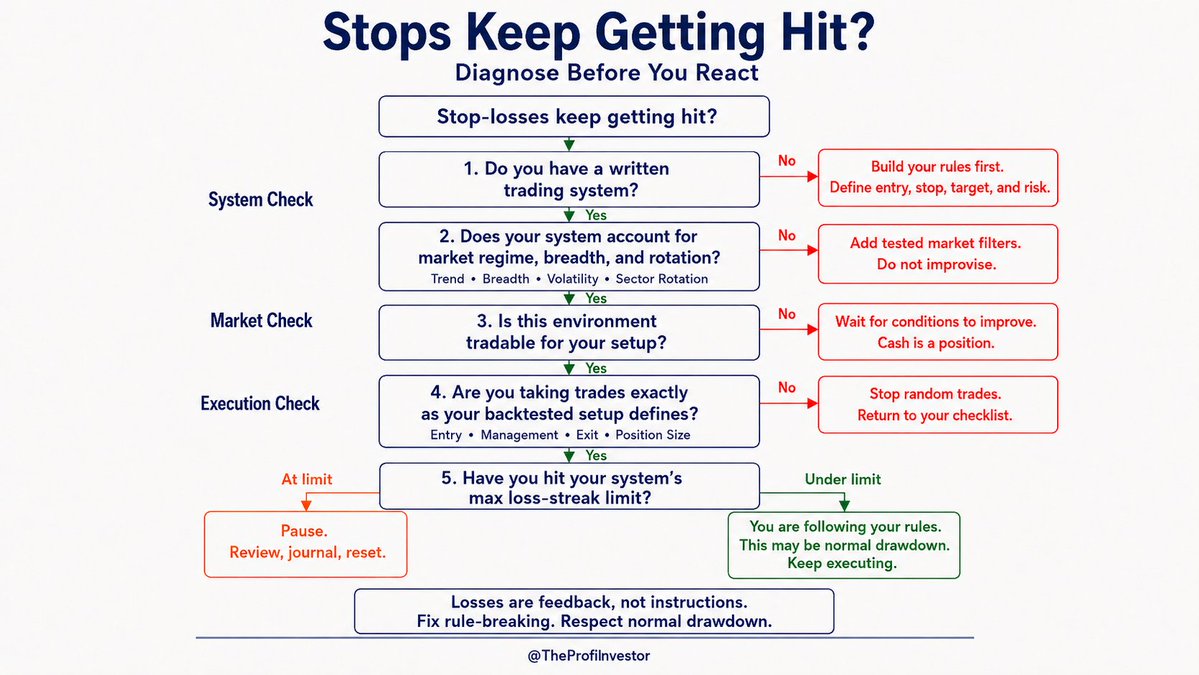
Please allow me to translate the profound message Linda is conveying. She is noting that the intraday price uptrend on Monday is very linear, such that even a very tight stop is not getting hit. Signal processing engineers would say that there is a high "signal to noise" ratio.
Smooth intraday trends typically happen when there is a large amount of money that needs to get put to work, but the big firms don't want to dump a large order into the market all at once and move prices. So their trading desks use algorithms to chop up the large slug of money into smaller pieces, doling orders out more slowly. This results in that linear form of the intraday chart plot.
The key takeaway, therefore, is that there must be a large amount of money deciding to move now, based on seeing footprints in the intraday plot which match the behavior of prices when that condition is in effect.
Semis revenues don't operate in a vacuum anymore…they are almost entirely tethered to cloud capex. With a correlation of 0.956 and an R² of 0.912, cloud capital expenditure explains over 91% of the quarterly variance in semiconductor sales through 2Q26.
Every dollar increase in quarterly cloud capex translates directly to a $1.30 lift in broader semi’s top line growth. As hyperscaler infrastructure commitments scale into multi trillion dollar territory, chip demand remains structurally locked into this underlying capital flood
Stunning stat: "Anthropic’s investors are expecting the company to reach a valuation of $2tn when it goes public in the coming weeks. Add in SpaceX, which began trading at $2tn after its IPO in June, and OpenAI, which is considering raising money privately at $1.2tn ahead of a public listing next year, and these companies alone could be worth well north of $5tn. Now compare that with the entire history of IPOs from 1980 to 2025. The 3,365 tech companies that went public in that period were worth a combined $4.1tn when they started trading."
While I've written much about AI's transformative potential across sectors, I've always been dubious about how much value hyperscalers can seize enabling that transformation. As I dissect in my recent report on "The AI Trade" (https://t.co/kEx5Z4BJH7), it's not about user acquisition. OpenAI claims to have over one billion active users across its services and two million businesses using its AI models. Anthropic has claimed to have more than 300,000 business customers. The question is not whether they can bring users to their services, but rather how much average revenue they can generate per customer relative to the price of building and maintaining their models. The cost of compute is inflating at the same time competition is depressing token pricing power. That's a precarious dynamic when so much hinges on the success of two companies.
To again quote the report:
"It’s hard to overstate how much hinges on these IPOs. As mentioned in the Executive Summary, OpenAI and Anthropic will account for 13% of AWS revenue and 27% of Google Cloud revenue this year. As for Microsoft, OpenAI alone accounts for roughly 70% of its AI-specific revenue ($24.1 billion out of an estimated $34 billion total for the fiscal year ending in June 2026). OpenAI has committed to tens of billions of spending on chips from the likes of Nvidia and Broadcom. Deepening circularity concerns, tech giant earnings growth has been increasingly driven by paper gains in the private-market valuations of Anthropic and OpenAI. In Q2, Amazon, Alphabet, Nvidia, Meta, and Microsoft reported $160 billion in cumulative “other income”, trouncing the $69 billion in “other income” reported in Q1. To quote the FT: “These one-off valuation boosts, derived in large part from enthusiasm around AI, risk distorting the financial picture at a time when investors are closely scrutinizing tech earnings.” If either Anthropic or OpenAI stumble in their IPOs, it’ll hit tech giants on multiple balance-sheet fronts and likely ripple through the US and global economy. A pin-prick popping of the AI bubble may not be our base case, but if a pin is out there, it’s likely the revenue versus spending trajectories of Anthropic and OpenAI."
FT link: https://t.co/4JNX9eKv9m
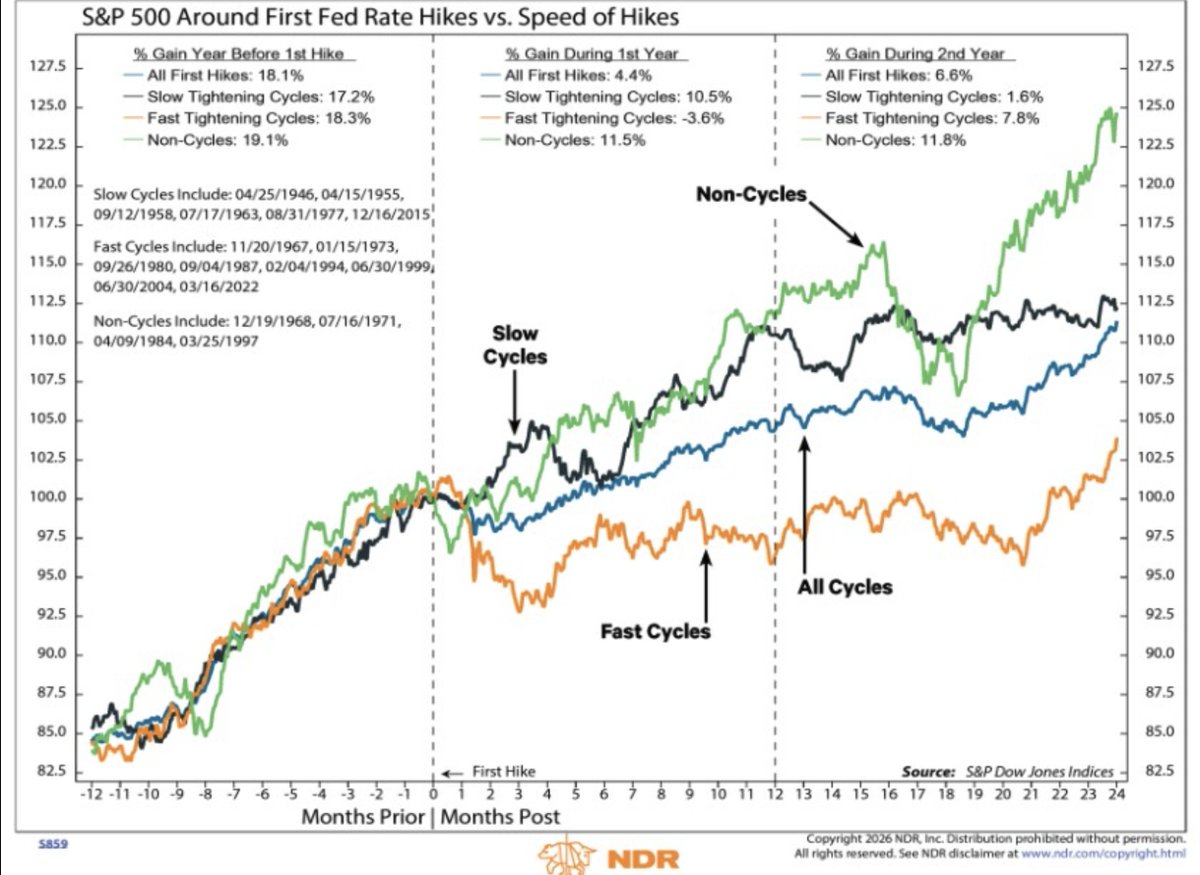
Slow hiking cycles are positive for stocks.
We're also entering the most positive phase of the US Presidential Cycle and our portfolio is positioned for a multi-month rally. $NDX $SPX
Chart @edclissold
6/6
Don’t Mistake Brains for a China Trade Deal
There’s an old Wall Street adage: don’t mistake brains for a bull market.
Central banks made the same mistake with China.
They believed two decades of WTO driven GOODS deflation reflected their own skill. The inability of services inflation to get below their 2% target should have been their warning. They missed it.
Now that goods deflation is over, and services inflation is heading toward 4%, they cannot reach their 2% inflation target (unless a recession kills demand). This means 3.5% to 3.75% funds rate is stimulative and only going to add already intolerable inflation (ask the "bottom of the K" if inflation is tolerable).
This is what the market has been signaling for two years, as we detailed yesterday.
https://t.co/hfHKieHI6F
🚨 1/MAJOR ESCALATION: Barack Obama just told Hakeem Jeffries to make AI regulation the center of the Democratic agenda — “once you are speaker.”
The NYT story reads like a former president weighing in. Read it closely and it’s something else: the next domino in an eighteen-day sequence.
Here’s the sequence. 🧵👇
https://t.co/D7hSYVbvy7
$ORCL is our Best Idea - Guggenheim PT $400
Oracle reported a strong F1Q27, guided F2Q27 in line with the Street, and increased FY27 guide. Those tactical thresholds are typically something investors want to see, but looking closer at the numbers indicates a more positive conclusion, and incremental details disclosed by management paint an even brighter future. Per the first point, F1Q Cloud Services and IaaS revenue grew 62% and 121% cc, respectively, versus consensus at 60% and 117%, and the buyside at about 61% and 118.5% per our TMT desk. F2Q guidance for 64-70% Cloud Services growth was above both consensus and the Street at 65%. FY27 guidance was raised to $1.10 EPS on $90+B revenue from $1.05 and $90B. Incremental details that paint an even brighter future include: 850MW new capacity in the Q (more than 2/3 of all FY26); $30B new AI IaaS bookings that will not require an increase in capital to be raised, implying upfront payments and perhaps some BYOH; renewals of AI IaaS contracts in the quarter at 120% of their original value (with same GPUs); GPU utilization of 97.9%; impressive GPU longevity of 4 years or longer – so far – for most that came up for renewal (it’s unclear how long the useful life is, but the depreciable life is 6 yrs); IaaS will accelerate in each FY27 Q. Beyond AI IaaS, ORCL completed the $20B ATM. Multicloud database revenue grew 353% y/y and customer count grew 180%, and Multicloud regions increased to 70. We realize revenue here is still relatively small, but we heard of broader adoption in the field this Q. One area of modest performance was SaaS that grew 10% due to slower NetSuite growth, with Fusion Apps growing 14%, Oracle Health continuing to accelerate (which we expect to persist), and industry apps growing > 20%. We expect AI capabilities to drive incremental Apps growth in the future per our field work. We reiterate ORCL as our Best Idea with a price target of $400, that may seem far from here, but we believe it is not only plausible, but likely in due time.
$ORCL is our Best Idea and what we view as a "Decade Stock” - Guggenheim PT $400
In our view, the $20B ATM equity raise has been the primary overhang on ORCL shares since the F4Q print, surpassing OpenAI concentration concerns. With the company having issued no equity in F4Q26, we believe investors want to see material progress this quarter, and completing most, if not all, of the raise would be positively received near term. That said, another equity raise could be on the horizon given ORCL's plan to raise $40B in FY27 (including the $20B Equity ATM) with no further capital raises planned for CY26. While most assumed the $20B balance would be debt raised in the first half of CY27, our recent conversations with rating agencies lead us to believe equity would likely have to be a component to keep debt investors happy. On the print, F1Q Cloud Services guidance of +57%-63% CC requires a significant IaaS ramp and just over $9B of New IaaS ARR coming online in F1Q vs. an estimated $4.2B in F4Q26 and $13.2B overall in FY26. That is consistent with Co-CEO Clay Magouyrk's comment that new capacity in F1Q should be approaching 1GW, following 1.2GW in all of FY26. Note that "approaching 1GW" doesn't necessarily mean 1GW. We continue to see risk to consensus Cloud gross margin given the negative margin period before customers go live, but less risk to operating margin given Opex efficiencies. On capex, we believe FY28 will be clearly higher than FY27 rather than flattish, as many have interpreted. Our July NDR with CFO Hilary Maxson reinforced that Oracle is past the highest-risk phase of its build-out and that maintaining its investment-grade rating is her top priority. Our partner checks also indicate stable to improving trends on the SaaS and database side of the business. Buy-rated ORCL is our Best Idea and what we view as a "Decade Stock." We maintain our PT of $400. ORCL reports F1Q earnings after the close on 9/10.
$INTC Northland Upgrades to Outperform PT $120
Intel has made material progress turning around the business. There is also a shortage of server CPUs benefiting the Company. We also believe that Intel’s Terafab partnership will materially benefit INTC’s foundry business and drive the needed scale of its process technology footprint. In our view, it is not an if; it is a when, reuniting with China. China’s reunification of Taiwan could happen within the next 18 months. The war in Iran has created a window of opportunity for a Chinese blockade of Taiwan; the presidential election on 1/28 is also a potential catalyst. We expect INTC will outperform in this eventuality. TeraFab Relationship: Elon Musk has historically leveraged the government through a strategy of state symbiosis—in which he builds critical technological infrastructure the state relies on. SpaceX is a case in point. Currently, 5nm and below wafer capacity is estimated to be roughly 12M 300mm wafers per year. We estimate that TSMC’s sub 5nm capacity is roughly 8M 300mm wafers per year. Over the lifespan of Elon Musk’s Terafab, total capacity is expected to be 22.4M advanced logic wafers annually, with a full build expected in the late 2030s. The first product is expected in mid-2028 or 2029. The first phase of the Terafab will cost $55B, and the complete build-out is expected to cost $120B. As a frame of reference, we estimate that TSMC will spend roughly $46B on sub 5nm capacity this year. We do not believe that SpaceX, Tesla, and xAI together will come close to filling the planned Terafab capacity this decade. The scale of Terafab makes no sense unless it is meant to replace TSMC’s Taiwanese capacity. Aligning with Musk's Terafab boosts Intel's turnaround efforts and validates its push into external foundry services.
If you want to know how Jane Street made $16.1B in trading revenue in Q1 and generated $10.3B in net income…bigger than JP Morgan. This is a must watch video. Free game!!