@xsgames_ Hi! 🙋🏽♀️🤗 We are WellAI, a Digital Front Door solution for doctors and hospitals. The latest Large Language Models are at the heart of this solution.
Honored to be a #Mentor at the #NurseHackathon at #HLTH on Tuesday, November 17, sponsored by Johnson & Johnson and NurseApproved.
Quick confession: I've spent years telling you what's real innovation in healthcare and what's just hype. I've seen dozens of products and companies that looked amazing on paper, only to eventually fall apart spectacularly.
Nurses are the antidote to that.
Nurses know how to spot real solutions versus empty promises. They see where workflows break down and where patients slip through the cracks, usually long before any dashboard catches up.
Frankly, nurses should be reviewing half (if not all) of the healthcare software out there.
I'll admit, I'm the kind of guy who gets unreasonably excited when a great idea from good people wins.
And what excites me most about nurse-led innovation is that it builds on what healthcare does best: empathy, rigor, resilience, and service. The best innovations amplify those qualities, and nurses demonstrate them every single shift.
My job with the teams is simple:
→ Tell you the truth (kindly, and with snacks if possible).
→ Pressure-test your ideas before the real world does.
→ Help turn frontline experience into something that scales.
Thank you to Johnson & Johnson and NurseApproved for backing nurse-led innovation, and to the NurseHackathon team and @HLTHEVENT for creating a space where it can thrive.
To every nurse building something: You're the experts. Build. Design. Create. I can't wait to see what you come up with.
#HLTH26 #HealthcareInnovation #NursesOnLinkedIn #HealthcareOnLinkedIn #DigitalHealth
The First Law of Thermodynamics applies surprisingly well to corporate acquisitions.
You cannot create real economic value simply by putting a bigger number on a company. If that valuation isn't supported by economic fundamentals, someone eventually pays the price.
Remember the First Law of Thermodynamics? Energy cannot be created or destroyed, only transferred or transformed.
In this Part 1 of my investigation, I examine the economics of healthtech M&A, using @OpenEvidence as a case study.
In Part 2, coming next week, I'll take a closer look at OpenEvidence's technology and raise some serious questions about whether the company has a defensible competitive moat.
Assuming, of course, I won't be swimming with the fishes by then. 😉
Here is Part 1 of the investigation: https://t.co/jIbqy3r0VQ
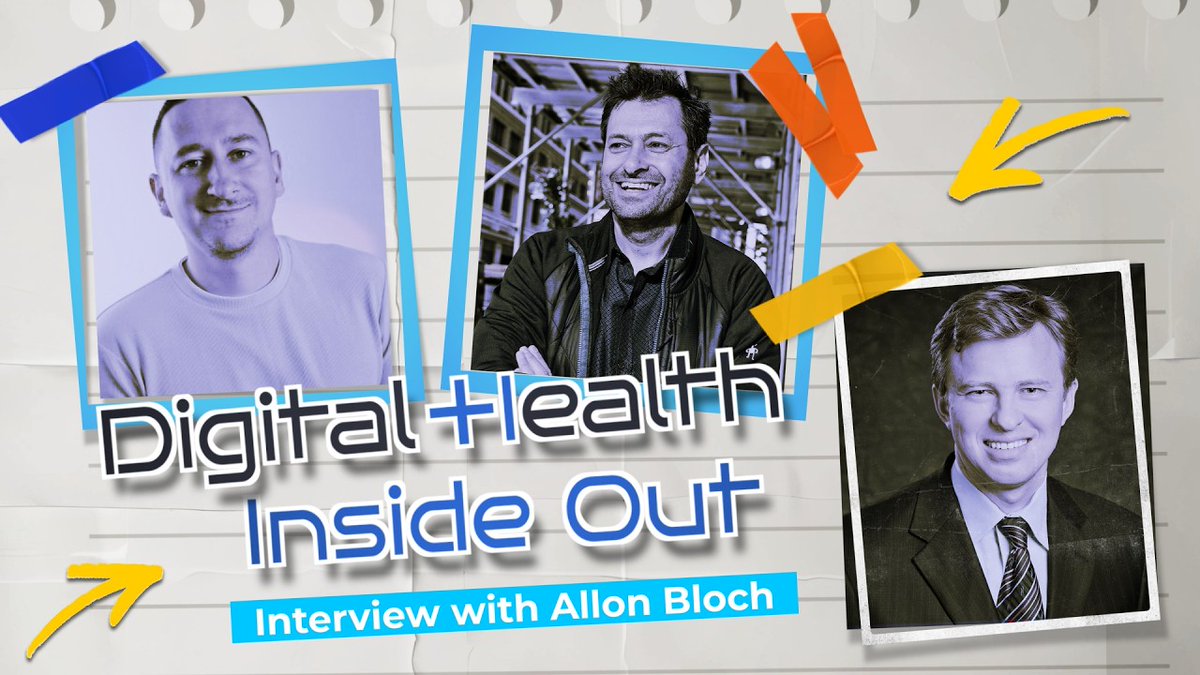
In August, I responded to @khealth CEO @allonbloch's funding announcement with, “WTF? I thought you guys were dead.” 😂
And that’s how the idea for our Digital Health Inside Out interview was born.
Allon took every tough question @AlexKoshykov and I threw at him, and was a remarkably good sport about it.
PatientGPT is real. 40,000 @HartfordHealthC patients are using it. Yet I still don’t know what AI model powers it, or why K Health killed off its consumer symptom checker on December 31.
Easily one of the spiciest interviews we’ve ever done. 🔥
Check it out!
Article: https://t.co/J8lHpC9vFL
Video: https://t.co/TZVnpC5XNE
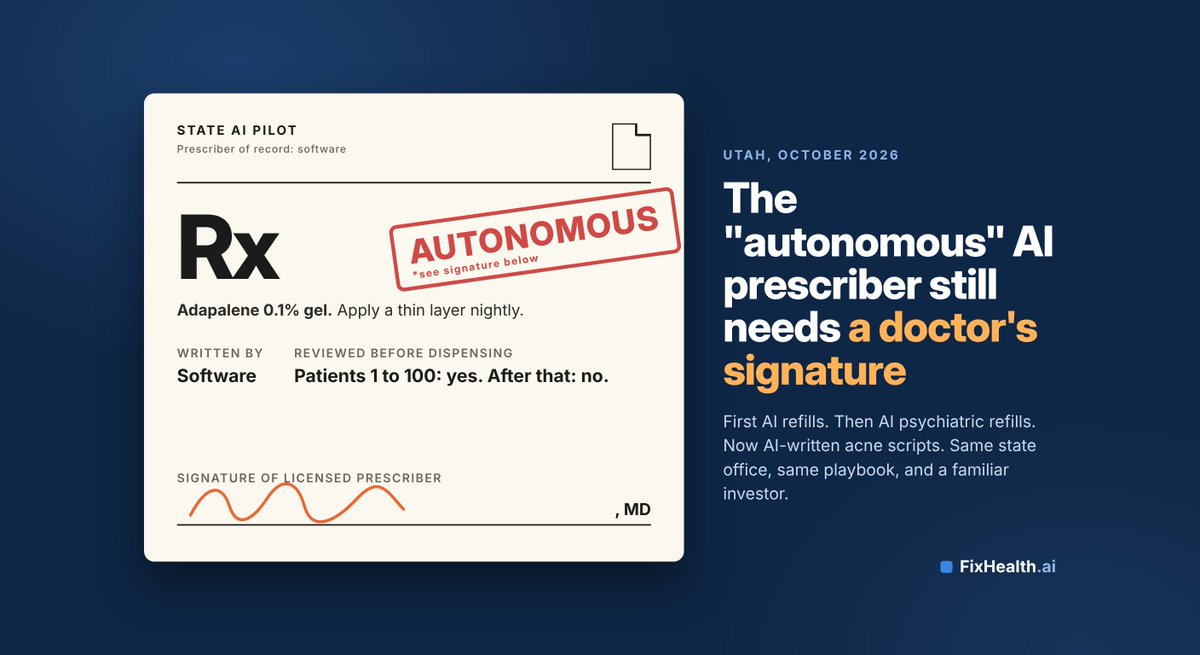
The world's first so-called "autonomous" AI prescriber still needs a doctor's sign-off on every script. The Utah state contract says it is not an approval. The lead investor also owns a hospital. And a dermatologist who tested the app got quoted $120 every 2 months for 2 creams, prompting the most accurate peer review of the day: "Those prices are nuts!" 🤦♂️
And I have no idea why a company legally named Magic Health does business as @nollahealth. Magic fits this story so much better. 😉 👇
https://t.co/eo2GLHKId9
Who Owns the Doctor in 2031: Epic or OpenAI?
I said @HeyEpic. Our special guest, Patrick E. Donohue, said @OpenAI. 😉
It was a spicy episode, of course, with my co-host @AlexKoshykov. Stephanie Davis had to sit this one out.
We also discussed:
🔥 @ouraring's IPO, which, of course, was pulled just one day after we recorded
🔥 @commonspirit's $1.9B RCM divorce
🔥 Thumbs up or down on @tryheidi, Tandem, Archy, and @Rightway
Check it out:
Video: https://t.co/LHkVPEos04
Article: https://t.co/mXgEkioUhK
Can AI actually replace doctors? And if so, what clinical decisions should AI never own?
That was the main topic of my recent conversation with Tom Foley on @HCNowRadio's The AI Shift.
We talked about where AI in healthcare actually stands today.
Not where the hype says we are. Where I believe we actually are, based on being deeply embedded in clinical settings as a healthcare AI vendor and on my work as a clinical AI researcher.
🤖 AI is the future of healthcare. But we’re not there yet. I still don��t see today’s models replacing physicians, especially when the clinical stakes are high.
🛠️ There is plenty of low-hanging fruit already. Administrative work, documentation, prior authorization, coding, workflow automation, and expanding access in underserved and rural areas.
📊 Some of the evidence being used to claim that AI is already superior to doctors is remarkably weak. Tiny samples, questionable study designs, and conclusions that sometimes go well beyond what the underlying research actually shows.
🤷 One of the biggest unresolved problems with LLMs in medicine remains deceptively simple: they don’t reliably know how to say I don’t know. In healthcare, that matters.
💍 We also talked about @ouraring, predictive health claims, the difference between a great consumer product and a medical product, and why healthcare AI still has a serious trust problem.
My bottom line hasn’t changed:
AI will be in the doctor’s office. In many places, it already is. But for the foreseeable future, I believe the strongest model is humans working with AI, not AI replacing humans.
Thanks, Tom, for a timely and thoughtful conversation.
🎧 Full interview: https://t.co/U9RjbOgoHX
It’s always a money grab.
I love @AIHealthUncut /Sergei’s unvarnished takes on tech companies pretending to be healthcare companies.
I also enjoy him calling BS on the “endless hockey stick” trajectory these companies sell to investors.
https://t.co/Xa0IHDXH8w
It’s almost as if @tomeghale, Oura’s CEO, read my September 5 piece, "Oura IPO: Slick Gadget, Shaky Business," and decided not to test my thesis in public markets just yet. 😉
Oura was expected to price its IPO today and begin trading on Nasdaq as early as tomorrow. Instead, the company postponed the offering this morning, citing "uncertainty in the IPO market." https://t.co/cc0iVKuGk8
I dive very deep into Oura’s story and explain what may have driven the delay. One obvious reason is demand. The IPO order book was only ~4x subscribed, a very weak showing for a high-profile offering.
I look at two other healthtech darlings: Peloton circa 2019 and Fitbit circa 2015.
@onepeloton has lost 73% of its stock price since its IPO. Fitbit lost 63% from its IPO price before being acquired by @Google for $2.1B.
Meanwhile, @ouraring was seeking a $14.9B fully diluted valuation on roughly the same revenue Fitbit had when @Google acquired it, while structuring an IPO in which the company would effectively spend ALL of its own IPO proceeds on day 0, something that almost never happens in a traditional IPO.
The IPO may now be on hold. The questions around Oura’s valuation, business model, and what has happened since my Part I earlier this month are not.
Kudos to @HLTHEVENT for featuring our interview with Piotr Orzechowski, co-hosted with @AlexKoshykov. @_orzech is the CEO of @Infermedica and one of the most thoughtful and caring leaders I’ve had the pleasure of meeting in our industry.
https://t.co/NY0EEwsEum
I think I’m fairly well known for giving candid criticism, so I’ll be candid this time too.
The inaugural Origin Point conference (https://t.co/4wirLNREby), where I was honored to be invited to speak, was exceptionally well organized and thoughtfully put together. Kudos to the organizers, @NoahVoreades, Callie Baker, and @dr_jacques.
And I’m giving them all this praise not only because we had black caviar for breakfast on Friday. 😉
Attached is the handwritten note I received immediately upon registration at the hotel. It was a really nice touch, I have to say. Got me a little emotional.
Everything was superb.
The conference was not huge, but it wasn’t small either. About 85 participants. Lots of investors. Lots of founders. And, most importantly, an amazing atmosphere.
We covered everything from longevity, GLP-1s, peptides, biomarkers, and healthy eating to consumer healthcare AI, wearables, AI agents, AI’s potential role in curing cancer and other diseases, women’s health, investing, M&A, and much more.
I think by the end everyone was probably sick of me because my curiosity had me asking questions at literally every session. 😀
I especially want to thank the moderator of our panel, Julia Croxen of @Rock_Health, and my fellow panelists, @DrParikhMBA and @ansonwhitmer, for an amazing and highly interactive discussion about digital health, consumer health, and AI products. Julia started preparing for our panel so far in advance that by the time the conference arrived, we had accumulated a bank of questions worthy of a USMLE exam. 😀
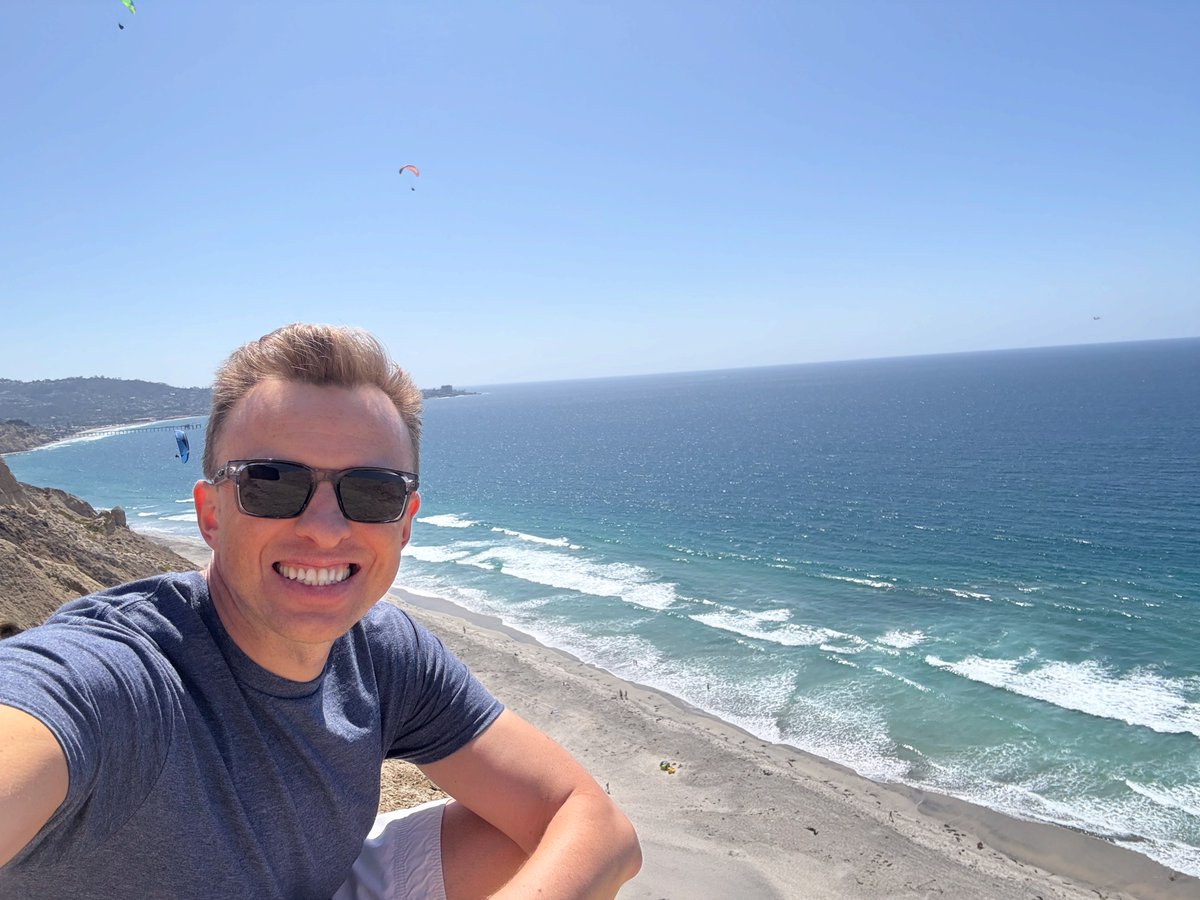
There were also plenty of breaks for networking and for exploring the beautiful La Jolla coastline, where apparently you have to remain vigilant because there is always a possibility of a paraglider landing on your head. 😊
And the weather was exactly where I left it when I visited San Diego many years ago. About 72F. Perfect.
The locals told me that the week before had been a scorcher, with temperatures in the 90s. Of course, I didn’t believe them. 😉
Great people. Great conversations. Great location. And a conference small enough that you could actually meet people and have meaningful conversations rather than simply collect badges and LinkedIn connections.
If you have a chance to attend Origin Point next year, do it.
I highly recommend it.
I wish someone would listen. I’ve been warning about @UHC’s erroneous "prediction" AI tool, developed by NaviHealth, for three years now: https://t.co/2CJyfnrJ38
Perhaps not coincidentally, @iamjohnoliver talked at length about $UNH’s questionable practices on his show tonight, including upcoding and this crazily error-prone AI tool by naviHealth.
Practitioners have known how to deal with Navier-Stokes singularities for decades. @OpenAI's so-called solution to the Millennium Prize Problem has zero impact on our everyday lives.
Whether @OpenAI's claim survives the next two years will be decided by mathematicians. Whether it matters was decided by engineers decades ago.
YouTube video: https://t.co/qgSPfCpxJD
Full article: https://t.co/2PImEcEQvs
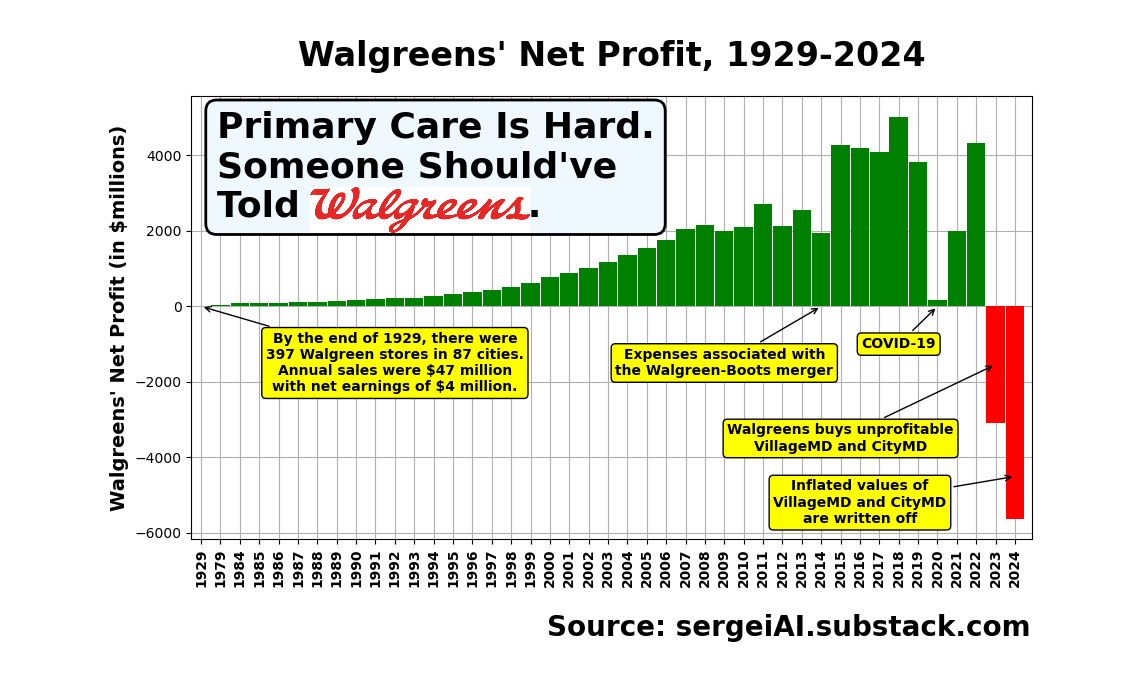
Charles R. Walgreen would turn in his grave.
He was famously one of the most frugal businessmen in American history, making Walgreens profitable in year one, in 1901.
Fast-forward 122 years.
A bunch of execs, under pressure from the board, of course, decided Walgreens needed to expand beyond its bread-and-butter pharmacy business into something it had never done before: primary care.
So Walgreens went on a buying spree, pouring billions into VillageMD and helping bankroll the acquisition of Summit Health/CityMD, for a total commitment of almost $10B, even though those companies were losing money.
Why?
At least in part, it was a knee-jerk reaction to Amazon's push into primary care and the broader Wall Street obsession at the time with turning pharmacies into healthcare companies.
VillageMD, in particular, effectively brought Walgreens to its knees.
Now Walgreens is worth less than what was poured into those primary-care bets, and the company that Charles Walgreen built through obsessive financial discipline has become a case study in what happens when management chases somebody else's strategy with shareholders' money.
What a sad chapter in American business history.
The entire story is here: https://t.co/NUyNAetdpK
Private equity and VC spent the last 12 months buying, merging, and funding every RCM asset with a pulse, all on the promise that a billing specialist at scale can collect more cheaply than a hospital can.
@commonspirit just paid @TenetHealthcare $1.9B to say, "Really? No thanks."
Insourcing could be the next big trend in RCM, with health systems deciding they may not need expensive middlemen like Tenet and @CommureOS after all.
And while CommonSpirit could buy its way out of an RCM contract for $1.9B, getting rid of Epic is a different story. There may not be a check big enough. 😉
My full analysis: https://t.co/Wt57EgjyR0
Are wearables on your finger actually better than wearables on your wrist?
I don’t think so. Despite all the hand-waving, glossy marketing, and increasingly grand promises.
Oura has made a lot of claims about its newest Oura Ring 5. But at some point, "potential" has to turn into an actual product.
I was expecting the promised "predictive power."
What I got was a very expensive explanation of things that had already happened to me.
If I slept badly, I know I slept badly.
I do not need an app to proudly inform me that I woke up at 5:14am and went to pee.
I know that.
I was there. 😉
That is not prediction. That is a $499 digital diary with a subscription fee.
When the product experience is this underwhelming, the financials need to be spectacular to justify rushing into the public markets. I'm not sure they are, but my friend @halletecco makes a strong case in her sharp analysis today that the financials and growth hold up: https://t.co/vwUY77moQp
Oura’s numbers are OK. The product is OK. The hype is considerably better than both.
Which is why I think Oura’s IPO is way too early.
My full article: https://t.co/89As79619c
My video: https://t.co/3E8Q04Sslq
Happy Labor Day, everyone! 🇺🇸🍁
I’m biased, of course, being on the board of Health2Tech. But the event we have coming up this Thursday, Sept 10, in NYC near Penn Station is shaping up to be just outstanding.
We’re bringing together a fantastic panel of women investors in digital health: Margaret Davidson, Michelle Wang, and Jessie (Laurash) Gentil, moderated by Perrin Joel, and organized by my friend and colleague Baily Morgan. (Of course, my good friend @AlexKoshykov is the founder of @health2tech_.)
If you’re investing in healthcare, want to understand how investors pick winners at different stages, or want to learn what (likely) separates a great company from something you should probably run away from, this event is for you.
And it’s completely free. You just need to register: https://t.co/HxDvmg9O2R
I’ll be there all evening and very much open to all kinds of conversations, debates, and uncomfortable questions. The more uncomfortable, the better. 😉
And yes, I know there are about a million other events happening in NYC that day. But I think you want to be where the cool people are. 😎
AI drug discovery is great for humanity. Turns out, not so great for investors.
AI is finding drug candidates faster. It still hasn’t proven it can find better drugs.
Full article: https://t.co/wpBPOXZkn1