EU sanctions on China are backfiring hard
The Netherlands (under sustained US pressure) has blocked ASML from selling its most advanced EUV lithography tools to China
In 7/2026, after EU included Chinese entities in the Russian sanction, Beijing added 14 European entities to its own export-control list. This bars Chinese dual-use items—including critical minerals and rare earths—from going to those firms (and blocks third-country workarounds involving China-origin materials).
One target was Sindlhauser Materials GmbH, a small German precision-coatings company (roughly a dozen employees) in ASML’s supply chain. It relies almost entirely on Chinese rare earths and critical minerals for the high-purity materials and coatings used in advanced optics and semiconductor equipment (tied into the broader Zeiss optics ecosystem that ASML depends on)
Result: the EU is now negotiating a one-for-one “sanction swap.” It would delist one Chinese firm previously targeted for alleged Russia support in exchange for Beijing lifting the restrictions on Sindlhauser. Talks surfaced around EU Trade Commissioner Maroš Šefčovič’s Beijing visit; any EU delisting needs unanimity among member states, which is difficult to achieve
🪃 hits hard especially when you have supply chain illiterate bureaucrats deciding on supply chain issue
https://t.co/uXMBUydhJl
🚨🚨 "La causa más común de presión arterial alta es una deficiencia de magnesio"...
"No tienes presión arterial alta porque tengas un gen malo, porque estés envejeciendo o porque tengas una maldición vudú"..
"Tu cuerpo se quedó sin el mineral magnesio".
Dr. Peter Glidden.
Más del 75% de las personas tienen una deficiencia manifiesta de magnesio, pero no relacionan sus enfermedades con ella.
Históricamente, nuestra agua, suelo y alimentos abundaban en los más de 80 oligoelementos necesarios para una salud plena. Ahora no es así... nuestra agua, suelo y alimentos son deficientes, lo que nos provoca deficiencias. Esto representa una amenaza para la salud y debemos priorizar minerales como el magnesio, el potasio y la sal mineral sin refinar, esenciales para la vida, en nuestra rutina diaria.
El magnesio es el corazón de la producción de energía ATP y participa en más de 600 reacciones enzimáticas.
Es imposible comprobar si existe deficiencia, ya que el 1 % del suero sanguíneo está estrictamente controlado y regulado para permanecer "normal", mientras que se supone que el otro 99 % debe estar en la capa intracelular.
La mayoría de las deficiencias no se diagnostican porque los niveles del suero sanguíneo permanecen normales mientras que los niveles intracelulares son tan bajos que constituyen una crisis de salud pública y crean enfermedades crónicas y disfunción.
El magnesio es el principal regulador del calcio, transportándolo a su lugar correspondiente: los huesos. El magnesio evita que el calcio se acumule en las células, lo que causa calcificación y muerte celular.
El magnesio es un cofactor de la vitamina D3 y también de la K2. La D3 y la K2 dependen completamente del magnesio como clave para su activación.
Dentro de mi propia familia, hemos experimentado el Milagro de la Terapia de Magnesio utilizándolo con protocolos para sanar:
Hipertensión
Síndrome de Tourette
Insomnio
Osteoporosis
Migraña
ERGE/Reflujo ácido
SII
Síndrome de piernas inquietas
Estreñimiento crónico
Espasmos de espalda
Dolor de ciática
Fatiga crónica
Niebla mental
Calambres en las piernas
Dolor articular
Ansiedad/Depresión
Arritmia cardíaca
Síndrome premenstrual/trastorno disfórico premenstrual
Deterioro cognitivo
Las 2 principales formas biodisponibles son el glicinato de magnesio y el L-treonato de magnesio.
El glicinato de magnesio es una forma perfecta para la mayoría de enfermedades y deficiencias.
El treonato de magnesio es el único magnesio que cruza la barrera hematoencefálica para revertir la disfunción cognitiva.
El citrato, malato y taurato de magnesio también son útiles para enfermedades específicas: motilidad intestinal lenta, fatiga crónica y salud cardíaca respectivamente.
Existen otras nueve formas, pero son mucho menos biodisponibles y absorbibles para curar deficiencias.
El libro milagroso del magnesio de la Dra. Carolyn Dean.
https://t.co/iCFg6X8OjR
Crisis de salud pública por deficiencia de magnesio...
https://t.co/oIxWiW2XXe
Deficiencia de magnesio y enfermedades crónicas...
https://t.co/QZLTjtvlXC
Cancerous tumor vanished after weeks on ivermectin and diet change
He avoided everything Mayo Clinic told him to do and went the alternative route. Nearly two years later, John Larson is thriving, but Mayo said he’d be dead by now.
Did you know YouTube censors alternative cancer cure stories?
Watch my latest interview exclusively on Rumble: https://t.co/QBKJcmCeQU
VIDEO - Chlorine Dioxide is my #1 go to for any respiratory infection, especially the flu or COVID-19. 😃
It was used extensively in Bolivia, Ecuador and Peru during the pandemic and completely emptied the hospitals.
This stuff is awesome and easy to get! 😎
🚨🚨 SHOCK: Cáncer de próstata en etapa final curado con dióxido de cloro (oral e intravenoso) y enemas diarios de CD. Le dijeron que moriría en 10 meses sin quimioterapia. Él se negó. En cambio, limpió y oxigenó su cuerpo (el CD oxigena y oxida). Esto podría ser básicamente el remedio para todas las enfermedades...
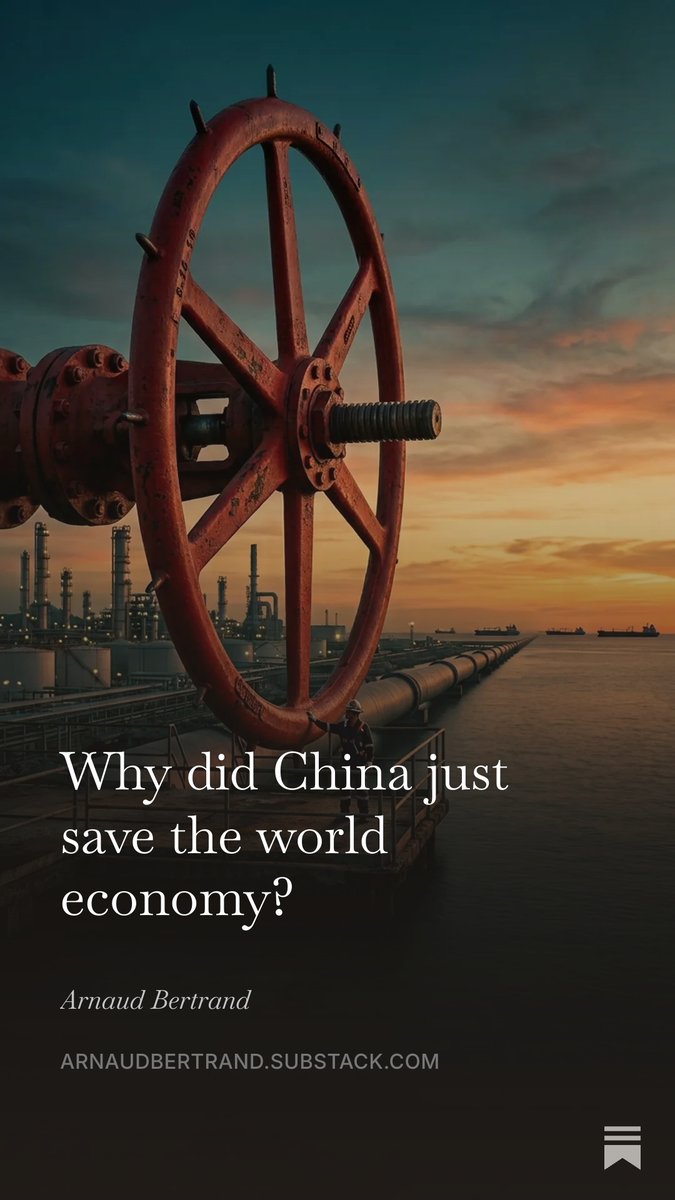
This is one of the biggest geopolitical mysteries of the year: why did China just save the world economy?
Because, make no mistake, it absolutely did. Analysts are pretty much unanimous on this: had China not dramatically - and I mean dramatically - reduced its oil imports this year, the price of crude oil would have gone through the roof and dragged the global economy down with it.
For proof, read how Javier Blas from Bloomberg - widely recognized as one of the world’s top energy analysts - explains what China did to Jake Sullivan and Jon Finer on their podcast “The Long Game” (https://t.co/bBD8yFFUdC).
As Blas puts it, China went “from 11, 12 million barrels a day to less than 6 million barrels a day” of seaborne crude imports, and that “freed a lot of oil for other countries, particularly in Asia.” India, Japan, Korea and Southeast Asia “could buy the barrels that China was not buying.”
To be clear, China wasn’t the only factor - surging US exports and the IEA’s emergency release helped too - but it was by far the biggest: JPMorgan reckons China accounted for about 74% of the fall in global crude trade (https://t.co/JCmFXYJcfh).
So it's no exaggeration to say that it is China, first and foremost, that saved the world economy this year.
If you remember the early days of the Iran war, none of this is what was predicted. In fact some US think tankers, such as the (always horrendous) Zineb Riboua from the Hudson Institute, were even cheering the war as being “all about China… the opening act in the larger contest against China,” the moment the US would crack “the central pillar of a regional order that Beijing has assembled” (https://t.co/RaCE05TcMp).
Seven months on, what actually happened is that not only did China come out of the war unscathed economically, and strengthened strategically, it also ended up shielding the world economy, America’s included, from the fallout of the very war that was supposed to be its undoing.
Breaking news: if you do something that’s supposed to be a “blow” to someone else - some sort of 3D chess move to gain the upper hand - and they end up having to rescue you from the fallout, maybe it wasn’t such a brilliant strategic move after all.
So how did China pull it off? And, more intriguingly, why did it choose to rescue countries, including the US, from a war that Washington’s own hawks were openly selling as a strike against China itself?
And why do this when it effectively dampened Iran's leverage considerably, even though they're supposed to be China's "ally" (which, as we'll see, is false)?
This is the topic of my latest article. I went very deep researching all the Chinese sources I could find on this, looking at the exact legal mechanisms, and at what officials, oil refiners and state media actually said.
The answer turns out to be far stranger than I expected: no-one in Beijing actually ever ordered an import cut. China, effectively, seems to have saved the world economy incidentally, as a by-product of its own domestic policy to protect Chinese consumers.
Which is the real story here: China has become so large and so important it can just rescue the world economy as a mere side effect.
In fact what I discovered, hilariously, is that the Chinese were just as surprised as anyone else: it’s only weeks after Western media started crediting China with saving the world economy that Chinese media picked up the story. And even then, CCTV’s first take in July (https://t.co/xLPyaJeZnT) presented it as something 外媒称 (wàiméi chēng, “foreign media claim”) 🤣
Almost like a giant suddenly waking up to its own powers. Because, that's the thing: intentions fade, consequences stay. Intentional or not, as Igor Sechin, the head of Rosneft, Russia’s largest oil company, put it (https://t.co/ckinOaHzJ7), the consequence is that it's now China, not OPEC, who calls the shots on global energy markets.
The valve of global oil pricing is now in Shandong, not in Zhongdong anymore (Zhongdong, 中东, is the Middle East in Chinese).
Full article here, with how China’s 20-year strategic nightmare, the “Malacca dilemma”, has now effectively become its leverage over the rest of the world: https://t.co/HsxPLJp45X
@AsianDawn4 If that was my outlet, she would have already caught the full load of my magazine. Not gonna lie, I'll pull out another mag and unload that too.
Another reason why the US is cooked with such people as their citizens. Chimping out is in their DNA. Self entitled baboons.
@MatrixPrime_ lock them up already yo!
Sunny Honey, a Utah Boba and Desserts shop was forced to close early the other day because a black woman walked in and trashed the place. Unfortunately, this is the price one must pay for owning a business in the United States...