Smoke's back. A box fan and a MERV 13 filter gets you through in a pinch.
The Nukit Tempest Pro is the same idea done right. Silent (39dB), all-metal, built to last decades, not one fire season.
No app. No "smart" anything. Fix it with a screwdriver.
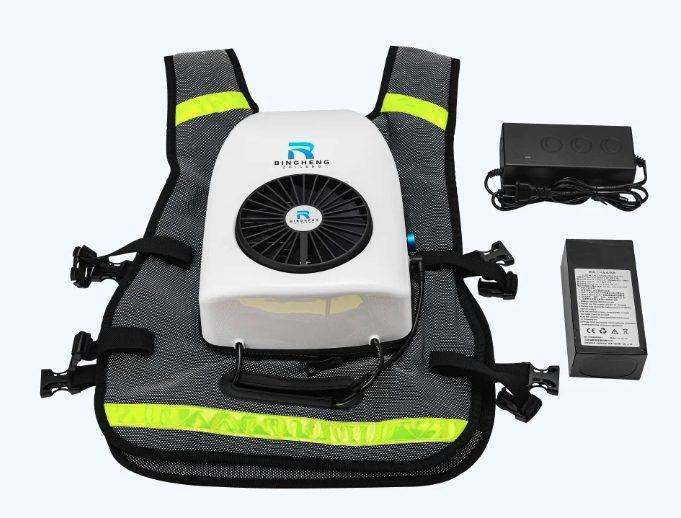
You could maybe add cooling using an elastomeric half-mask-style PAPR.
You can cool the body with inhaled cold air-
https://t.co/zZEvVSZYQ6
So, back-of-the-napkin math: a PAPR with a hood requires 170 L/min, versus 115 L/min for an elastomeric half-mask (NIOSH).
So if we want to cool 50% RH air (can't dry out those mucous membranes) from 40°C to 22°C, that's maybe 225 W for a hood but just 155 W for an elastomeric mask if you are using TEC/Peltier. So using a mask will save you a lot of power, weight etc.
The problem with a TEC is that even with a more efficient mask design running at 115 W, you still have to dump around 300 W of heat somewhere, which is a huge heatsink and fan, bottle of ice water, etc., that will take up most of whatever size using a TEC saves you.
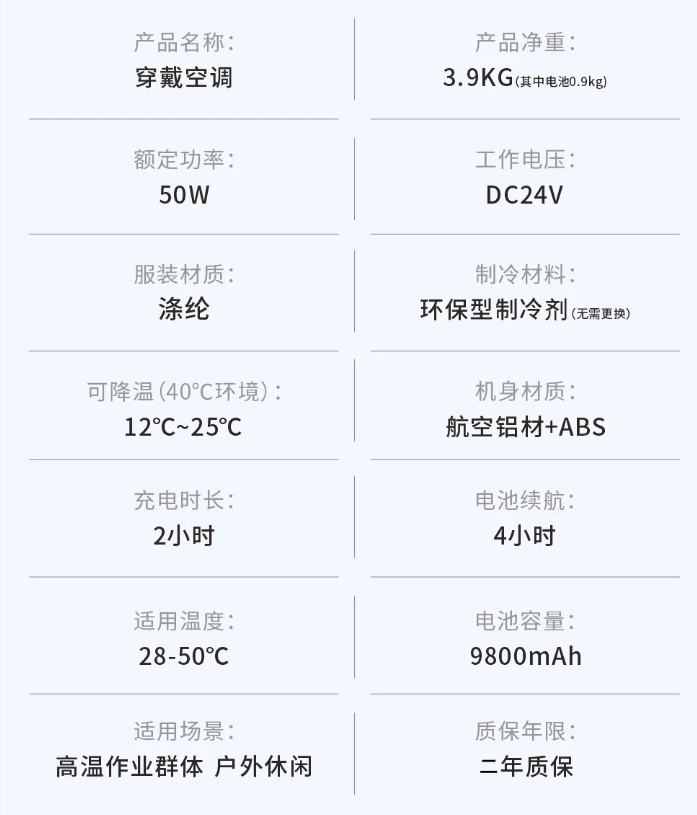
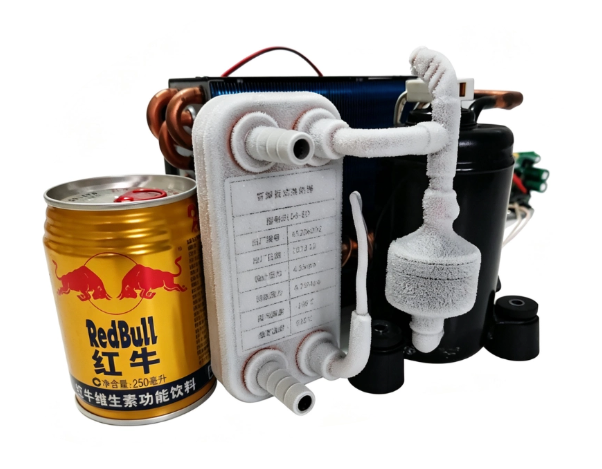
At that range, you are probably better off with a micro compressor as shown. They still are a lot more efficient at this kind of thing. One of those would take about 50-60 W to run, and maybe have to dump only 170 W. They are kind of bulky, but I have seen some neat wearable designs and DIY bare bones micro compressors for sale.
Then you have to design something pressure-tight with fins to cool the air from the PAPR- and that's kind of a pain since those designs tend to leak eventually- which is why very cheap Chinese PAPRs are not so great.
It's doable, but it would be more work than it looks like. (Sorry, can't help, provide links etc, dance card is full folks)
The Nukit Lantern should offer roughly 2-log inactivation of Cyclospora in 5 min at 15cm
UV radiation at 222, 254, and 282 nm inhibits sporulation and suppresses infectivity of Eimeria acervulina oocysts
https://t.co/Beuohy3BES
*But* this isn't actually going to work well on produce. Far-UVC is going to be a game changer for food prep in terms of sanitizing surfaces, but GUV can't penetrate- so can't get to the underside of produce, can't reach anyplace in shadow, can't penetrate clumps of...matter.
The only time researchers were able to get GUV to work on produce was when they put it in water and agitated it simultaneously.
Decontamination Effect of the Spindle and 222-Nanometer Krypton-Chlorine Excimer Lamp Combination against Pathogens on Apples (Malus domestica Borkh.) and Bell Peppers (Capsicum annuum L.)
https://t.co/2cWiJs8R4W
That will be good for large commercial kitchens- some sort of tank with an agitator and Far-UVC inside, but not great for home use.
I use an ozone bubbler next to an open window on all my produce when I bring it home. But, I have monster ventilation and stay out of the kitchen while they soak. For most people, a bucket outside on the balcony or porch is much safer, and you can also use it with a large plastic bin to gas-disinfect pillows, stuffed animals, etc.
https://t.co/ZkBUaVgYz4
Aqueous Ozone Efficacy for Inactivation of Foodborne Pathogens on Vegetables Used in Raw Meat-Based Diets for Companion Animals
https://t.co/AeDisC8oZH
Evaluation of ozone efficacy on the reduction of microbial population of fresh cut lettuce (Lactuca sativa) and green bell pepper (Capsicum annuum)
https://t.co/jWjBtCH4N6
There's also decent evidence that ozone will be effective against Cyclospora when many other anti-microbials aren't:
Aqueous Ozone Exposure Inhibits Sporulation in the Cyclospora cayetanensis Surrogate Eimeria acervulina
https://t.co/BrT2p96lKC
It's still not completely safe (my dogs are obsessed with inhaling ozone, laser-cutter fumes, anything they shouldn't and have to be kept away from it) or super user-friendly for apartments.
There are produce sanitizing gizmos that make HOCL, which I am normally a huge fan of, but I've moved away from making it by electrolyzing water since it's harder to control pH and dose than with NaDCC tablets.
The big problem here is that Cyclospora is resistant to chlorine compounds, so HOCL is very likely to be ineffective.
Evaluation of aqueous chlorine and peracetic acid sanitizers to inactivate protozoa and bacteria of concern in agricultural water
https://t.co/0beWMfQRJe
Chlorine and other common anti-microbial chemical treatments are not effective against C. cayetanensis.
https://t.co/enXZyB1FFo
This has been a big problem because many restaurants use chlorine-based sanitizers on produce (and often neglect accompanying time-consuming hand washing)
The overarching issue with all of this is that thorough hand washing with plain water is really, really effective- 1 to 1.5 log reduction, so that should always be the first step:
Removal of Parasite Transmission Stages from Berries Using Washing Procedures Suitable for Consumers
https://t.co/FQqMICcMQS
Look at it this way: if a bird pooped on your arm, would you shine UV at it, soak it in a bucket with some detergent, or wash it off with scrubbing and a ton of water? Active washing- disinfection via dilution, is very effective, basically free, and makes everything else much more effective.
Recently, I've received several emails requesting H13 or even higher-grade filters. I would still like to explain here why H13 and higher-grade filters are not a good choice for air purifiers.
A good air purifier's primary goal is to clean the air in a room as quickly as possible. There is a specific metric to describe this: CADR (Clean Air Delivery Rate). The higher the CADR, the faster the purifier captures airborne particles on the filter.
Achieving a high CADR requires two conditions:
High filtration efficiency – the filter should capture a high percentage of particles that pass through it.
Large airflow volume – a large amount of air should flow through the filter per unit of time.
If the airflow is large but the filtration efficiency is low, only a few particles are captured each pass. Conversely, if the efficiency is high but the airflow is small, the total number of captured particles is also low. But these two factors contradict each other. With the same fan, using a higher-grade filter improves efficiency, but it also increases resistance, which reduces the airflow. So a higher-grade filter is not always better.
Filters like H13 or H14 commonly found on the market have very high resistance, significantly reducing airflow and thereby lowering CADR — meaning slower purification. After extensive testing, I found that the E11 filter offers the best balance. With about 95% filtration efficiency, its airflow loss is minimal, resulting in the highest overall CADR and thus the fastest cleaning speed.
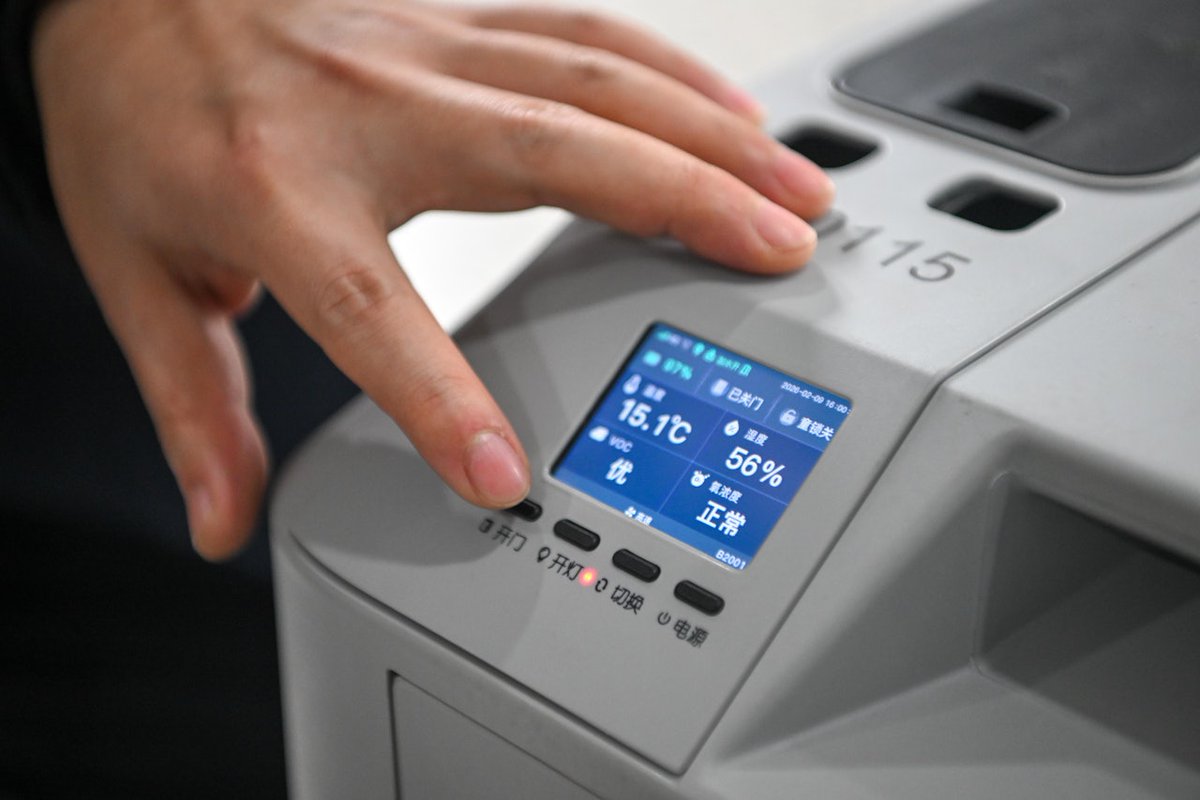
Very cool new pet transport crates for high-speed rail. Temperature, humidity, air-quality monitor and a night-vision camera. All remotely monitored with alarms for the crew. Also, water dispenser, etc. This should become the standard for pet transport...
@Biff234523 Whatever for tests well. I was shocked because I tested well on an Aura but the Trident which felt like it got better tested terrible on me with a few attempts. I'm another who loves Zimi now as my go to when not in a p100
The consequence of pretending airborne things aren't (see https://t.co/mSA5b9ZcSd) is a lack of data on the best ways to prevent transmission.
For those of you interested, the best numbers we have on Neisseria meningitidis put it at around 2-log inactivation with 3–4 mJ/cm² of 254nm UVC- (and a whole raft of caveats too long to get into, those aren't solid numbers).
No one wants to admit airborne is a dominant mode of transmission because that means nearly all indoor spaces made in the last 100 years are unsafe without extreme retrofitting, but if they ever swallow that pill, there's a lot of catching up to do with research.
https://t.co/nCgsYzrkfX
https://t.co/ktnks5PXAn
I'm a bit embarrassed about posting this because I recorded it in a hurry during a busy week, and did it off the cuff without notes to reproduce that live spaces feel, but I know some people missed it and wanted to hear it, so here it is with subs.
Since we could not afford to manufacture the emitter with the integrated catalyst ourselves, instead of retaining the IP like any other rational company would have done- we put it into the public domain so other manufacturers could use it to make safer products for the public:
https://t.co/sCLIsabFLJ
Which, several months later, they did, just testing it only with Ushio emitters- not Nukit's working unit:
https://t.co/GGHCJjKg3p
...and crediting everyone but Nukit, of course, who first publicly implemented and demonstrated it.
https://t.co/NnBXKNyGzy
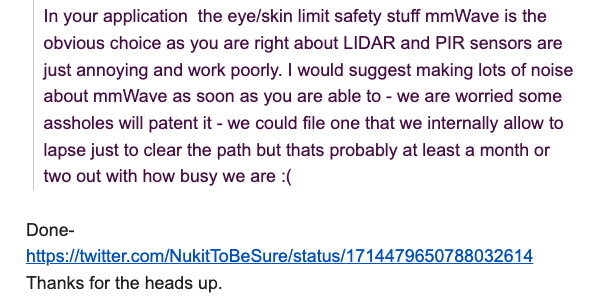
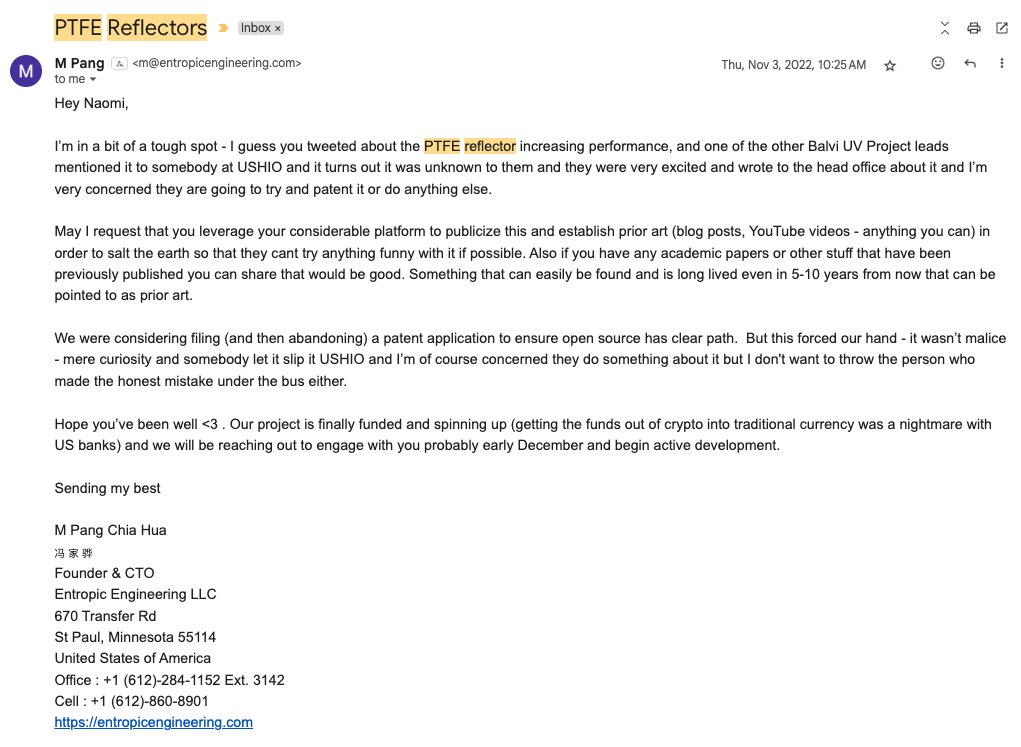
In case this seems familiar, yes, this is exactly what was done with microwave proximity sensing and PTFE reflectors:
PTFE in August 2022:
https://t.co/r77E37Ovv8
Ushio in September 2022
https://t.co/L1HhVzlJrn
Microwave proximity sensing in October 2023:
https://t.co/oXygGM2epM
And then OSLUV decided to implement it only for Ushio, with no attribution:
https://t.co/HnxH2Z6GNL
https://t.co/HnxH2Z6GNL
Every time, we show it first, then a few months later, Ushio / OSLUV / Blueprintbio pretend it is "obvious" and use it without any mention or attribution because of their discomfort with the source (see longstanding issue: It's all about merit, until merit has tits).
Although oddly enough, since we've stopped posting our "obvious" innovations, they haven't had a single original idea🤔
Of course, despite the fact that Ushio was handed the solution to their ozone problem for free, and then gifted a lengthy research study with only their emitter tested to validate it, they have shown no intention of implementing it when they can just lobby against any reasonable regulation.
There's currently a load of *expired* stock available FOR FREE at The Face Mask Store - just at the cost of shipping. Some great masks that will still be fully effective.
Several other lines discounted too.
https://t.co/9gQpvdDMqo