EU Top Diplomat Borrell:
“The existence of Ukraine depends on us. I know how to end the war in Ukraine. This can be done in a few weeks - just stop supplying. If the supply of weapons stops, then Ukraine will not be able to resist and will be forced to surrender, and the war will end. Do we want the war to end like this? I don't want to, and hopefully a lot of people in Europe don't want that either.” #Velsig #geopolitics
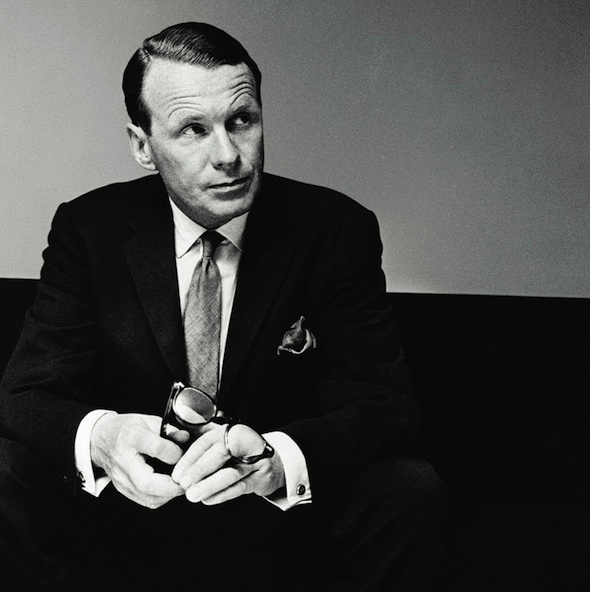
23 lessons from David Ogilvy:
1. Search all the parks in all your cities; you'll find no statues of committees.
2. The best ideas come as jokes. Make your thinking as funny as possible.
3. You are advertising to a moving parade, not a standing army.
4. Do not address your readers as though they were gathered together in a stadium. When people read your copy, they are alone.
5. Remember you are a human being writing to another human being. Neither of you is an institution
6. Tell your prospective client your weakness before they notice them. This will make you more credible when you boast about your strong points.
7. Avoiding excess in all things is a recipe for dullness and mediocrity.
8. A good advertisement is one which sells the product without drawing attention to itself.
9. There is no need for advertisements to look like advertisements. If you make them look like editorial pages, you will attract about 50% more readers
10. Big ideas come from the unconscious. This is true in art, in science, and in advertising. But your unconscious has to be well-informed, or your idea will be irrelevant
11. People who think well, write well
12. The most important word in the vocabulary of advertising is 'test'.
13. On average, five times as many people read the headline as read the body copy.
14. When you have written your headline, you have spent eighty cents out of your dollar.
15. Tell the truth, but make the truth fascinating
16. Advertising is only evil when it advertises evil things.
17. Advertising people who ignore research are as dangerous as generals who ignore decodes of enemy signals.
18. Raise your sights. Blaze new trails. Compete with the immortals.
19. I am a lousy copywriter, but I am a good editor. So I go to work editing my own draft.
20. If you're trying to persuade people to buy something, use the language in which they think.
21. Insist that due dates are kept even if it means working all night. Hard work never killed a man. People die of boredom
22. If you are lucky enough to write a good advertisement, repeat it until it stops selling.
23. At the start of your career in advertising, what you learn is more important than what you earn.
'early bird catches the worm' was huge one for me because its not 'the worm that works the hardest wins'.
Rather its about gaining an advantage by optimizing for time
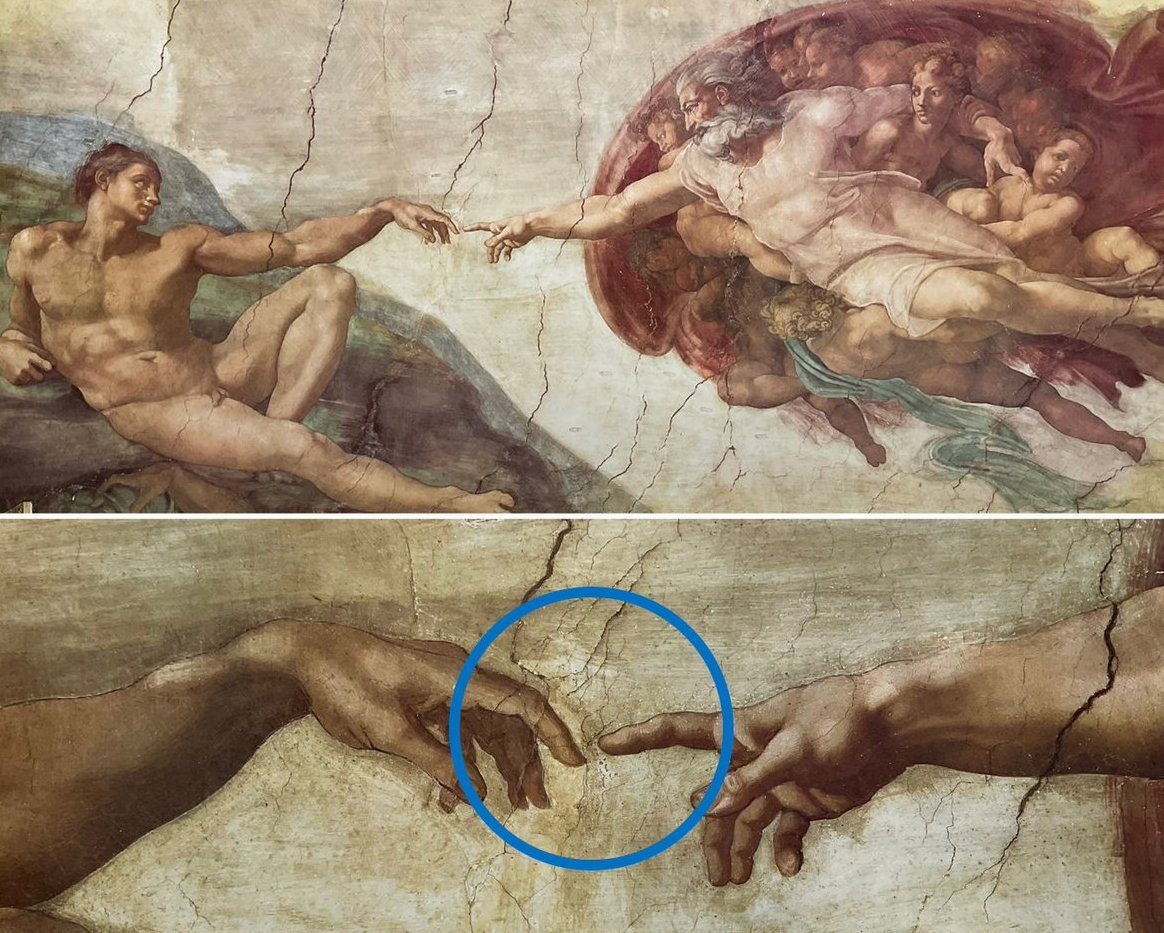
The Creation of Adam is the iconic ceiling fresco which forms a central panel of Michelangelo's magnum opus, the Sistine Chapel ceiling, completed in 1512.
It depicts the moment in Genesis when God gives the gift of life to the first man, inspired by the passage: "Let us make man in our image, after our likeness."
A now-common observation is that God reaches out through what appears to be the prefrontal cortex of an anatomically correct human brain, represented here by a crimson cloak. This was the famous claim published by American doctor Frank Lynn Meshberger in 1990.
Although Michelangelo is not explicitly known to have studied the brain, he is well known to have been a master anatomist, who began conducting his own dissections as early as his teenage years.
As the prefrontal cortex is the key area of the brain which deals with creative thinking, and because Adam is depicted already alive and conscious, it appears God is not just giving life to Adam, but bestowing upon him the gift of artistic creativity - the talent that Michelangelo believed was a divine gift to him.
In the remarkable composition, the fingers of Adam and God famously do not touch, reflecting that man can never obtain divine perfection.
But my favourite detail is that the finger of God is fully extended whilst Adam's is not. The implication - to find God, we need only reach towards him as vigorously as he reaches towards us.
In 2002 - Amazon's stock was down 95%, employees were jumping ship, and investors had completely given up on the company - Bezos stood up at our all-hands with an inspiring message: "Everyone hates our biz because it's hard, but that's exactly why I love it. Hard is our moat!"
MAKING SUCCESSFUL EXEC HIRES IS HARD
In a conversation with a Series A founder, I learnt that they are letting their Sales leader go. This one was particularly painful since this was their second Sales leader, hired after a pretty exacting process. They knew the industry and customers cold, had an outstanding track record at their prior company, and were an inspiring leader. So why the separation?
Turns out the KEY thing everyone missed during the process was that the sales leader came from a well established brand in the same space. So they and their teams were more of “order takers” at this prior company (this is over simplification to make the point), since the pull was very strong already, lubricated by the brand.
Obviously, the Series A company had a fraction of the brand the prior company did, and consequently the sales was much tougher and more challenging, and the leader was unable to adapt to a “brand unaided” motion, leading to poor execution and ultimately misses.
Founders and CEOs: when hiring executives, you can try to get everything right, but a seemingly tiny thing can torpedo their tenure. It’s hard to predict. Don’t be too hard on yourself. Ensure that you detect lack of fit within the first year, gracefully cut your losses, and make a new hire incorporating the learnings from the prior one. (One of the top startups in the Valley has hired 3 heads of product in the past 6 years, and it hasn’t impeded them in the least, so you’re not alone :))
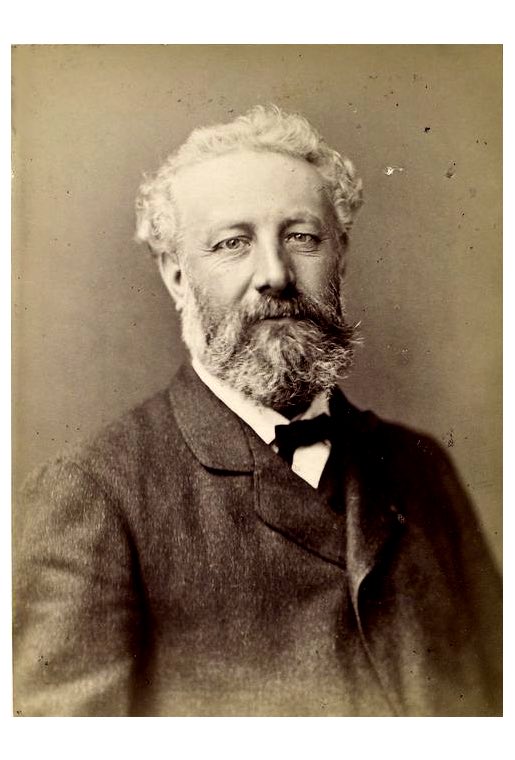
“Science, my lad, is made up of mistakes, but they are mistakes which it is useful to make, because they lead little by little to the truth.”
– Jules Verne
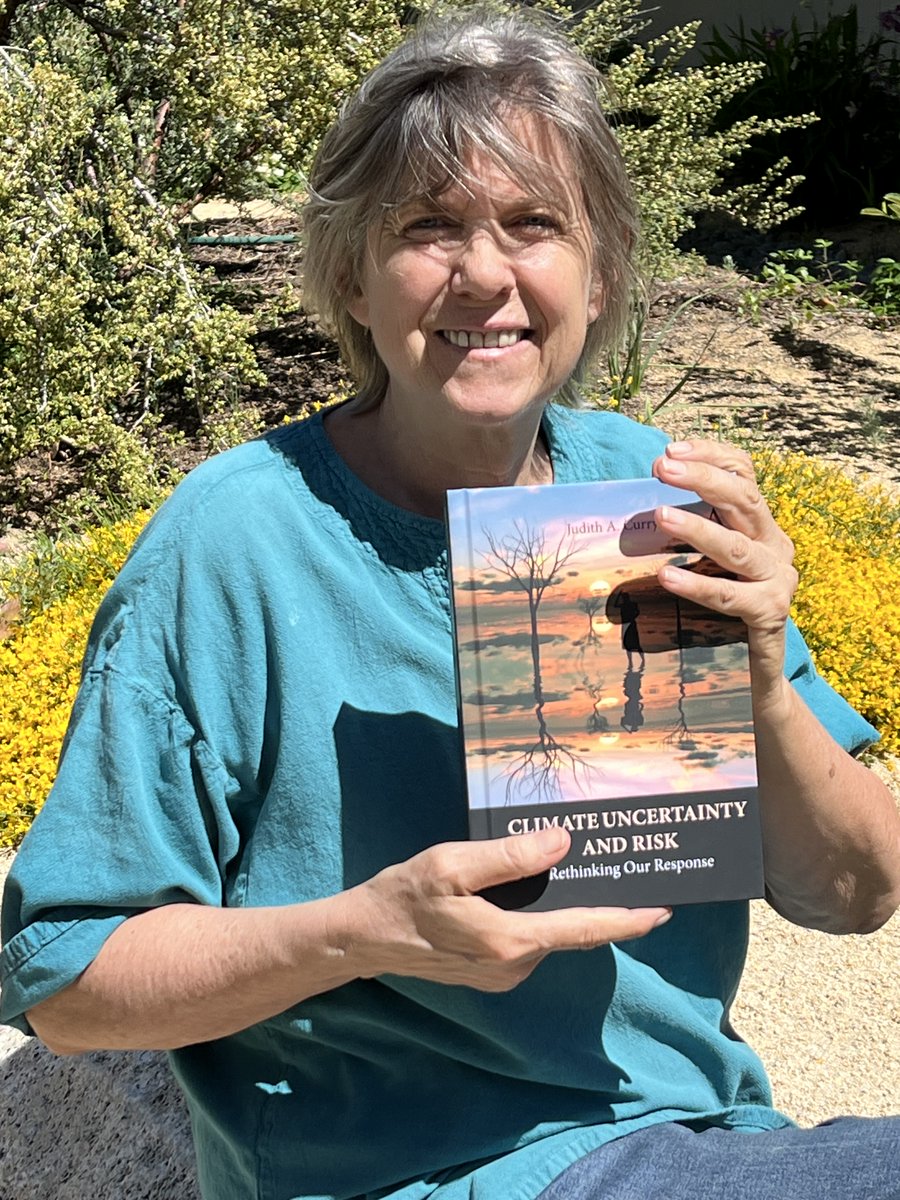
My new book Climate Uncertainty and Risk has arrived!
Early reviews:
“Judith A. Curry leverages her background in climate science, weather forecasting, and devising risk management strategies to present the climate policy debate we have never had. Her balanced, evidence-based, and multifaceted discussion leaves the reader ‘better informed as to the uncertainties and the various values in play’ in designing climate policy.”―Peter Hartley
“Judith A. Curry is one of the world’s leading scholars of climate change and a deep thinker about how science copes with uncertainty. In this refreshing and comprehensive book, she shows with meticulous care and great clarity that exaggerated claims about climate change made for political purposes are wide of the mark. Instead, she shows the way to a rational and practical discussion of this polarized topic.”―Matt Ridley
“With climate models running too hot by a factor of 2 for 30 years, with everything that used to be called a weather event now a portent of climate change, and with billions being invested against this as opposed to other more pressing world needs, Judith A. Curry provides us with a much-needed and convincing rethink.”―Michael Kelly
https://t.co/z1QUG44OQv
"I just don’t believe in anything from my past. Anything. No memories. No regrets. No people. No trips. Nothing. A lot of our unhappiness comes from comparing things from the past to the present."
@naval