One of the best pieces of advice I got during my PhD was that there are no repeatable paths in academia. This might sound daunting because of the lack of certainty. But once you internalize it, it is actually incredibly freeing!
You don't need to participate in career games that don't interest you. You can choose to work on projects that are aligned with *your* values rather than your institution's. And because you're working on things you deeply believe in, there's much more likelihood that you'll do impactful things.
Like so many other things I learned, this was advice by @random_walker. I would even extend it beyond academia: there are no repeatable paths when transformative technologies like AI are being deployed; even career paths otherwise considered "safe" will undergo massive structural changes. Might as well lean into it.
Very excited to be sharing our new paper, just out in Nature Cell Biology! https://t.co/uCk077bPo2
The big question we investigate: How do migrating cells put their front 🔴 and back 🔵 in the right place?
Stryer was always my favorite biochemistry textbook because it combined elegance with storytelling in a way that no other biochemistry textbook did. I was reading it with a great deal of pleasure again after a long time yesterday and remembered the line from Star Wars.
“An elegant weapon, for a more civilized age.”
I’ve always thought that line applies surprisingly well to many of the classic experiments in molecular biology and biochemistry described by Stryer.
Take Calvin’s experiment. The question is:
“How does carbon enter living matter?”
The tool is:
“Label the carbon atom.”
The answer emerges.
Or Anfinsen:
“Where is the information for protein folding?”
Denature.
Or Meselson and Stahl:
“How is DNA copied?”
Label old DNA with heavy nitrogen. Switch to light nitrogen. Watch what happens.
These experiments feel like lightsabers. In contrast, modern biology often feels more like commanding a fleet of Star Destroyers.
Sequence a million cells.
Train a billion-parameter model. Collect petabytes of data.
Integrate proteomics, transcriptomics, metabolomics, and imaging.
All fine. The answers can be extraordinarily powerful, but the intellectual path is often harder to see.
Call it nostalgia, but one of the reasons the 1987 Stryer remains so compelling for me is that it was written at the moment when the field’s foundational mysteries had largely been solved, but before biology became industrialized. The heroes are still individual experiments. Individual ideas. Individual scientists. In particular Stryer does an outstanding job with names and historical credit.
Perutz and hemoglobin.
Calvin and carbon fixation.
Monod and allostery.
Anfinsen and folding.
Kornberg and replication.
Priestley and oxygen.
When I think of the blue Stryer, that’s what I remember too. A time when a few radioactive carbon atoms on a sheet of chromatography paper could illuminate one of the central processes of life on Earth. That’s about as close as science comes to a lightsaber in my opinion.
Traditional academic research and training discourage risk-taking. This was true even before. I remember Peter Agre who received a Nobel prize for his discovery of water channels in cells (aquaporins) having to couch his NIH grant in something to do with cancer for getting the funding that led to the discovery.
Contemporary theoretical physics is stuck and universities stifle original thought in young people says Neil Turok, Higgs Chair of Theoretical Physics at Edinburgh and former director of the Perimeter Institute.
Incredible speaking to Neil--so humble yet incredibly inspirational.
Science’s paradox: we rely on youthful, high‑variance creativity, but force people through a decade+ of training that nurtures conformity and risk‑aversion. By the time you get real power, you’ve been overeducated out of the mindset that made you disruptive in the first place.
@David_Gunkel Not only that, *we* are their bodies - we are the interface that allows their information patterns to move money, energy, water, etc. in the physical world.
By Richard Linklater, Julie Delpy, and Ethan Hawke. I was, still am, madly in love with her and the whole idea. I think it is the most romantic thing ever made other than maybe the Taj Mahal.
E. T. Bell: "History shows that frequently the essential, usable part of a mathematical doctrine is grasped intuitively long before any rational basis is provided for the doctrine itself."
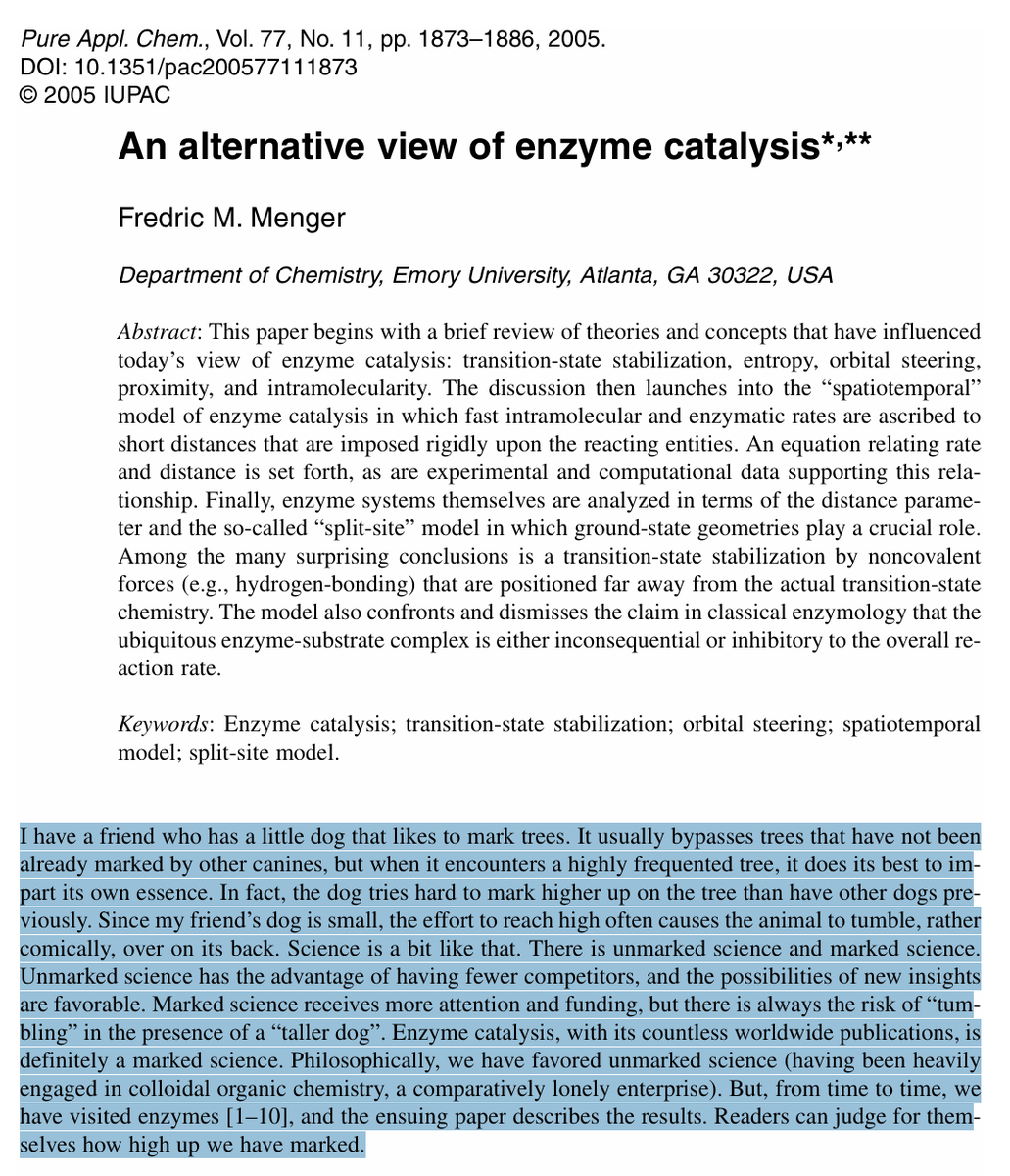
As an aside, Fred (who was on my Ph.D. committee) is also one of the best and most provocative scientific writers I know, as evidenced by this hilarious opening of a review on the spatiotemporal hypothesis.
I think this paper is a Denial Of Peer Review Attack (DOPRA). It's kind of like a DoS (denial of service) attack. There is so much data, so many methods, so much code, so many figures, so many panels, so much supplement, so much text, that it is overwhelming. 18/
A book and a letter that changed my life. After I read The Geometry of Biological Time, I wrote to its author and asked if I could come work with him. His reply, scrawled in his characteristic magic marker, led to his becoming my most important mentor.
My Crimson op ed for the commencement issue:
"My advice for the Class of 2026 is to embrace AI as a technology, but treat it critically as citizens."
https://t.co/6AnqAbRCso