How? By filing cases under the "Atrocious" Act against erudite professors in premier institutions for preventing "young talent" from cheating in examinations.
New cat alert! A call from a wildlife sanctuary about a "weird cat" has led to the first new cat species discovered in over 100 years in Bolivia’s Yungas forest ecoregion. Learn more about this feline surprise: https://t.co/crffXvPqH4
The most expensive part of a hospital bill may never touch the hospital at all.
A patient admitted for care has no way of knowing whether the price on a medical consumable reflects its actual cost or a markup fixed long before it ever reached the ward. That gap in information is, at its core, a public health issue.
A survey of hospital consumables in Maharashtra found an IV infusion set with a trade price of ₹11.05 carrying a printed MRP of ₹325 ; a markup of 2,841%. A syringe procured at ₹6.75 carried an MRP of ₹57.20. A catheter procured at ₹29.41 carried an MRP of ₹310.
These are not elective purchases. Patients cannot compare prices, seek alternatives, or question a number printed on a box while receiving care and the MRP itself is often fixed upstream by manufacturers and distributors, disconnected from the trade price by a wide, unexplained margin. The result is a system where the party bearing the cost has the least information to evaluate it.
The regulatory gap is structural: scheduled medicines are capped under the Drugs (Prices Control) Order, 2013. Most medical devices and consumables are not leaving both the pricing and the information around it almost entirely unmonitored.
A review of these findings and clear guidelines on the permissible gap between trade procurement price and declared MRP have been recommended to the Department of Pharmaceuticals and the NPPA ; a step toward closing not just a pricing gap, but the information gap patients are left to bear alone.
#PublicHealth #GoodGovernance #Leadership #TukaramMundhe
https://t.co/Ye9CVzr8qU
India mein koi 5 minutes number Google kar le to doodh ka doodh paani ka paani ho jaye.
RBI surplus to Govt : ₹2.87 Lakh Crores (US$30 Bn)
Total listed bank profits : ₹4.11 Lakh Crores (US$42 Bn)
NPCI - which runs UPI pre tax ‘surplus’ : ₹ 1,888 crores (US$200 Mn)
To nuksaan kis ka ho raha hai UPI se aur kaunsi subsidy de rahi hai Govt UPI pe jo chubh rahi hai?
Cost of running ATMs and cash logistics in India is ₹30,500 crores (US$ 3.0 Bn). If you want to optimise shut ATMs and promote UPI instead.
Any levy on UPI is just tax collection. UPI is the one scientific achievement of India everyone acknowledges par ab tax ki bali chadhegi.
A few years ago, my TV interviews would usually happen at 12 PM, 3 PM, or 4 PM, when not many people were watching.
The prime 9pm TV news was usually focused on politics, bollywood, cricket. Not many people were interested in listening about food safety.
But today, food safety has finally become an important issue for India, and now I’m regularly invited on prime time at 9 PM to talk about it.
When I started Food Pharmer, I just wanted Indians to read food labels and question what they eat. So I’m very proud to see food safety becoming a national conversation finally.
Because the more Indians talk about food safety, the harder it becomes for companies and the system to ignore it.
This is just the beginning of India’s Health Revolution.
Let’s Make India Healthy Again!
"DO YOU THINK YOU'RE A LORD?"
BOMBAY HC asks Mundhe as it set aside the orders issued by the Maharashtra FDA department suspending the food licenses at outlets of the Mumbai Cricket Association's (MCA) BKC premises.
BUT WHAT'S WITH THE CONDESCENDING TONE?
Must milords fire barbs when reason will do?
How much of India’s Defence Sector has grown since 2014?
- 100%of Defence Industrial Corridors
- 100%of Defence Startups
- 100% of IAF-Ready Highways
- 100% of Long-Range Air Defence Systems
- 99.2% of Defence Exports
- 75.4% of Total Defence Production
- 75% of Defence Export Destinations
- 72.7% of Women Defence Officers
- 70.1% of Defence Expenditure
- 66.7% of Private Defence Production Share
- 60.2%of Naval Vessels
- 56.8%of Defence Capital Expenditure
India’s defence capabilities have been built over decades.
But some decades have added more than others.
Gen Z, Millennials, and Boomers everyone should stand against this duopoly of Airtel and Jio.
TRAI or the government do nothing, we have to raise our voice.
🚨 @airtelindia & @reliancejio please launch a truly affordable/low cost Voice + SMS only Monthly recharge plan with ZERO internet data.
Not everyone needs daily data. Many poor, low income, senior citizens and basic keypad phone users mainly need calling and SMS.
Example - Start With 100Rs Plan
💬Comment & Repost if You are agreee with this proposal 🇮🇳👍
#Airtel #Jio #Recharge #Telecom #India
I binge-watched Operation Safed Sagar over the weekend.
And I want to say thank you to everyone who had a hand in making this series & to Netflix for commissioning it.
For many reasons…
Because, despite some reviewers cribbing about inconsistent CGI & performances that could have been better, I found the actors competent and credible. More importantly, I was moved and inspired by the story & the emotions underlying it.
Because I wish that, when I was growing up, we had had more films like this, recording the feats of our armed forces in the many conflicts we have experienced, in a gritty and convincingly realistic manner.
Instead, we grew up on a diet of Hollywood war movies which, despite often taking enormous liberties with historical accuracy, helped build American pride & self-belief while we watched as envious bystanders.
Because, even though I knew a great amount about the courage of soldiers like Vikram Batra and the role of the Bofors gun in Kargil, I confess I knew far too little about the critical role played by the Indian Air Force.
And I certainly didn’t know that, apart from extraordinary valour, Operation Safed Sagar showcased the ingenuity & rapid improvisation that we now celebrate as a hallmark of Indian innovation.
The IAF acquired handheld GPS receivers, put them into MiGs & used them to calculate release points for ordinary “dumb” bombs. They conducted hurried trials, initially got disappointing results, refined the technique within a handful of sorties & took it into combat almost immediately.
The Mirage story, dealt with more briefly in the series, was equally remarkable. The IAF had Mirage 2000s, Israeli Litening laser-designation pods and Paveway II guidance kits, but had not yet turned that combination into an established combat capability. When a required component could not be obtained from abroad due to the 1998 sanctions, IAF technicians displayed what I call ‘denial-driven innovation’ & engineered the solution themselves!
So at a time when we are debating whether human intelligence will increasingly become a slave to machine intelligence, it’s incredibly valuable to be reminded that even in battle, where decisions are made in seconds & lives depend upon them, it’s ultimately the humans behind the machines who make the difference.
I hope as many people as possible watch this series.
Because when the men and women of our armed forces know that we know their stories & remember their sacrifices, they also know that their courage will not be forgotten.
The heroes of Operation Safed Sagar are my #MondayMotivation.
With a special salute to Squadron Leader Ajay Ahuja. 🇮🇳
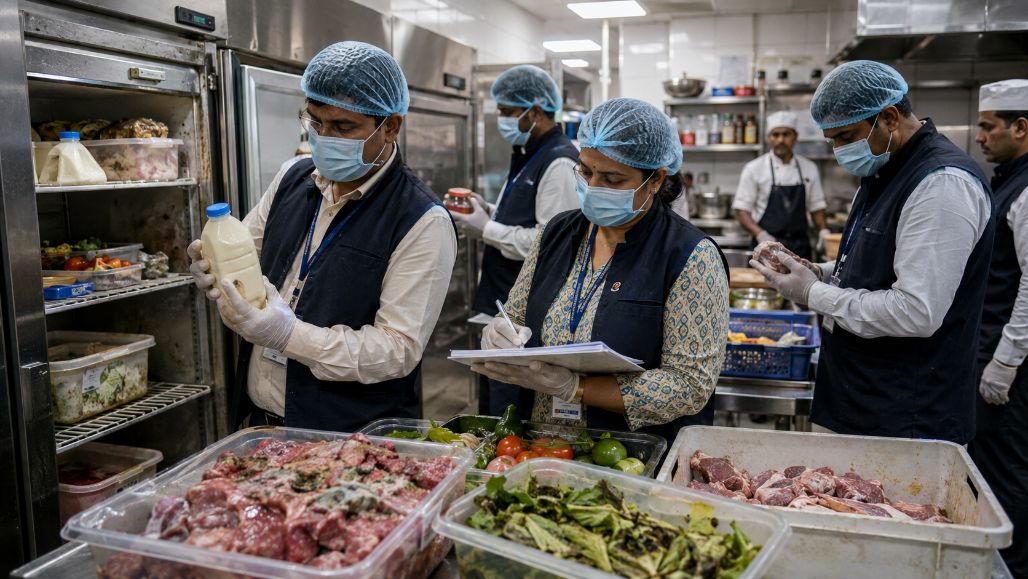
🚨 Bengaluru’s 5-star hotels and resorts, including Four Seasons and Shangri-La, were found with expired milk, rotten meat, and fungus-covered vegetables. 🙏
- At The Lalit Ashok (Annex South), officials seized and destroyed 76 kg of meat, 200 kg of vegetables, and 32 liters of expired milk.
- At Shangri-La, 15 kg of meat were seized.
- At Four Seasons Hotel, officials confiscated 19 kg of meat.
- At Vivanta Bengaluru Whitefield, three kg of expired bakery products were destroyed.
- At Taj Yeshwantpur, officials seized 72 kg of meat and fish.
- At Radisson Blu (The Atria), authorities seized and destroyed 105 kg of expired food articles.
From 2004–2014, many emerging economies rode a favourable global cycle to rapid growth.
India, despite operating in a relatively stable international environment interrupted mainly by the 2008 financial crisis, failed to translate its demographic and economic potential into economic leadership.
From 2014–2026, India emerged as the G20's fastest-growing major economy while navigating a far more turbulent world shaped by the pandemic, inflation, fractured supply chains and geopolitical conflicts.
The "lost decade" was not defined by difficult global conditions.
It was defined by India's inability to convert a favourable global environment into sustained economic leadership.
The following decade demonstrated that stronger leadership can deliver high growth even in an era of persistent global disruption.
@MeghUpdates Prices spiked around the world during 2021-26 by more than 40-50% thanks to war but india remains the only country where prices showed modest spike ( 8%)
@DhurandarBhai@MeghUpdates Prices spiked around the world during 2021-26 by more than 40-50% thanks to war but india remains the only country where prices showed modest spike ( 8%).