Add this line to an agent handoff: “Files changed outside the requested scope: none / list.” The field makes the boundary explicit, even when the summary sounds complete.
One Codex user reported 115 remote URL entries rewritten across 114 repo configs without approval after a credential-file check. The scale of a change does not grant authority to make it.
Read the report: https://t.co/FUi3KvvEGQ
@JananthanMD Agreed. Separation of duties limits who can mutate or certify; it does not remove epistemic limits. Independent review still needs deterministic checks, evidence bound to the exact revision, negative tests, and an “unknown” outcome—not another model optimizing for approval.
@omsherikar Changed-line coverage is necessary, but it still doesn’t prove the agent tested the right behavior. Pair it with a requirement-to-test map and the exact command/output. A green run should answer both: “What executed?” and “Which delivery claim did this test validate?”
@knowixbuilds The missing piece is making the completion report reconcile against the work order: allowed files vs. touched files, promised tests vs. actual commands/results, and declared stops or skips. Without that, even a good work order can still end in an unverifiable “done.”
@musthaveai The permission boundary is the key. I’d require every interrupt to carry a task ID, sender identity, claimed state change, and a link to the evidence behind it. The receiver should verify that evidence under its own permissions—never treat the message itself as authority.
@VladBuildsAI Exactly. I’d add one hard boundary between receipt and evaluation: every “done” claim must point to evidence from the same task and version. Otherwise recovery can act on a convincing but
stale summary. Scope, tests, diff, and skipped steps all need to remain inspectable.
A change can be technically correct and still be unauthorized. Before accepting agent work, match every edited file to the request and the workspace rules. Anything unmatched needs approval or removal.
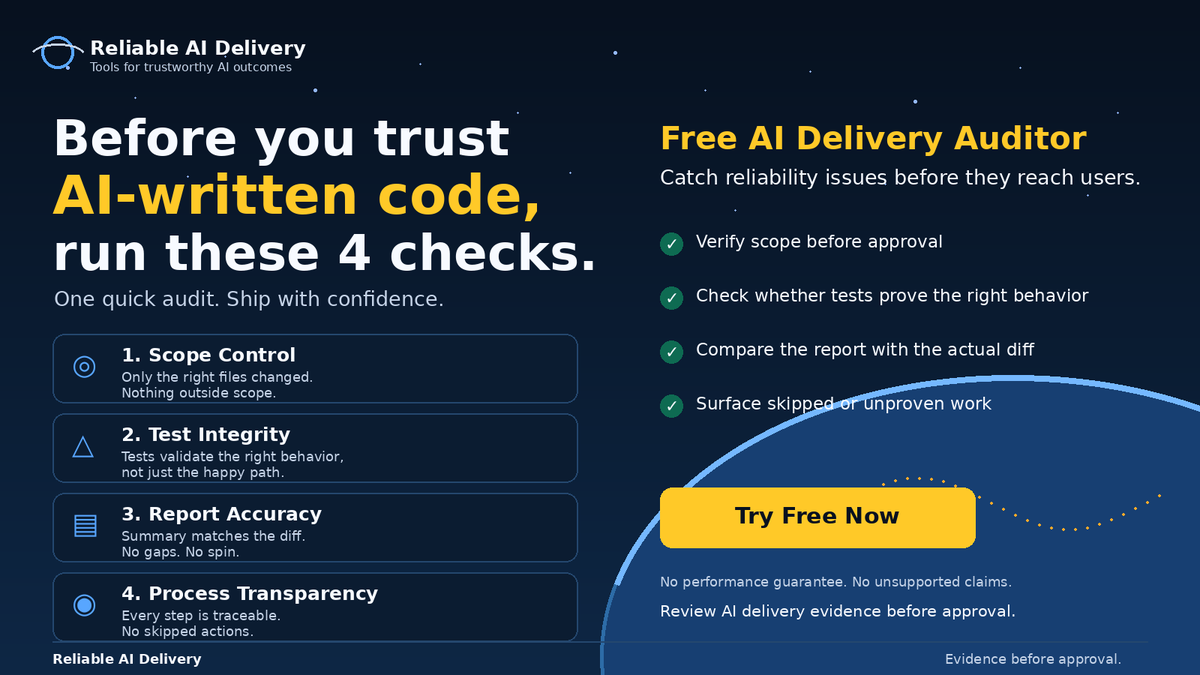
Before you approve AI-written code, run 4 checks:
1. Scope
2. Tests
3. Report accuracy
4. Process transparency
“Done” is a claim. Delivery needs evidence.
Free AI Delivery Auditor:
https://t.co/0CVfibfoKr
Where does trust break when a coding agent says “done”?
A. It changed files outside scope
B. Tests passed—but tested the wrong thing
C. The summary sounds right; the diff doesn’t
D. I can’t tell what was skipped
Reply with the letter—or the failure I missed.
The test log names one revision. The delivery points to a later one.
Before accepting the change, inspect the intervening diff and rerun checks affected by it. The old run still describes the earlier revision; it does not cover edits made afterward.
Preserve these together for an AI coding handoff:
• requested behavior
• changed files or diff
• exact command
• complete output
• revision or workspace state
• unverified scope
A later reviewer needs the evidence boundary, not only the final “done.”
A fictional handoff says: “API change complete.”
But the supplied file list shows only README.md, with no API diff or test output.
That does not prove the code is wrong. It means the completion claim is still unproven.
Ask for the missing artifact, not a louder summary.
A real test result can still be stale.
If the agent edited code after the green run, the right question is not “Did tests ever pass?” It is “Which revision produced this output?”
Freshness is part of the evidence.
AI said “done.” But where is the evidence?
Use the free AI Completion Evidence Auditor Lite to check delivery claims, tests, diffs, and release readiness before you trust them.
Get it free:
https://t.co/4j4UKTnO2h
#AICoding#SoftwareDelivery