The work produces daily immunity indices for each regional location, given vaccination and infection data for different infectious diseases, which in turn can be used to, e.g., predict the spread of disease.
Ferdous Nasri presenting her work on the 'Spatio-temporal immunity index tool for infectious diseases' at the Digital Health Summit @UCT_news in Cape Town, South Africa!
Happy that I had the honour of presenting my work at the Digital Health Summit in Cape Town, and got the chance to get into great discussions with researchers on the continent!
Thanks to @ictdchick for organising the summit and bringing us all together 💐
With an ablation study, we demonstrated the added value of information derived from clinical notes not only for the computable phenotyping, but also the disease prediction task.
🧵 6/6
New paper: Electronic Health Records-Based Identification of Newly Diagnosed Crohn’s Disease Cases
By @SusanneIbing , @JulianHug0, et al., now available in Artificial Intelligence in Medicine.
https://t.co/omYRBfV3hh
🧵 1/6 Thread below:
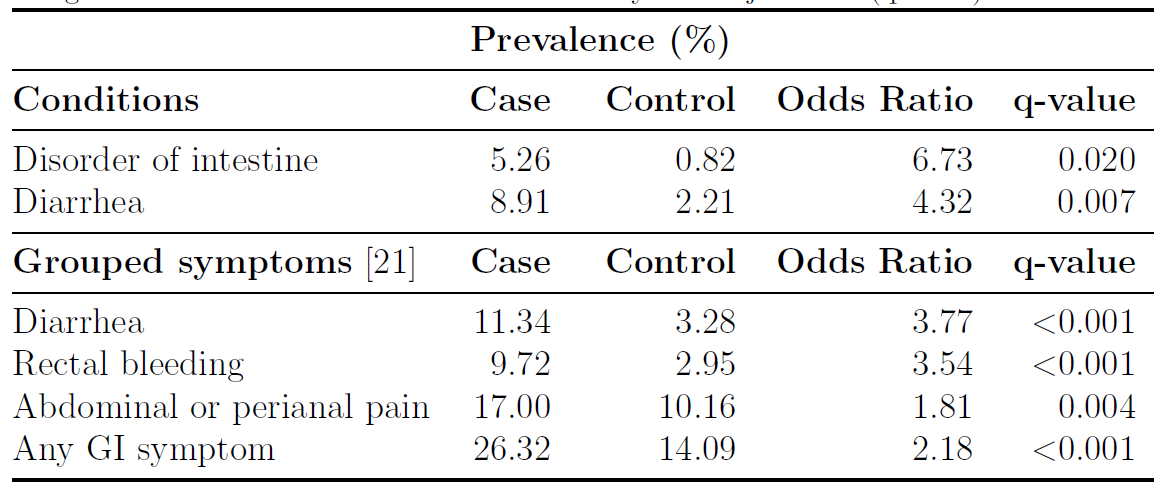
When comparing coded conditions between identified cases and controls, we saw significant overrepresentation of GI-related conditions in cases, indicating the diagnostic delay of the disease.
🧵 5/6
Check out “Electronic Health Records-based identification of newly diagnosed Crohn’s Disease cases”, a new paper from HPI·MS PhD student @SusanneIbing, Masters graduate @JulianHug0, and collaborators, now available in Artificial Intelligence in Medicine.
https://t.co/supqwRrpMe
... and that's a wrap from our group at #ECCB2024!
Thank you and congratulations to @EloLab_fi, @nyronen and
the organising teams for bringing together such a great conference!
Looking forward to the next @ECCBinfo 🚀
Our collaborator Alexander Rakowski presented „Metadata-guided Feature Disentanglement for Functional Genomics“ @ECCBinfo#ECCB2024
Check out the proceedings paper: https://t.co/X0G4zb5ftL
They show that feature driving the mean prediction of low-density lipoprotein cholesterol considerably differ from the features driving aleatoric uncertainty. This highlights the value of uncovering hidden factors behind predictive uncertainty.
Simon Witzke presenting his poster @ECCBinfo! #ECCB2024@witsyke and @Iv_Pascal recent work in explaining aleatoric uncertainty in regression can help increase transparency in digital health.
Towards connecting deep learning and ODEs: We present a framework to optimize synthetic dataset characteristics for time series forecasting in biological systems.
Meet @JulianZabbarov at poster 188, today from 5-6:30pm @ECCBinfo. #ECCB2024
We proudly present PEPerMINT @ECCBinfo#ECCB2024, a new deep learning method for replacing missing peptide measurement values for improved downstream analyses!
https://t.co/vj9ZLs8nnp
#DeepLearning
PEPerMINT is based on a graph neural network structure and also leverages amino acid sequence embeddings.
It is a joint project with the labs of Katharina Baum, Sukrit Gupta (@YoSukrit) and Hanno Steen (@steen_lab).