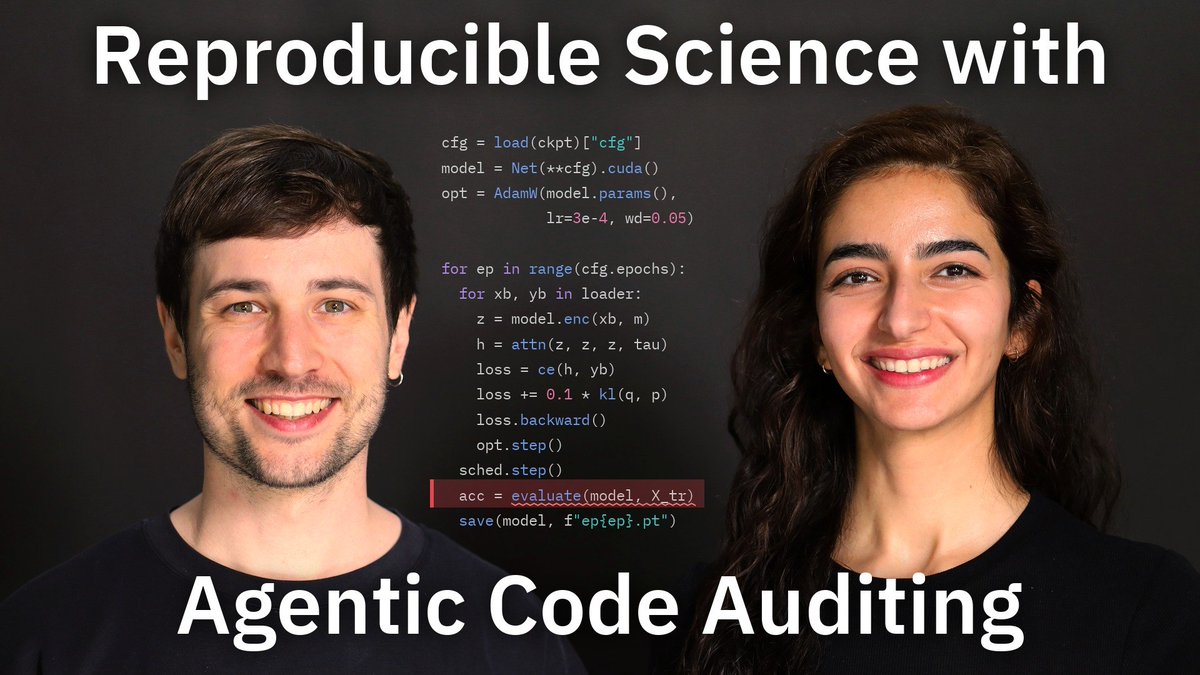
Our work on automating scientific code review using agents received the Best Paper Award in the NeurIPS 2026 MLRC Track 🥹
Big thanks to my co-first author @ferbsx, our supervisors Katharina Baum and Bernhard Renard, and the MLRC organizers @repro_challenge
Meet us in Sydney! (Our talk is on Thursday, December 10, in Room C3.2: 9:45)
Intense moment at MLCB when @jmschreiber91 tells an audience of MLCB presenters that half of the presentations were Claude slop:
https://t.co/XuInwuzz09
He argued for what I think should be a tautology: science communication should stay in the hands of … scientists.
New Bitter Lesson for computational biology: no amount of computational power (or intelligence) can offset datasets that are too small, noisy, confounded, and biased.
@schlimmerrick Da liegst du falsch. Es sind dann ungepaarte Stichproben, und damit ist die Teststärke geringer, aber bei so einer großen Stichprobe sollte das kein Problem sein. Fast jedes Randomized Controlled Trial läuft so.
Does the code match the paper's claims?
We audited 100 NeurIPS 2025 papers with an LLM agent pipeline. Only 8% fully traced their findings to code, and we flagged 609 discrepancies.
Now in TMLR, and @Iv_Pascal & I will present it at NeurIPS in Sydney!
https://t.co/wxyTQymxNy
@kserrec@cremieuxrecueil They are everywhere in the training set, marked as intended bullshit. It would recognize it. You have to write a new hoax paper :)