Patients with rare diseases need better access to lifesaving treatments.
At the Cleveland Clinic, @CMSGov and the @FDA announced coordinated action to cut red tape, lower costs, and expand access to cell and gene therapies.
Innovation only matters when it reaches patients.
Great post by Tanita!!
"There is something powerful about standing in a room and telling the truth about what it means to live with Huntington’s disease (HD). Every time I share my story, I am reminded that advocacy is not just about speaking. It is about being seen, making space, and helping change"
https://t.co/fzPqke6e1Q
@mahesh_shenai, Although we have never met, I addressed Dr. Mallika Mundkur at the @FDA's CNPV public meeting, whom I understand is your wife.
After reading nearly 20 of your posts concerning Huntington’s disease (HD) and AMT-130, I have to ask: Are you evaluating the totality of the evidence, or predominantly searching for reasons to discount it?
You repeatedly express hope that you will someday treat Huntington’s disease patients. But how much direct experience have you had with our community? Have you spent meaningful time with symptomatic patients across disease stages, witnessed their progressive neurological decline, or spoken with families about their risk tolerance?
I ask because I have.
HD has devastated three generations of my family. My grandmother died after years of suffering. Her chorea was so severe that she wore padded mittens for nearly four years to prevent her involuntary movements from dislodging her feeding tube.
I was nearly my daughter’s age when my grandmother developed symptoms. Now both my daughter and son are watching their grandfather and aunt experience the same disease. My father is in the middle stages of Huntington’s disease, while my aunt is further along in its devastating progression. As a mother, I live with the painful reality that my children may one day witness this same deterioration in me—or, even more heartbreaking, experience it themselves.
What I witnessed as a little girl, my children are witnessing today. Different generations, the same devastating cycle we are desperately trying to break.
The psychological consequences are equally profound. A fellow Michigander and HD advocate recently lost her father to suicide. Another Michigan chapter board member nearly lost her niece, and several HD friends have lost loved ones to suicide. Suicide risk among people with Huntington’s disease is substantially higher than in the general population.
Why? Imagine caring for someone you love while witnessing years of relentless neurological deterioration, all while knowing you could face the same fate. And even if you escape inheriting the mutation, you may carry the lifelong burden of survivor’s guilt as those you love continue to suffer. This is the profound, multigenerational trauma of Huntington’s disease.
More than 40,000 Americans live with HD, and over 200,000 are at risk. Those figures do not include the countless caregivers and relatives whose lives are also affected.
Your anecdote about a surgeon with another movement disorder reinventing his professional life was particularly revealing. When I read it, I immediately questioned your firsthand understanding of HD.
HD does not afford patients the luxury of simply reinventing their lives. It progressively damages the brain circuits responsible for cognition, judgment, behavior, movement, and independence. Symptoms can worsen over 10–25 years, gradually taking away the ability to work, communicate, maintain relationships, swallow, walk, talk, and care for oneself.
The ability to reinvent one's life requires precisely the neurological capacities HD progressively destroys. HD takes away the ability to meaningfully participate in life altogether.
The 2024 HD Symptoms and Treatment Impact Survey found that nearly three-quarters of respondents would accept treatment risks for five years without progression, while approximately 35% would accept risks for even three years.
Three more years raising children. Five more years working, communicating, remembering, and living independently. More birthdays, graduations, and time with family.
Then consider the economic consequences of inaction. Over 10–25 years, HD families will face neurologists, psychiatrists, hospitalizations, expensive chorea and psychiatric medications, physical and occupational therapy, speech and swallowing therapy, mobility equipment, home modifications, specialized residential care, and eventually around-the-clock assistance.
HD removes two people from the workforce: the patient and the family member who becomes their caregiver. Families lose wages, insurance benefits, retirement savings, and years of financial security. Many conventional care facilities lack the specialized neurological and behavioral resources required for HD, leaving families with limited options.
These costs accumulate across households, employers, Medicare, Medicaid, disability programs, and society.
When evaluating the risks and costs of treatment, why is the cost of inaction so often treated as though it were zero?
If AMT-130 meaningfully preserves independence, the potential economic and societal benefits deserve consideration.
You have described yourself as one of approximately 80 U.S. neurosurgeons with expertise relevant to this procedure. If AMT-130 does not meet your personal threshold for clinical adoption, that is your judgment. But your threshold is not the FDA's regulatory standard, nor should it determine the choices available to every informed patient and qualified physician.
Other neurosurgeons may recognize the broader significance of this investigational gene therapy. If its clinical benefits are confirmed, AMT-130 could help transform how we approach inherited neurodegenerative disorders beyond HD.
Regarding surgical risk, stereotactic neurosurgery has been performed in humans since 1947. Trial experience suggests the procedure has generally been tolerated.
But the question is not whether neurosurgery carries risk. It does. The question is whether those risks are acceptable relative to the potential benefit for patients facing a progressive, fatal disease without an approved disease-modifying treatment.
Your professional risks and our personal risks may look entirely different.
For you, this is a discussion of procedural complications, evidence, and professional responsibility. For us, it is progressive neurological deterioration, dependency, and premature death.
The reported AMT-130 findings, including favorable Total Functional Capacity trajectories compared with external controls, deserve serious consideration. TFC measures employment, financial management, domestic responsibilities, daily living, and care requirements. It measures the independence HD progressively takes away.
Scientific skepticism is essential, but it must be applied symmetrically.
Our community has also been wounded by regulatory rhetoric. @VPrasadMDMPH, your wife’s former boss, recently compared patients pursuing unproven treatments to a drowning person reaching for a blade. Regardless of the intended scientific warning, such language risks reducing informed, deeply personal benefit-risk decisions to acts of desperation, overlooking the devastating consequences patients and families face without treatment.
Our willingness to accept uncertainty is not desperation. It reflects a rational understanding of what HD will otherwise take from us.
Imagine watching someone you love progressively lose the ability to think, communicate, walk, swallow, or even recognize the people they love most. Now imagine living with the knowledge that the same devastating disease could one day affect you, your children, your siblings, or generations of your extended family. This is the reality of Huntington’s disease.
What would a few additional years together mean? What would you do to break the cycle?
I am not asking you to abandon scientific standards. I am asking you to recognize that the consequences of waiting are as real as the risks of treatment.
The absence of treatment is not the absence of risk. It is continued disease progression, escalating dependency, enormous psychological and economic suffering, and irreversible neurological loss.
You may see an investigational neurosurgical procedure that has not met your preferred evidentiary threshold. We see a potential opportunity to preserve the ability to think, communicate, work, love, and remain present in our families' lives.
We are asking for scientific judgment that accounts for the full reality of Huntington’s disease.
P.S. Go Blue! 〽️💙💛
#HuntingtonsDisease
#RareDisease
Remember when pedro was buying this piece of shit for $700M USD. The glowup in other assets will probably be similar @spikesharvey
Some will hopefully be felt globally
I can’t bear to watch these videos of people suffering from Huntington’s. Painful memories of a loved one destroyed by seizures. $QURE might be run by scientists, certainly not salesmen, but they had better become storytellers. Speed kills & speed saves, hurry up, time is short
you can either look at a mortgage as a bank letting you long real estate against a perpetual devaluing dollar for a carry cost slightly above the risk free rate of return, or you can choose to be ignorant of how money works, if you spiritually have the mind of a medieval peasant
Matt has really excelled at the whole “not shooting himself in the foot“ issue. However, as the CEO, the rubber is now meeting the road. We need him out there being promotional, being a cheerleader, and educating the masses.. It’s like he was an afterthought on that Guggenheim call. Once again, this might be part of an overall strategy, but the times they are a changing
@adamfeuerstein@kevin__mak I am no one of consequence, but @adamfeuerstein I don’t see any of this as your fault. You are doing your job as a reporter and followed the embargo to the letter. This falls on $QURE and their comms choices.
@cagrimbakirci I have never heard of you but I really appreciate you providing your 2 cents and what seems like your considerable twitter following and weight. Liked and followed. 🫡 I will now be following your career with great interest.
🚨 AMT-130 FOUR-YEAR DATA: Before you panic over “75% → 44%,” we need to talk about SURVIVOR BIAS.
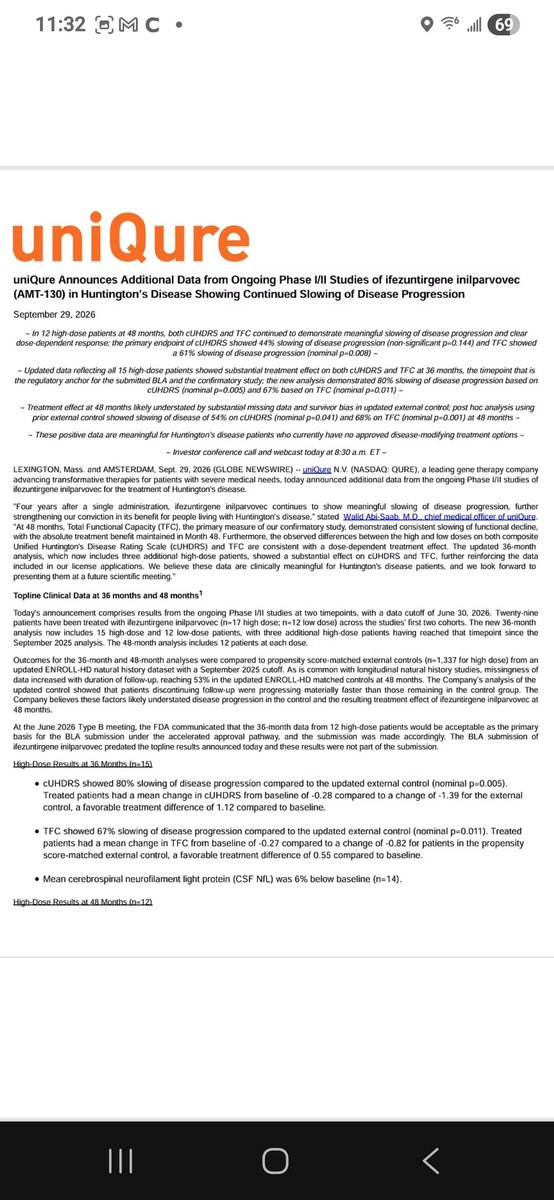
uniQure released its four-year AMT-130 data today.
You're probably going to see headlines focusing on one number:
At 48 months, high-dose AMT-130 showed 44% slowing of disease progression on cUHDRS compared with the updated ENROLL-HD natural-history control.
That result was not statistically significant.
But that is NOT the entire story.
One of the most important numbers in today's release may actually be this:
53%.
By four years, 53% of the matched ENROLL-HD control data were missing.
And uniQure reports that the patients who stopped providing follow-up data were progressing materially faster than the patients who remained.
Why does that matter?
Imagine following 100 people with HD.
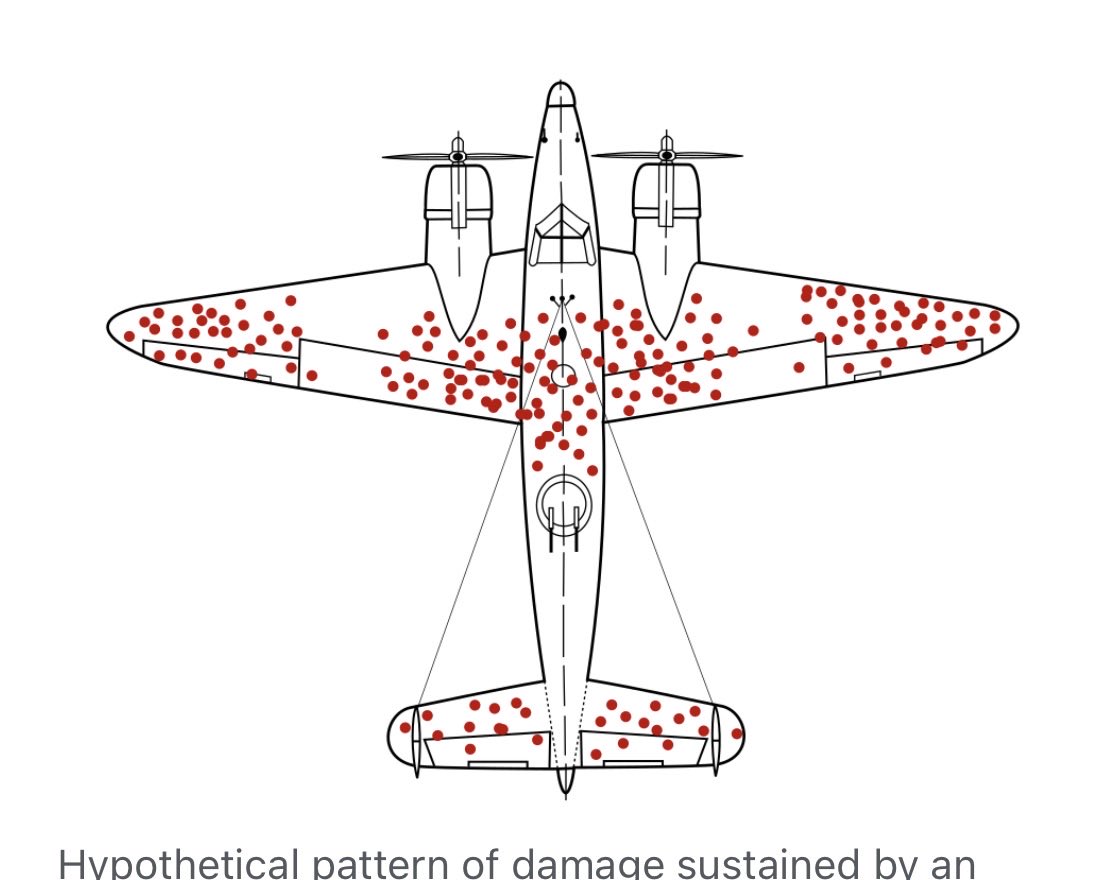
Over time, the people progressing fastest become less likely to remain in an observational study — traveling gets harder, disability increases, participation becomes more burdensome, etc.
Eventually, the people remaining in your dataset disproportionately represent those progressing more slowly.
If you only look at who's left, it can make untreated HD appear to progress more slowly than it actually does.
That's survivor bias — or, more specifically here, bias caused by non-random loss to follow-up.
And when that group is your comparison for AMT-130, it matters enormously.
Simple example:
Treated patients decline 1 point.
Untreated patients decline 4 points.
➡️ 75% slowing
But imagine survivor bias makes the untreated group appear to decline only 2 points.
The treated patients STILL decline exactly 1 point.
Now the calculation says:
➡️ 50% slowing
The treated patients didn't change. The comparison did.
That's why saying simply, “AMT-130 dropped from 75% slowing to 44% slowing” leaves out an enormous part of the story.
A few other important findings from today:
🔹 48 months — high dose
cUHDRS: 44% slowing (p=0.144; not statistically significant)
TFC: 61% slowing (nominal p=0.008)
🔹 When the SAME 48-month patients were compared with the previous ENROLL-HD control:
cUHDRS: 53.5% slowing (nominal p=0.041)
TFC: 68.3% slowing (nominal p=0.001)
🔹 Updated 36-month data — now 15 high-dose patients
cUHDRS: 80% slowing
TFC: 67% slowing
And importantly, the four-year data continue to show a dose-response pattern, with the high-dose group declining less than the low-dose group.
None of this means survivor bias automatically explains everything we're seeing at year four. We need to be careful about making that claim.
But it DOES mean the 44% number cannot be interpreted in isolation.
The percentage of “slowing” depends on BOTH sides of the equation:
How the treated patients are doing AND how the comparison group is doing.
If the faster-progressing people disappear from your natural-history dataset, your comparison group starts looking healthier — and the apparent treatment effect gets smaller.
So please don't let a headline tell you that AMT-130 suddenly “stopped working.”
The four-year data are more complicated than that.
And for a progressive disease like Huntington's, understanding who is missing from the data can be just as important as understanding who is still there.
#HuntingtonsDisease #AMT130 #TimeMatters
1. That probably breaches HIPAA compliance 2. These people are suffering from an egregious and debilitating disease and have the right to do so on their own terms, in private. 3. These people could be deceased or non ambulatory. Unfortunately there is no way to rate their decline
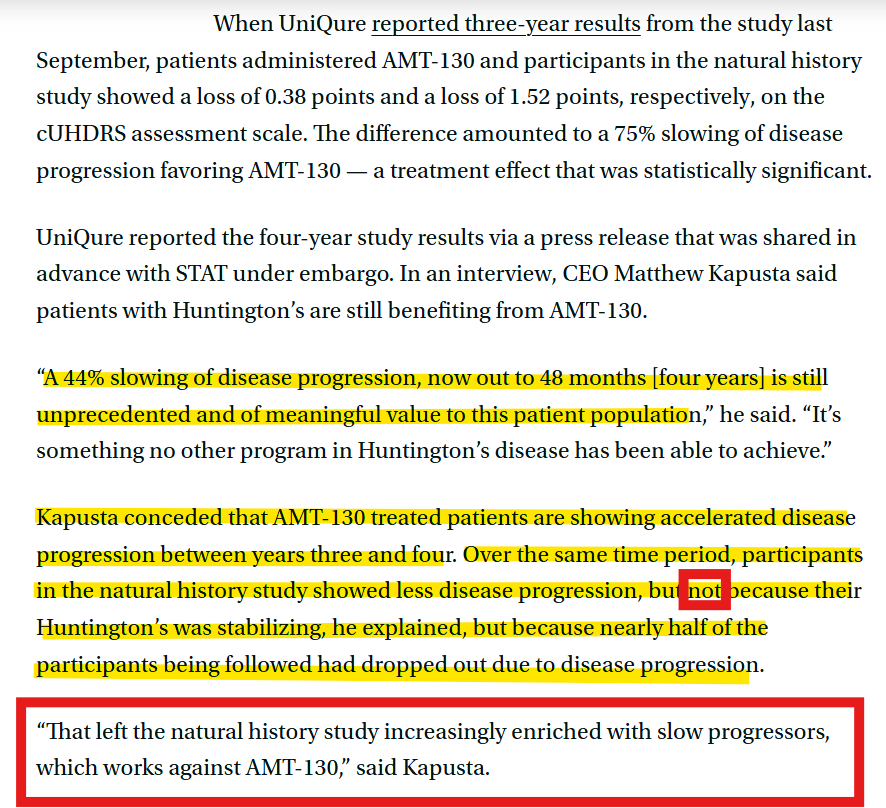
“53% of enroll HD control group dropped out due to disease progression at 48 months” #QURE is comparing its clinical patients against the healthiest of who remain in the control pool. Those who left the control group did not leave voluntarily.