Can male cells make eggs? Prof. Katsuhiko Hayashi, of the University of Osaka, spoke at Reproductive Frontiers 2026 about converting male cells from XY to XX for oogenesis, and building ovary-like organoids from nothing but stem cells.
YouTube link in reply. ⬇️
Timestamps:
00:00:00 Intro
00:01:00 In vitro gametogenesis: why make eggs and sperm from stem cells
00:03:14 Primordial germ cells in a dish, from mice to rhinoceros
00:06:21 Reconstituting the ovary: oocytes from stem cells alone
00:10:26 The limitation: no dormant oocytes
00:14:15 Hypoxia and pressure keep oocytes dormant
00:20:44 Reconstituting the testis and sex determination
00:31:56 Toward human gonadal cells
00:33:35 Sex reversal: oocytes from male cells
00:41:37 Q&A
Just published our state-of-the-art polygenic scoring results.
We're emphasizing our benchmarking methods, especially how we split.
https://t.co/0TmxFf68O5
Pretty curious about this too. Most of the objections I see on twitter end up being about the destruction of embryos. What if we genomically vector stem cells, turn them into gametes, and then make a single embryo at a time that we try to implant?
https://t.co/EGCn9YgVAl
Seeing reactions like this, I'm curious how often the objection would lessen or disappear if people selected or edited sperm/egg cells directly, never creating additional embryos.
It would address a core Catholic objection in theory. But would anyone react differently?
Egg retrieval sucks currently, yeah. At some point this will be overturned by in vitro oogenesis, which will greatly increase access to assisted fertility. At that point, we should be ready to get the massive gains from reprogenetics--lower disease risks, lower mental illness risks, increase cognitive capacities--and avoid the various dangers, such as Gattaca-like discrimination.
I think your worry makes some sense, but it's far from a good reason to not develop this technology, and it's inappropriate to perform as though your moral position is an open-shut case. Your worry does make a good argument for correctly communicating to parents what the technology can and cannot do, and for upholding general social norms that parents have to be open to the unbidden from their children.
@GeneSmi96946389@InezFeltscher The criticism is that you might give some parents incorrect expectations about how much control polygenic embryo screening gives, and (in the parents's heads) offload moral agency for taking care of the kid from the parents to the embryo screening companies.
Should polygenic embryo scores be kept from parents because probability is confusing? Dr. Jonathan Anomaly, co-founder of Herasight, spoke at Reproductive Frontiers 2026 about enabling informed choice that's better than government control.
YouTube link in reply. ⬇️
Timestamps:
00:00:00 Intro
00:01:36 Informed choice vs. paternalism
00:02:59 Genetic testing laws in Europe
00:06:23 Reasons to restrict testing
00:08:07 Decision fatigue and the paradox of choice
00:14:31 Complex, probabilistic choices are everywhere
00:17:57 How companies can promote informed choice
00:19:54 Pleiotropy
00:29:10 Presenting results; closing thoughts
00:33:23 Q&A
Something that could happen faster is parental or societal attitudes shifting. E.g. parents might inappropriately expect a happy child, and be unwilling or unprepared to care for an unhappy child. Here I would agree, at least directionally, though I don't expect this to be a large problem in comparison to the benefit. I do think this requires some actions, such as communicating clearly to parents that there remains lots of variance, and generally societally upholding the value that parents should be open to the unbidden.
https://t.co/9KLiUVRERC
For perspective, since "playing with fire" indicates that maybe you're thinking of these events as being urgent and fast, what you describe would take generations. I hope there will be millions of people who use this technology over the coming few decades, and I want the technology to be accessible and affordable for as many people as possible, but I certainly do not expect that there will be billions using it, at first. The technology will take decades to develop, improve, roll out, make accessible, and so on.
Within people who do use reprogenetics, many people will not use the newest strongest reprogenetic methods. Many who use stronger methods won't prioritize this trait, and so may apply only weak vectoring to it. Within people who do strongly vector this trait, there will still be quite a lot of variance in the trait. What might not be preserved in the medium-term (several generations) is most of the far tails (suicidal, anhedonic, etc.).
We can watch this happen in very slow motion and reflect on what it means for humanity in its full potential range. We can listen to the people who still find themselves at these farther tails. (For kids who got intelligence vectoring but not anti-depression vectoring, maybe they will more prolifically explore the possible unique beauties & fulfillments of their way of being, and more clearly explain or even advocate for those.) I think this is the way that the tension between important conflicting poles of value is supposed to play out.
It sounds like you might not be sufficiently taking in the impact of Wolfram's testimony. I agree that one important pole is around preserving (and even expanding) human diversity, e.g. "Don't delete important dimensions or elements of the human experience; don't delete types or communities of people; don't delete regions of mindspace that have their own beauty / uniqueness / special contribution / etc.". But that's one pole among several. Another pole is to avoid really needless, unhelpful suffering; this pole is clear in the case of most diseases, but conflicted in the case of depression. How do we deal with that tension? IDK, but I think one key element is testimonial and multigenerational feedback. That is, we listen and give a lot of weight to people who have trait X, in order to find out how to orient to the possibility of increasing or decreasing X in our children. https://t.co/S3SWSNaYE1
This is great news. When parents ask "How can I give my future child a life they'll love?", one of the top concerns is the child's happiness and wellbeing. Cognitive traits, especially other than intelligence, are generally hard than diseases to predict with genetics in part because they are hard to define and measure consistently. This research is a substantial step in the right direction.
https://t.co/b3DefcHBV6
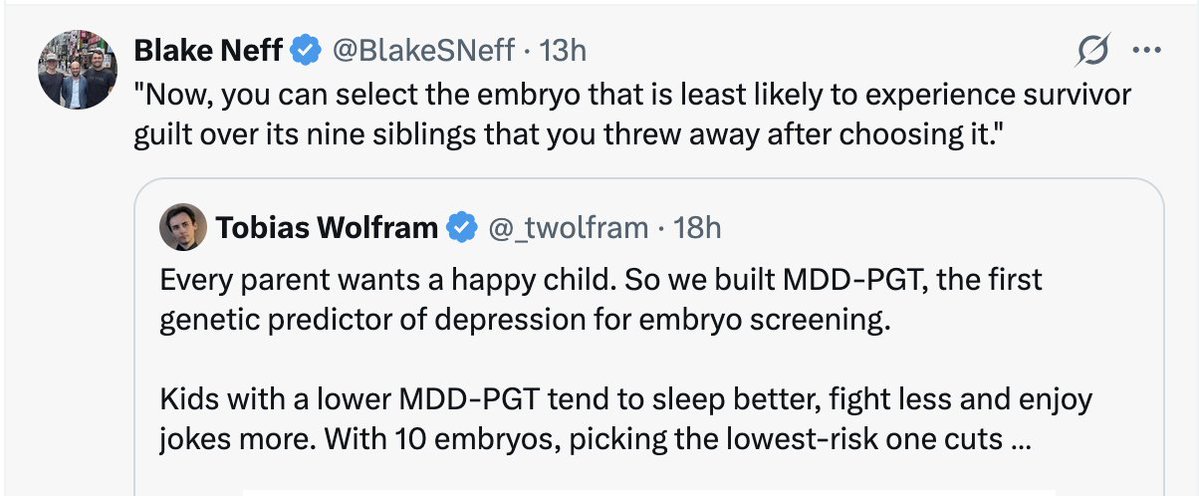
Every parent wants a happy child. So we built MDD-PGT, the first genetic predictor of depression for embryo screening.
Kids with a lower MDD-PGT tend to sleep better, fight less and enjoy jokes more. With 10 embryos, picking the lowest-risk one cuts depression risk by over 40%.
Should we correct disease mutations before a child is born? Dr. Eriona Hysolli, formerly @ Church lab & Colossal Bio, spoke at Reproductive Frontiers 2026 about why embryo-stage prevention of severe genetic disease deserves a path forward.
YouTube link in reply.⬇️
Timestamps:
00:00:00 Intro
00:01:07 Why embryo editing, and why now
00:03:18 The toolkit: from CRISPR-Cas9 to base editors
00:06:07 Multiplex editing, recoding, and the mammoth mouse
00:09:37 Human embryo editing with CRISPR-Cas9, 2015-2020
00:16:23 Base editors in human embryos
00:19:15 Why pursue prevention
00:23:11 Precedents: IVF and mitochondrial replacement
00:26:39 Regulation in the US and worldwide
00:30:11 Concluding remarks
00:31:56 Q&A
Can we grow a human blastocyst from stem cells, and watch it implant? Prof. Jun Wu of UT Southwestern spoke at Reproductive Frontiers 2026 about creating embryo-like structures that can implant into endometrial organoids.
YouTube link in reply. ⬇️
Timestamps:
00:00:00 Intro
00:00:46 Why build embryo models from stem cells
00:06:28 Making human blastoids
00:09:58 Implantation on an endometrial organoid chip
00:13:10 Implantation failure: patient cells and a drug screen
00:15:49 Assembled blastoids: trophectoderm via YAP
00:21:24 Mouse-human chimeras implant on the wrong side
00:23:44 FGF signaling sets the implantation side
00:27:04 Q&A
Exciting talk from @PaternaBio. If they can mature sperm in the lab, men with severe infertility could have biological kids.
The same tech could let us genetically screen sperm before conception, making embryo screening far more powerful.
Kudos to @nucleusgenomics for sponsoring this IRB study testing whether screening embryos based on polygenic risk scores will decrease implantation rates compared to screening only on embryo morphology!
https://t.co/KVSkL0GRlF
Many IVF programs treat the ASRM Opinion as a guideline for polygenic embryo selection. I’m pleased to announce the launch of PRISM (Polygenic Risk-Informed Selection versus Morphology), one of the largest clinical studies of polygenic embryo analysis to date. More in thread.