How to tell if you've found your "thing"
- You instantly absorb anything you read on the subject
- You stay up late working on it (without effort)
- You can perform better on it at 60% than others at 100%
- It doesn't drain you, but rather gives you energy
- You end up doing it without being prompted
Play to you, work to others. Don't waste your time dedicating yourself to something you're bad at. Work hard at games you're uniquely suited to win. You can and should take every unfair advantage you have access to
"You need to make yourself a big target for luck, and the way to do that is to be curious. Try lots of things, meet lots of people, read lots of books, ask lots of questions."
— Paul Graham, How to Do Great Work
https://t.co/AyIk5fnKZL
This Chinese guy built a Second Brain in Obsidian and every morning gets 3 trading ideas that brought him $180,000 in 6 months.
Inside he runs a pipeline of 6 workflows on N8N that automatically pulls every read article, listened podcast, and voice note into a shared Obsidian vault, and a neural network analyst every morning at 6:00 finds connections between the fresh and the old and puts the 3 strongest trading ideas for the day into the inbox.
No analytics desk, no Bloomberg terminal, no Telegram chats with traders. Just a Mac Mini by the wall, an iPhone in the pocket, and 1 local Obsidian vault.
And traditional quant funds keep entire teams of 8 people on salary for the same flow of insights, while his expenses are only subscriptions to Readwise, Whisper API, and N8N hosting.
6 pipelines process about 200 sources a day and close the monthly API bill at about $120.
The Mac Mini itself stores the entire vault and keeps the neural network analyst running 24/7, and from the iPhone the owner drops any idea he hears on the go into a Telegram bot, and it lands in the vault inbox in just 30 seconds.
The starting instruction that sits in the VAULT.md file at the root of his vault looks like this:
"you are the AI analyst of a solo trader. you read his vault every morning at 6:00, find connections between fresh and old notes, and deliver 3 trading ideas he can verify in the hour before the market opens.
pipelines:
- Reader (pulls every article and highlight from Readwise, Twitter bookmarks, and Kindle into /notes)
- Listener (transcribes podcasts through Airr and voice notes through Whisper, puts them in /notes)
- Catcher (accepts any message from the Telegram bot and writes it to /inbox with a timestamp)
- Connector (every night reads across the entire vault and updates the connection graph between 4,000 notes)
- Briefer (at 6:00 AM writes a brief: 3 trading ideas for today plus the emerging thesis of the week, puts it in /inbox)
- Mobile (lives in the iPhone, answers any question about the vault by voice, and confirms alerts while the owner is on the go).
you wake the owner with a push notification only when a fresh note contradicts his active thesis or when 1 of the 3 morning ideas has a confidence score above 90%."
This instruction immediately sets the role for the system and the limits of its autonomy.
It knows it is supposed to connect new with old on its own.
It knows it is supposed to prepare 3 trading ideas every morning on its own.
It knows it connects the live trader only when a thesis is contradicted or an ultra-confident idea appears.
→ Reader pulls about 80 articles and highlights a day from Readwise, Twitter, and Kindle
→ Listener transcribes 4 to 6 podcasts a week through Airr and Whisper
→ Catcher intercepts all voice and text ideas through the Telegram bot, averaging 15 to 20 a day
→ Connector updates the connection graph between 4,000 notes every night, adding 25 to 30 new edges
→ Briefer puts a fresh brief with 3 trading ideas and the emerging thesis into the inbox at exactly 6:00
→ Mobile answers any question about the vault by voice and confirms alerts right from the iPhone
And only when a new note contradicts his active thesis or 1 of the ideas breaks 90% confidence does the orchestrator raise the owner with a push notification.
And when the trader at that moment is driving to the gym or eating breakfast, the Mobile agent in his iPhone answers any quick question about the vault by voice: what he wrote about this ticker last week, which 3 sources support the idea of long NVDA, and what counter-thesis already sits in his notes.
The trader makes the decision and sends the order before New York opens.
The fresh brief from last Monday looks like this:
"reader: 78 materials added over the weekend, 11 of them about semiconductors, 4 about energy, 3 about biotech. passing to connector."
"connector: 27 new connections found between fresh materials and the vault, the strongest one is that the Goldman report from Wednesday matches the NVDA thesis you wrote 3 weeks ago."
"briefer: 3 trading ideas for today: long NVDA (confidence 0.84), short Tesla at the close of the quarterly report (0.71), watch URI (0.62). emerging thesis of the week: the market is underpricing capex on data centers."
"alert: your fresh note about long-term risk in semis contradicts the NVDA thesis. sending for review."
In his work setup there is no cloud server, no team of analysts, and not even a Bloomberg subscription.
At home sits a Mac Mini with a local Obsidian vault, on top run 6 N8N pipelines and a neural network analyst, and the same vault mirrors to a secure terminal on the iPhone.
Out of everything I have seen this year, this is the cleanest solo trading setup on a second brain: $120 a month on the API, about $30,000 a month into the account, and between them 6 pipelines, 4,000 connected notes, and 1 iPhone in the pocket.
Scientists shut off the dopamine in some rats and they stopped eating. Food everywhere. They starved in a full cage, not because they hated it. Put sugar on their tongue and they licked their lips. They still liked it. They just lost the drive to go get it.
This is one of the strangest things we know about the brain, and it traces back to a researcher named Kent Berridge at the University of Michigan. Your head runs two different systems. One is wanting, the push that gets you off the couch and moving. The other is liking, the good feeling once you are in it. Dopamine runs the wanting. The enjoyment runs on separate wiring. So you can be sure you will love something and still feel almost no pull to start it.
That is the man in the cartoon, swinging at rock with diamonds all around him. He could see the good stuff. He just could not make himself dig toward it.
Once you see why, the usual story about procrastination stops making sense. We say lazy, or bad with time. Mostly, it is neither. Two psychologists, Fuschia Sirois and Tim Pychyl, argued back in 2013 that it runs on emotion. A task makes you feel something you would rather not feel, even just the small dread of starting, and putting it off makes that feeling vanish on the spot. So you scroll, or you suddenly need to clean the kitchen. Dodging the task is a quick hit of relief, and your brain grabs it. The bill goes straight to future-you, who is left holding the guilt and the deadline.
You can even see it on a brain scan. In 2018, a team in Germany scanned 264 people and matched the scans against how much each person put things off. The big procrastinators had a larger amygdala, the little alarm bell deep in the brain that flags anything risky. They also had a weaker link to the part meant to quiet that alarm and get you moving, a region called the dorsal anterior cingulate cortex. Loud alarm, weak off-switch.
And if this is you, you have plenty of company. A big 2007 review found that 80 to 95 percent of college students procrastinate, that roughly one in five adults does it long-term, and that more than 95 percent of them wish they could quit. Students alone burn about a third of their day on it.
The fix falls out of that same split. If wanting and liking are two different systems, then waiting to "feel like it" is waiting for a bus that may never come. The main treatment for the severe version, called behavioral activation, flips the order. You start first, as small as you can stand, before any motivation shows up. The wanting tends to arrive a few minutes after you begin. The diamonds were there the whole time. You just have to swing the pick before you feel ready.
My phones have been successfully warmed up and the first videos have been posted successfully. I’m about to hand them over to the students I hired so they can continue making content, and 50% of the phones will be automated. My goal is still to scale to 100+ accounts and automate them to promote my apps. I just ordered a wooden phone rack, it actually looks pretty nice. 😌
High-paid tech workers are cutting life down to the basics so they can invest and retire by 30
One Meta engineer makes over $300K a year and still owns no car, couch or TV
More successful Gen Z are choosing calm life over career and money
The consistent practice of cardio, Tai Chi, and stretching will beat most of the nootropics a lot of people use and they are free.
Cardio alone:
-Boosts neurotrophic factors (BDNF, GDNF, NGF) A LOT.
No, no. A LOT.
Just 30 minutes of aerobic exercise 3–5 times/week increases brain-derived neurotrophic factor (BDNF) by 20–30%.
-Enhances glial cell line-derived neurotrophic factor (GDNF) in motor circuits, aiding neuron survival and motor function.
-In older adults, exercise boosts nerve growth factor (NGF), promoting neuronal health and cognitive resilience.
-Promotes synaptic plasticity, strengthening neural connections in the hippocampus and prefrontal cortex, critical for long-term and short-term memory.
-Increases dopamine release and receptor sensitivity. It modulates the hypothalamic-pituitary-adrenal (HPA) axis, lowering cortisol levels and enhancing stress resilience.
-Supports the glymphatic system.
While sleep primarily drives glymphatic clearance, exercise enhances cerebral blood flow and CSF dynamics.
-Reduces amygdala hyperactivity.
-Boosts endorphin release, enhancing mental resilience and reducing irritability or anxiety.
-Lowers the risk of Alzheimer’s and Parkinson’s by reducing beta-amyloid and tau accumulation and protecting dopaminergic neurons.
The list is endless.
These 3 are also among the few consistent forms of exercise for non-fat billionaires as well.
And some of the billionaires also push the envelope quite a lot.
Ratchliffe did an Ironman at 64, Karp does a lot of technical Norwegian-style training etc.
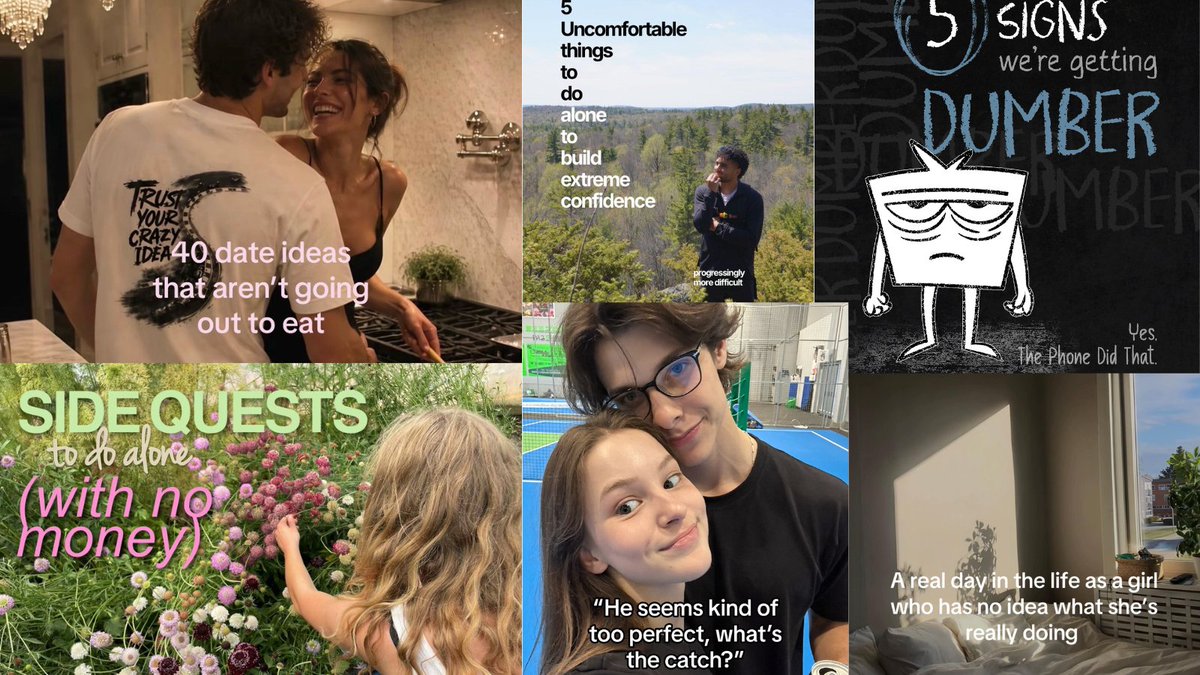
the format printing on tiktok right now and you can clone it easily
- face on slide 1
- "how to" hook
- 3-4 advice slides
- app CTA
nothing fancy
just works