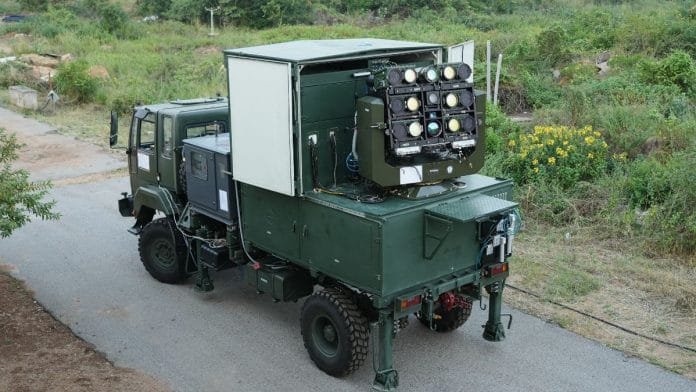
India has developed a 30 kW-class high-power laser system designed to engage drones at ranges of up to 5 km.
The truck-mounted system uses a focused laser beam to damage or disable drones and other aerial targets, without relying on conventional ammunition.
The technology has completed its final trials and is now moving towards the next stage of production.
A significant step in India’s development of next-generation defence technology.
This is developed by an Odisha based drone technology company.
IG Defence showcased its indigenous T-SHUL BEAM counter-drone system at the IAF’s Dronathan 2026 exercise in Pokhran.
The man-portable system is designed to counter UAVs and FPV drones by disrupting their communication, video, telemetry and navigation signals.
Another homegrown defence technology emerging from Odisha.
where does all the VRAM go during LLM inference?
(4 ways GPU memory is used)
loading the model is only the first part of the memory story.
once inference starts, GPU memory gets divided across multiple components, and some of them keep growing as context length, batch size, and concurrency increase.
the graphic breaks it into four useful buckets:
→ model weights are the mostly fixed part. once the model is loaded, their memory footprint stays roughly constant. the biggest lever here is precision. moving from FP16/BF16 to INT8 or INT4 reduces the number of bytes needed to store each parameter.
→ KV cache grows as generation continues. for every previous token, the model stores key and value tensors so attention can reuse them instead of recomputing the entire sequence. longer contexts mean a larger KV cache, and more concurrent requests mean more active caches sitting in memory.
→ activations and workspace hold temporary intermediate values needed while running attention, MLP layers, kernels, and other computations. this memory is reused across inference steps, but its size can still change with sequence length, batch size, and the kernels being executed.
→ runtime overhead comes from everything around the model itself. CUDA kernels, memory allocators, metadata, serving-engine buffers, and other runtime structures all consume some VRAM. it is usually smaller than the other buckets, but it is never zero.
this is why “the model fits on the GPU” and “the workload fits on the GPU” are two different statements.
a model may load comfortably, then run out of memory when you increase the context window, serve more users simultaneously, or increase the batch size.
it also explains why quantization can help beyond simply fitting a larger model. shrinking the weight footprint creates room that can instead be used for larger KV caches, more concurrent requests, or bigger batches.
that is the broader GPU lesson too.
performance is not just about how much arithmetic a GPU can do. it is also about what data occupies memory, how much of it moves during inference, and how often that data can be reused.
i wrote the full breakdown of how GPUs actually work and why memory movement sits at the center of LLM inference performance.
the article is quoted below.
This guy on Reddit built a god-level 3D game using GPT-6 Astra. 🤯
His process is stupidly simple:
→ Connected Codex to Blender MCP
→ Pasted the game concept
→ Told Astra to generate concept art using image gen
→ Then told it to iterate until in-game screenshots matched the concept art at 60fps
That's it. Three steps. The AI designed the art style AND built the game to match it.
His reaction: "This is absolutely insaneeeeee"
He's not wrong.
While “cockroaches” are adding to the mess, the real Gen-Z are cleaning up! But I hope the local administrations and municipalities make sure these places remain clean!
It’s the least they can do! @PMOIndia@moefcc
since you guys loved the exploding tesla..
I used GPT-6 Astra to create a 3D website that pulls apart the male anatomy into 2,234 modeled pieces!
we are in a renaissance of learning
#WATCH | Sriharikota, Andhra Pradesh: ISRO successfully launches the GSLV-F17/EOS-05 mission from the Second Launch Pad at Satish Dhawan Space Centre.
(Source: ISRO)
𝚆𝙷𝙰𝚃 𝙷𝙰𝙿𝙿𝙴𝙽𝚂 𝚆𝙷𝙴𝙽 𝚁𝙾𝙱𝙾𝚃𝚂 𝙴𝙽𝚃𝙴𝚁 𝚃𝙷𝙴 𝙱𝙰𝚃𝚃𝙻𝙴𝙵𝙸𝙴𝙻𝙳?
No fear. No fatigue. No hesitation.
Military robotics is moving fast, and autonomous machines are getting closer to real-world combat. What we’re seeing today could be an early look at how warfare might change in the years ahead.
Would you want robots fighting wars instead of humans?