In a new documentary with ABC, Retro CEO @BettsLaCroix shares Retro’s mission of adding 10 healthy years to the human lifespan.
He explains the science behind that goal to reporter @NormanSwan, including Retro's work on autophagy, the process cells use to clear out damaged material as they age. That program is now in a Phase 1 clinical trial for Alzheimer’s disease.
Watch the full documentary: https://t.co/lPl2Swqrt0
Recently, joe sat down with @juliankissa of The Beyond Tomorrow Podcast to talk about using AI to engineer better proteins, going upstream to treat Alzheimer's, and why biological timescales are the one thing you can't accelerate. https://t.co/UO96Qj7Ojf
We set out to reach the clinic in Q4, and we delivered.
With our First In Human milestone achieved, Retro officially becomes a clinical stage company.
Deep thanks to the teams who made this possible. We are excited for what 2026 will bring.
https://t.co/ttLM6uoWeF
Exclusive: I talked with leaders of OpenAI and Retro Bio about new lab results from an AI protein model called GPT-4b micro.
While the model won't be released publicly, the research shows how LLMs could be applied to life sciences research:
https://t.co/avi3f3QhYY
excited to share @OpenAI's latest blog post on our collaboration using gpt-4b to accelerate protein engineering, including our result where we rewrote the Yamanaka factors using our model, leading to drastic increases in reprogramming efficiency https://t.co/jYGdGabjkL
Ever wondered what it takes to defy aging?
@ashleevance takes you inside our lab in the latest episode of Core Memory.
Hear from our CEO @bettslacroix and the scientists driving Retro's mission to add 10 years to healthy human lifespan. https://t.co/e4rCP5PesM
"It’s like taking having 80% of all your cells become zero age." Retro Biosciences artificial intelligence-powered biotech’s mission to increase human lifespan by a decade https://t.co/kGctTiaLS7
Tech leadership reinvented: “Move fast and break ignorance”
Joe Betts-LaCroix — co-founder and CEO of Retro Biosciences talks to Big Think about invention, authenticity, and Sam Altman’s “art of the startup.”
Key Takeaways
➡️ A crucial aspect of good leadership is “matching people with the challenges that fit them.”
➡️ Aspiring CEOs should use “actual values and desires” to drive startup selection.
➡️ Slowness incurs costs but speed is inspiring and progress energizes us.
The Full Story
Joe Betts-LaCroix (@bettslacroix ) is co-founder and CEO of longevity tech company Retro Biosciences (@RetroBio_ ). Under his leadership, and backed to the tune of $180 million by Sam Altman (@sama ), Retro built its laboratories, at a fraction of the usual cost, from re-fitted shipping containers. The company mission is to “increase healthy human lifespan by ten years […] by focusing on the cellular drivers of aging.”
Raised by countercultural parents in Oregon — and educated at Harvard, MIT, and Caltech — Betts-LaCroix counts invention and experimentation among his lifelong companions. His previous ventures include computer hardware startup, OQO, which created the world’s smallest Windows device (a Guinness World Record in 2006) and was sold to Google; and medical research automator, Vium, acquired by Recursion Pharma in 2020. He has been a part-time partner at the accelerator Y Combinator and has invested in numerous startups.
Today, at 62, he embodies an approach to work that seeks solutions at speed — and his business philosophy is built on ideas and principles that would benefit any leader, in any industry.
In true “smarter, faster” spirit, Big Think asked Betts-LaCroix about role models, startup culture, his implanted ID chip, and more. His fascinating and insightful responses include our favorite hacked business maxim of the year so far: “Move fast and break ignorance.”
Big Think: How did your Oregon childhood of tinkering and curiosity shape your current leadership philosophy?
Betts-LaCroix: Curiosity comes from within: My models for leadership (my parents) didn’t force interests on me. I love what I do because it’s authentic to me, and that makes me productive, so I find that people who are doing their work because they love it are a good fit. It’s a quality I select for. To me, leadership is matching people with the challenges that fit them, as well as what excites them, and what they need for that next challenge.
Big Think: Mentorship is a great way to pass on your experience to new waves of startups. What are some of the discoveries about leadership you try to impress on startup neophytes?
Betts-LaCroix: Trust yourself. You become a followable leader by being true to your instincts. People can smell inauthenticity; if you try to be someone you are not, you become bland or worse. Don’t let the conservatism of the world shrink your ambitions. Choose a startup that aligns with your actual values and desires, and that alignment will drive everything: fundraising, recruiting, partnering, and most of all, yourself, during all the intense doubts and challenges you will inevitably face.
Big Think: What are some of the leadership techniques and practices you use to encourage innovation at Retro?
Betts-LaCroix: For one, I avoid the use of the word “innovation” — I pretty much only hear it used by companies I classify as “dead players.” People will immediately dismiss a culture tenet the CEO doesn’t exemplify. So I invent constantly and openly: I normalize it. I rarely take “it’s not typically done this way” as an answer if that means we have to go slowly; there’s almost always a way. Sometimes there isn’t, but it’s the optimistic sense that there probably is that means I find one 90% of the time.
Big Think: You have an RFID (radio-frequency identification) chip implanted in your hand? What are the advantages of this enhancement and what does it tell your team about your approach to leadership?
Betts-LaCroix: I never have to worry about forgetting my key fob to the building. I don’t have a strong key habit because I don’t own a car (it’s more efficient to take Lyft because I can get work done on the way). But the main reason I like my chip is that it’s fast: I don’t have to fish a fob out of my pocket or attach one to myself every day. I also like the feeling of connecting my body with the company.
I’m a participant in our autophagy (cellular recycling) phase-0 trial. I give blood immediately when scientists need it for a study. I’ve never understood the idea of “work” because I’ve always followed the maxim: pursue projects I love. So for me there is no separation between work and life, and the phrase “work-life balance” is like a typo; it’s semantically invalid. So it’s natural for me to merge with the project.
Big Think: Recruitment can make (or break) companies. How have you positioned Retro’s company culture to make sure you’re successful in this regard?
Betts-LaCroix: Extremely capable people love to build what matters, so the first criterion is to choose a mission that matters: a really challenging one. Another is to give people room to run. Authoritarian cultures destroy creativity. I trust people a lot. I have a positive view of human nature, and mostly that works well for me. Sometimes I’m extremely disappointed, and experience painful exceptions [to my default positivity], but they pass — and statistically, they are indeed exceptions. Believing in people helps them believe in themselves.
Big Think: Which leadership virtues will be the most effective and valuable in navigating the decade of accelerating technologies that lies ahead of us?
Betts-LaCroix: Valorizing rate of learning over amount of knowledge. Information gets outmoded faster and faster, so to thrive in the coming times, we must get really good at adapting and learning, not resting on our stale knowledge base of ten years ago. So I look for people to hire who’ve mastered several new things over a short period of time, and promote people who learn quickly.
Big Think: Is it time to rethink the accepted wisdom of tech leadership? Does “move fast and break things��� still hold as a practical mantra?
Betts-LaCroix: Speed is everything. My job is to maximize the probability of mission success given limited resources. Slowness incurs costs: salaries, rent, and everyone’s patience. Conversely, speed is inspiring. Progress energizes us, and attracts even more talented team members, which further increases progress, which drives acceleration.
People confuse fast with sloppy, but we expect more of ourselves. On a two-dimensional chart of fast and accurate, I expect us to be in the upper right quadrant. Fast means knowing you are vastly ignorant and have the self-confidence to find out why: Don’t hesitate to devise a rapid experiment to see if your hypothesis is wrong. So yes, I think we should move fast and break ignorance. I celebrate iteration. An experiment that disproves your hypothesis rapidly is considered a success here.
Big Think: Over the course of your life and career so far, which leaders have you most admired and why?
Betts-LaCroix: When I was a kid, it was Buckminster “Bucky” Fuller (whom I got to see lecture in Oregon) and Nikola Tesla. Later, I was in awe of my advisor at Harvard, because, not only was his mind a paradise to play in, but also it was amazing how he remade his world: the prodigy sent out by his fundamentalist community to disprove this “ghastly theory” of continental drift, only to realize how beautifully true it was — then devote his life to being a world leader of elucidating other such truths.
Jory Bell, the co-founder of my first venture funded company, OQO, was inspiring to me because he taught me that I can have an aesthetic point of view about machines. I knew that dogwood trees in the spring, and Käthe Kollwitz paintings, were beautiful — not until meeting Jory did I appreciate that some machines were also beautiful, especially when the focus is on their function, not on decoration. But I didn’t really have any inspiring models after that until I met Sam Altman, which was a long gap.
Big Think: Altman’s backing of Retro has caught the eye. How has his involvement inspired your leadership and vision?
Betts-LaCroix: Sam has been a shockingly positive influence on me as a leader and on the company culture. At first I wondered, why is this Sam guy concerning himself with the art of the startup so much? Then I realized that startup is the lever that drives all inspiring change. I love learning to do hard things that enable exciting outcomes, and startup culture is the key: it became legitimately interesting and then intensely empowering once I realized it could (and should) be authentic, which means I can bring my whole self to the task (including my body, lol). I don’t get judgement from Sam, just constructive ideas: “Have you considered ‘X’? Here’s a practice you could try.” There’s zero learned helplessness.
✒️ by Mike Hodgkinson
📷 by Claire Merchlinsky
We're excited to partner with @multiplylabs. Their cutting edge technology will bolster our efforts to add 10 years to healthy human lifespan. Read the press release for more details: https://t.co/p8hfNmkUgW
Our thanks to @Hilarx@BusinessInsider for profiling Retro - the why and how we are "breaking all the rules of early-stage biotech" to achieve our mission of adding 10 years of healthy lifespan. https://t.co/0zkoEvx3x8
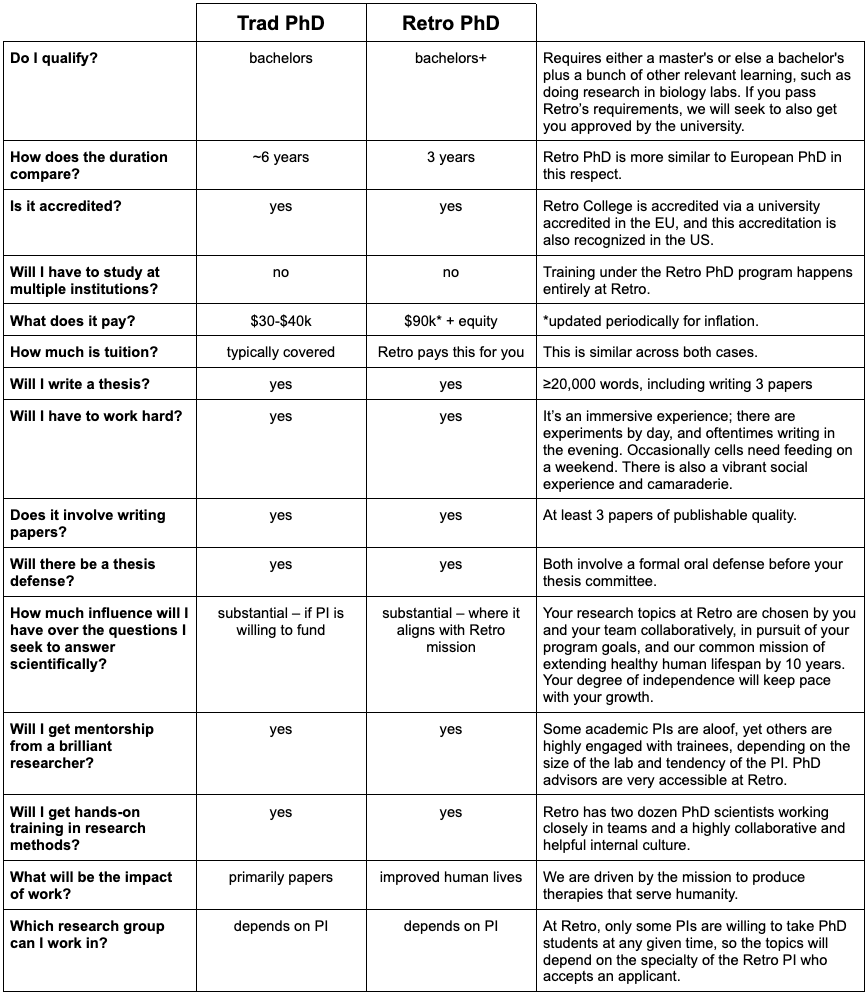
We are proud to announce the Retro PhD!
Retro College is now accredited in both the EU and USA to grant PhDs.
Our first 2 students have been accepted, and we have openings for 3 more.
https://t.co/ogs21Lx3WI
Next month, our CEO @bettslacroix will share his insights on longevity and aging science alongside @kpfortney and @mkaeberlein at @theA4LI’s inaugural D.C. Fly-In event uniting scientists, policymakers, and longevity industry leaders.
Learn more at https://t.co/CsnpXbwicG
Join us for The Alliance for Longevity Initiatives (A4LI)'s inaugural D.C. Fly-In event on March 20-21, 2024! This groundbreaking gathering will unite leading scientists and policymakers committed to advancing legislative and policy initiatives that promote healthy human lifespan.
By attending, you'll have the opportunity to:
- Engage in critical conversations with industry experts and policymakers.
- Contribute to shaping the future of longevity biotechnology.
- Network with like-minded individuals and key stakeholders.
- Advocate for policies that support healthy aging and combat age-related diseases.
Don't miss this chance to join the forefront of longevity advocacy and policy development. Secure your spot today and help drive positive change for the future of human health and longevity.
Spots are limited, so register today with this link: https://t.co/zi5kdDapqU
We look forward to welcoming you all on Capitol Hill this March!
Thanks to @omri_drory and @thisisward@NFX for featuring Retro and insights from our CEO @bettslacroix in this inspiring documentary showcasing key efforts to shape the future of longevity science.
We're at the beginning of a landmark moment for Longevity.
The companies built in the next 10 years will power a radical transition from sickcare to true healthcare.
Here's a short documentary w/ @omri_drory & friends about the future of Longevity:
https://t.co/geRbThluWQ
Happy holidays from the Retro team!
We gathered to celebrate everything we've built in 2023 and look ahead to another year of team science, growth, and accomplishment.
Wishing all a healthy and productive 2024.
Thanks to @ashleevance at @Bloomberg@BW for the in-depth look at how we built Retro, our intensely challenging and ambitious research tracks, and the longevity science we’re pioneering to extend healthy human lifespan.
https://t.co/QDSeN9kQY5
This week on A4LI’s Scientist Spotlight, we are delighted to be joined by Alex Trapp (@AlexandreTrapp) of Retro Biosciences.
In this episode, we discuss how Alex’s journey into longevity science first began, his experiences working at @RetroBio_, as well as the cross section between computational and experimental biology.
You can listen to our discussion here: https://t.co/9jo1DrRuwN


![bigthink's tweet photo. Tech leadership reinvented: “Move fast and break ignorance”
Joe Betts-LaCroix — co-founder and CEO of Retro Biosciences talks to Big Think about invention, authenticity, and Sam Altman’s “art of the startup.”
Key Takeaways
➡️ A crucial aspect of good leadership is “matching people with the challenges that fit them.”
➡️ Aspiring CEOs should use “actual values and desires” to drive startup selection.
➡️ Slowness incurs costs but speed is inspiring and progress energizes us.
The Full Story
Joe Betts-LaCroix (@bettslacroix ) is co-founder and CEO of longevity tech company Retro Biosciences (@RetroBio_ ). Under his leadership, and backed to the tune of $180 million by Sam Altman (@sama ), Retro built its laboratories, at a fraction of the usual cost, from re-fitted shipping containers. The company mission is to “increase healthy human lifespan by ten years […] by focusing on the cellular drivers of aging.”
Raised by countercultural parents in Oregon — and educated at Harvard, MIT, and Caltech — Betts-LaCroix counts invention and experimentation among his lifelong companions. His previous ventures include computer hardware startup, OQO, which created the world’s smallest Windows device (a Guinness World Record in 2006) and was sold to Google; and medical research automator, Vium, acquired by Recursion Pharma in 2020. He has been a part-time partner at the accelerator Y Combinator and has invested in numerous startups.
Today, at 62, he embodies an approach to work that seeks solutions at speed — and his business philosophy is built on ideas and principles that would benefit any leader, in any industry.
In true “smarter, faster” spirit, Big Think asked Betts-LaCroix about role models, startup culture, his implanted ID chip, and more. His fascinating and insightful responses include our favorite hacked business maxim of the year so far: “Move fast and break ignorance.”
Big Think: How did your Oregon childhood of tinkering and curiosity shape your current leadership philosophy?
Betts-LaCroix: Curiosity comes from within: My models for leadership (my parents) didn’t force interests on me. I love what I do because it’s authentic to me, and that makes me productive, so I find that people who are doing their work because they love it are a good fit. It’s a quality I select for. To me, leadership is matching people with the challenges that fit them, as well as what excites them, and what they need for that next challenge.
Big Think: Mentorship is a great way to pass on your experience to new waves of startups. What are some of the discoveries about leadership you try to impress on startup neophytes?
Betts-LaCroix: Trust yourself. You become a followable leader by being true to your instincts. People can smell inauthenticity; if you try to be someone you are not, you become bland or worse. Don’t let the conservatism of the world shrink your ambitions. Choose a startup that aligns with your actual values and desires, and that alignment will drive everything: fundraising, recruiting, partnering, and most of all, yourself, during all the intense doubts and challenges you will inevitably face.
Big Think: What are some of the leadership techniques and practices you use to encourage innovation at Retro?
Betts-LaCroix: For one, I avoid the use of the word “innovation” — I pretty much only hear it used by companies I classify as “dead players.” People will immediately dismiss a culture tenet the CEO doesn’t exemplify. So I invent constantly and openly: I normalize it. I rarely take “it’s not typically done this way” as an answer if that means we have to go slowly; there’s almost always a way. Sometimes there isn’t, but it’s the optimistic sense that there probably is that means I find one 90% of the time.
Big Think: You have an RFID (radio-frequency identification) chip implanted in your hand? What are the advantages of this enhancement and what does it tell your team about your approach to leadership?
Betts-LaCroix: I never have to worry about forgetting my key fob to the building. I don’t have a strong key habit because I don’t own a car (it’s more efficient to take Lyft because I can get work done on the way). But the main reason I like my chip is that it’s fast: I don’t have to fish a fob out of my pocket or attach one to myself every day. I also like the feeling of connecting my body with the company.
I’m a participant in our autophagy (cellular recycling) phase-0 trial. I give blood immediately when scientists need it for a study. I’ve never understood the idea of “work” because I’ve always followed the maxim: pursue projects I love. So for me there is no separation between work and life, and the phrase “work-life balance” is like a typo; it’s semantically invalid. So it’s natural for me to merge with the project.
Big Think: Recruitment can make (or break) companies. How have you positioned Retro’s company culture to make sure you’re successful in this regard?
Betts-LaCroix: Extremely capable people love to build what matters, so the first criterion is to choose a mission that matters: a really challenging one. Another is to give people room to run. Authoritarian cultures destroy creativity. I trust people a lot. I have a positive view of human nature, and mostly that works well for me. Sometimes I’m extremely disappointed, and experience painful exceptions [to my default positivity], but they pass — and statistically, they are indeed exceptions. Believing in people helps them believe in themselves.
Big Think: Which leadership virtues will be the most effective and valuable in navigating the decade of accelerating technologies that lies ahead of us?
Betts-LaCroix: Valorizing rate of learning over amount of knowledge. Information gets outmoded faster and faster, so to thrive in the coming times, we must get really good at adapting and learning, not resting on our stale knowledge base of ten years ago. So I look for people to hire who’ve mastered several new things over a short period of time, and promote people who learn quickly.
Big Think: Is it time to rethink the accepted wisdom of tech leadership? Does “move fast and break things��� still hold as a practical mantra?
Betts-LaCroix: Speed is everything. My job is to maximize the probability of mission success given limited resources. Slowness incurs costs: salaries, rent, and everyone’s patience. Conversely, speed is inspiring. Progress energizes us, and attracts even more talented team members, which further increases progress, which drives acceleration.
People confuse fast with sloppy, but we expect more of ourselves. On a two-dimensional chart of fast and accurate, I expect us to be in the upper right quadrant. Fast means knowing you are vastly ignorant and have the self-confidence to find out why: Don’t hesitate to devise a rapid experiment to see if your hypothesis is wrong. So yes, I think we should move fast and break ignorance. I celebrate iteration. An experiment that disproves your hypothesis rapidly is considered a success here.
Big Think: Over the course of your life and career so far, which leaders have you most admired and why?
Betts-LaCroix: When I was a kid, it was Buckminster “Bucky” Fuller (whom I got to see lecture in Oregon) and Nikola Tesla. Later, I was in awe of my advisor at Harvard, because, not only was his mind a paradise to play in, but also it was amazing how he remade his world: the prodigy sent out by his fundamentalist community to disprove this “ghastly theory” of continental drift, only to realize how beautifully true it was — then devote his life to being a world leader of elucidating other such truths.
Jory Bell, the co-founder of my first venture funded company, OQO, was inspiring to me because he taught me that I can have an aesthetic point of view about machines. I knew that dogwood trees in the spring, and Käthe Kollwitz paintings, were beautiful — not until meeting Jory did I appreciate that some machines were also beautiful, especially when the focus is on their function, not on decoration. But I didn’t really have any inspiring models after that until I met Sam Altman, which was a long gap.
Big Think: Altman’s backing of Retro has caught the eye. How has his involvement inspired your leadership and vision?
Betts-LaCroix: Sam has been a shockingly positive influence on me as a leader and on the company culture. At first I wondered, why is this Sam guy concerning himself with the art of the startup so much? Then I realized that startup is the lever that drives all inspiring change. I love learning to do hard things that enable exciting outcomes, and startup culture is the key: it became legitimately interesting and then intensely empowering once I realized it could (and should) be authentic, which means I can bring my whole self to the task (including my body, lol). I don’t get judgement from Sam, just constructive ideas: “Have you considered ‘X’? Here’s a practice you could try.” There’s zero learned helplessness.
✒️ by Mike Hodgkinson
📷 by Claire Merchlinsky](https://pbs.twimg.com/media/GNzF1WMaMAAGyUs.png)