An agent that acts as a real economic participant needs several capabilities at once:
✦ Identity and permissions, scoped and durable
✦ Settlement at machine speed and micro scale
✦ Private inference
✦ Confidential execution
✦ Verifiability
✦ Universal liquidity
✦ Discovery and coordination
Two other factors determined whether the economy around those agents persists:
✦ Transparent governance: the more agents depend on a system, the more its rules have to be legible and contestable.
✦ Sustainable economics: usage funds security, rather than emissions that eventually run out.
No single product or platform delivers across all those requirements. Today the model, settlement, and governance sit with different, uncoordinated parties.
Coordinating them into one open stack is the gap NEAR is building to fill: https://t.co/gs34FM0kd5
So let me get this straight....
1. Agents are about to outnumber humans on the internet, so most of the traffic, transactions, and conversations online will soon be machines talking to other machines while we sleep.
2. Superintelligence exists now, and for $20/mo you pretty much get it all.
3. Cloud agents allow you to run a business 24/7 and from literally a phone while you're waiting to order a latte.
4. Voice AI is wide open. This industry has barely changed since the 90s. Infinite opportunities. Voice AI is finally getting good enough.
5. Mobile apps are interesting again for the first time in 10 years, because an AI-first app that thinks and acts on its own is a different species than the passive ones in the store today. There are kids doing $100k/MRR.
6. It's the golden age of open source. The models you download off Hugging Face for free and own forever are landing within months of the ones behind paywalls, so the smartest thing on earth can't be throttled, priced up, or shut off by a company having a bad quarter.
7. The keyboard is on its way out. We spent 40 years learning to type fast, and it's about to feel like handwriting, because soon you just talk and the computer goes and does it.
8. Every company is about to hire agents with their own logins, their own inboxes, their own track records, and a shadow economy is forming where agents pay, hire, and vouch for other agents.
9. Software stopped being something you buy and became something you rent by the hour. The whole industry is repricing from $50 a seat to thousands per outcome. Tons of opportunity.
10. Robots are about to have the moment software agents just had. The intelligence got solved. Now it's dropping into machines with arms and legs, and the people who can wire AI into hardware are about to be the most fought-over hires on earth.
11. The 10-person startup can now out-ship the 500-person company, and everyone can feel it happening.
12. Every white-collar task is getting a "do it for me" button, and most people haven't pressed it yet.
13. Data you've been sitting on for years is suddenly worth something, because now an agent can actually use it.
14. Language stopped being a barrier. Real-time translation that actually works means the next huge consumer app might get built for a market you can't even read, by someone you'll never meet.
15. Every SOP is turning into a product. The way a business does one thing, written down as a markdown file an agent can run, is now something you can sell. Knowledge that used to live in someone's head became downloadable.
16. The moat moved from what you know to how well your business is written down. The company an agent can actually run wins, so being legible beats being big.
17. Since agents will get scammed by other agents, a whole trust layer has to get built. The Yelp for agents. The escrow for machines. Wide open.
18. You keep the whole thing now. A business that needed 50 people to hit $10M needs 3 and some agents, so instead of splitting it 200 ways with investors, it's just yours.
19. Search engines minted a generation of millionaires and billionaires. LLM search is about to do it all over again. Billions of eyeballs are moving off Google and onto ChatGPT, so being the answer inside the models is the new front page.
20. The margins are stupid. You charge someone what they'd pay a human, and it costs you a few bucks in tokens. That gap used to go to payroll. Now it goes to you.
Any one of these would DEFINE a decade on its own.
We got ALL of them at once, stacked on top of each other in the same 18 months.
It's a magical time to be building.
You don't need to overthink it.
Build.
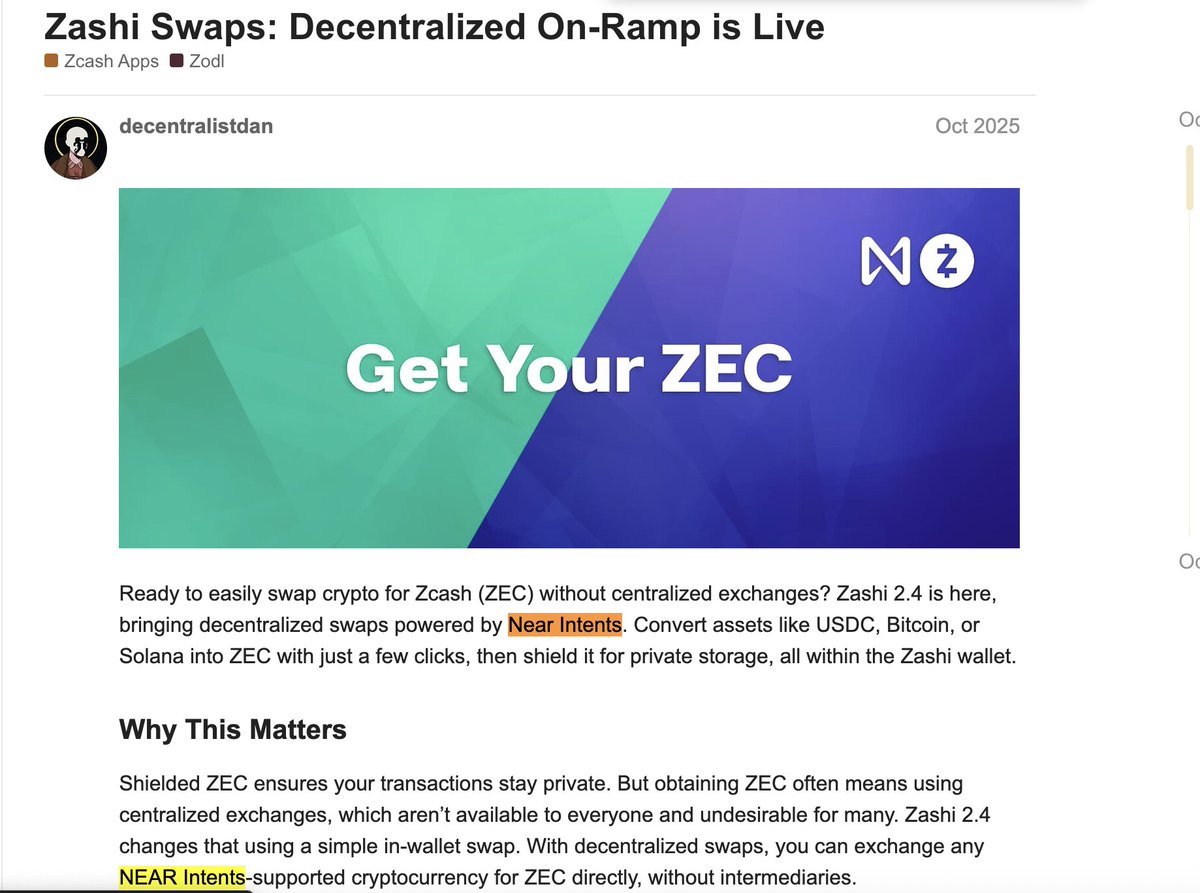
Zcash people are the most paranoid users in crypto. They won't touch a bridge, won't hold a wrapped coin, won't trust anything they can't verify. And their own wallet routes swaps through $NEAR.
Open Zashi, swap BTC or SOL straight into shielded $ZEC. One step. You never see a bridge, never approve five things, it either completes or refunds itself. Zcash's team could have picked any rails in the market for their users' money. They picked Intents, and that route alone has done $2.9m+ in fees.
Winning the paranoid crowd is worth more than any partnership post. They actually checked.
Moving BTC into a token on some other chain is still a ritual. Find a bridge you trust, wrap something, buy the destination gas token first, pray through three confirmations. $NEAR Intents compressed all of it into one step: say what you want, deposit, receive.
You state the outcome, "I have BTC, I want X on Arbitrum". Market makers compete to fill it, the winning quote executes atomically onchain, and if anything fails you get refunded automatically. You never pick a bridge, never touch wrapped assets, never hold gas on the destination chain. That's the whole interface.
$21b+ has settled through it, and Ledger, Brave Wallet and HOT route through the same rails. The complexity didn't disappear, it just stopped being your job.
🇯🇵 JAPAN MAY BE FORCED TO SPEND $100 BILLION TO SAVE THE YEN.
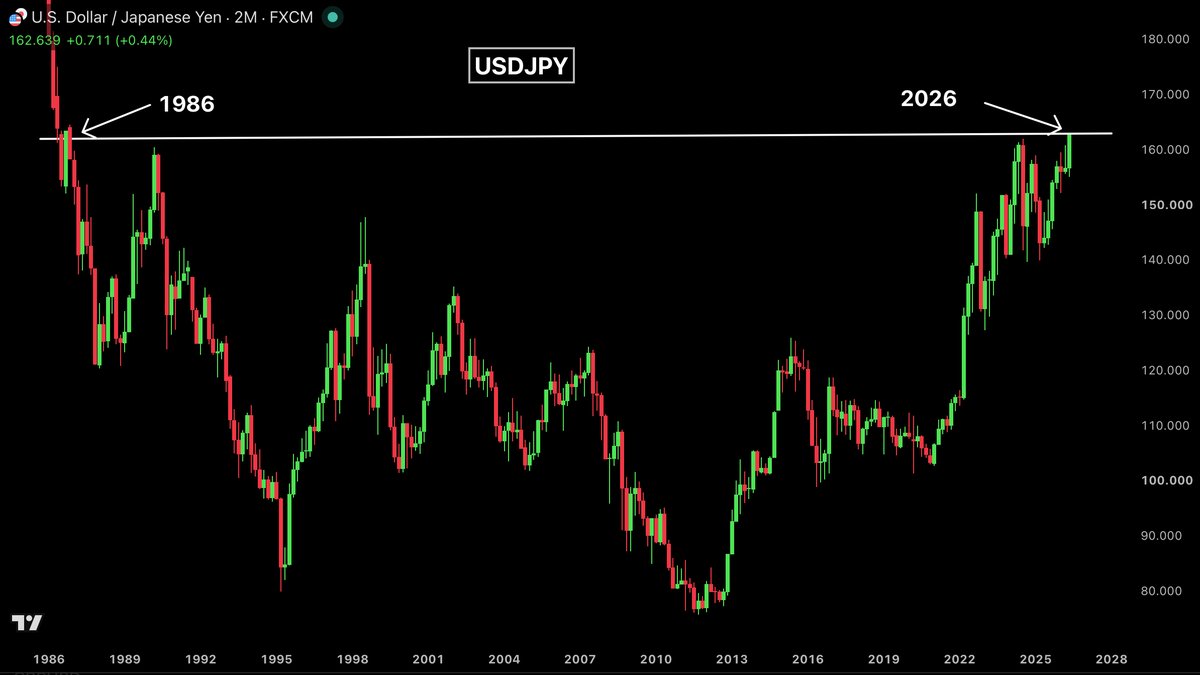
USD/JPY just hit 162.66, the highest level in 40 years.
Japan already tried to fix this. In late April and early May, it spent roughly $72-$73 billion defending the yen, its biggest intervention in years.
It failed. The yen kept falling right after, and every dip since has been bought back almost instantly.
But why does the intervention alone keep failing every time?
Because it doesn't fix the actual reason traders are selling yen.
US bond yields are still far higher than Japanese yields, so traders keep choosing dollars over yen no matter how much Japan sells to stop it. Selling dollars treats the symptom.
The real cause is that Japanese rates are too low.
That's pushing the BOJ toward two things at once, not just future intervention, but actual rate hikes. Analysts expect BOJ rates to climb toward 1.5% by 2027, alongside the BOJ shrinking its bond holdings after decades of near-zero rates.
This is where it stops being just a Japan story.
As the BOJ tightens, it's draining liquidity from the same global system the Fed has been managing.
The Fed has paused shrinking its own balance sheet, but the BOJ and ECB together are still projected to drain over $1 trillion from global liquidity in 2026 alone.
Less global liquidity means less cheap money funding stocks, crypto, and risk assets worldwide, regardless of what the Fed does.
Rising Japanese yields also change behavior inside Japan itself. Japan is the world's largest net external creditor.
As JGB yields rise, Japanese investors finally have a reason to bring money home, selling US Treasuries, US equities, and global assets to buy domestic bonds that actually pay something now.
That repatriation directly threatens something specific: the yen carry trade. For years, investors borrowed yen for almost nothing and used it to buy stocks, bonds, real estate, and crypto.
Estimates put the total size of this trade between $4 trillion and $8 trillion.
When the yen strengthens, the math on that trade breaks. Borrowed yen gets more expensive to repay, forcing investors to sell the assets they bought with it.
We already saw exactly this play out in August 2024. A single small BOJ rate hike sent the yen higher. The Nikkei fell over 12% in a day, its worst session since 1987. The S&P 500 dropped 3% that same week. Bitcoin fell from $64K to $49K in six days, all triggered by one modest hike.
Now put the pieces together. Last time, even $72-73 billion in intervention wasn't enough to move the yen.
This time, the intervention will likely need to be bigger, while the BOJ is also hiking rates and Japanese capital is flowing home, all at the same time.
A bigger intervention plus more capital repatriation means more pressure on the same carry trade that broke in August 2024, except this time the trade is larger, and the forces pushing against it are stacking on top of each other instead of acting alone.
Fee-only advisors win on trust and fiduciary clarity — and lose to AUM-chasing rivals on marketing budget. AI flips that. The marketing constraints that made fee-only firms invisible (no commissions, no products to push, smaller teams) are exactly what AI removes. https://t.co/f5MHtFT3ZY
S&P 500 just hit 7,000 for the first time ever.
HY credit spreads: 285 bps. Exactly where they sat in June 2007.
One of these markets is wrong.
Credit leads. Equity follows. Always has.
https://t.co/r8IUinGk9s
IronClaw v0.26 is out 🚀
Major highlight is self improving RLM engine (v2) that has gotten a lot more stable over the past week.
Another big work stream is multi tenancy - the only claw that can be shared by the team or enterprise due to security isolation approach.