The Large Hadron Collider at CERN operates at 1.9 Kelvin, colder than the average temperature of outer space, because its superconducting magnets must be near absolute zero to function.
At full energy, protons travel at 99.9999991% the speed of light.
They complete 11,245 orbits of the 27 km ring per second.
600 million particle collisions happen per second.
The engineering to maintain a 27 km machine at -271 degrees C, continuously, while 600 million collisions happen inside it every second, is more remarkable than most people appreciate.
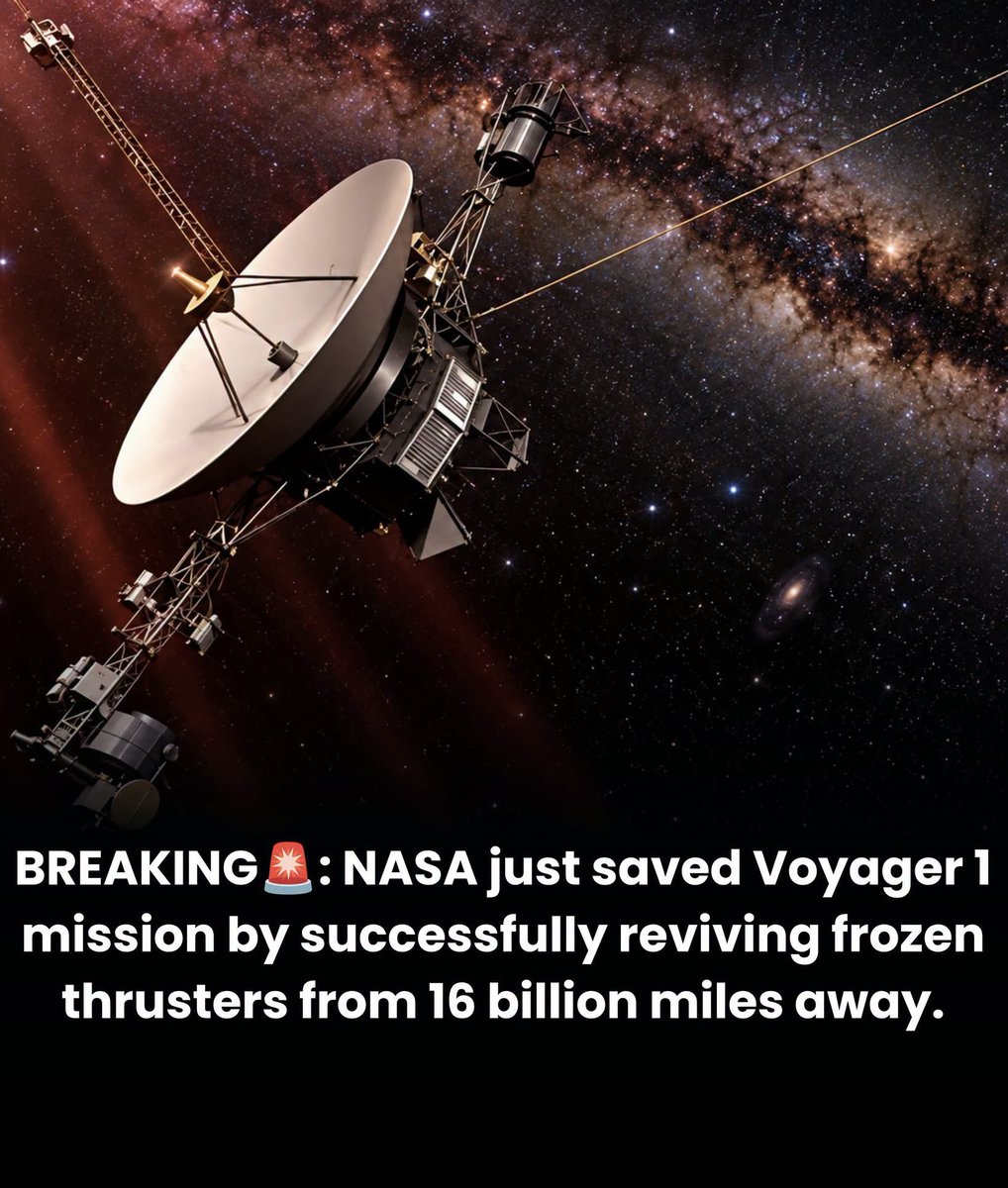
VOYAGER 1 JUST CAME BACK FROM THE DEAD
Something thought to be broken for more than 20 years has suddenly come back to life on a spacecraft more than 15 billion miles from Earth.
NASA’s Voyager 1, launched in 1977, recently faced another problem that could have threatened its ability to communicate with us. Engineers needed backup roll thrusters to help keep the spacecraft’s antenna precisely aimed at Earth. But those thrusters had been considered unusable since 2004 after their tiny heaters stopped receiving power.
Then NASA engineers took another look at the old failure. They suspected the heaters might not actually be dead, but stuck in the wrong electrical state.
So they sent a carefully planned command into deep space.
The signal took more than 23 hours to reach Voyager 1. There was no instant response and no way to intervene if the spacecraft reacted badly. Engineers had to wait.
Then, more than a day later, the telemetry arrived.
The temperature had risen.
The heaters were working.
A system believed to be lost for two decades had been brought back to life from billions of miles away.
The timing matters. Voyager’s working thrusters are slowly becoming less reliable as fuel residue builds up inside their narrow tubes. Meanwhile, the spacecraft’s nuclear power source loses about four watts every year. NASA has already been forced to shut down instruments to conserve its shrinking supply of electricity. Only two science instruments remain operating.
And Voyager 1 is still heading farther into interstellar space.
In November 2026, it is expected to become the first human-made object to reach a distance of one light-day from Earth — about 16.1 billion miles away.
A spacecraft built nearly half a century ago is still whispering information back to Earth from the darkness between the stars.
And somehow, every time it seems ready to fall silent, engineers find another way to keep it talking.
Source: NASA/JPL
In the UK, suicide is the biggest killer of men under 50, largely because so many men are taught to bottle it up.
To every man who thinks he has to
suffer in silence to be strong: real
strength is asking for help. This world is better with you in it.
You matter.
"It was at this point that an oyster went down the wrong way and blocked my ear canals, meaning I missed the whole conversation where I agreed to a foreign donor illegally giving us £500,000..."
#BBCLauraK
If one takes the time to watch the entire recording an interesting fact jumps out, James Orr, admitting on camera that there's very little financial support for Reform coming from the UK. The overwhelming majority of their donations come from abroad.
#FourScandals
"While enjoying enjoying a dozen oysters and Champagne with some friends a gentleman approached me and, against my will placed £50,000 in my pocket, his father, an American man later forced me to accept a further £250,000"
In Case You Missed It: This morning's launch of @NASA's Nancy Grace Roman Telescope.
[7:26am ET, August 30, 2026].
Will arrive at Sun-Earth L2 in Early December, to discover Exoplanets and observe the effects of Dark Matter & Dark Energy on the Universe.