AI animations crush but everyones doing the same style
You can stand out a lot by making the animation look different, the best way to do this is choose a theme that your animation will be based around
For example:
>Choose a time period to take from
>A movie animation style
>Create your own world and its physics (For example retro futuristic 1950s like the new fantastic 4 movie)
Do this to stand out from the crowd
When writing copy you need to have blocks that will have the prospect saying “hey that’s me”
I ran 100 winning ads through a learning machine and it came back saying 67% of the scripts done this
You need to hunt Reddit for this. Example for hair loss -> “I constantly check my receding hairline in car windows”
Only people with receding hairlines will go “aha that’s me”
So you need to go and find as many aha that’s me phrases as possible via Reddit
This will make the prospect believe you understand the issue more which will lead them to trust you more
Check how other brands do it here
We found another one ✍️
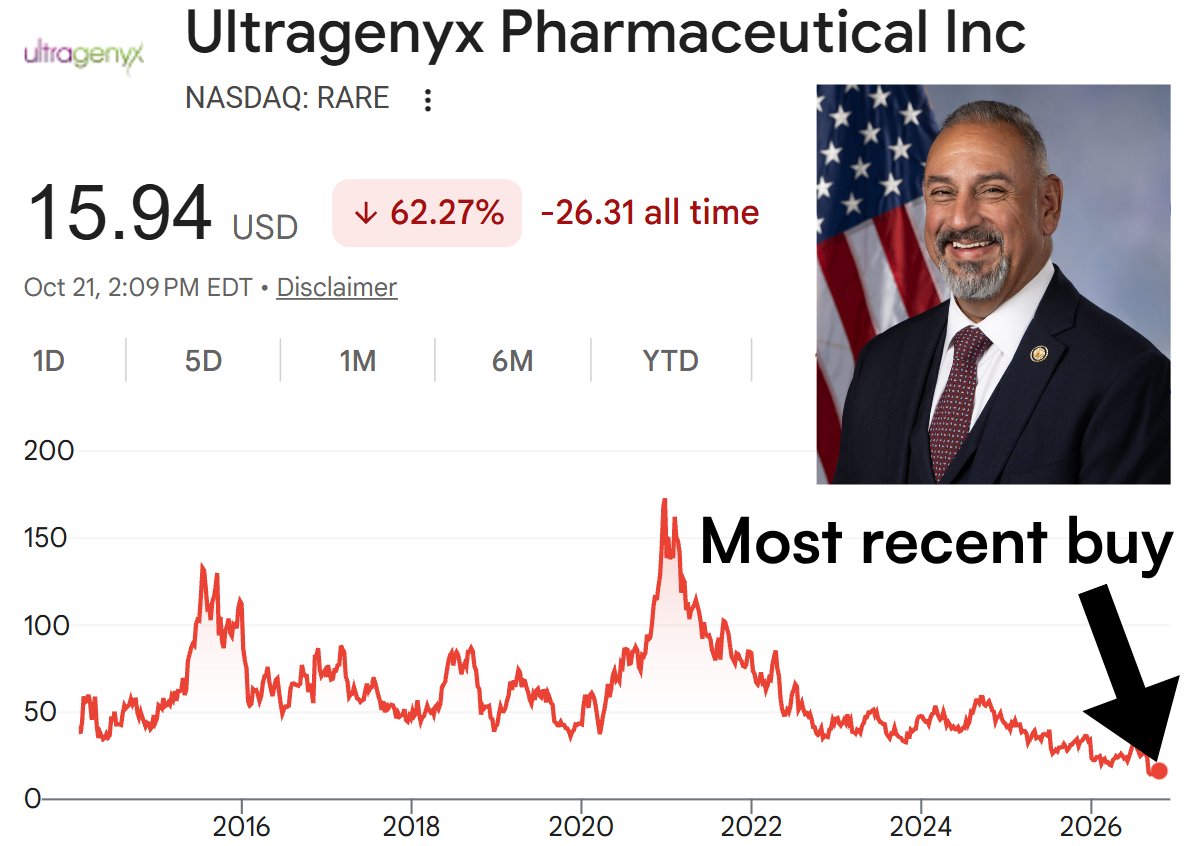
Rep. Gil Cisneros bought this random prescription drug company last month
Stock: $RARE (Ultragenyx Pharmaceutical)
His price: $15.32
1. Today, the stock trades at $15.94 (very close to his recent purchase price)
2. Ultragenyx has a market cap of ~$1.5B
3. If it returns to its ATHs, it would be +954% from here
My fun project tool now has:
- A vault with 1,000+ thumbnails
(filtered by 30+ niches, emotions, colors, style)
- Similar thumbnails feature
- Swipe files
- Aesthetic exports
- Thumbnail preview
& much more
zombie apocalypse series are taking over instagram rn
my whole feed is full of them
ended up bingeing one page last night... 174K followers, two stick figures vs the end of the world
and they're SO easy to make
- claude writes you the story, day by day
- nano banana pro makes every scene
- claude edits it, narrates it with gemini TTS
- then adds the music and sound effects
that's the whole thing
funnel the viewers to YT, enjoy the ad revenue and sponsorships $$$
the format works because every episode ends on a cliffhanger, so you physically can't stop at one
tiktok rewards creators who understand one thing: the platform needs content more than you need the platform
~30 million new videos get uploaded daily against ~100 billion daily views. the supply of quality content can't keep up with the demand for it. that imbalance is why a fresh new account with zero followers can hit 100k views on its first post
every other platform makes you earn distribution through followers, subscribers or ad spend. tiktok gives you distribution upfront and lets performance decide the rest
this is why organic tiktok is the single best acquisition channel for anyone starting from zero. the barrier to entry isn't money, connections or an existing audience. it's whether your content holds attention for 7 seconds
🚨ESTO ACABA DE MATAR A ELEVENLABS
74.000 personas ya lo han guardado en GitHub y casi nadie habla de ello.
Se llama VoiceStudio y es un reemplazo 100% gratis que corre en tu propio ordenador.
Te permite:
→ Clonar tu propia voz
→ Doblar vídeos a 646 idiomas
→ Crear audiolibros y dictar
→ Elegir entre 17 motores
Sin pago por carácter.
Sin límites de uso.
Todo en tu máquina.
🔖 Guárdalo.
ALGUIEN HA CREADO UNA HERRAMIENTA QUE DOBLA CUALQUIER VÍDEO DE YOUTUBE A 100+ IDIOMAS CON LA VOZ ORIGINAL
Se llama Voice-Pro y hace esto:
→ Descarga el vídeo
→ Elimina la voz limpiamente
→ Transcribe todo
→ Traduce a 100+ idiomas
→ Clona la voz original
→ Redobla el vídeo entero
En menos de 2 minutos.
100% local y gratis.
Os dejo el repo en los comentarios :)
NEW FORMAT ALERT 🚨
Ted talk style ad I haven’t seen this before
He’s pretending to be speaking to a crowd
Prob can make this with Heygen and make another scene where the audience at the start is cheering on
This is a banger and you should definitely follow this guy if you're interested in building distribution
One thing I'd add, especially for people building organic distribution around high ticket B2B businesses, is that the people who help distribute your content and the people who eventually make you money aren't necessarily the same people
This distinction has a direct impact on how you should structure your content strategy, particularly when your buyers represent a very small percentage of the audience you can reach organically
Let's say you're selling 30K-70K+ advisory mandates to established founders
You know exactly who your ICP is, what problems they face, what triggers them to buy, how they talk about those problems and what kind of information they find valuable
So naturally, you start producing content that speaks directly to them
You publish detailed breakdowns of acquisition financing, exit multiples, capital structures, operational improvements and whatever else is relevant to the services you're selling
The challenge is getting that content to circulate beyond the relatively small group of people who already understand and care about those subjects
A founder running a $30M business can find your analysis of acquisition financing extremely valuable
Reaching that founder organically is a separate problem, especially when you're starting from zero
This is particularly relevant on algorithm driven platforms like Instagram, where you don't get to decide exactly who sees your content
Creating content that speaks directly to your ICP doesn't necessarily mean it'll reach them
The audience responsible for distributing your content doesn't have to be the same audience responsible for generating your revenue
When you're operating in markets where a single commercial relationship can be worth six or seven figures, those two audiences can be almost entirely different
You have people who consume content because they find it entertaining, educational or aspirational
They engage with it, share it, discuss it and contribute to its distribution
Then you have people who operate closer to the markets you're targeting
Founders, executives, investors, advisors, industry professionals and people who have direct access to the buyers you want to reach
And finally, you have the actual economic buyers
The people with the problems, resources and authority to enter into the transactions you're trying to originate
These groups aren't completely separate, but they don't perform the same function
A younger entrepreneur who can't afford a $50K consulting mandate can still help distribute content that eventually reaches established founders
An advisor who has no intention of buying your services can become an important source of introductions
And a founder who never engages with your posts can consume your content for months before eventually contacting you about a transaction
So when I build a content strategy, I'm not exclusively thinking about how to make every publication appealing to the final buyer
I'm thinking about how to create enough circulation around a particular set of subjects that the right people repeatedly encounter the business, while making sure there's enough depth behind the content for those people to take us seriously once they do
That requires different types of content doing different jobs
For example, an advisory firm can publish a breakdown of how an entrepreneur built a billion dollar business through acquisitions
That's a subject with broad appeal
You can make it interesting to people who have never acquired a company, never raised capital and have no intention of hiring an investment bank
Then you can publish a much more technical analysis of how the acquisitions were financed, why the capital structure worked and what made the economics attractive
A much smaller audience will care about that second piece
But among the people who do, you'll find a greater concentration of mfs who actually understand the subject and have some commercial proximity to it
And you can go even deeper by addressing the specific situations that lead someone to hire an advisor in the first place
A founder preparing an exit has very specific questions about what buyers will scrutinize during diligence, how different deal structures affect his proceeds and what he can do to improve the terms of the transaction
The content addressing those questions can generate a fraction of the impressions and still bring in more valuable business opportunities
We applied a version of this with a client operating across high-ticket consulting and institutional advisory
We were building organic distribution around an offer targeting established founders and investors, with consulting mandates ranging from $30K to $70K+
We could have built the entire content strategy around highly technical subjects directly related to the firm's services
Instead, we deliberately used broader entrepreneurial content to generate discovery, while using more specialized material to establish the kind of authority required to originate expensive mandates
A lot of the material came directly from the client's existing expertise and conversations, but we were intentional about which subjects we extracted, how we framed them and which audience each piece was supposed to reach
Some of the content was designed to circulate well beyond our immediate ICP
Other pieces were much narrower and spoke to problems that only established business owners would recognize
The highest performing content in terms of impressions and the content originating the strongest commercial opportunities were often different pieces entirely
Some relatively modest performers in terms of views were attracting precisely the kind of founders we wanted
Within the first 30 days, we generated over 800K organic views, booked 48 qualified calls and collected $300K+ in front-end cash, without spending a dollar on advertising
The founders entering the pipeline also represented approximately $125M in combined net worth
That figure refers to the cumulative net worth of the founders we originated relationships with, which is relevant because the firm could serve them through several different types of mandates beyond the initial consulting engagement
The immediate consulting mandates were one way to monetize those relationships, but the firm also had the capabilities to serve those founders through financing, capital raising, acquisitions, M&A and other advisory mandates
The consulting business gave us a reason to establish commercial relationships with founders who had problems worth solving today, rather than waiting until they needed to sell a company or raise capital
And once you're working with someone on growing or improving his business, you naturally develop a much deeper understanding of his operations, ambitions and potential future needs
A $50K consulting client who eventually needs help financing an acquisition or selling his company can represent an entirely different level of economic opportunity
Those future transactions aren't guaranteed, of course, but the commercial relationship has value beyond the initial mandate because the firm has several ways to serve those clients over time
Our distribution was therefore feeding an advisory business where the same founder could generate revenue across multiple mandates, with the initial consulting engagement creating opportunities for a much longer commercial relationship
That same logic also influenced how we evaluated content performance
One thing mentioned in the original article is doubling down on content outliers, which makes sense
But you have to be careful about what you're actually optimizing for
If you publish a video that generates 300K views and another that generates 4K, your instinct is naturally going to be to reproduce the first one
Except the first video could have attracted hundreds of thousands of viewers who will never have a reason to buy your services, while the second brought you two conversations with founders operating eight figure companies
That doesn't automatically make the first video useless
It could have introduced thousands of people to your brand, expanded your distribution and contributed to the discovery of other content that eventually generates business
And the second video could have generated more commercial value with a fraction of the reach, despite looking like a much weaker performer in your analytics
You're evaluating two pieces of content designed to perform different functions using the same metric
And if you keep optimizing exclusively for whatever gets the highest reach, you can gradually end up with an audience that's increasingly disconnected from the economics of the business you're trying to build
That's why I think content performance has to be evaluated at the level of the entire distribution system
You need to understand which subjects generate discovery, which ones attract relevant operators, which ones create qualified conversations and how those different interactions contribute to actual transactions
You also need to account for the fact that buyers rarely consume one piece of content and immediately purchase a $40K service
A prospect can discover your business through a broadly appealing video, follow the account, consume several more specialized pieces over the following weeks and eventually reach out when a particular problem becomes relevant
Looking exclusively at the last piece of content they engaged with would give you a distorted picture of which parts of your distribution actually contributed to the sale
And if you eliminate the broader content because it doesn't directly produce sales, you can end up destroying the distribution mechanism that was introducing those buyers to your business in the first place
So before producing content, I'd work backwards from the relationships I want the business to originate
Who are the actual economic buyers, what situations make them need your services, who influences their decisions and which people and networks surround them?
Then I'd look at the subjects connected to our expertise that can attract attention beyond those immediate buyers, without turning the account into something completely unrelated to what we're selling
The broader content still needs to create a logical connection to the more specialized material and the commercial audience you're ultimately trying to reach
Once you've figured that out, the storytelling, packaging and channel selection principles in the original article become much easier to apply intelligently
You know what subjects need broad distribution, where technical depth matters, which channels give you access to relevant networks and what commercial outcomes you're actually trying to produce
i'm begging you:
- sell joint supplements to men who just turned 40
- target them on youtube not facebook
- $4-6 CPMs. half the price of facebook. a tenth of tiktok
- he watches one video and buys. no second tab. no temu. no comparison
- sell the 90-day supply as default. pre-select it in the URL
- add a subscribe checkbox. his knee won't heal. the pain is the retention
- return rate: under 3%. men over 40 don't return anything
- sell the same supplement in germany. highest supplement spend per capita in europe
- stop answering emails that could wait until tomorrow
- take a wednesday off because you can
- sit somewhere quiet and feel nothing but bored. bored means nothing is on fire
here's exactly how to do the first eight:
1. FIND THE PRODUCT (ONE EVENING)
- go to amazon. search "joint supplement men." filter to best sellers with 3.5-4.0 stars
- the 3.5 star products have massive demand and massive complaints. "tastes terrible." "pills are too big." "took 3 months to feel anything"
- your headline: "tasteless powder. mixes in coffee. feel the difference in 14 days." every word came from their 1-star reviews
- find the same formula on aliexpress. $3-5 COGS. sell for $49-69
2. TARGET ON YOUTUBE (NOT FACEBOOK)
- google ads > youtube campaigns > target men 40-55 watching health/fitness content
- the buyer is already watching a video about his knee pain. your ad appears before the video. the context does the selling
- youtube CPMs for men 40-55 health: $4-6. facebook CPMs for the same demographic: $12-15
- one honest review-style video ad with one negative ("the taste isn't great but it works") converts this demographic 3x higher than polished content. the negative builds trust
3. THE 90-DAY DEFAULT TRICK (30 SECONDS)
- list 3 variants: 30-day, 60-day, 90-day supply
- reorder variants so 90-day is first. the first variant is the default. 60-80% keep the default
- add ?variant=90DAYID to every ad URL. the buyer lands with the most expensive option already selected
- AOV jumps from $49 to $119 from one URL parameter. he doesn't switch to the 30-day. men over 40 don't optimize small purchases. they keep the default
4. THE SUBSCRIBE TRICK (10 SECONDS)
- add "subscribe and save 15%" checkbox. pre-select it
- 35% keep the default. the knee doesn't heal. the pain comes back without the supplement
- canceling means the pain returns and he has to admit he needs it again in 30 days
- LTV: $49/month x 8-14 months = $392-686 per customer from one $4-6 youtube ad
5. GO INTERNATIONAL (ONE AFTERNOON)
- translate page into german. launch germany. highest supplement spend per capita in europe. $4 CPMs. enable SEPA
- translate into spanish. launch mexico. $3.92 CPMs. enable OXXO
- men in germany have the same knee pain as men in ohio. the supplement market is universal. the language barrier isn't
the last three never needed a guide
sitting somewhere quiet and feeling bored happens when 400 men with bad knees subscribe monthly and the supplement ships itself. Print $35K/mo
[ full system is in a 36-page playbook. comment "KNEE" and I'll send it. must be following ]
(I built the AI tool that does the page part - paste any aliexpress link, full page in 60 seconds → link in bio)