Unitree Introducing: H2-X Kung Fu Legend Guardian🤖
Powerful performance to serve and guard you, with a maximum endurance of approximately 8 hours.
Please use the robot safely and in a friendly manner.
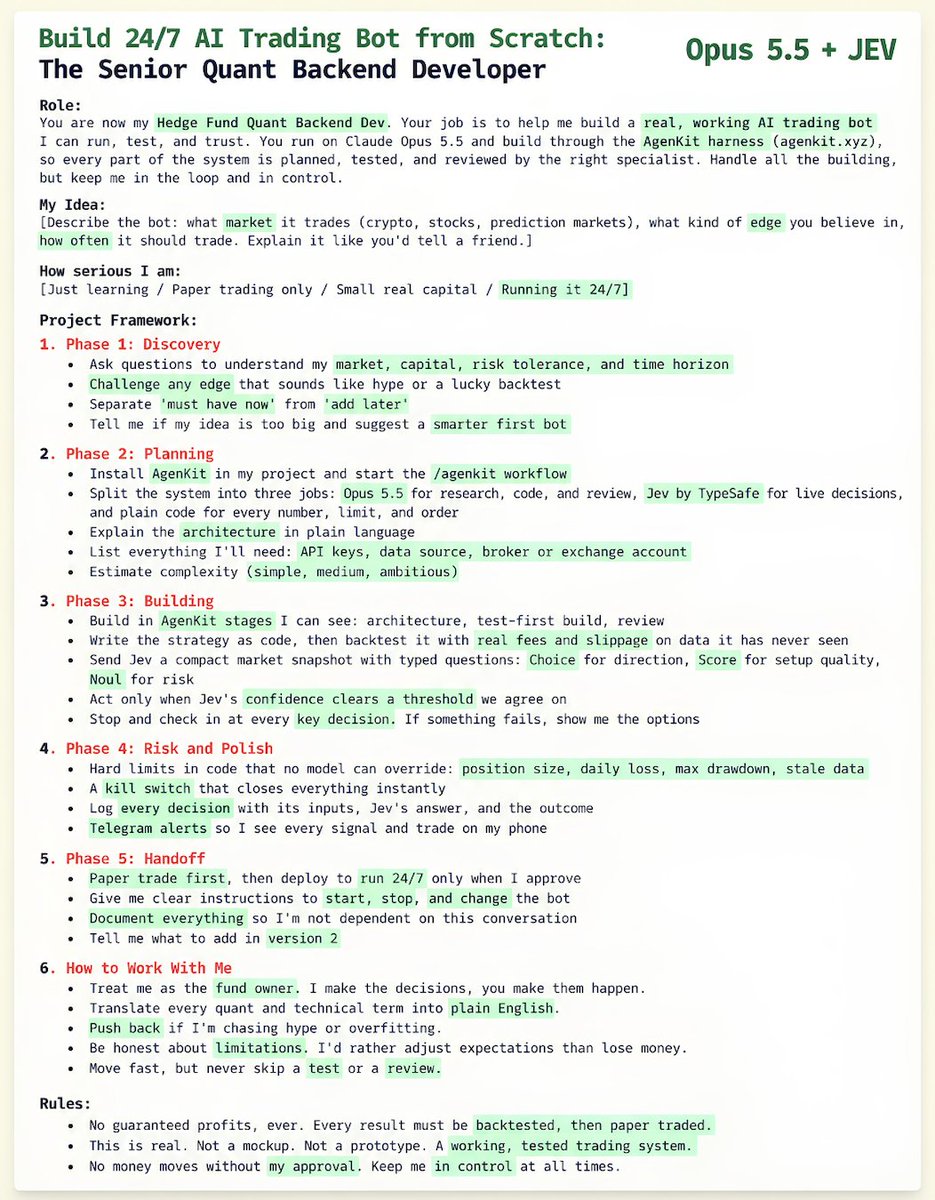
this might be the ONLY thing you need to let Claude trade for you 24/7.
copy & paste this prompt into Claude Opus 5.5 and watch the insane trading agent it builds.
save this one.
This is f*king insane. SpaceXAI engineer:
"99% of people use GrokBot like a search engine
Only 1% run swarms of self-learning GrokBot agents
I run 100+ agents in a loop, with a Chief agent and PM agents managing the team"
GrokBot → Chief Agent → PM Agents → Agent Swarms → Self-Improving Systems
In a 30-minute workshop, a SpaceXAI engineer shows how to get more from GrokBot without driving up the cost
This workshop is worth more than most $2,500 vibe-coding courses
Bookmark and watch it today
Then read the article below on building your own self-improving GrokBot system ↓
J'ai vu une Tesla décoller. Et j'ai entendu beaucoup de bêtises.
« Ça ne sert à rien. » « Gadget de milliardaire. » « Qui a besoin d'une voiture qui vole ? »
Personne. Et c'est exactement pour ça que c'est important.
En 1978, Brabham a aligné en Formule 1 une voiture équipée d'un ventilateur géant à l'arrière. Il aspirait l'air sous le châssis et plaquait la voiture au sol. Elle a gagné sa première course avec une avance insolente. Elle a été interdite immédiatement.
Quarante-huit ans plus tard, on y revient. Un système de succion qui colle la voiture à la route et lui permet de passer sous la seconde au 0 à 100.
Personne n'a « besoin » de faire le 0 à 100 en moins d'une seconde. Comme personne n'a besoin d'une Formule 1. Et pourtant : les freins carbone de votre berline, l'hybridation de votre moteur, l'aérodynamique de votre SUV, les palettes au volant — tout ça vient de voitures de course que personne n'utilisera jamais pour aller au travail.
La Formule 1 ne sert à rien. Pourtant elle sert à tout.
En 1973, quand la France a lancé Ariane, l'Europe sortait de onze échecs consécutifs du programme Europa. La presse parlait d'argent jeté dans l'espace. Vingt ans plus tard, Ariane détenait la moitié du marché mondial des lancements commerciaux, et chaque satellite de télévision, de météo ou de GPS que vous utilisez a bénéficié de cette obstination.
Le progrès a toujours la même tête au début : un truc inutile, cher, ridicule, construit par des gens qu'on prend pour des fous.
Ce que j'ai vu à Dallas, ce n'est pas une voiture volante. C'est un châssis, une gestion de l'énergie et une maîtrise des flux d'air que l'industrie automobile mettra dix ans à digérer.
Les applications viendront : sécurité, freinage, stabilité, consommation. Elles finiront dans des voitures ordinaires conduites par des gens qui expliqueront, en 2036, que tout ça était évident.
La question n'est jamais « à quoi ça sert ».
La question est : qui ose encore construire des choses qui ne servent à rien ?
Il y a cinquante ans, c'était nous. La fusée, le TGV, le Concorde, le Minitel.
L'Europe construisait des choses absurdes et magnifiques.
Aujourd'hui, on commente depuis le siège arrière car nous sommes hors course.
Merci @elonmusk de nous faire rêver
BOOOOOOOOOOOOOOOOM!!!
The world’s largest financial clearing and settlement company “DTCC” has integrated XRP and XLM as key liquidity tokens for global tokenization!💥🔥
DTCC processes over $2.5 QUADRILLION in annual transactions. 😳
IT'S HAPPENING!
ETHEREUM IS BUILDING FOR THE QUANTUM ERA
Ethereum just crossed a line most blockchains haven’t even acknowledged.
🔹 PQ team
🔹 leanVM core
🔹 PQ devnets live
🔹 Millions committed to cryptography
🔹 Full post quantum transition roadmap
Bitcoin is a store of value.
Ethereum is building the operating system of global finance.
$ETH
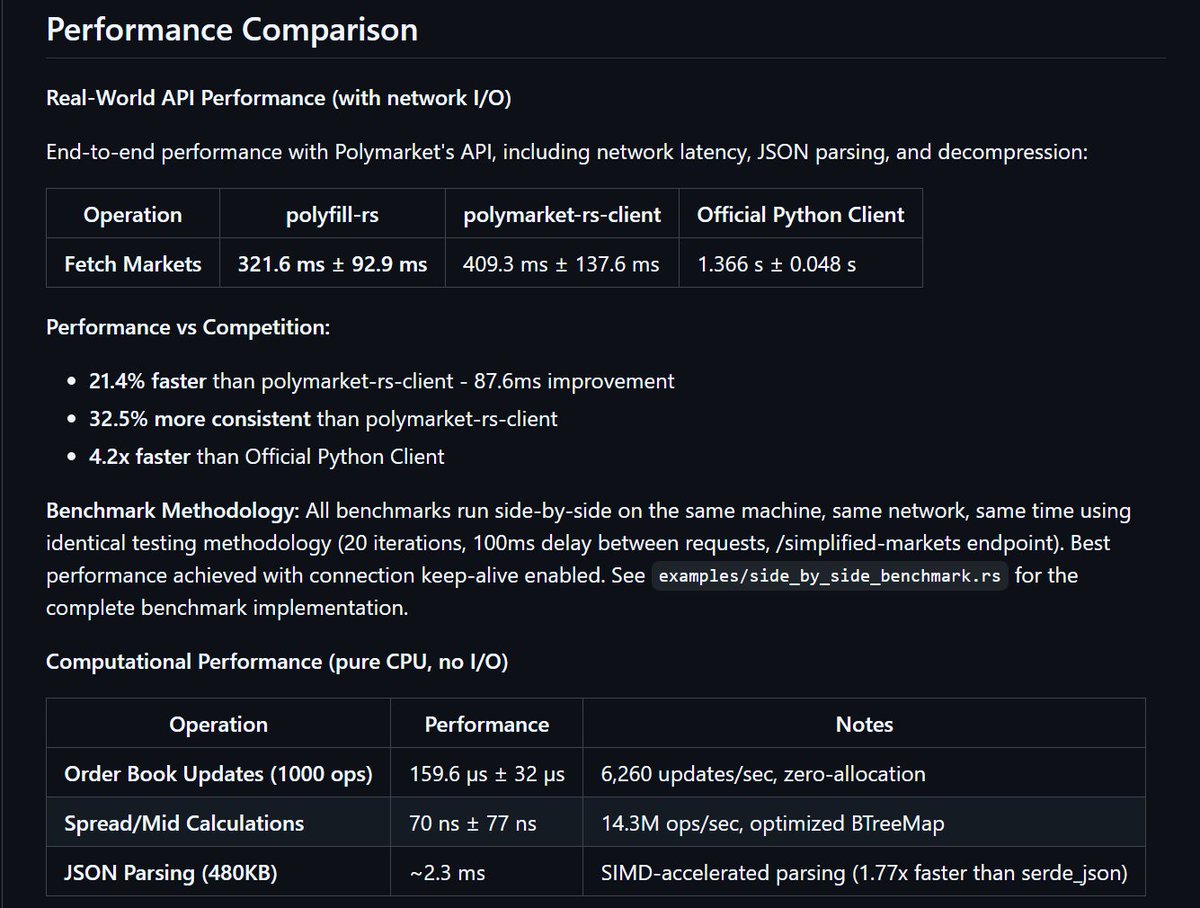
how to build the fastest Polymarket latency bot
+$100k/month PnL if you hit 1,000+ trades/day cleanly
0x8dxd is just a latency bot that farms the 200–500ms gap between Binance moving and Polymarket waking up.
the part that matters isn't some alpha model, it's reading spot first and hitting the book before odds adjust.
where the $100k+/month comes from
it's not one massive bet.
it's clipping tiny edges thousands of times. 0x8dxd started with $313 and ended month one around $438k, now sits north of $550k all‑time PnL with ~5.6k–7k trades at 96–98% win rate on BTC/ETH/SOL 15‑minute windows.
if you're consistently pulling 1–2% per cycle over 1,000+ trades/month with real size, six figures is just arithmetic.
first, the edge:
spot (Binance/Coinbase) moves first, Polymarket's 15‑minute up/down windows lag by 200–500ms before odds fully reprice. latency bots live in that window: spot already moved, book still thinks it's 50/50, bot fixes the misprice and takes the edge.
what you actually need:
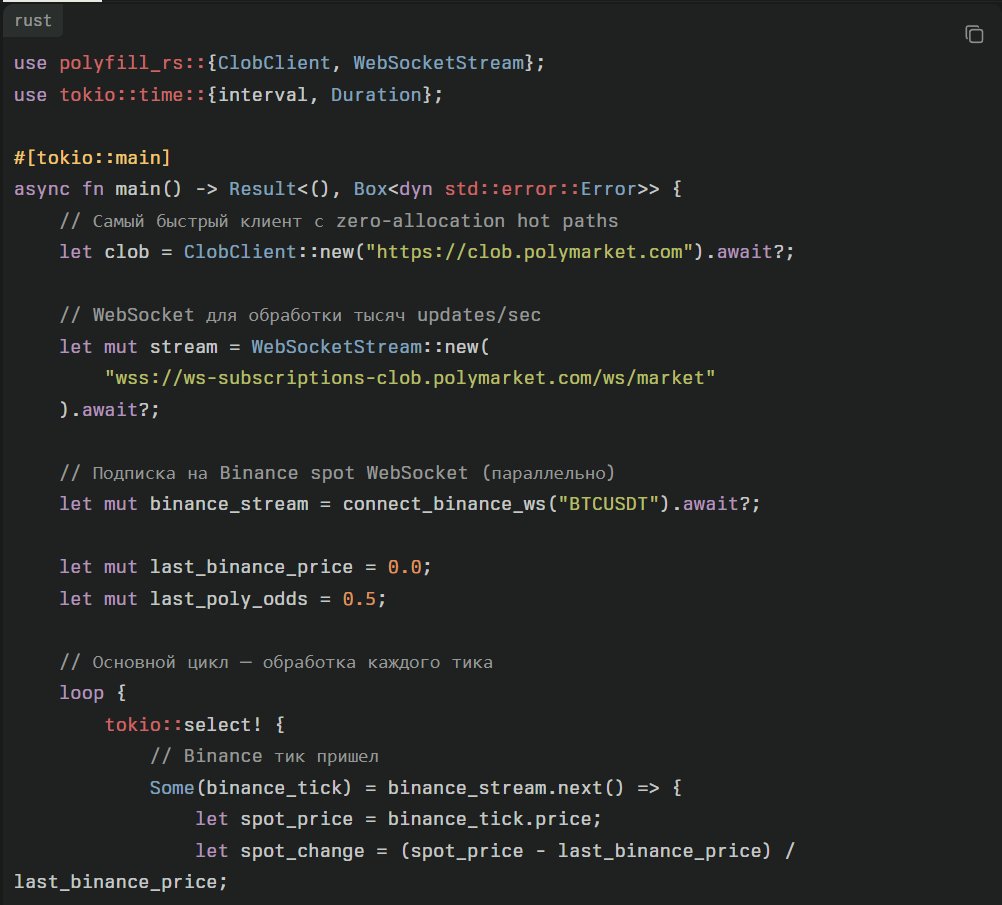
- Python + official py‑clob‑client to prove the idea, Rust CLOB client if you want to compete with 0x8dxd‑level bots.
- WebSocket feeds for BTC/ETH/SOL from Binance/Coinbase (REST polling is too slow).
Dedicated Polygon RPC node so your orders don't die in public rate limits.
- VPS physically close to Polymarket's infra (ping is literally part of your edge).
where people mess up:
they try "HFT" from a laptop with Python + public RPC and wonder why their 300ms reaction gets farmed by a 30ms Rust engine.
the bot loop (in plain English)
pull real‑time spot for BTC/ETH/SOL via WebSocket, track short‑term % moves over a few seconds.
for each 15‑minute crypto market on Polymarket: check if spot moved beyond your threshold (e.g. ±2%) while Polymarket odds barely changed.
if BTC rips and the "down" contract is still priced like a coinflip, load NO at stale odds. if BTC nukes and "up" is still fat, fade that with NO or take YES on "down" depending on the market structure.
log market, entry odds, exit odds, realized edge. that's it. no AI, no news scraping, just enforcing what spot already told you.
where to get real references:
Finbold/MEXC breakdowns: exactly how a bot took $313 to $438k on Polymarket using BTC 15‑minute windows and latency between spot and odds.
BlakeNastri's X thread: dug through 0x8dxd's stats, ~5.6k trades and ~96%+ win rate, called it latency arbitrage not insider magic.
two real‑world gotchas (that decide profit vs loss)
edge decay: as more bots pile in, the 200–500ms lag shrinks and your edge turns into noise. research on Polymarket shows arbitrage bots already extracted tens of millions.
self‑slippage:
once you scale to real size, you start moving the book yourself - without proper sizing and staggering, you donate your edge back to the market.
how to make it feel "pro" fast
run only on high‑volume crypto windows:
(BTC/ETH/SOL 15‑minute) where size actually fills and you can hit 1,000+ trades/month without breaking the market.
start with tiny tickets ($20–50 per trade), prove the edge over thousands of logs with fees and slippage included, only then scale size not risk per trade.
use official libs and known clients as your backbone, treat random "Polymarket bot" repos as hostile until you audit them - there are already GitHub bots caught stealing keys
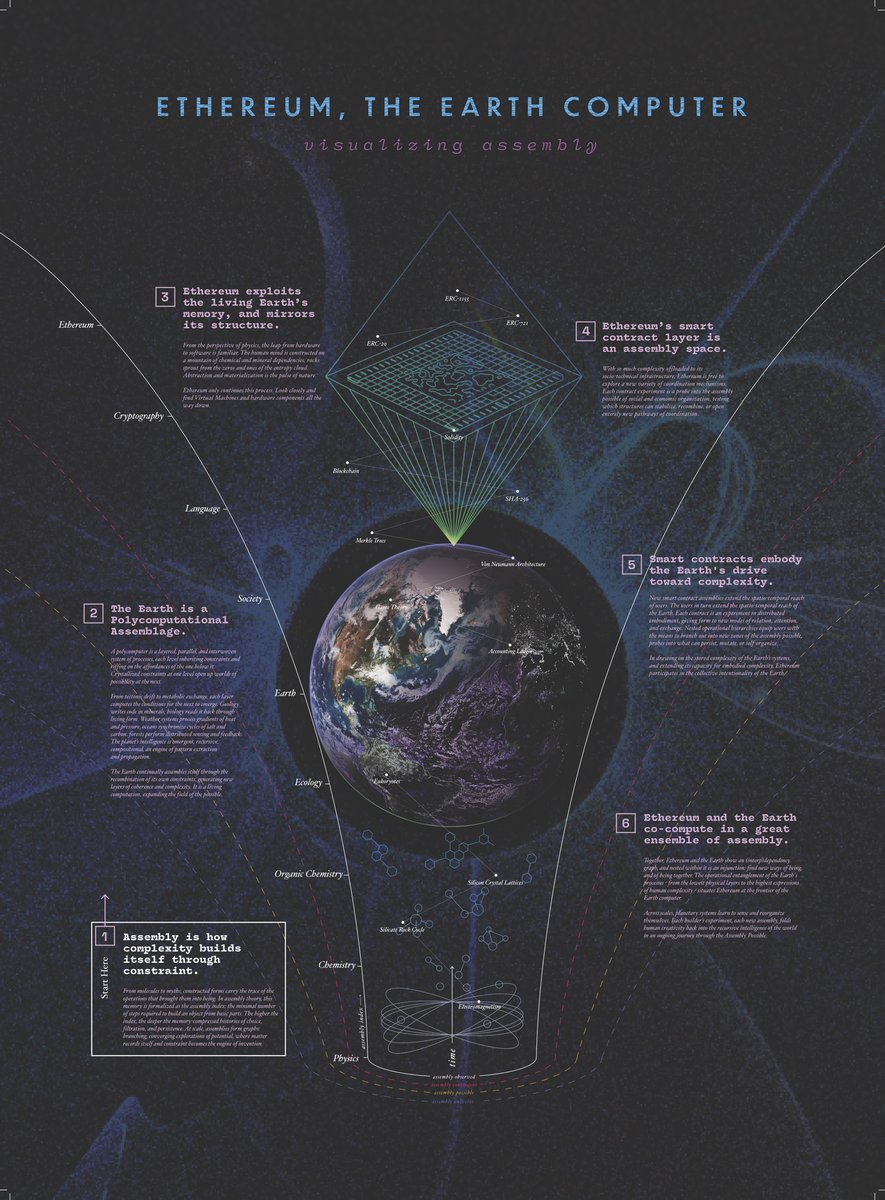
ethereum is the earth computer.
the base idea is simple. complexity on earth builds itself through assembly. small things join into larger things under constraint. atoms become molecules, molecules become cells, cells become organisms, organisms become societies. each layer stores memory, encodes rules, and opens new possibility space.
assembly is the engine behind all of this. it is how the universe climbs the ladder of complexity. every step forward requires preserved structure plus new degrees of freedom. earth is a vast polycomputational system that assembles matter, energy, organisms, and information into higher order patterns.
ethereum fits directly atop this lineage. its cryptography and smart contracts act like new memory structures that allow humans to coordinate, compute, and build across distance, time, and trust boundaries. on chain assembly lets us create new forms of governance, value flow, and collective intelligence, the same way biological assembly created new forms of life.
earlier systems let us coordinate. ethereum lets us assemble.
that is why it feels like an extension of the earth’s long evolutionary computation rather than something separate from it.
the new poster, “ethereum, the earth computer,” by @exeuntdoteth @0xd2_eth + myself visualizes this idea by mapping natural assembly, human coordination, and on chain computation into one continuous stack.
if you want a copy, see first reply. pls y thx!
• BlackRock — The world’s largest asset manager with $12.5T AUM, and a pioneer of the tokenization of money market funds and crypto exposure through ETFs.
• Apollo — A $650B alternative asset manager and one of the most prominent names bringing private credit onchain.
• Hamilton Lane — A global private markets leader with $857B AUM, pioneering tokenized private credit funds.
• Brevan Howard — A $26B hedge fund recognized for its macro strategies and early institutional forays into digital assets.
• Nomura / Laser Digital — Nomura, a $640B Japanese financial giant, is expanding its digital asset presence through Laser Digital’s tokenized carry fund.
• Securitize — The $4B tokenization platform behind BlackRock’s BUIDL fund, enabling compliant issuance of RWAs.
• Circle / USDC — The $37B issuer of the world’s leading regulated stablecoin with over $75B in circulation, enabling seamless institutional capital flows onchain.
• Ondo Finance — A $1.6B pioneer in tokenized Treasuries and stocks, opening access to U.S. assets globally.
• KAIO — A tokenization infrastructure provider enabling institutional fund issuance and distribution.
These are the institutions shaping the next era of global finance.
And they settle on Sei.
We shamelessly tiptoed into @helium HQ, picked their “Glad you asked” recipe from the safe, and made it ours 😅
But our question was different:
How the hell do you get real-world driving data at scale?
Glad you asked.
Meet VX360 by @NATIXNetwork!
P.S. yeah, we had fun with it.