Four years ago, James Lee warned that the National Institutes of Health engaged in a policy of censorship, that they were limiting the topics researchers could look into.
Over the weekend, the New York Times published a defense of doing just that: a call for censorship.
The piece is a bunch of furor over the fact that 'the wrong people' (allegedly: myself, @KirkegaardEmil, a professor, and another student)—again, allegedly—have access to taxpayer-funded data, and that said access allows looking into topics that offend some people.
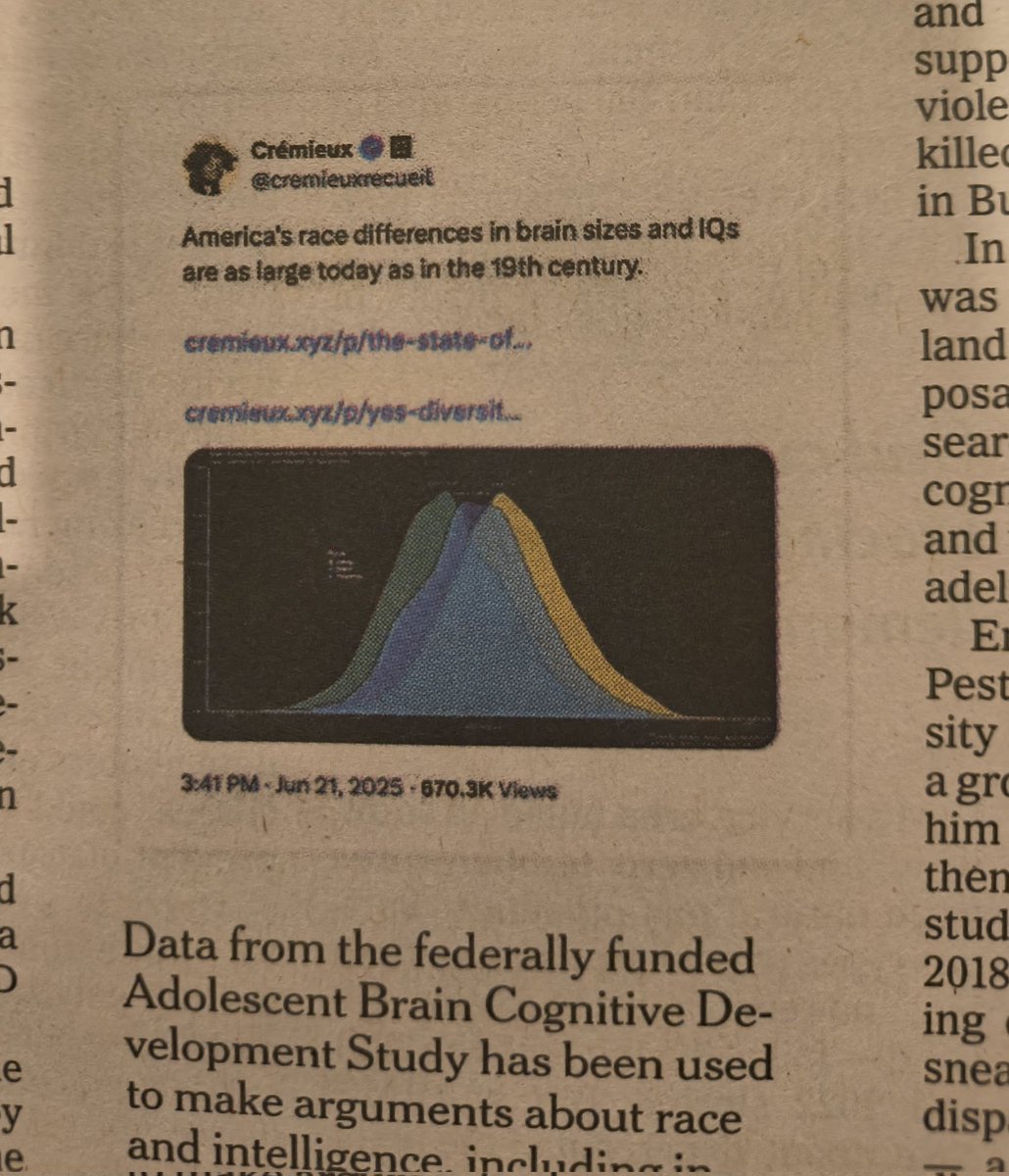
The main example provided in the article was that I posted a graph showing brain size gaps by race—an extremely well-replicated finding and, indeed, a finding that was subsequently reproduced by other researchers working with the same dataset!
The NYT failed to articulate the problem with this. Their case was, ultimately, that this and this sort of thing just shouldn't be looked into, that access to publicly-funded datasets should be forbidden to certain people and research into certain topics with those datasets should be restricted as well.
Which research? Allegedly "race science"—a made-up term that conveniently describes anything bad. It's essentially a smear word, a slur to describe scientific research done by people regarded as undesirable. We know this is a fact because other people who are not undesirables can sometimes get away with doing the same research and reaching the same conclusions without any problem. They just can't be too loud about it or they'll face censure.
The point of many of these NIH-maintained datasets—like the one they cited, the ABCD—is to provide researchers with data that lets us peer into different cross-sections of American life, with all the diversity that entails. The dataset that graph is based on was built with a lot of focus on understanding race and class in modern America, and much of the research done using that dataset is focused on exactly that.
That research is not maligned, however, because its authors abide by the unstated academic consensus. Among other things, that means:
- Always ascribe any group difference to the environment, regardless of the evidence otherwise.
For example, in the ABCD, most of the Black-White gap in IQ is genetic in origin, but there's a sizable portion that's environmental. Simply recognizing that any portion of it is genetic is enough to get you hounded out of academia, but it's necessary to figure out what we can manipulate in the environment to augment this outcome. It's also important to act as a constraint on our understanding, to help us with theorizing, and so on and so forth.
If we reject reality or simply prevent it from being recognized at all, we will end up wasting time and public funds. The NYT does not care.
- Never be open. Minimize the presentation of summary statistics, the frankness of conclusions, the interpretability of data, lest someone 'bad' notice that it reaches uncomfortable conclusions for anyone with the approval of the professional middle-class.
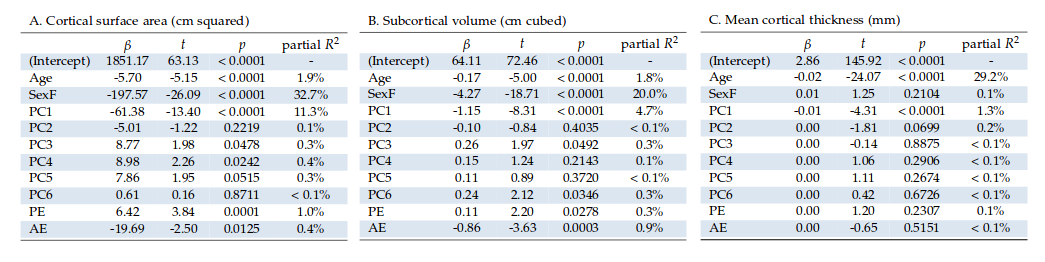
This happened in another of the datasets mentioned in the NYT piece, the PNC. Some researchers were using that dataset to investigate supposed environmental effects on brain volume by carelessly correlating variables like parental education and a measure of childhood adversity with brain volumes and subvolumes. They came to causal conclusions despite not using a causal design, but they were never hounded for that. More importantly, they followed the rule and they weren't too open about one of their important findings.
They observed that several different principal components of genetic admixture—a quantitative measure of your ancestry—correlated in various ways with brain volumes. One of these correlated extremely negatively, and was the largest principal component in the set. They did not label it, but if they had, we would have seen that it was African ancestry.
That is to say, they found what the NYT reviled me for posting on here: that African ancestry is related to smaller brain size. That could be inferred with the right background and with the result in hand, but it could be only be verified by actually having this data. Thank god for accessibility!
But, despite making that finding and it having considerable theoretical importance and, in fact, being capable of undermining some of their results, the authors of that article avoided saying a word about it. To be too open is a punishable sin in academia, and the NYT hates openness.
- If you touch the third rail, couch it in euphemism. If you happen to accidentally find something that makes a certain group look bad, misportray it. If you find something that you feel is inappropriate or could get you in trouble, lie and say it's good, or blame someone else for it.
There are umpteen many examples of this, but one of my favorites uses one of the datasets I've posted results from: the Human Connectome Project. The result was that racial ancestry could be predicted with extremely high accuracy (93%) from fairly unreliable brain scan data. Accordingly, race must be very obvious in the brain! But what did the authors conclude? Well: "genetic ancestry constitutes a bias" in resting state fMRI.
A bias! This is certainly one way to put it, but others would just call this "a difference". Importantly, this matters, so calling it a bias isn't totally unwarranted.
Why does this politically incorrect finding matter? Many reasons, but one that the authors focused on was that it affects how people should handle this sort of data in the first place. Consider: if, say, race differences in neural morphology are not accounted for in subsequent analyses, then they might create spurious associations that are actually attributable to a failure to recognize group differences.
If you want to do research on which environmental variables affect people's brains during development, you actually have to recognize and care about these race differences, or you will end up wasting time and taxpayer money. But if the NYT had their way, we would just burn that money.
Side note: this finding replicated in the ABCD with other MRI data.
- Don't be too curious. If you're interested in particular topics, you will be considered to be a bad actor, even if those topics are important, answerable with existing data, can lead to positive interventions, and so on. If you have the gall, you can lose it all. If you're familiar with cancel culture in academia, your list of examples is effectively unlimited. The NYT stands for more cancellation.
What America's paper of record has done with their "race science" article is declare that they are enemies of free and open inquiry, of open data, of research into any topic, regardless of where it may lead. I don't think they'd actually disagree with that characterization either, to be frank.
Too many on the modern left will accept that they want limits on what's acceptable to research. They accept a delusion that a lack of knowledge is somehow preferable to knowledge, because knowledge might do us harm.
They have never made any arguments in favor of this case that aren't just built on misrepresentations and distortions, fabrications, or outright lies, but that doesn't matter since they are substantially in control of the institutions that decide what is right, moral, and true, even if they're wrong, even if their conclusions actually lead to blood libel, terrorism, discrimination, and more (and they certainly do. See: wokism, affirmative action, the Covenant shooting, perhaps even more prominent events like Charlie Kirk's assassination).
Where we should go from here is actually very clear.
We can weaken and potentially crush these cancerous, anti-scientific, anti-progress, anti-knowledge building calls for censorship once-and-for-all by having the government open up the datasets that the American people have already paid for. In fact, with the HHS Open Data Plan (see the statements by @HHS_Jim) and the establishment of the MAHA Commission, the President has already established doing just that as a goal.
The only thing left to do is to actually make it happen, and in doing so, to crush waves of censors forever.* Making anti-censorship into actual policy is the next step after that, and doing that is simply the American way.
Sources:
https://t.co/FhblUIDfQn
https://t.co/UgfVG7LRY6
https://t.co/q6c10bAbu9
https://t.co/aGCZlsJDKk (preprint: https://t.co/OtAEf7Bt9i)
https://t.co/b1s48sPJeQ
https://t.co/zwCiUnNzID
https://t.co/s9oG4U9M5F
* They'll argue there will be chilling effects on participation in scientific research, but (1) so what? The pursuit of the truth should not be held up by any such possibility and (2) there are, realistically, only chilling effects in so far as they are created by the censors riling people up into fear and anger over scientific findings that they do not like.
@yeselson@BlueBoxDave@RoKhanna I don’t think you are correct when you say most Americans are repulsed. A ton of people are repulsed by these protesters and have been for years.
@vplasma_ I’m your run of the mill midwit and was leary of being able to “build” my own pc. Watched a couple of YouTube vids and went for it. Was surprisingly easy.
@JoshuaLevyX @KdeanGames @shelbyfitzzz@XFreeze That’s a good question. I’m not sure how that works. I’d imagine if the ISS turned heat off the station would cool.