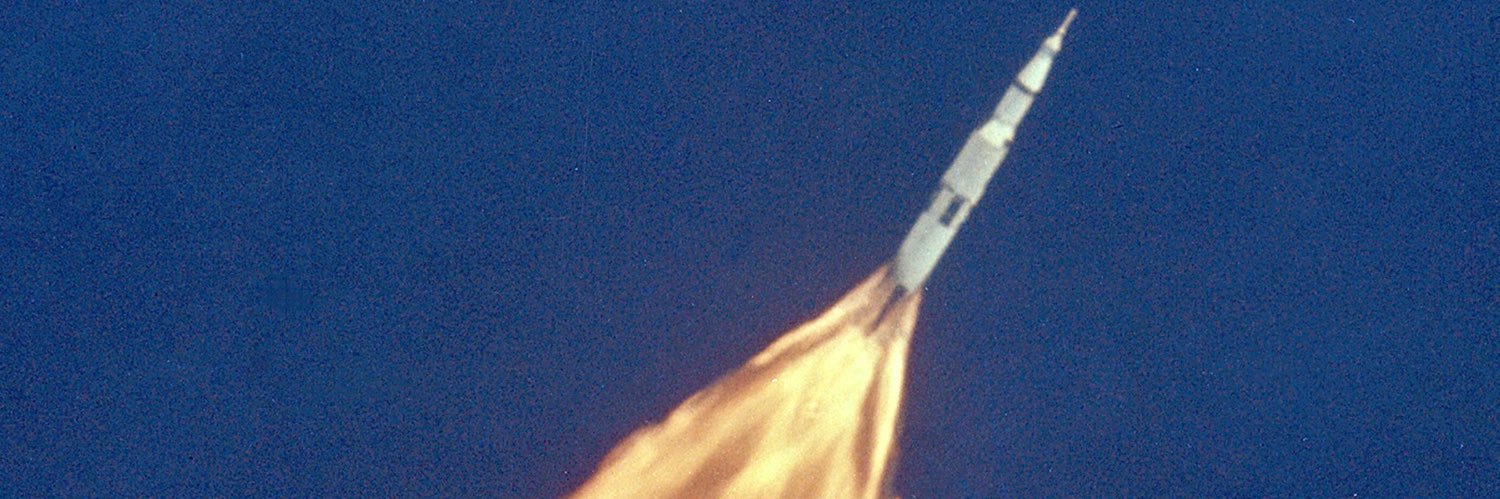
Voyager 1 is now one light-day from Earth, an extraordinary @NASA achievement for a spacecraft assembled by human hands and launched nearly 50 years ago. As we celebrate this milestone, with Voyager continuing her journey through interstellar space at nearly 38,000 mph, consider what those brilliant minds made possible with the technology of 1977 and how much farther we should aspire to go with the tools, resources, and ambition of our time.
Responding in my personal capacity, but wanted to share my perspective..
We are in a great-power competition with so much at stake in the years ahead. There is no one in America who has lived during a time when the United States wasn't the preeminent superpower and, despite our imperfections, a force for good in the world. A nation that fought and helped end wars on behalf of those who couldn't, pioneered powered flight, put humanity on the Moon, led revolutions in medicine and technology that improved billions of lives and distributed hundreds of billions in aid around the world.
I don't know how handicapping this nation by going after one of its largest employers, a company that has created wealth for millions, ushered in electric cars, rockets that don't need to be thrown away, satellites that connect the disconnected and have unquestionably saved lives, not to mention access to information that is pretty foundational to solving many of the world's problems, biotech to restore function to those with disabilities, and so much more, serves America's interests. Without the contributions of these companies, there is little question America would be behind in a competition where the outcome is far from certain and the consequence so great.
Now, maybe I am just a bit new to this, but from the billboards, TV and digital ads, spam texts, and fundraising calls, it would seem both parties have no issue raising money, including from billionaires, with the aim of influencing and buying votes. And if that means campaign reform, maybe include dialing back the spam calls and texts..But with all that is going on in the world, and so much at stake for our country, I question the priorities reflected in the post below.
Phenomenal post
The stakes are high — it’s not guaranteed that America will maintain its position as the world’s preeminent superpower
I’d go further and say: we’re currently the underdogs relative to China
We need to reprioritize around this reality
Less focus on petty issues and regulatory decline
More focus on innovation, building, and bringing all Americans along for the ride
This is actually a bigger deal for humanity than most people can imagine. I will always remember the looks on the engineers’ faces in the Starbase conference room in December 2020 when @elonmusk suggested, then insisted, that the Mechazilla launchpad arms could catch a returning Starship.
WHAT DID I JUST WITNESS?!?!? I just watched a Starship reenter after over 22 hours in orbit AND GOT CAUGHT BY THE TOWER!!!!! UNBELIEVABLE!!!! Huge congrats @SpaceX@elonmusk
Fate loves irony, so what if...
- Nvidia fires Jensen
- NVDA crashes
- Elon hires Jensen, Jensen hires his best lieutenants
- SPCX skyrockets, NVDA crashes more
- SPCX can now afford to acquire NVDA
- Jensen back in seat, NVDA board is out
Prediction. Screenshot this post, we'll talk again in five years.
They're going to pull it off. Jensen Huang is going to be pushed out of Nvidia.
And here's what happens next.
Elon hires Jensen and puts him in charge of Terafab.
He's already said it publicly: hiring him would be an honor. And Terafab is the project made for him. A chip factory Musk wants to be the largest ever built, one terawatt of compute per year, from design to packaging under one roof. Terafab's challenge is to do in a few years what the industry took decades to build. There's only one man on Earth who knows every layer of that stack.
They execute like absolute maniacs.
Musk brings speed, capital and appetite for risk. Jensen brings thirty years of mastery of the stack: architecture, software, customers, supply chain. Musk builds factories faster than anyone alive. Jensen knows exactly what to put inside them. It's the only duo in the world capable of compressing a decade into three years.
SpaceXAI merges with Tesla.
This isn't even science fiction anymore: independent committees are already studying the merger. Rockets, satellites, AI, robots, self-driving cars, energy, and now chips. One single entity, integrated from silicon to orbit.
The group climbs to $50 trillion.
Today, SpaceX and Tesla are worth around $3.4 trillion combined. $50 trillion sounds insane. But remember: ten years ago, Nvidia was worth a few tens of billions. When you own superintelligence, the robots that do the work and the rockets that go to space, you don't capture a market. You capture the economy.
Elon buys Nvidia.
Meanwhile, Nvidia without Jensen does what every company does after losing its founder: it manages. It protects its margins. It loses ground to its own customers' in-house chips. And one day, it becomes a target. For a $50 trillion group, buying Nvidia is just one acquisition among others.
Jensen becomes the chip boss again.
He takes over the semiconductor division of the new entity. Pushed out of his own company, he gets it back from above, inside the largest industrial group in history.
Sounds crazy? Steve Jobs did exactly that. Pushed out of Apple, he came back when Apple bought NeXT. You know the rest.
Nvidia's board thinks it's getting rid of a problem.
It's creating the biggest competitor in its history.
See you in five years.
Today, two visions of the world are colliding. And Bill Gates is probably the clearest example.
On one side, the people who build. On the other, the people who manage.
For 30 years, Gates has presented himself as the man who wants to save the world. But look closely at how it actually works.
His philanthropy is first and foremost a reputation machine. Millions poured into media, massive funding for supranational organizations, a presence everywhere the narrative gets written. When you fund the people who write the story, the story is rarely hard on you.
Then there's the model itself. Foundations, NGOs, grants. A system where money flows, reports pile up, conferences follow one after another, but the problem never actually needs to be solved. Because a solved problem is a cause that disappears. Grants keep the problem alive. Entrepreneurs kill it.
The Elon Musk episode sums it all up.
In 2022, Gates reaches out to Musk to talk about philanthropy and climate. Musk asks him one question: do you still have a half-billion-dollar short position against Tesla? Gates replies: sorry to say I haven't closed it out.
Read that again. The man who wants to save the planet from climate change was betting hundreds of millions on the collapse of the company that did more than anyone to electrify global transportation. And he was asking its founder to back his climate vision.
Musk said no. Obviously.
Because underneath, these are two irreconcilable philosophies.
Musk believes we need more. More energy, more humans, more planets. Abundance as the answer.
Gates believes we need to manage. Consume less, emit less, have fewer children. Ration, regulate, control. It's Malthus for the modern age: the conviction that humanity is a problem to contain rather than a force to unleash.
Bill Gates is the pure, sick product of our era. A society that rewards the appearance of goodness over goodness itself. That prefers the press release to the result. The charity gala to the factory.
And deep down, I find this man profoundly sad. To have had so much money, so much power, and to choose to manage the world instead of building it.
Interesting that you should mention that. Since I took over as Administrator, we put three Moon rocks on display in the lobby of NASA HQ. They are there now, and anyone can walk in and see them. We also brought Moon rocks to multiple public events, including America’s 250th birthday celebration on the National Mall and NASA fan engagement zones in Cleveland, New York, Pittsburgh, and Tuscaloosa.
President Trump is the third president to have a Moon rock in the Oval Office. Presidents Clinton and Biden did as well, so you have your facts wrong. You should maybe try to put the obvious political bias aside for a second. If you love NASA, having a president who supports the space program and where we are going, the Moon, is a good thing.
And, as inconvenient as it may be for you, the facts are that POTUS established the Artemis program, the Artemis Accords, and the Space Force, and has now provided the National Space Policy calling for a Moon Base.
This is an interesting topic. I see the other side, where the employer pays for the tool and the disrespect towards tool care storage and loss is horrendous. Even though they are not mine I treat them with respect, there is something about tool ownership that changes the picture. I wonder if there is something to this model…