He shot at a politician's home 13 TIMES.
Over war? Racism? No. He was mad that the pol supports data centers.
The hate makes no sense. Data centers power everything we do online, and now AI.
That's a good thing!
"It's going to find cures for diseases," says @paigelambermont.
Why is there suddenly such an aggressive push against American data centers and AI infrastructure? After seeing a major spike in coordinated opposition campaigns around our Utah projects, we conducted a digital audit and traced a large amount of the activity back to an organization called Alliance for a Better Utah, which has been pushing misinformation throughout Box Elder County about our data center developments. What’s even more concerning is where the funding appears to originate. After reviewing IRS Form 990 filings and tracing the network behind it, the money appears tied to Chinese linked funding channels connected through an organization called Arabella. Think about the incentive, if China is racing to dominate AI and compute capacity, why wouldn’t they want to slow American infrastructure down?
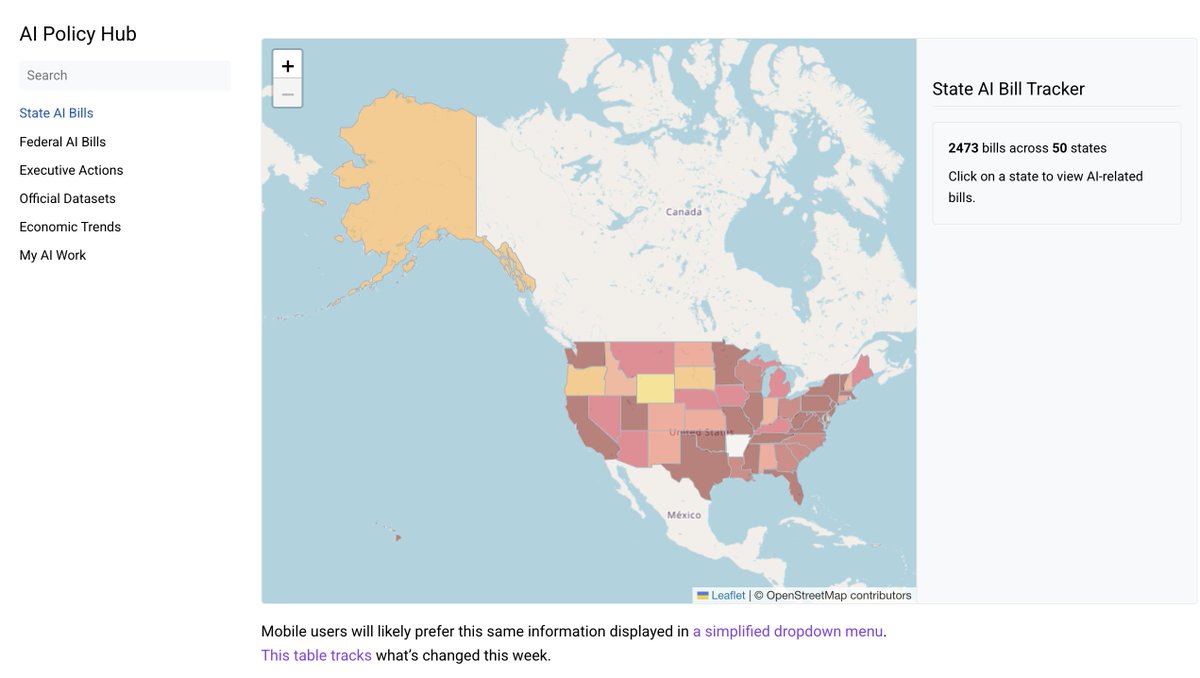
Today I'm launching AI Policy Hub, a project I've been working on and developing the last couple months.
While I have plans for other pages in the future, it currently features
- A state AI bill tracker that automatically updates every Monday
- A federal AI bill tracker that also updates every Monday
- A list of major government actions on AI
- A curated list of FRED charts that are important for understanding AI's economic impacts
- A economic trends page built on my testimony to the JEC, describing what's happening accorrding to the data; and
- A narrative description of my AI work
This is a working project, so please send me ideas for additions or changes!
The page is here: https://t.co/Z56upt2LhZ
My Substack on the project is here: https://t.co/ldTPfEYqff
The Biden Admin argued that the Defense Production Act (DPA) gave them the open-ended ability to regulate AI via executive decrees, and now the Trump Admin is using the DPA to threaten private AI labs with quasi-nationalization for not being in line with their wishes.
In both cases, it's an abuse of authority. As I noted in congressional testimony two years ago, we have flipped the DPA on its head "and converted a 1950s law meant to encourage production, into an expansive regulatory edict intended to curtail some forms of algorithmic innovation."
This nonsense needs to end regardless of which administration is doing it. The DPA is not some sort of blanket authorization for expansive technocratic reordering of markets or government takeover of sectors.
Congress needs to step up to both tighten up the DPA such that it cannot be abused like this, and then also legislate more broadly on a national policy framework for AI.
As it happens, the new issue of @reason is out today. I wrote the cover story on how data centers are fine and the people who oppose them are whiny babies.
important speech on AI policy from OSTP director @mkratsios47 in India today. Some key takeaways:
REJECT FEAR-BASED GLOBAL GOVERNANCE DIALOGUE:
✅“We must replace that fear with hope. We cannot allow AI to become, as nuclear power was for many decades, a foundation for a future of abundance, abandoned and left unrealized."
✅"Ideological, risk-focused obsessions, such as climate or equity, become excuses for bureaucratic management and centralization. In the name of safety, they increase the danger that these tools will be used for tyrannical control.”
DON’T BASE POLICY ON SPECULATIVE RISKS:
✅“I believe that if we embrace AI and exercise its power well, it will advance human flourishing and drive unprecedented prosperity.”
✅“Focusing AI policy on safety and speculative risks, however, rather than concrete opportunities, inhibits a competitive ecosystem, entrenches incumbents, and isolates developing countries from full participation in the AI economy.”
AVOID CONFUSING REGULATION & RULE BY TECHNOCRATS:
✅“The other primary limiting factor to U.S. AI adoption is regulatory certainty and clarity. It is our position that, with smart updates to existing frameworks to reflect new technological realities, use-case and sector-specific regulation best allows adoption. This gives industry confidence that tomorrow’s rules will be common-sense developments of today’s, allowing them to focus on creative deployment.”
✅“We totally reject global governance of AI. We believe AI adoption cannot lead to a brighter future if it is subject to bureaucracies and centralized control. Prioritizing AI for your people does not mean joining international efforts that are either purely symbolic or a sacrifice of national self-determination. It does not mean constructing a regulatory regime that exchanges your countries’ capacity to build and innovate for the self-satisfaction of technocrats.”
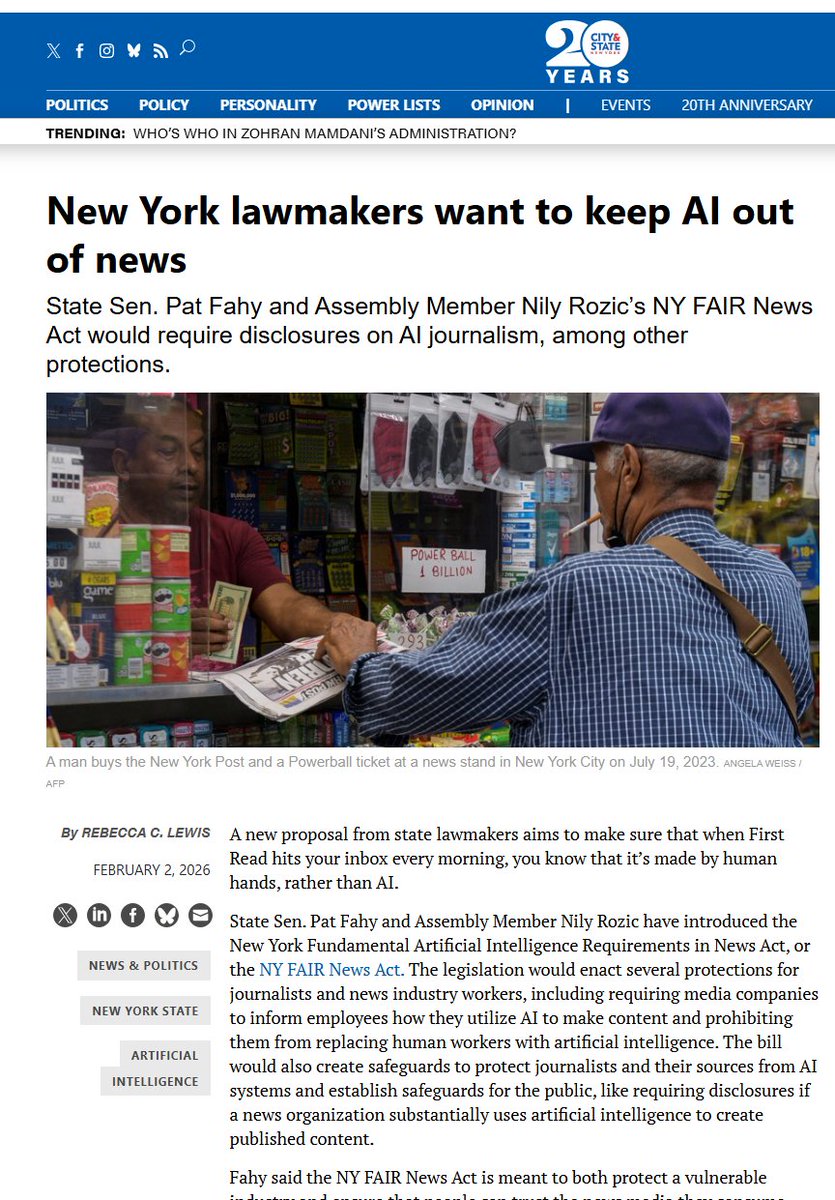
Another patchwork of bad AI laws coming. Politicians are about to get deeply involved in the news business in the name of saving journalism from AI. It's one thing to push transparency, it's another to micromanage all the varied uses of AI in the news business.
My views are included in this comprehensive survey of what's happening with "Right to Compute" laws at the state level as the battle over state AI regulation continues. Only a couple of states have currently floated such laws, but hopefully this is the beginning of a serious pushback on the tidal wave of European-style technology mandates that are being introduced across the nation. We're only one month into the year yet over 1,200 AI-related laws are already pending, and most are quite technocratic, heavy-handed, and costly.
https://t.co/vkBjrxzalI
New @ALEC_states analysis on #RightToCompute moving through NH: "This proposal makes a positive difference and help the Granite State stand out as a beacon for responsible entrepreneurs, respecting the liberties and property rights that NH has a history of strongly defending."
With the release of Guy Kawasaki's new book "Everybody Has Something to Hide" we're looking back at this recent discussion between Kawasaki and EFF Executive Director Cindy Cohn. https://t.co/EQo6zerJK9