China looked at the lessons of 20th century great power conflict and drew the conclusion that military power alone doesn't determine outcomes, upstream industrial capacity does.
The Allies won because of overwhelming industrial might. Japan and Germany lost because they lacked critical industrial inputs. Starved of oil, they were forced into gambles that cost them the war…Japan attacking Pearl Harbor to seize the oil in the Dutch East Indies, Germany marching to the Caucasus to take the Baku oil fields. Input scarcity doesn't just weaken you. It steers your decisions. It pulls decisions away from the optimal plan and toward the necessary plan.
China learned this lesson and decided to be the one holding the chokepoints. By embedding itself so deeply into the upstream supply chains that feed American military production, a conflict would trigger Western industrial paralysis and neuter its ability to fight a long war.
But the chokehold only works if the West doesn't rectify its supply chain vulnerabilities before China is ready to move on Taiwan. So China's central strategic requirement was to delay Western recognition of the threat for as long as possible.
Thus, China's entire foreign policy posture becomes oriented around appearing non-threatening. And it works because it aligns with the economic incentives of Western elites who benefit from cheap inputs and profitable trade. The cost of denial is kept artificially low. Raising the alarm looks like paranoia or protectionism when cheap goods keep flowing and no shots are being fired.
The administration is now racing to unwind its supply chain vulnerability before the conflict window opens. But that takes years, and they face significant inertia, both domestically and among allies who remain naively blind to the risk.
China knows this. So their strategy is to keep the West sleepwalking. Which means they can’t show their hand. If China comes into direct military conflict with the US in order to defend a proxy, the West wakes up. The inertia collapses. The reshoring and remilitarization that China spent decades trying to prevent happens on an emergency timeline.
But the US finally realized it could use this against them.
Since China can’t show its hand until it's ready to move on Taiwan, the US realized that it can turn China's greatest strategic asset, the pacifist disguise, into a structural trap.
They cannot take overtly aggressive action without triggering the Western industrial mobilization their entire strategy depends on preventing.
So the US can eliminate their proxies and China can’t respond without destroying the disguise.
Maduro removed. Cuba strangled. Now Iran.
Beijing must decide if defending the proxy is worth waking the West up? And the answer keeps being no.
Until China’s window to move on Taiwan opens, the pacifist posture that enabled its chokeholds constrains their response to US actions.
Everything the US is doing right now is a race to be ready before that moment arrives. Clear the proxies. Arm the allies. Break the chokeholds. And build new ones of its own.
AI OVERPRODUCTION
China seeks to commoditize their complements. So, over the following months, I expect a complete blitz of Chinese open-source AI models for everything from computer vision to robotics to image generation.
Why? I’m just inferring this from public statements, but their apparent goal is to take the profit out of AI software since they make money on AI-enabled hardware. Basically, they want to do to US tech (the last stronghold) what they already did to US manufacturing. Namely: copy it, optimize it, scale it, then wreck the Western original with low prices.
I don’t know if they’ll succeed.
But here’s the logic:
(1) First, China noticed that DeepSeek’s release temporarily knocked ~$1T off US tech market caps.
(2) Second, China’s core competency is exporting physical widgets, more than it is software.
(3) Third, China’s other core competency is exporting things at such massive scale that all foreign producers are bankrupted and they win the market. See what they’re doing to German and Japanese cars, for example.
(4) Fourth, China is well aware that it lacks global prestige as it’s historically been a copycat. With DeepSeek, becoming #1 in AI is now something they actually consider possibly achievable, and a matter of national pride.
(5) Fifth, DeepSeek has gone viral in China and its open source nature means that everyone can rapidly integrate it, down to the level of local officials and obscure companies. And they are doing so, and posting the results for praise on WeChat.
(6) Finally, while DeepSeek was obscure before recent events, it’s now a household name, and the founder (Liang Wengfeng) has met both with Xi but also the #2 in China, Li Qiang. They likely have unlimited resources now.
So, if you put all that together, China thinks it has an opportunity to hit US tech companies, boost its prestige, help its internal economy, and take the margins out of AI software globally (at least at the model level).
They will instead make their money by selling inexpensive AI-enabled hardware of increasing quality, from smart homes and self-driving cars to consumer drones and robot dogs.
Basically, China is trying to do to AI what they always do: study, copy, optimize, and then bankrupt everyone with low prices and enormous scale.
I don’t know if they’ll succeed at the app layer. But it could be hard for closed-source AI model developers to recoup the high fixed costs associated with training state-of-the-art models when great open source models are available.
Last, I agree it’s surprising that the country of the Great Firewall is suddenly the country of open source AI. But it is consistent in a different way, which is that China is just focused on doing whatever it takes to win — even to the point of copying partially-abandoned Western values like open source, which seemed like the hardest thing to adopt.
On that point: they did build censorship into the released DeepSeek AI models, but in a manner that’s easily circumvented outside China. So, you might conclude they don’t really care what non-Chinese people are saying outside China in other languages, so long as this doesn’t “interfere with China’s internal affairs.”
Anyway —this is an area I’ve been watching, and my reluctant conclusion is that China is getting better at software faster than the West is getting better at hardware.
Singapore has perhaps the world's best government.
Only UAE is close.
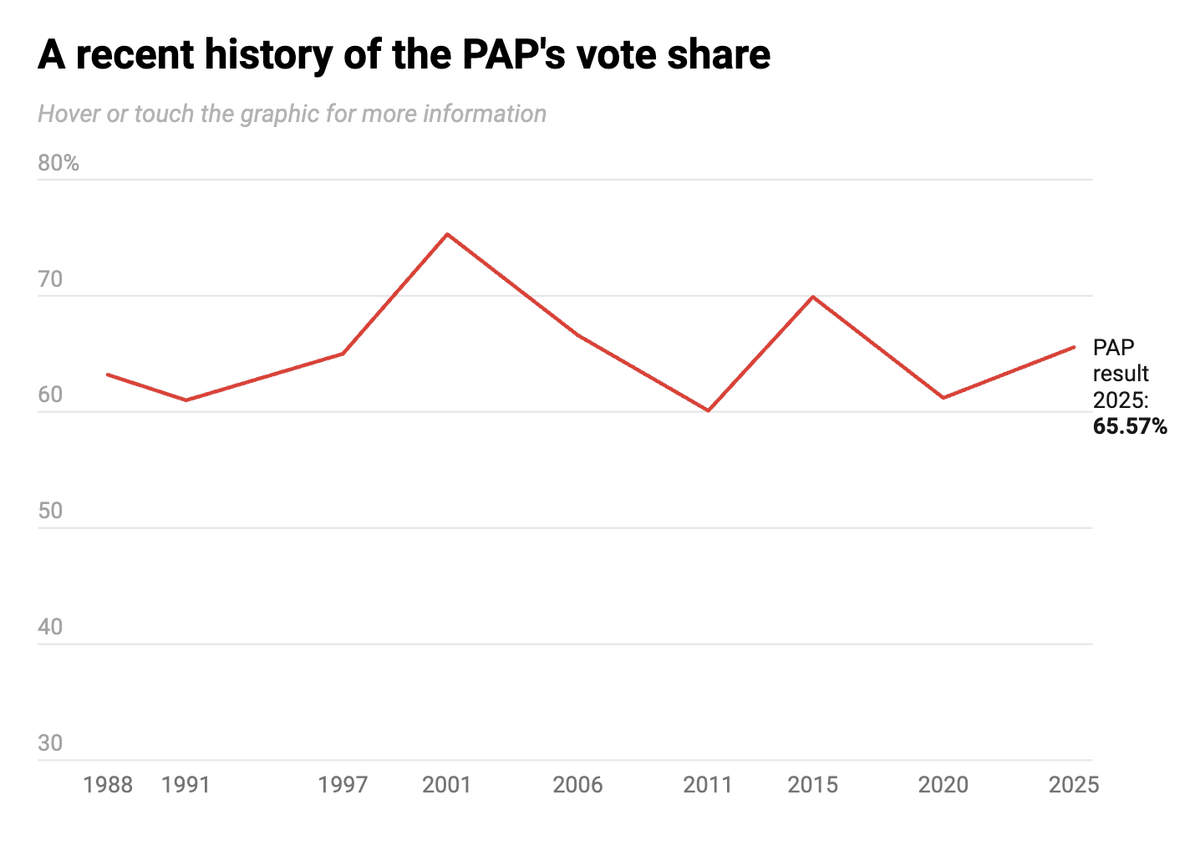
But expectations had been set to such a point for the party that built Singapore that even 60% support was considered low. They smashed it nevertheless with 65.7%.
Onward and upward.
https://t.co/Kn5qPwlD3P
“How did you end up in Dubai?”
It’s a question I get all the time. Here's my story...
▶️ Full episode here: https://t.co/YsqAUVBHn9
🎙️ Credit: Minimum Viable Podcast