"The web of this world is woven of Necessity and Chance" (Goethe) The big challenge is to make use of Randomness. Evolution does not work without Randomness.
Everyone's saying "design loops not prompts." Almost nobody can explain what that means.
Here's the plain version — and the part nobody's talking about that matters more than the loop itself. 🧵
This works really well btw, at the end of your query ask your LLM to "structure your response as HTML", then view the generated file in your browser. I've also had some success asking the LLM to present its output as slideshows, etc.
More generally, imo audio is the human-preferred input to AIs but vision (images/animations/video) is the preferred output from them. Around a ~third of our brains are a massively parallel processor dedicated to vision, it is the 10-lane superhighway of information into brain. As AI improves, I think we'll see a progression that takes advantage:
1) raw text (hard/effortful to read)
2) markdown (bold, italic, headings, tables, a bit easier on the eyes) <-- current default
3) HTML (still procedural with underlying code, but a lot more flexibility on the graphics, layout, even interactivity) <-- early but forming new good default
...4,5,6,...
n) interactive neural videos/simulations
Imo the extrapolation (though the technology doesn't exist just yet) ends in some kind of interactive videos generated directly by a diffusion neural net. Many open questions as to how exact/procedural "Software 1.0" artifacts (e.g. interactive simulations) may be woven together with neural artifacts (diffusion grids), but generally something in the direction of the recently viral https://t.co/z21CP5iQfu
There are also improvements necessary and pending at the input. Audio nor text nor video alone are not enough, e.g. I feel a need to point/gesture to things on the screen, similar to all the things you would do with a person physically next to you and your computer screen.
TLDR The input/output mind meld between humans and AIs is ongoing and there is a lot of work to do and significant progress to be made, way before jumping all the way into neuralink-esque BCIs and all that. For what's worth exploring at the current stage, hot tip try ask for HTML.
A physicist spent fifty years asking a question biologists had stopped asking: what physical conditions make a sign possible?
Not metaphorically. Physically. What must be true of a material system before any part of it can mean anything? 🧵 1/4
The LLM wiki is the best node machine ever built.
Vannevar Bush in 1945 knew that wasn't enough.
A thread on his second problem — the one Karpathy's wiki doesn't solve — and why it turns out to be exactly the same as the writer's problem. 🧵
Current AI: trained to satisfy human raters → converges on human average → compresses culture.
AlphaGo Zero: trained against the game itself → escapes human average → expands culture.
The difference is the training objective. That's a design choice. https://t.co/HAQCEfEwyb
The scariest thing about a compiled knowledge base isn’t that it makes mistakes.
It’s that its mistakes become consistent.
An error that propagates through enough pages starts to look like truth — every page agreeing, no contradiction for lint to catch. Link⬇️
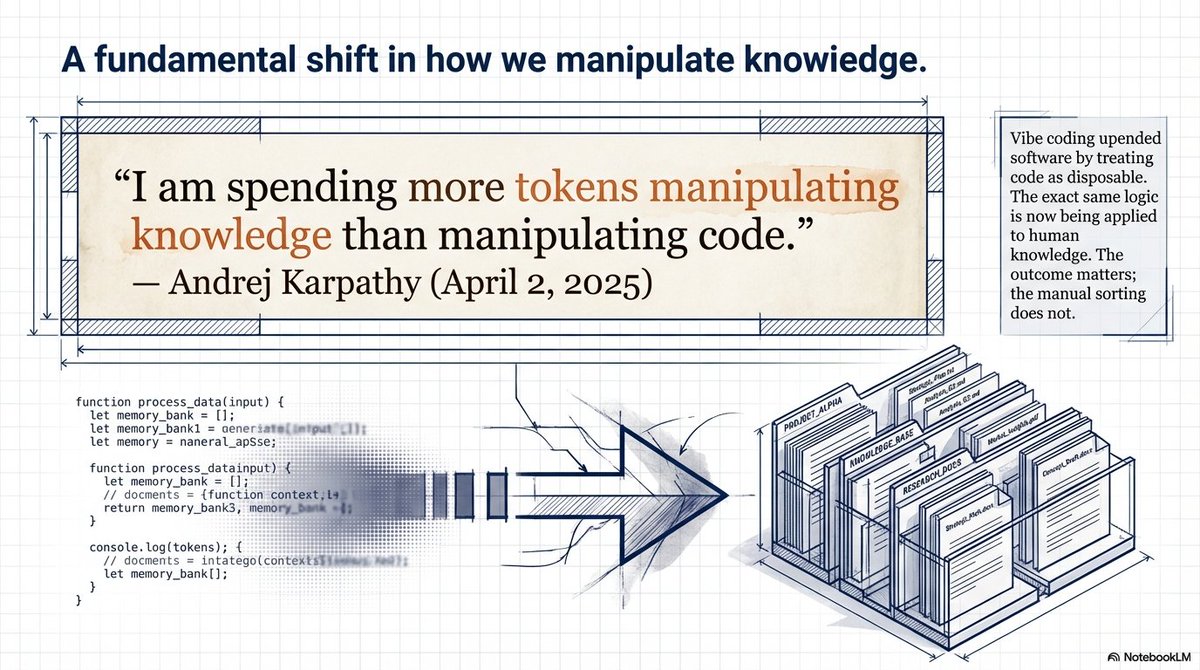
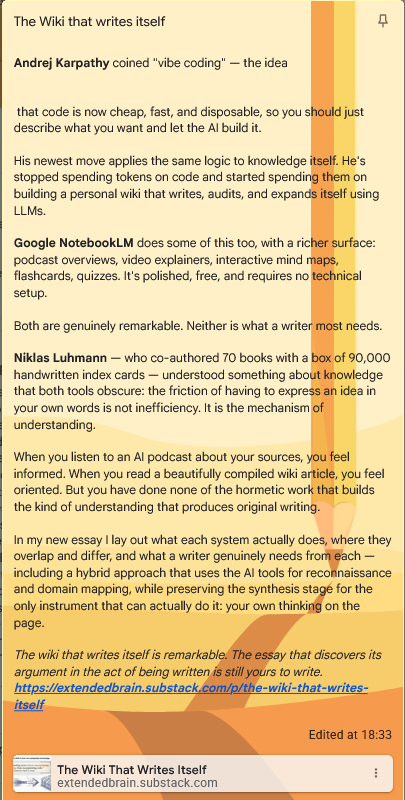
@Extended_Brain Andrej Karpathy recently announced he'd shifted from vibe coding to: building personal knowledge bases with LLMs. Drop papers into a folder, the AI compiles a living wiki, health checks run automatically, answers loop back in. The system grows itself. Awesome. But writing?
Three knowledge systems walk into a bar.
Karpathy's LLM wiki: compiles itself, grows overnight, files your own Q&A back in as new articles. Powerful. Yours.
NotebookLM: podcast your papers, mind-map your corpus, quiz yourself on the AI's synthesis. Frictionless. Google's.