S&P 500 thoughts: Don't get lost in the euphoria. The greed is not limited to retail participants alone, even active fund managers have positioned their clients with the most bullish exposure since the market peaked in January 2022.
The chart of the S&P 500 marks the relative peaks of both the CNN Fear & Greed Index, and the NAAIM Exposure Index. During this bear market, extreme greed and elevated exposure has acted as the 'canary in the coal mine,'— this combination has preceded all meaningful declines.
If this is in fact a bull market, it really will be different this time. $SPY $SPX
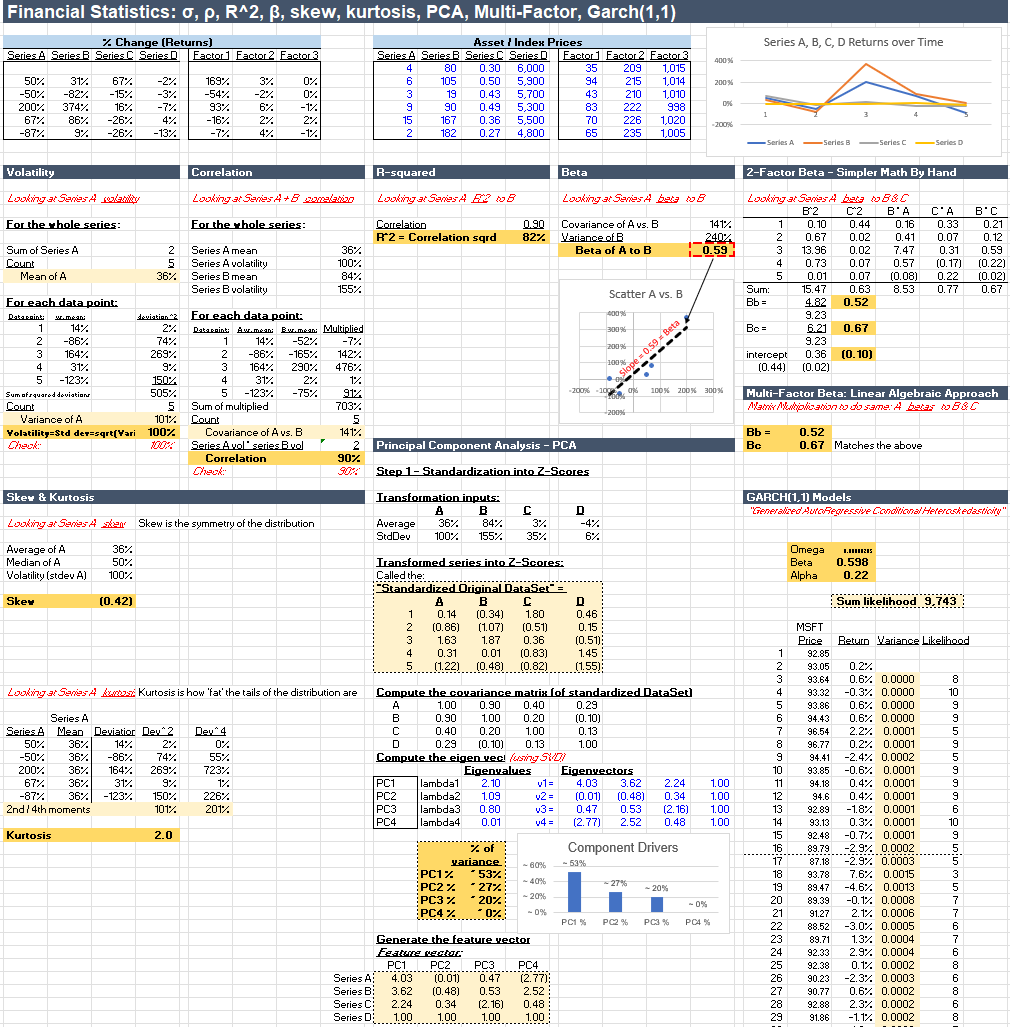
6 stats concepts put you ahead of 99% of analysts.
And the math fits on one page: *Updated*
Like & comment if you want the excel.
*1) Volatility*
How volatile are the returns of an asset?
The calc is just the standard deviation.
So:
Square each day's deviation from the average return = variance.
And the square root of the variance = volatility.
Simple.
*2) Correlation*
How related are two series' returns?
The same deviation math above for each.
Multiply them together for each day, and take the average = covariance.
Divide that by each of A & B's vols.
And that's the correlation.
*2b) The "R-squared"*
Just the correlation, squared.
But a powerful interpretation:
"The % of each series' return explained by the other."
Important concept from a simple transformation.
*3) Beta*
While correlation tells you how tight a relationship is.
Beta describes the relationship itself -- the "slope" of the line between A and B.
When A returns X%, knowing nothing else, what would you expect B to return?
In math: same as correlation, but divide by just the predictor's variance.
*3b) Multi-Factor Beta*
What if you want to predict A from many other signals?
Meaning: if you know just B, C, and D, what is the best prediction of A?
The most sophisticated models invert this equation and use fundamental factors in a high-dimensional cross-sectional regression to derive factor returns.
Discussion of that for another time.
But matrix math (using a little linear algebra) attached to build out multi-factor betas.
*4) Skew & Kurtosis*
Skew tells you whether the distribution of the series tilts in one direction.
The calc is just 3 x (average - median), divided by its vol.
Kurtosis tells you how likely are far from average events.
*5) Principal Component Analysis (PCA)*
In the multi-factor beta math, you pre-specified what factors move stocks.
But PCA says the opposite: let the data find the drivers.
To do that it groups the data across many dimensions.
And simply points to the largest clusters.
In this case, only PC1 is 'useful', and explains 53% of the variance.
All four have high loadings to PC1, meaning it notices all have a strong positive trend, and is clustering that behavior into a single new factor.
*6) GARCH models*
What if the vol itself is volatile?
"GARCH" assumes vol today is correlated with vol tomorrow, and models persistent high and low vol 'regimes'.
Ultimately, statistical methods are tools for analysis.
They are only as good as the data, and the analyst.
Without care and analytical rigor, hidden assumptions can "stack" on top of each other.
But done well, statistical models can also tame some of the chaos of the thousands of datapoints investors ingest daily.
The key as always is to understand deeply, make conscious choices, and execute on your best judgment in a world of imperfect alternatives.
That's all for now.
Like & comment if you want the excel.
If you don't leverage ChatGPT in 2023, you will be left behind.
Here are 226 ChatGPT Extensions to crush your 2023 goals:
(Bookmark this or lose it forever)
Thanks to ChatGPT and other AI tools
A 1-person business can easily outperform a huge company
Here are 8 innovative AI tools that can help you 10x your success:
ChatGPT Plugins are now available to everyone.
GPT-4 plugins are the easiest way to start making serious money online.
Here are the 9 best free GPT-4 plugins to start PRINTING cash.
You have been lied to.
For generations our education system has excluded basic information on what your entire working lives depend on: money and finance.
This is intentional.
As Henry Ford said almost 100 years ago:
"It is well enough that people of the nation do not understand our banking and monetary system, for if they did, I believe there would be a revolution before tomorrow morning."
2023 now represents the biggest banking crisis in all history.
Yet politicians will tell you the system is stable. It is not.
We have built up an unmanageable amount of debt. We are living in hyperinflation, and banks cannot compete on aggressive interest rates. The system is bursting at the seams.
If the government was a person, it would have maxed out every credit card it owns, and every bank in the world would reject its application for a home loan. Because if simply can't foot the bill. The math does not add up anymore. The pathway, unsustainable.
The Fed and the government know this. They are trying to roll out a CBDC which will allow infinite 1984 style financial control. Your spending will be limited, your saving value destroyed and the manipulation capability of those pulling the strings will reach new absurd heights.
CBDCs should be illegal.
As always, the value destruction will be passed to the people.
At the same time, the only viable modern alternative: uncorruptable, digital, distributed money - Bitcoin - has been under an orchestrated attach by the government and regulators. They unlawfully shut down Signature Bank, the largest fiat onramp to Bitcoin. The SEC attacks major complaint digital asset companies, but they still can't tell you what Ethereum is. They say it's too volatile. Too risky. Bad for the environment.
The list of bollocks goes on.
Don't confuse volatility for risk. All fast growing assets experience it. It's impossible not to when going from 0 to 1.
Fiat is the riskiest asset to own today, not Bitcoin.
The storm is coming. Manage your risk, because the government won't.
That's a wrap!
If you enjoyed this thread, I'd really appreciate if you would:
1. Follow me @moritzkremb for more.
2. Like/Retweet the tweet below to share it with others:
Instagram is dead.
In the next 3 - 5 years, every single image in social media will be generated by AI.
And here is the kicker: It will be impossible to tell fake from reality.
I wrote a few lines of Python code to show you how screwed we are:
Economic Update:
1. SVB collapse marks the 2nd largest bank failure in U.S. history
2. Total U.S. credit card debt set to cross $1 trillion with interest rates at a record 25%
3. Interest rates are rising at their fastest pace in history
4. Mortgage demand at a 30-year low with home prices falling at their fastest since 2011
5. Average new car payment is now above $800/mo
6. Total U.S. mortgage debt now double the 2006 peak
7. 36% of Americans have more credit card debt than saving
8. Average American spending a record 46% of their income on house payments
9. U.S. government debt on track to hit $50 trillion in 10 years
10. Interest on U.S. debt expected to hit $1 trillion by 2033
Meanwhile, inflation has been above 5% for 21 straight months.
The system is officially broken.
The gov’t has about 48 hours to fix a-soon-to-be-irreversible mistake. By allowing @SVB_Financial to fail without protecting all depositors, the world has woken up to what an uninsured deposit is — an unsecured illiquid claim on a failed bank. Absent @jpmorgan@citi or @BankofAmerica acquiring SVB before the open on Monday, a prospect I believe to be unlikely, or the gov’t guaranteeing all of SVB’s deposits, the giant sucking sound you will hear will be the withdrawal of substantially all uninsured deposits from all but the ‘systemically important banks’ (SIBs). These funds will be transferred to the SIBs, US Treasury (UST) money market funds and short-term UST. There is already pressure to transfer cash to short-term UST and UST money market accounts due to the substantially higher yields available on risk-free UST vs. bank deposits. These withdrawals will drain liquidity from community, regional and other banks and begin the destruction of these important institutions. The increased demand for short-term UST will drive short rates lower complicating the @federalreserve’s efforts to raise rates to slow the economy. Already thousands of the fastest growing, most innovative venture-backed companies in the U.S. will begin to fail to make payroll next week. Had the gov’t stepped in on Friday to guarantee SVB’s deposits (in exchange for penny warrants which would have wiped out the substantial majority of its equity value) this could have been avoided and SVB’s 40-year franchise value could have been preserved and transferred to a new owner in exchange for an equity injection. We would have been open to participating. This approach would have minimized the risk of any gov’t losses, and created the potential for substantial profits from the rescue. Instead, I think it is now unlikely any buyer will emerge to acquire the failed bank. The gov’t’s approach has guaranteed that more risk will be concentrated in the SIBs at the expense of other banks, which itself creates more systemic risk. For those who make the case that depositors be damned as it would create moral hazard to save them, consider the feasibility of a world where each depositor must do their own credit assessment of the bank they choose to bank with. I am a pretty sophisticated financial analyst and I find most banks to be a black box despite the 1,000s of pages of @SECGov filings available on each bank. SVB’s senior management made a basic mistake. They invested short-term deposits in longer-term, fixed-rate assets. Thereafter short-term rates went up and a bank run ensued. Senior management screwed up and they should lose their jobs. The @FDICgov and OCC also screwed up. It is their job to monitor our banking system for risk and SVB should have been high on their watch list with more than $200B of assets and $170B of deposits from business borrowers in effectively the same industry. The FDIC’s and OCC’s failure to do their jobs should not be allowed to cause the destruction of 1,000s of our nation’s highest potential and highest growth businesses (and the resulting losses of 10s of 1,000s of jobs for some of our most talented younger generation) while also permanently impairing our community and regional banks’ access to low-cost deposits. This administration is particularly opposed to concentrations of power. Ironically, its approach to SVB’s failure guarantees duopolistic banking risk concentration in a handful of SIBs. My back-of-the envelope review of SVB’s balance sheet suggests that even in a liquidation, depositors should eventually get back about 98% of their deposits, but eventually is too long when you have payroll to meet next week. So even without assigning any franchise value to SVB, the cost of a gov’t guarantee of SVB deposits would be minimal. On the other hand, the unintended consequences of the gov’t’s failure to guarantee SVB deposits are vast and profound and need to be considered and addressed before Monday. Otherwise, watch out below.
ChatGPT is the future.
Master it and you'll be miles ahead of the world.
Here's a my top 11 ChatGPT threads to help you get started:
(Bookmark this for later)
ChatGPT is everywhere and everyone is using it.
But most academics don't know how to use it *smartly.*
Here's how to use ChatGPT intelligently (and ethically) for academic purposes: