Salience is now live: connect your website for free and start measuring first-party data that most teams never see, let alone act on.
Your server and CDN logs show what is actually reaching your site, what gets requested, how often crawlers return, what your infrastructure serves them and where things go wrong.
Built alongside my co-founders @ndredding and @channel5 , Salience is designed to make that raw log data genuinely useful and actionable in real time.
That includes seeing how search engines and AI crawlers such as ChatGPT and Claude interact with your site: which pages they visit, how frequently they return, what they request and whether they encounter errors.
We originally built it off the back of problems we were solving for clients, particularly around crawling, indexing, and AI visibility across products, collections and editorial content, and large marketplace listing websites while giving teams access to a layer of insight they’d rarely had before.
It’s designed for a broad range of sites, from Shopify and BigCommerce stores through to publishers, marketplaces and larger businesses running custom technology stacks.
It’s also useful beyond #SEO and search, with insights for development, content and security teams, whether you’re in-house, an agency or a consultant.
We’ve already had some great feedback from beta users, so thank you to everyone who has tested it so far.
We’d love more of it: what’s useful, what’s missing and what could be better.
There’s a working demo to explore, or you can connect a production site for free and see what your own data tells you.
Please share it with anyone on your team who might find it useful.
Visit: https://t.co/0YhHLhSzzb for more detail.
Did you know WHOIS is largely being phased out, with RDAP replacing it? I built a CLI `rdap` command to replace `whois`. Use it to see the registrar, expiry date, nameservers, etc., for supported domains 🤓
https://t.co/8lD6t5PyoJ
Clearing out some domains - 437 UK domains, to be exact. £100 each, or 5 for £300. Includes dictionary domains, high search-volume exact-match domains and some with authority (up to DR 60) 🤓
https://t.co/I6tcD50Zzn
After over 25 years in SEO, I’ve built the website monitoring tool that I wanted for myself. @techdash_com runs on your desktop, watches your sites for important technical SEO changes, and keeps your crawl data local.
It’s now live! 🎉👇
https://t.co/VzGmk257SL
We have published a free @Ayima course to help #SEO teams integrate @claudeai and Claude Code into technical SEO workflows. Go from no coding background to building practical SEO tools in 4 weeks, with just a few hours of learning each week. No signup required - link in comments.
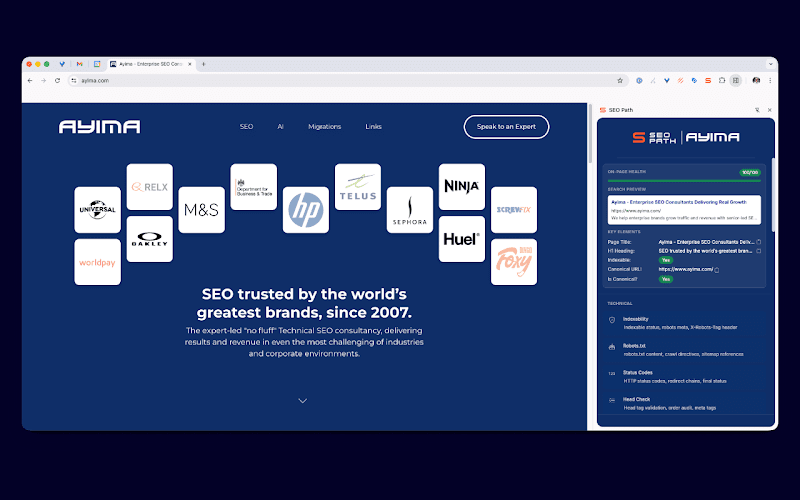
Ayima has just launched its fourth Google Chrome browser extension today, SEO Path! It provides instant access to every on-page SEO element you can think of, along with helpful SEO shortcuts and tools 🎉 📈 Links to the download and video tour in the comments.
After an awesome journey at Teamworks, I've been laid off and am looking for my next opportunity as a Senior Software Engineer.
I bring 8+ years of experience in PHP, MySQL, and Laravel with strong back-end expertise! I'm an eager self-starter who loves building maintainable, scalable solutions.
Fancy a little web scraping this Friday? @ayima has released another Google Chrome extension today, called Scrape Path. It’s excellent for quickly extracting data from a set list of URLs, and it works on sites that actively block bots or that are behind a login/paywall/firewall/intranet. (link in the comments)
@tnylea@thedevdojo Wouldn’t requiring a user to hook up their GitHub account limit spam easier, without requiring users to run remote code on their devices? It’ll deter most spammers, and if you block by GitHub account ID, it’ll be too much work for the rest to do at scale.
Introducing "ChatGPT Path", a new free Google Chrome extension by @ayima, the creators of Redirect Path. This new browser plugin reveals the inner workings of ChatGPT, including the live searches it performs, its thought process, and all the data sources it utilises.
If you follow Neil Patel, a couple of months ago, he started posting videos on every channel about "The time I got sued," about a case from 2011.
I thought, “Why is Neil flooding social media with a story from 14 years ago?“
The answer is a clever bit of reputation management.
These posts are pushing down Google search results that he most likely doesn't want anybody to see.
It's a truly remarkable story of SEO, contracts, deliverables, and ultimately, bankruptcy. Anyone working in digital marketing should be aware of it.
"What Is Neil Hiding? Bankrupt FTX Sues Neil Patel for $55 Million"
Link in comments 🔗