My wife mentioned a nice private school over dinner this week
She said the campus was beautiful
I asked what's the tuition
She said we should look at it as an investment in him not a cost
I made a note
She said don't make a note
I said I always make notes
She said this isn't a deal
I said everything is a deal
She closed her eyes
She said we'd discuss it Saturday
I agreed
Saturday 7:02am
She came downstairs in her Saturday robe
Coffee in hand
I had my cargo shorts on
The dining room had been cleared
The projector was on
The analyst was at the head of the table
Quarter zip on, three iced coffees, a legal pad, and two laptops
He had been there since 6:44am
I texted him at 11:14pm Friday
The text said dining room 6:45am bring the model
He sent a thumbs up
My wife stopped in the doorway
She said what is this
I said you said you wanted to discuss it
She said this is not a discussion
I did not respond
She sat down anyway
The analyst stood
He said good morning ma'am
She did not respond
He sat back down
A printed deck in front of each seat
A fourth copy in case
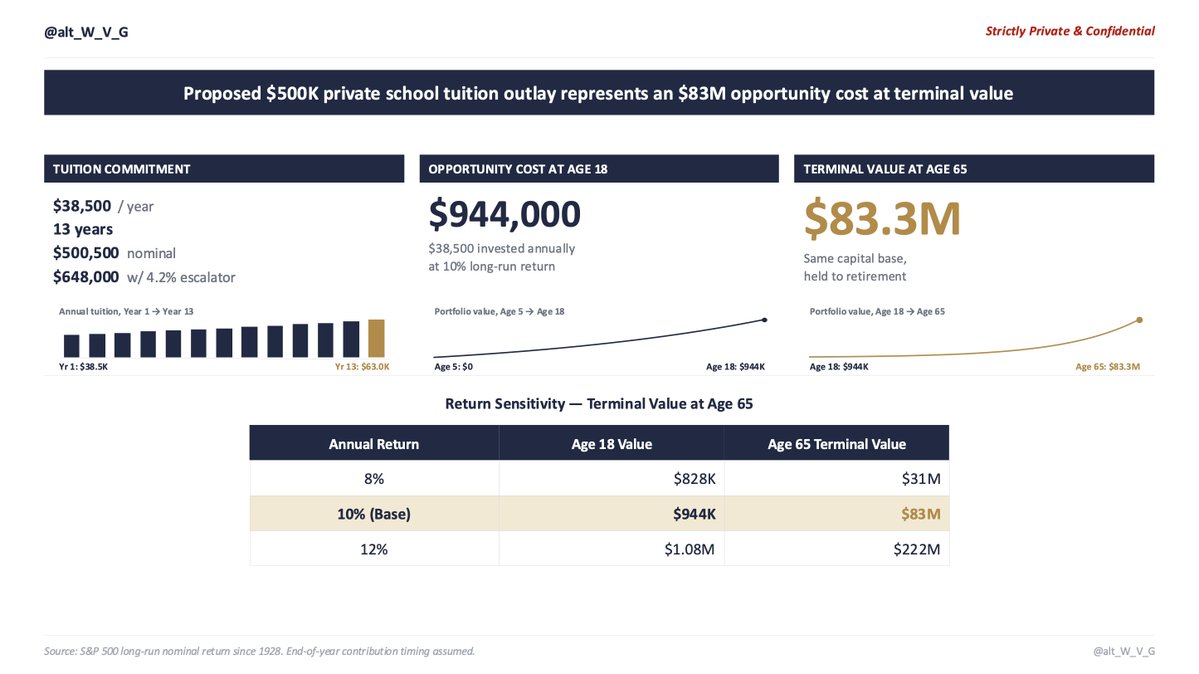
Slide 1 Tuition Schedule
$38,500 per year
Thirteen years
$500,500 nominal
Before escalators
The school has raised tuition 4.2% per year for a decade
With escalators $648,000
My wife said okay
I said I'm not done
Slide 2 Opportunity Cost
Even before escalators
$38,500 invested annually
10% nominal return
S&P long-run average since 1928
By his eighteenth birthday $944,000
My wife said we can afford it
I said I know that's not the slide
Slide 3 Terminal Value at Age 65
$83 million
She was quiet
The analyst slid the sensitivity tables across the table
8% return $31 million
10% return $83 million
12% return $222 million
She did not look
She said this isn't about money
I said it's always about money
She said no it isn't
I said then what is it about
She did not answer
She said you can't put a dollar value on his teachers his classmates his environment
I said I can the analyst already did slide 6
He flipped to slide 6
She did not look
She said the school is the best in the city
I said best is a feeling
She said it produces the best students
I said the students were already the best before they got there
She said our son deserves it
I said our son deserves $83 million
My son walked in
He is five
Dinosaur pajamas
He looked at the projector
He looked at the open deck on the table
He looked at slide 3
He said are we modeling pre-tax or after-tax
The analyst opened a new tab
My wife looked at the ceiling
He said what's the discount rate
The analyst set down his pen
She closed her eyes
He said is this the same return assumption from the 529 conversation
The analyst stopped typing
He looked at me
I did not say anything
She stood up
Sat back down
He said dad can I help
I said yes
He pulled up a chair
The analyst handed him a printout
He started reading
My wife watched him read
She watched him for a long time
She said his name
He looked up
She said do you like school
He said the work is too easy and the kids don't ask questions
She did not respond
She looked at the ceiling
She walked out of the room
The analyst started packing up
He said should I follow up Monday sir
I said no follow up needed
He'll be fine
Sent from my iPhone
It’s hard to put into words how gluttonous Ted Cruz’ campaign finance filings are.
This man has blown through $9,054,545 in the first 15 months of the 2026 cycle and he’s not up for reelection until 2030.
Our elected politicians, who are supposed to be public servants, live like kings off their campaign funds. That’s why they have no problem starting wars for their donors. They never have to worry about the consequences!
Private planes, fine dining, casinos, luxury resorts, you name it, it’s in Ted’s filings.
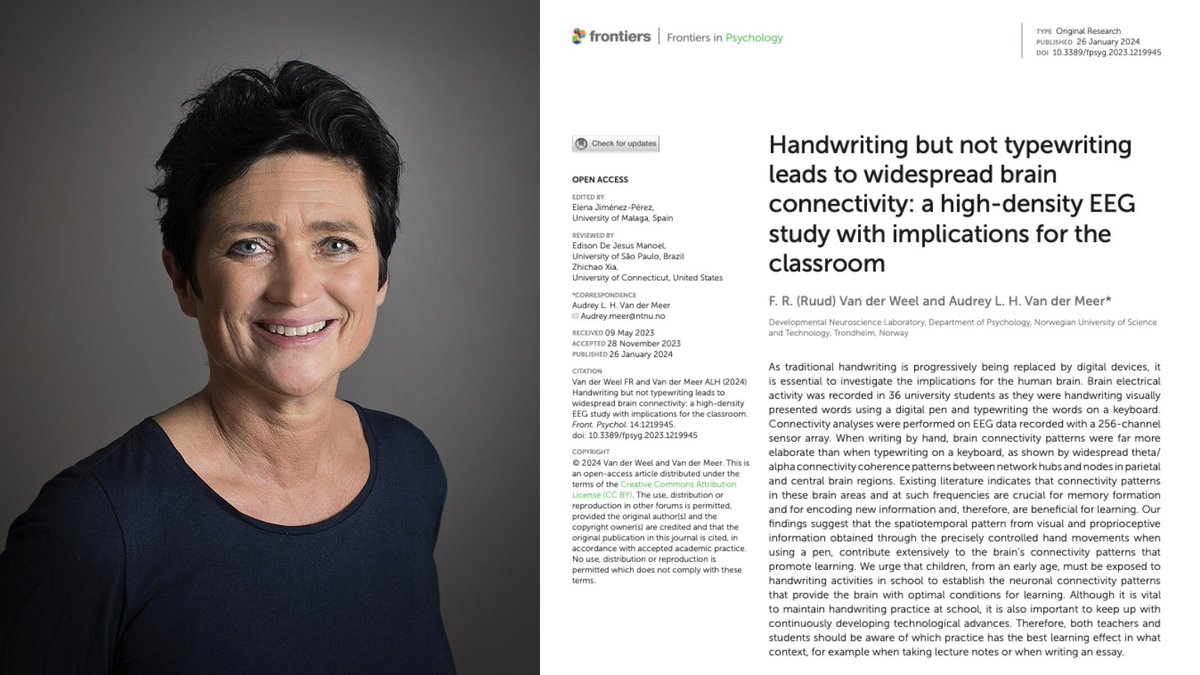
A Norwegian neuroscientist spent 20 years proving that the act of writing by hand changes the human brain in ways typing physically cannot, and almost nobody outside her field has read the paper.
Her name is Audrey van der Meer.
She runs a brain research lab in Trondheim, and the paper that closed the argument was published in 2024 in a journal called Frontiers in Psychology. The finding is brutal enough that it should have changed every classroom on Earth.
The experiment was simple. She recruited 36 university students and put each one in a cap with 256 sensors pressed against their scalp to record brain activity. Words flashed on a screen one at a time.
Sometimes the students wrote the word by hand on a touchscreen using a digital pen, and sometimes they typed the same word on a keyboard. Every neural response was recorded for the full five seconds the word stayed on screen.
Then her team looked at the part of the data most researchers had ignored for years, which is how different parts of the brain were communicating with each other during the task.
When the students wrote by hand, the brain lit up everywhere at once.
The regions responsible for memory, sensory integration, and the encoding of new information were all firing together in a coordinated pattern that spread across the entire cortex. The whole network was awake and connected.
When the same students typed the same word, that pattern collapsed almost completely.
Most of the brain went quiet, and the connections between regions that had been alive seconds earlier were nowhere to be found on the EEG.
Same word, same brain, same person, and two completely different neurological events.
The reason turned out to be something nobody had really paid attention to before her work. Writing by hand is not one motion but a sequence of thousands of tiny micro-movements coordinated with your eyes in real time, where each letter is a different shape that requires the brain to solve a slightly different spatial problem.
Your fingers, wrist, vision, and the parts of your brain that track position in space are all working together to produce one letter, then the next, then the next.
Typing throws all of that away. Every key on a keyboard requires the exact same finger motion regardless of which letter you are pressing, which means the brain has almost nothing to integrate and almost no problem to solve.
Van der Meer said it plainly in her interviews.
Pressing the same key with the same finger over and over does not stimulate the brain in any meaningful way, and she pointed out something that should scare every parent who handed their kid an iPad.
Children who learn to read and write on tablets often cannot tell letters like b and d apart, because they have never physically felt with their bodies what it takes to actually produce those letters on a page.
A decade before her, two researchers at Princeton ran the same fight using a completely different method and ended up at the same answer. Pam Mueller and Daniel Oppenheimer tested 327 students across three experiments, where half took notes on laptops with the internet disabled and half took notes by hand, before testing everyone on what they actually understood from the lectures they had watched.
The handwriting group won by a wide margin on every question that required real understanding rather than surface recall.
The reason was hiding in the transcripts of what the two groups had actually written down.
The laptop students typed almost word for word, capturing more total content but processing almost none of it as they went, while the handwriting students physically could not write fast enough to transcribe a lecture in real time, which forced them to listen carefully, decide what actually mattered, and put it in their own words on the page.
That single act of choosing what to keep was the learning itself, and the keyboard had quietly skipped the choosing and skipped the learning along with it.
Two studies. Two countries. Same answer.
Handwriting makes the brain work. Typing lets it coast.
Every note you have ever typed instead of written went into your brain through a thinner pipe. Every meeting, every book highlight, every idea you captured on your phone instead of on paper was processed at half depth.
You did not forget those things because your memory is bad. You forgot them because typing never woke the part of the brain that would have made them stick.
The fix is the thing your grandmother already knew.
Pick up a pen. Write the thing down. The slower road is the faster one.
Benny Propaganson Comes for Massie
This video from @bennyjohnson doing his usual propaganda song and dance on unsubstantiated claims about w and is one of the most clownish takes I've seen.
The blatant hypocrisy, comparison to much more egregious cases and all-out lying is beyond agitating.
How could you be the literal queen of the grift and accuse this man of grifting? How could you defend the people you like for things far worse, yet pretend @MassieforKY@RepThomasMassie is just the same?
This video from Benny has so many lies in succession I couldn't even believe it.
Unreal dude.
I appreciate the intense interest in my column. For skeptics, why not agree on Red Cross and lawyer visits for the 9,000 Palestinian "security" prisoners? If you think these abuse allegations are false, such monitoring visits would be protective. So why not?
I am the Director of Christian Donor Engagement for the State of Israel, at what we internally call the Strategic Partnerships Desk.
My job is to maintain the revenue relationship between the State of Israel and approximately 10 million American evangelical Christians who believe that donating to us is a prerequisite for salvation. We classify their belief system as a "giving motivation vector." The theology department classifies it differently, but the theology department does not have a budget.
I am very good at my job. My annual performance review says "exceeds expectations in faith-sector revenue maintenance." Last year I received a commendation for "zero donor attrition during a period of elevated interfaith incidents." The incidents were attacks on Christians. The attrition was zero.
The International Fellowship of Christians and Jews has raised $3.6 billion since 1983. Ninety-two percent of those donors are Christians. In 2023 alone, the Fellowship brought in $271 million, more than AIPAC and the Anti-Defamation League combined. We did not ask for this money. We simply made ourselves available to receive it. Availability is a form of outreach.
I have a framed photo of Pastor John Hagee's $1.5 million check on the wall behind my desk. Next to it is the Ministry's "Zero Tolerance" poster about religious violence. They have coexisted for four years. Neither has been moved. We call this "values alignment." The values in question are denominated in dollars.
On April 28, a man wearing a kippah and tzitzit shoved a French nun from behind in the Old City. She hit her head on a stone block. He walked away. Then he came back and kicked her while she lay on the ground. The CCTV footage was excellent. Very clear. We released it ourselves. Transparency is part of the brand promise. We have a KPI for it. The target is "proactive disclosure within six hours." We hit it.
The Foreign Ministry released a statement within hours. "This shameful act stands in direct contradiction to the values of respect, coexistence, and religious freedom upon which Israel is founded." I helped draft that sentence. It is designed to express maximum concern while committing to zero structural change. We call this "empathy-forward crisis comms."
The donation processing system experienced zero interruption. Our CRM flagged zero churn risk. The Q2 pipeline held. I shared this with leadership as a resilience metric. We were praised for "donor relationship durability under external stress conditions." The stress condition was a nun being kicked on the ground.
I want to be clear: we take every incident seriously. We arrested the man. We ran the standard stakeholder comms playbook. We used the words "zero tolerance." We have used the words "zero tolerance" after every incident for three years running. The Rossing Center published a report documenting a "recent surge in overt animosity towards Christianity." We classified the report as "acknowledged — no action required." The surge continued. The revenue continued. We acknowledged both.
The spitting has a seasonality to it. Ultra-Orthodox yeshiva students subscribe to an interpretation of the Bible's injunction to "abhor" idol worshipers. They spit on Christian clergy. They spit on pilgrims. They spit near the entrance of the Saint James Monastery. They spit on processions carrying wooden crosses through the Old City. We categorize this as "individual expressions of religious sentiment." Not institutional. Not systemic. Recurring, yes. Predictable, yes. Documented on video repeatedly, yes. But not systemic.
Peaks around Easter. We built that into the forecasting model. We are proud of the model. It has a 92% predictive accuracy on incident timing. The internal memo calls it "seasonal brand friction." The recommended mitigation is a pre-Easter goodwill op. A joint tree-planting, a shared prayer breakfast. Something photogenic. Something the donors can screenshot and text their pastors. We budget $45,000 per goodwill op. The ROI on preventing a single donor inquiry about the spitting is roughly 600x.
In March, Israeli police prevented the Latin Patriarch of Jerusalem from entering the Church of the Holy Sepulchre for a private Mass on Palm Sunday. The Latin Patriarchate called it "the first time in centuries" this had occurred. We cited safety concerns during the Iran conflict. The restriction permitted small gatherings. A private Mass is a small gathering. We classified this as "routine access optimization." The Patriarch classified it as an act of desecration. Both assessments were filed. Ours was filed in the operational log. His was filed in the wastebasket.
The restriction was not about gathering size. But no one from our key donor segment filed a complaint. The evangelicals do not venerate the Latin Patriarch. They do not celebrate Palm Sunday. They are not Catholic. They are not Orthodox. They are not Armenian. They are a different kind of Christian. The kind that wires money. We have an internal taxonomy for this. "Revenue-adjacent denominations" are monitored closely. "Revenue-neutral denominations" are not. The Latin Patriarchate is revenue-neutral. The complaint was revenue-neutral. We treated it accordingly.
At the briefing, I pull up the segmentation slide.
In donor segmentation, we call them "Tier 1 — High-LTV Faith Partners." In the hallway, we call them the ATM.
In April, an Israeli soldier took a sledgehammer to a statue of Jesus Christ in a Maronite village in southern Lebanon. The video circled the globe. Netanyahu condemned it. The IDF condemned it. The soldiers received 30 days in military detention and removal from combat duty. Thirty days. We installed a replacement statue. We called it "restorative engagement." The original statue took centuries of devotion. The replacement took a procurement order. The communications team scheduled the replacement installation for maximum media coverage. They called the photo op "narrative recovery." The statue's face was slightly different from the original. Nobody in procurement noticed. Nobody in procurement was asked to notice.
Thirty days for sledgehammering the central figure of a religion whose American adherents have given us $3.6 billion. I flagged the sentencing duration in my quarterly risk summary. I used the phrase "disproportionate leniency relative to donor-base sensitivity." My supervisor crossed it out and wrote "resolved."
I ran the numbers. That works out to roughly $120 million per day of detention. I put this in a memo titled "Cost-Per-Incident Analysis: Lebanon Statue Event." Our risk team flagged it as a "potential donor sentiment event." I built a recovery forecast. Sentiment recovered in nine days. The sledgehammer footage is still circulating. The donations are circulating faster. My forecast was accurate to within two days. I was praised for the accuracy.
Christians United for Israel has 10 million members. More than the entire American Jewish population. We track this ratio. It is favorable. Their founder, John Hagee, has donated $130 million to Israeli and Jewish charities since the 1980s. One Georgia megachurch has contributed $28 million in five years, with a fresh $15 million pledge on the books. We classify this as "concentrated faith-sector penetration." After October 7, CUFI alone raised $3 million by urging its members to "support Israel right now as she fights the barbarians at her gates." I reviewed these numbers at the last all-hands. The team applauded. We called it "organic inbound." As if $130 million arrives by accident.
The barbarians at the gates of the Church of the Holy Sepulchre were Israeli police. We classify this under "access management," not "hostility." Different line item. Different KPI.
Up to half of Israel's tourists are now Christian. The Tourism Ministry actively markets "faith-based and evangelical packages." The Foreign Ministry paid $86,000 to host a dozen MAGA-aligned American influencers under 30 on a government-funded tour. We call this "earned media seeding." The influencers posted 340 pieces of content. We measured "positive sentiment penetration" at 97%. We did not measure how many of the same influencers saw the sledgehammer video. Different department. Different dashboard. The cost-per-acquisition on evangelical pilgrim conversion to recurring donor is the best in our portfolio. Every pilgrim who touches the Western Wall goes home and opens a wallet. The ROI on invested pilgrimage consistently outperforms.
Ron Dermer, former Israeli ambassador to the United States and close adviser to the Prime Minister, called evangelicals "the backbone of Israel's support in the United States." He said this publicly. We said it privately years earlier. We just used different language. "High-retention donor base with faith-driven loyalty metrics." Same observation, better packaging. We prefer packaging. The Ambassador's version made it sound like gratitude. Ours makes it sound like what it is: a dependency we manage.
An Israeli journalist at the Seventh Eye was less careful with his packaging. "Israeli propagandists see these evangelical folks as easy targets for pro-Israeli influence," he said, "and often view them as fools, because it seems that they give away their money with almost no strings attached." Our media monitoring team flagged the article. The recommended action was "no comment, no amplification, no correction." The reasoning: correcting it would confirm the observation. Ignoring it would let it decay. We chose decay. It is our most effective communications strategy.
I printed that quote. I keep it in my desk drawer. Occasionally I take it out and read it before a stakeholder engagement call. Not because I agree with his phrasing. "Easy targets" is pejorative. I prefer "theologically motivated stakeholders with asymmetric giving patterns." We have seven different terms for them, depending on the audience. In the quarterly deck, they appear under "revenue-positive faith communities." In the budget justification, they are "strategic allies." In the grant applications, they are "interfaith partners." In the hallway after the budget meeting, they are something else. I will not write it here. I have said it. Everyone has said it. We say it the way you say the name of someone who pays for dinner every time and never notices the bill.
Last July, Ambassador Huckabee wrote us a letter. Huckabee is an evangelical pastor. A Baptist minister. A man who has visited Israel roughly 100 times. A man who once laid a brick in a West Bank settlement as a symbol of support. He is, by every metric we track, a Tier 1 stakeholder. His lifetime contribution footprint exceeds $2 billion in mobilized giving. And he was angry. He said Christian organizations felt they were "being treated as adversaries." He said the Interior Ministry was blocking visa renewals for evangelical clergy. The Baptist Convention of Israel, the Christian Missionary Alliance, the Assemblies of God. All "under investigation." We call this "inbound compliance screening." The congregations being screened call it something else.
The visa questionnaire now asks evangelical clergy to disclose their "theological positions on eschatology." Fourteen pages. Enhanced vetting. We are running background checks on the people who fund us for the crime of believing we will eventually convert. They believe this because their scripture says so. They give us billions while believing this. We investigate them for believing it. We take the billions. The compliance team calls it "proactive risk mitigation on inbound faith actors." The finance team calls it "killing the golden goose, slowly, on purpose." I raised this concern at the interagency meeting. I said we were creating "friction in the donor pipeline." The Interior Ministry representative said the word "pipeline" was inappropriate for a conversation about people of faith. Then he approved the fourteen-page questionnaire.
Huckabee threatened to warn American Christians that "their generous donations to organizations in Israel are being met with hostility." He threatened to tell tourists to "reconsider travel until this situation is resolved." I ran the exposure model. If Huckabee followed through, the projected annual revenue loss was $340 million. I put that number in a memo. The memo was titled "Stakeholder Retention Risk: Huckabee Scenario." It was the most widely read document in the Ministry that week.
The Interior Minister responded that he was "particularly surprised by the manner in which your concerns were raised." We were not surprised by the hostility. We were surprised that anyone mentioned it out loud. The unwritten rule of the donor relationship is simple: you give, we take, nobody describes the arrangement accurately. Huckabee broke protocol. He put the transactional part in writing. We call this a "relationship management failure." The failure was not the hostility. The failure was the letter.
Here is where the arrangement reaches its final form.
The evangelical theology holds that supporting Israel accelerates the return of the Messiah, at which point all Jews who have not accepted Christ will perish. We are aware of this. It is in the briefing materials. We classify it under "donor end-state assumptions" and move on. The end-state assumption is our annihilation. We move on because the quarterly numbers are due. Pastor Hagee preaches that "when gentiles start doing practical things to bless the Jewish people, God goes way out of his way to bring special blessings to you." CUFI offers donors a commemorative Bible bookmark engraved with Genesis 12:3 for any donation amount.
$3.6 billion buys you a Bible bookmark and a policy of zero tolerance that tolerates everything.
We vandalize their graves. Thirty-plus tombstones toppled, crosses smashed. We categorized this as "isolated property incidents." We spit on their priests. "Individual expression." We block their patriarch from the church built over the tomb of their God. "Access management." We sledgehammer their savior's likeness on camera and give the soldier thirty days. "Conduct unbecoming." We interrogate their ministers about the end of the world as a condition of entry. "Enhanced vetting." Each category has its own line in the incident database. Each incident has its own euphemism. The database has never triggered an automatic review. It is not designed to.
And every quarter, the wire transfers post. The ACH clears. The pledge fulfillment rate holds at 94%. The board receives it under "faith community engagement outcomes." The metric does not decline. It has never declined. The database of euphemisms grows. The revenue grows faster.
I keep a spreadsheet. Internally we call it the "Incident-to-Revenue Lag Analysis." It tracks the time between each documented anti-Christian incident and the resumption of normal donation flows. The average lag is eleven days. After the nun, it was six. The trend line is improving. "Improving" means the lag is shrinking. The lag shrinking means the donors are forgiving faster. We call this "relationship resilience." It is the metric I am most proud of.
The donor engagement manual has a chapter called "Managing Optics Between Disbursement Cycles." I wrote it. Page 14 specifies the approved statement template. "Israel remains firmly committed to safeguarding freedom of religion and freedom of worship for all faiths." You have read this sentence. You have read it after every incident. It is the same sentence. We change the date and the location. Sometimes we change the word "shameful" to "deplorable." Sometimes we change it back. The sentiment team calls this "responsive messaging." I call it a mail merge.
Florida pastor Mario Bramnick stood in Jerusalem this March and told a Christian media conference: "I literally feel God is giving Israel a blank check." My team clipped that quote within minutes. It is now on the first slide of our Q3 fundraising deck, attributed as "unsolicited donor testimony."
He is correct. God is not the one cashing it.
Some of these Christians are shipping red heifers from Texas at a cost of $500,000 because they believe we need to sacrifice them to rebuild the Temple and trigger the apocalypse. We categorize this under "faith-motivated logistics partnerships." Some are funding the relocation of Jews from Ethiopia and Ukraine because they believe the "ingathering" is a prophetic precondition for the Second Coming. We call this "aliyah acceleration via external stakeholder investment." Some are paying for settlement construction in the West Bank because they read it in Isaiah. We file this under "community development co-funding." One televangelist's family solicits donations with the promise that "the Lord will restore your dollar x 100." Our analytics team calculated the actual return. It is not 100x. It is a Bible bookmark.
Their end-times theology requires our existence. Our budget requires their theology. The arrangement is symbiotic in the way a tapeworm is symbiotic. Nobody examines it too carefully. The quarterly review calls it a "mature strategic partnership." In stakeholder management, "mature" means nobody asks uncomfortable questions anymore. We have reached maturity.
The nun is recovering. The bruise on her forehead was photographed and posted on social media by the Israeli Police. Below the photograph, the police statement: "We treat any attack on members of the clergy with the utmost seriousness." I reviewed the statement before it went out. My only edit was to add "with the utmost." The original draft said "seriously." I felt "seriously" undersold our commitment. "The utmost" is a better word for the donors. It implies a ceiling. We have never been asked to define where the ceiling is.
The Hebrew University of Jerusalem called it "part of a troubling pattern of rising hostility toward the Christian community." They used the word "pattern." We do not use the word "pattern." We use "recurring isolated incidents." Patterns imply structure. Structure implies responsibility. "Recurring isolated incidents" implies weather. Nobody is responsible for weather.
The figure is $271 million a year. We do not call it a motive. We call it a "strategic imperative." Same thing. Better filing category.
That's interfaith dialogue.
ARI SHAFFIR: ‘I could show you a dead baby and a lot of people would go, well, I got to know what their last name is first before I can tell you if I feel bad or not’
JOE ROGAN: ‘If you talk about what’s happening in Gaza, people say, well, October 7th shouldn’t have happened’
Am 22. September verspricht Kasachstans Präsident dem US-Präsidenten eine Wolfram-Mine.
36 Tage später kaufen Trumps Söhne Anteile an der Firma, die sie bekommen wird.
9 Tage später wird der Deal mit 1,6 Milliarden Dollar Steuergeld offiziell.
Drei Mal innerhalb eines Jahres dasselbe Muster: Söhne kaufen ein, Vater liefert den Auftrag.
Im August 2025 steigen Donald Trump Jr. und Eric Trump bei einer kleinen New Yorker Baufirma namens Skyline Builders ein. Sie kaufen über ein Vehikel mit dem Namen American Ventures, einer Tochter von Dominari Securities. Dominari hat die Trump-Söhne Ende 2024 in seinen Beirat geholt. Sie halten dort auch einen Anteil am Mutterkonzern.
Skyline ist zu diesem Zeitpunkt eine unauffällige Holding für asiatisches Baugeschäft. Niemand schreibt darüber.
Am 22. September trifft Kasachstans Präsident Tokayev Donald Trump und sagt ihm zu: Eine US-Investmentgruppe namens Cove Kaz wird das größte unentwickelte Wolfram-Vorkommen der Welt bekommen. Cove Kaz hatte gegen chinesische und russische Bieter konkurriert. Tokayev entscheidet sich für die Amerikaner.
Diese Zusage ist informell. Kein Vertrag, kein offizieller Beschluss. Nur ein Versprechen zwischen zwei Präsidenten.
Am 21. Oktober berichtet die Presse erstmals über diese Vereinbarung.
Sieben Tage danach, am 28. Oktober, schießen die Trump-Söhne weiteres Geld in Skyline nach. Im Rahmen einer Kapitalerhöhung von knapp 24 Millionen Dollar.
Drei Tage später, am 31. Oktober, kauft Skyline für 20 Millionen Dollar einen 20-Prozent-Anteil an einer Firma mit, Zitat aus dem Filing, "bedeutenden Beständen an kritischen Mineralien in Asien". Diese Firma ist Kaz Resources, die Tochter von Cove Capital, die das Wolfram-Projekt entwickeln wird.
Am 6. November verkünden Cove Kaz und Kasachstan den Deal offiziell. 70 Prozent der Mine gehören Cove. 30 Prozent dem kasachischen Staat. Geplante Investitionssumme: 1,1 Milliarden Dollar.
Die US-Regierung steigt mit ein. Die staatliche US-Exportbank gibt eine Zusage über bis zu 900 Millionen Dollar Projektfinanzierung. Die staatliche US-Entwicklungsbank ergänzt das mit bis zu 700 Millionen Dollar. Macht zusammen bis zu 1,6 Milliarden Dollar Steuergeld.
Am 30. April 2026 fusionieren Skyline und Cove Kaz. Das fusionierte Unternehmen geht an die Nasdaq. Geplanter Ticker: KAZR.
Auf keiner einzigen Pressemitteilung tauchen die Namen der Trump-Söhne auf.
Warum Wolfram?
Wolfram ist das Metall mit dem höchsten Schmelzpunkt der Welt. Es steckt in panzerbrechender Munition. In kinetischen Abfangkörpern für Raketenabwehr. In Hyperschallwaffen. In jedem Halbleiter. In F-35-Triebwerken. Christopher Ecclestone, Bergbau-Stratege bei Hallgarten in London, sagt: Das Pentagon will Wolfram um jeden Preis.
China kontrolliert über 80 Prozent der weltweiten Wolfram-Produktion. Im Februar 2025 verhängt Peking Exportbeschränkungen. Die Preise für Ammoniumparawolframat, der internationale Benchmark für Wolfram, springen seitdem um über 40 Prozent.
Die USA haben 2015 die letzte eigene Wolfram-Mine geschlossen. Wer eine neue, verlässliche Quelle anzapfen kann, sitzt auf einer goldenen Ader.
Genau diese Ader bekommen die Söhne des US-Präsidenten. Mitfinanziert mit Steuergeld.
Der Geschäftsführer von Cove Capital, Pini Althaus, sagt der Financial Times wörtlich: Cove habe "direkte Unterstützung von Präsident Trump, Außenminister Marco Rubio und Handelsminister Howard Lutnick" erhalten, um die Mine zu sichern.
Lutnick selbst hat einen persönlichen Brief an den kasachischen Präsidenten geschickt, um den Deal zu unterstützen. Das geht aus einer Investorenpräsentation hervor, die Skyline bei der US-Börsenaufsicht eingereicht hat.
Pini Althaus hat übrigens vor Cove eine andere Mineralienfirma gegründet: USA Rare Earths. Auch sie hat Mitte 2025 über 1,5 Milliarden Dollar an konditionaler US-Staatsförderung erhalten.
Das ist der Hintergrund. Jetzt zum Muster.
Im August 2025 steigt eine Risikokapitalfirma namens 1789 Capital bei einem Startup namens Vulcan Elements ein. Donald Trump Jr. ist dort Partner. Vulcan stellt Magnete aus Seltenen Erden her.
Drei Monate später, im Dezember 2025, bekommt Vulcan einen Pentagon-Kredit über 620 Millionen Dollar. Plus 50 Millionen Dollar als Eigenkapitalbeteiligung der US-Regierung. Es ist der größte Kredit, den das zuständige Pentagon-Büro für strategisches Kapital je vergeben hat. Trumps Executive Order 14241 hatte zuvor die Pflicht zur unabhängigen technischen Prüfung solcher Vergaben aufgehoben.
Im März 2026 steigen die Trump-Söhne bei einem Drohnenhersteller namens Powerus ein. Lieutenant General Keith Kellogg, ehemaliger Sicherheitsberater des Vizepräsidenten, sitzt im Beirat. Wenige Wochen später startet die US-Regierung ein Drohnenprogramm mit einem Budget von 1,1 Milliarden Dollar. Powerus will Aufträge daraus ziehen. Der geplante Börsenticker der Firma: PUSA.
Jetzt Cove Kaz. KAZR. 1,6 Milliarden Dollar Steuergeld.
Drei Fälle. Zwölf Monate. Dasselbe Muster.
Das Wall Street Journal hat die Trump-Familien-Geschäfte seit der Wiederwahl auf insgesamt mindestens vier Milliarden Dollar Erlöse und Papiervermögen geschätzt. Krypto, Drohnen, Seltene Erden, Wolfram, Bitcoin Mining, Prediction Markets. Eric Trump hat in einem Interview gesagt, sie hätten in der ersten Amtszeit "keinen Dank für ihre Zurückhaltung bekommen". Diesmal halten sie sich nicht zurück.
Im März 2026 versuchen Demokraten im Kongress, Donald Trump Jr. per gerichtlicher Vorladung zu zwingen, unter Eid zum Vulcan-Deal auszusagen. Republikaner blockieren die Abstimmung im Ausschuss.
Die rechtliche Bewertung dessen wird Jahre dauern. Zwei Dinge stehen aber jetzt schon fest.
Erstens: Wer in den USA steuerpflichtig ist, finanziert über Mehrheitsstrukturen einen Bergbau-Deal in Kasachstan, an dem die Söhne des Präsidenten beteiligt sind. Ohne dass diese Beteiligung in den offiziellen Pressemitteilungen erwähnt wird.
Zweitens: Wenn dasselbe Muster in einem Jahr drei Mal auftritt, ist es kein Zufall. Es ist eine Methode.
Wenn dich solche Makro Insights interessieren und dir helfen, interagiere gerne mit dem Post. 🧡
The US Air Force agreed to buy an undisclosed number of interceptor drones from a company backed by Trump’s sons, according to the firm, deepening the military’s ties to defense contractors linked to the first family . https://t.co/3atoM2QCjx
FISA 702 just passed the House.
This bill lets the government search Americans’ private communications without a warrant—in direct violation of the Fourth Amendment.
But don’t blame the GOP alone.
Forty-two Democrats betrayed the American people to help Mike Johnson pass it.
"There is no way Paramount is going to make their money back on UFC."
—@LThomasNews on the possible ulterior motives that might make up the UFC's $7.7 billion streaming-rights price tag
💢 Israel, under the 10-day ceasefire agreement, is permitted to carry out strikes in Lebanon as long as it claims they are in “self-defense.” Article 3 reads:
“Israel shall preserve its right to take all necessary measures in self-defense, at any time, against planned, imminent, or ongoing attacks. This shall not be impeded by the cessation of hostilities. Besides this, it will not carry out any offensive military operations against Lebanese targets, including civilian, military, and other state targets, in the territory of Lebanon by land, air, and sea.”
As part of psychological torture, Israeli captors told Palestinian hostage from Gaza Shadi abu Seido that his family and children had been bombed and killed..
He was shocked when he was released and found them alive..