I’ll be at OpenAI DevDay in San Francisco on September 29.
The transition from increasingly capable models to systems that can accelerate scientific discovery and AI research is the technical problem I care most about. Looking forward to learning from the teams working closest to it.
@TheSeaMouse For sure helpful, but those customers will not be valid for actual simulations, and your experiments won’t mean much, this is what @simile_ai is building a solution for it sounds like
📣 We are organizing the first InterpScience Workshop @ NeurIPS 2026 in Sydney! The goal of the workshop is to build a more rigorous scientific foundation of LLM interpretability.
📝 Papers due: Aug 28
🌐 https://t.co/lWJOhgZLuI
✉️ [email protected]
[1/7]
Tao gives explicit coordinates. Conceptually, set h = va + ub and k = -2vb + uc. Since r = vh + uk, projection from the common point sends H and R to a constant section and the diagonal in P1 x P1.
Their complement is A2, so X is an A1-bundle over A2. Such a bundle is trivial, hence X is A3.
This is essentially the Sawin-Speyer-Litt argument from what I understand from back and forth with GPT
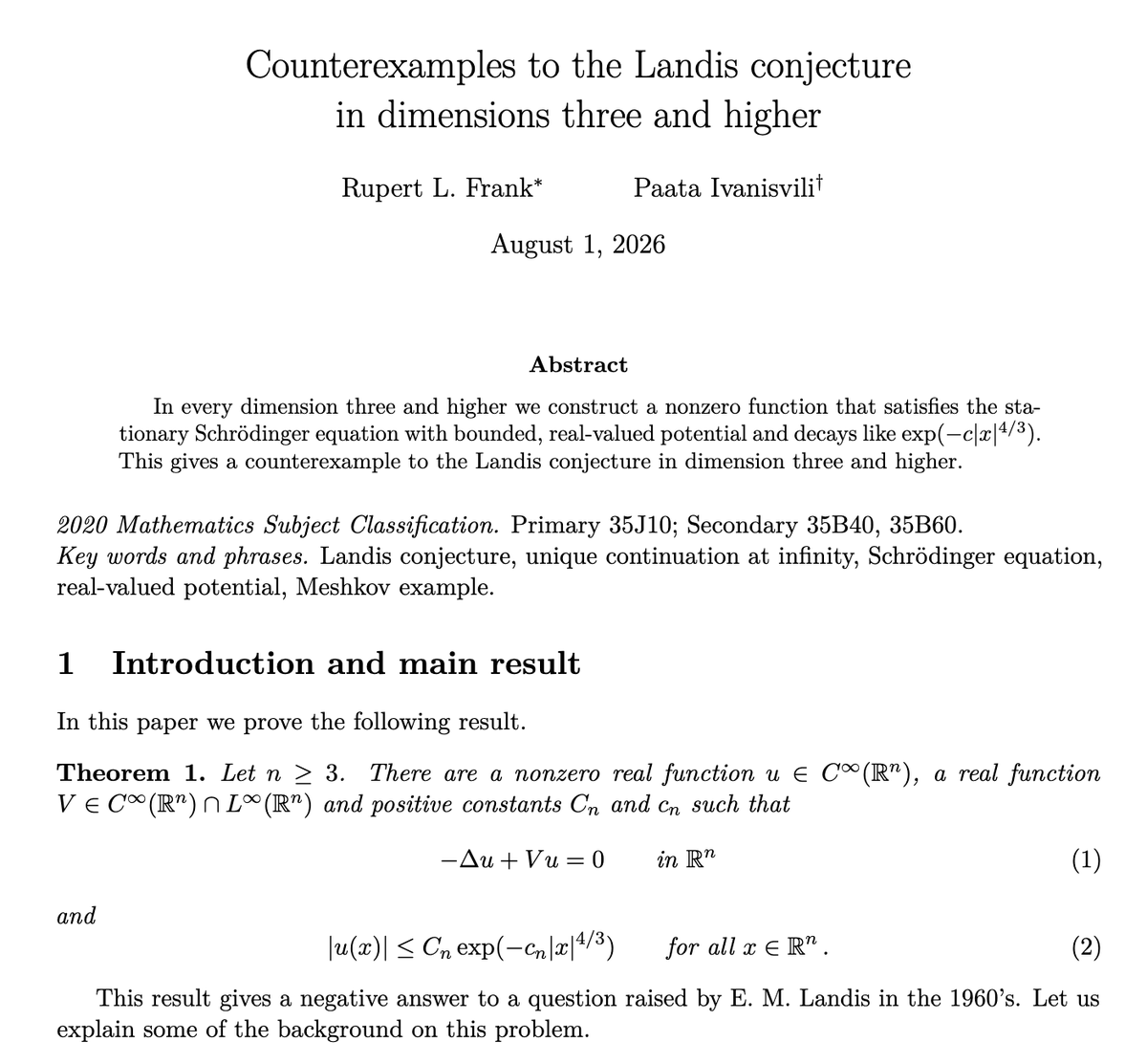
We’re releasing the manuscripts, formal Lean certificates, and reasoning walkthroughs so mathematicians can examine these results and build on their ideas. https://t.co/oDT2J8F6Ez
A couple of websites
I want to share a couple websites aimed specifically at mathematicians regarding AI-safety and AI-risk .
The first one I made myself: https://t.co/Ye2ZF5CmJj. This is designed to be a very high level and accessible resource describing some research agendas, collections of problems, and organizations in the field of AI-safety. I hope that for mathematicians considering directing some of their effort in this direction, this eliminates some of the friction. I plan to expand it quite a bit, but I hope it's already useful! I'd be happy and grateful to hear (constructive) feedback on it :-)
1/2
Exactly. The hard part is often not learning one more framework; it’s having the math in the right order. There is a rigorous source grounded Math → ML track for that: calculus, linear algebra, probability, learning theory, optimization, then deep learning.
https://t.co/yw3njkPHuv
I'm actually less shocked about the open problems solved by AI and more shocked about how many people truly believe research is about competing to get the results, instead of learning for the sake of our own curiosity and meaning.