Ik er kan zo kwaad over worden ze bezuinigen 470 miljoen op verpleeghuiszorg voor ouderen en geven 470 miljoen aan asielzoekersopvang.
En ik als ernaar vraag en schande over spreek heeft #Bontenbal niet de beleefdheid te fatsoenlijk te antwoorden. WALGELIJK!
#debat#wilders
1. Respectfully, BTC is completely screwed because of its security budget. It would only cost $8B to 51% attack BTC today. When this gets down to $2B (AKA, BTC's security market cap becomes 0.1% of its asset market cap), a 51% attack is virtually certain to happen. This will become blindingly obvious over the next decade. ETH is the only truly decentralized crypto-asset that can become the internet's SoV Schelling point.
2. At Etherealize, I've talked to the pico top of tradfi infrastructure firms. They literally want a million TPS. This is impossible to do on a single global state machine. A million TPS is quite possible when you have a neutral, trustless settlement layer that multiple hyper-fast L2s settle down to. Decentralized NASDAQ in the memecoin datacenter ain't happening any time soon.
3. This is true. You pay premium prices for premium blobspace. Securing your data with a globally decentralized network with thousands of validators and nearly $100B of staked asset security is going to be a bit more expensive than doing it with some VC AWS chain. For mission critical data though, I know which DA I'd prefer to use.
Generally speaking, I find the "ETH is trying to do too many things at once" argument quite weak. Would you say that about Windows? Would you say that about the internet itself? These are the types of platforms that Ethereum is comparable to.
Zoom out and look at the big picture: ETH is a mature bearer asset which will secure the global financial system after it gets tokenized on crypto rails. 85% of RWAs exist on Ethereum, as well as most of the world's stablecoins. RWA adoption is exploding on ETH - tradfi firms who will tokenize trillions value stability and maturity far more than a slightly faster L1 execution environment.
We zijn vreemden in onze eigen steden geworden. Wat we op Eerste Paasdag zagen in Rotterdam - Mekka aan de Maas - is het resultaat van 40 jaar massa-immigratie en een totaal mislukte inburgering. Onze stad Rotterdam overgenomen door islamitisch machtsvertoon. Onaanvaardbaar.
JD Vance called out the Europeans at CPAC for jailing their political opponents.
Today Marine Le-Pen was sentenced to 4 years in prison.
Everything JD said here turned out to be true.
Listen in to @cmoyall Head of Digital Assets at @apolloglobal describing her vision for the future of onchain savings accounts with a model portfolio of BlackRock BUIDL, Apollo Private Credit and Ethena USDe 👇🏻
My bat signal 🦇🔊 will return when ETH is ultra sound again, soon enough™.
ETH supply currently grows 0.5%/year. That's 1%/year of issuance minus 0.5%/year of burn. To become ultra sound again, either issuance has to decrease or the burn has to increase. I believe both will happen, let me explain :)
ETH vs BTC
Before diving into Ethereum's issuance and burn, quick interlude on ETH vs BTC.
Internet-native money is an enormous opportunity, think tens of trillions of dollars. Monetary premium rarely accrues at scale. You need a truly attractive asset with outstanding properties for society to coordinate around.
At first approximation moneyness is a zero-sum game. Gold is primed for demonetisation in the internet age. There are only two candidates to supplant it and win internet money—BTC and ETH. Nothing else comes close. IMO the determining Schelling points are credible neutrality, security, and scarcity.
Since the merge, ETH is definitely scarcer than BTC. It's remarkable BTC supply grew 666K BTC, worth $66B, all while ETH supply stayed flat. Today BTC supply grows 0.83%/year, 66% faster than ETH. And for those looking ahead, as I explain below, ETH supply is poised to decrease again.
Scarcity is important, but ultimately the fight for internet money will likely be settled by security. Ironically, the famous 21M BTC cap is to blame. BTC issuance is going to zero—that's Bitcoin's strongest social contract. In a few halvings, issuance will be so small as to be irrelevant.
Here's a shocking stat: in the last 7 days only 1% of miner revenue came from Bitcoin fees. Yes, 99% came from issuance. And that's despite 4 halvings that reduced issuance by 16x, and despite 15 years of search for transactional utility on Bitcoin.
IMO the Bitcoin blockchain is cooked. It takes roughly $10B and access to 10GW to permanently 51% attack Bitcoin. The cost is peanuts for nation states. As for the power, Texas—a single state of a single country—can produce 80GW. The BTC security ratio is 200-to-1, it's a $2T asset secured by $10B of economic security.
Any shortable instrument correlated to BTC mining incentivises an 51% attack attack. There's $20B of Bitcoin mining stocks—those would insta-nuke. There's $40B of open interest on BTC perps—direct short exposure. Not to mention potential short exposure through the $100B in ETFs and the $100B in MSTR.
Will BitVM solve the fee problem? Any BitVM bridge is an incentive to 51% attack Bitcoin. Indeed, a 51% attacker can censor fraud proofs over the challenge period and drain BitVM bridges. Ironically, BitVM is arguably a direct attack on Bitcoin. And no, Bitcoin doesn't have social slashing to recover from 51% attacks.
What if the BTC price grows by 10x, flipping gold, is Bitcoin safe then? Let's say this happens in the next 11 years. BTC would be a $20T asset but issuance would shrink 8x because of the three halvings. The security ratio would grow beyond 1000-to-1. IMO this is untenable especially as BTC institutionalises, becomes more liquid, and ultimately become easier to short in size. Imagine $1T of perp open interest but just $10B of economic security.
Can Bitcoin somehow fix itself before it's too late? Bitcoin is the epitome of blockchain ossification. Can it have 1%/year tail issuance? Ha, good luck fighting the 21M cap! Maybe Bitcoin can switch to PoS and rely on minimal fees? PoS is sacrilege. Maybe Bitcoin can change to another PoW algorithm? Nope, that nuclear option won't help. Maybe Bitcoin can have big blocks and sell data availability at scale? Ser, a holy war was fought over small blocks.
If you made it this far and understood the above, congrats. Even today few appreciate how screwed Bitcoin PoW is long term and what the ramifications are for BTC the asset. This is a frontrunable opportunity but it requires patience. The time frame is not 1 month or even 1 year—it's 10 years.
Talking about long time frames, the Lummis proposal to lock BTC for 20 years is kinda insane—Bitcoin will be smoked by then. Worse, if the US were to hold trillions in BTC it would directly incentivise US enemies to muster a 51% attack. Contrary to popular belief, Bitcoin is not remotely resistant to nation states—China and Russia can pull off a 51% attack with ease.
ETH issuance
Ok, back to ETH :) The current issuance curve is a trap. Unfortunately, like Bitcoin's issuance, Ethereum's issuance was misdesigned. It guarantees 2% tail APR, even if 100% ETH is staked. Every rational ETH holder is incentivised to stake as staking costs are significantly lower than 2%.
We all lose when most ETH stakes:
→ ETH displacement: Liquid staking tokens like stETH and cbETH displace pristine ETH as unit of collateral. This injects systemic risks—custodial risks, slashing risks, governance risks, smart contract risks—into the core of defi. This displacement also erodes ETH as a unit of account, with further knock-on effects to monetary premium.
→ real yields and taxes: Real yield, i.e. the yield adjusted for supply growth, decrease as more ETH stakes. When 100% of ETH stakes all ETH holders get equally diluted. Worse, income taxes are drawn on nominal yield. It would be a tragedy of the commons for no staker to enjoy positive real yield and for all ETH holders to suffer billions of dollars per year of tax sell pressure.
IMO the issuance curve should drive discovery of a fair issuance rate through staker competition—no arbitrary 2% floor. This means the issuance curve must eventually decline and return to zero with increased ETH stake. My suggestion is "croissant issuance".
Croissant issuance is a simple half-oval with two parameters:
→ soft cap: The staking fraction where issuance returns to zero. To me a 50% staking soft cap feels credibly neutral and pragmatic. In particular it's large enough to address discouragements attacks.
→ peak issuance: The theoretically-maximal issuance borne by ETH holders. An arbitrary round number like 1%/year will do as ultimately the equilibrium rate would be market-set.
EF researchers have studied issuance for years—IMO there's rough consensus the current curve is broken and needs to change. Navigating the social layer to change issuance won't be easy. This is an opportunity for a champion to rise to the occasion and coordinate change to mainnet over the next couple years.
ETH burn
IMO the sustainable way to burn vast amounts of ETH is to scale data availability. It's much more lucrative to have 10M TPS with each transaction paying $0.001 in DA than it is to have 100 TPS at $100/tx.
Yes, the data availability supply shock from EIP-4844 that introduced blobs temporary lowered total burn. This is the nature of supply and demand. When demand for DA catches up expect the blobs to burn hard. The Pectra hard fork, in a couple months, will double blob count. The short-term goal is growth and I expect lots of it.
For the next couple years it will be a cat-and-mouse game between supply and demand as full danksharding is deployed. I wouldn't be surprised if this year we see hundreds of ETH per day of blob burn, and then that burn suddenly collapsing again with peer DAS in the Fusaka fork.
Zooming out, we're here to build infrastructure for the next decades and centuries. Fundamentals will play out over years. Whether it's Bitcoin security, ETH issuance, or the ETH burn, stay patient and have conviction :)
AI models need to be able to run on consumer-grade hardware
Locally-run AI gives us sovereignty from Big Tech and Nation State censorship
The same is true for blockchains! Locally-run software on consumer-grade hardware is freedom
Come and take it!
Beam Chain was the biggest announcement at Devcon, introducing 9 major upgrades for Ethereum.
But most people still don’t understand them...
So, here are 9 tweets to explain the 9 upgrades: 🧵
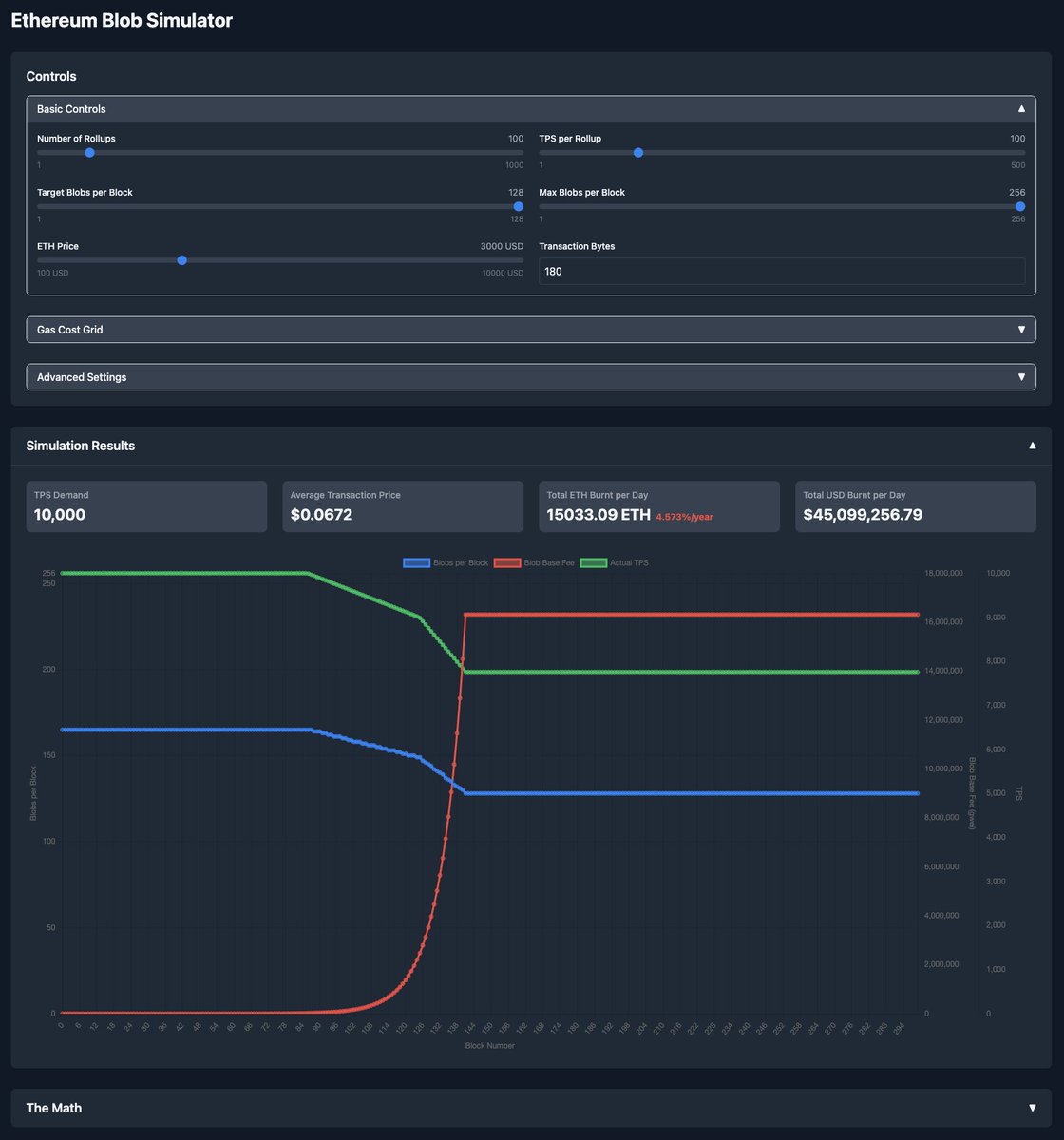
Many people arguing about blobs, but so far no one has simulated how they respond to demand... until now. TL;DR: Blobs are insanely bullish for ETH long term
Based Rollups
What are they, why do they exist, and which projects are already making waves?
A 101 explainer 👇
==================================
Scaling #Ethereum has been one of the most discussed challenges in crypto.
To address this, the community chose a rollup-centric approach. The idea is simple: Instead of hosting all applications on Ethereum, the focus is on rollups that offer faster, cheaper transactions while still settling back on Ethereum. As a result, you get faster, cheaper transactions, but still keep Ethereum’s security.
We now have optimistic rollups like @Arbitrum, OP Mainnet, and @Base alongside zk-rollups like @ZKsync, all contributing to Ethereum's growth.
They're bringing more users and value to Ethereum, however, concerns remain about their reliance on centralized sequencers and liquidity fragmentation across chains.
This is where based rollups come in. They integrate more closely with Ethereum's infrastructure, helping retain value within the ecosystem. This new method of building rollups could bring additional value to Ethereum and $ETH.
What are Based rollups?
Based rollups, or L1-sequenced rollups, are a type of rollup where the base L1 chain, like Ethereum, manages transaction sequencing directly.
Unlike traditional rollups that rely on their own sequencers, based rollups tap into the security, liveness, and decentralization of the L1 by outsourcing transaction sequencing to the L1’s infrastructure. This infrastructure includes proposers, searchers, builders, and other actors who permissionlessly include based rollup blocks in L1 blocks.
Initially, this approach seemed inefficient — @VitalikButerin once called it "total anarchy" in his 2021 article on rollups. But today based rollups have become much more feasible. In 2023, Ethereum researcher @drakefjustin brought the concept back into focus, arguing that based rollups not only align more closely with Ethereum but also eliminate the need for separate security assumptions for each new rollup.
How do Based rollups work?
Based rollups use the L1 for consensus, data availability, and settlement layers, while handling execution independently. For instance, when Ethereum is the base L1, the key layers of based rollups are as follows:
1. Execution Layer — Managed by the rollup itself, where transactions are executed off-chain.
2. Consensus Layer — Relies on Ethereum validators to sequence transactions.
3. Data Availability Layer — Uses Ethereum as the DA layer to ensure that transaction data is available for validation by anyone.
4. Settlement Layer — Also part of Ethereum, where final transaction states of the rollup are recorded.
Based rollups use Ethereum for everything from ordering transactions to settling them. While this approach may not seem radically different from traditional rollups, it fundamentally shifts how sequencing is handled. Instead of relying solely on separate sequencers, based rollups leverage Ethereum itself for transaction sequencing.
In a traditional rollup, users send their transactions to a dedicated sequencer — essentially a single machine operated by the rollup team. This sequencer is responsible for collecting user transactions, determining their sequence, and packaging them into blocks that are posted on Ethereum.
In contrast, based rollups direct user transactions to block builders who manage both Ethereum and the rollup. This use of Ethereum’s infrastructure allows based rollups to benefit from the same guarantees provided by Ethereum, enabling transactions to achieve finality more reliably than in non-based rollups.
Top projects in the based rollup landscape
As a relatively new concept, based rollups are still being developed, with a few key projects emerging:
@taikoxyz — an Ethereum-equivalent (Type 1) ZK-EVM that is maximally compatible with Ethereum and does not introduce additional trust assumptions.
KeySpace — a zk-rollup by @Coinbase aimed at creating smart wallets usable across any chain.
@gwyneth_taiko — a based rollup using pre-confirmations, designed for synchronous composability with Ethereum.
@puffer_unifi — a based rollup developed by the @puffer_finance team that employs pre-confirmations to enhance user experience.
@Spire_Labs — a framework on Ethereum that allows developers to build based appchains.
Why based rollups?
As Justin Drake outlined in his original post, based rollups are worth your attention for several reasons:
1. Inherited Liveness and Decentralization — One of the key advantages of based rollups is their ability to inherit the liveness guarantees of the base L1 chain. As long as the L1 is operational, so is the rollup.
2. Economic Alignment with L1 — The economic model of based rollups creates a mutually beneficial relationship with the L1. Priority fees and MEV from these rollups naturally flows to the L1. This synergy doesn’t just add value to the base layer, it also boosts the legitimacy and brand awareness of the rollups themselves, thanks to Ethereum’s community.
3. Cost Efficiency — Outsourcing sequencing to Ethereum reduces development costs, accelerates time to market, and lowers user costs (especially at scale) for based rollups.
However, based rollups have trade-offs. They sacrifice some profitability by relying on Ethereum for sequencing, missing out on priority fees and MEV. Additionally, they contend with Ethereum's inherent challenges, such as slow block times, which can cause latency issues.
These challenges explain why existing rollups are designed with their own sequencers — to offer a fast user experience. Although solutions like pre-confirmations of inclusion and execution are being discussed as potential ways to enhance the user experience of based rollups, it remains uncertain whether such improvements can be achieved without introducing trusted third parties.
There's a real debate that these changes might compromise the simplicity and security that initially made based rollups appealing.
Analysis by @arjunnchand ✍️