Presidente, como colega del Externado, en su análisis le falta un punto importante: el salario mínimo no beneficia a todos los trabajadores. Solo a una minoría. De hecho, la mayoría de trabajadores en la informalidad no perciben mejores salarios. Para Bogotá las personas que ganan menos de 1 Salario Mínimo subieron 13,7%.
Los ingresos de los trabajadores no se incrementan vía decreto sino con trabajadores mejor formados y mas y mejores empresas
La inflación básica, esto es, excluyendo energéticos y alimentos, alcanzó en mayo de 2026 una tasa anual de 6,5 %, frente al 5,4 % en el mismo mes de 2025. Este indicador suele reflejar los efectos de factores de demanda agregada (p.ej., déficit fiscal, consumo final y salario mínimo). Es la tercera tasa más alta desde 2010 para periodos comparables 👇🏼
@garrytan People should check out the awesome video that @ycombinator did on what we’re up to at @Starcloud_ (8 months ago before data centers in space was cool!)
https://t.co/aAvtzZxTRC
Starcloud just became the fastest YC company ever to a $1B valuation after Demo Day. 17 months. Building data centers in orbit.
The hardest possible problem, the fastest possible ascent. This is what we should be building.
La abogada colombiana @GabrielaTafur, con un MBA de Stanford, acaba de obtener US$5M para Idilio, una plataforma de microdramas.
Con más de 1.5 millones de descargas, atrajo como inversionistas a @speedrun, @wndrco y David Vélez.
https://t.co/kroE4Zlt3C
En cumplimiento de la sentencia de tutela proferida por el Tribunal Administrativo de Cundinamarca, Sección Tercera, Subsección "A", el 12 de febrero de 2026, dentro del expediente 2025-00469, y en relación con las menciones que como Presidente de la República formulé sobre los señores Roberto Moreno Mejía y Luis Alberto Moreno Mejía durante el Consejo de Ministros del 21 de octubre de 2025, me dirijo al país en los siguientes términos.
He dedicado buena parte de mi vida pública al examen de los asuntos que comprometen el patrimonio público de Colombia. En el año 2001, como Representante a la Cámara, convoqué junto con otros parlamentarios el debate de control político sobre el caso del Banco del Pacífico, debate cuya transcripción íntegra reposa en la Gaceta del Congreso de la República número 60 del 26 de marzo de 2002. Cuatro años después, en 2005, publiqué bajo el sello de Editorial Intermedio el libro "El caso del Banco del Pacífico", registrado con el ISBN 978-958-7092-49-3, en el cual recogí las pruebas, los documentos y las conclusiones de aquella investigación parlamentaria. En los años que siguieron, el debate público sobre el llamado volteo de tierras en la Sabana de Bogotá y sus efectos ambientales fue objeto de control político en el Concejo Distrital de Bogotá, de estudios técnicos de la Corporación Autónoma Regional de Cundinamarca sobre los humedales y el río Bogotá, y de investigaciones periodísticas nacionales e independientes.
Por respeto a la administración de justicia y a la Constitución Política que como Jefe del Estado tengo el deber de proteger, formalmente ACLARO:
Primero. Que los señores Roberto Moreno Mejía y Luis Alberto Moreno Mejía no han sido sujetos de decisión penal alguna, ni de imputación, ni de acusación, ni de condena, por hecho criminal asociado al caso del Banco del Pacífico, al volteo de tierras en la Sabana de Bogotá, al predio Hacienda San Simón o a ningún otro de los asuntos referidos en mi intervención del 21 de octubre de 2025.
Segundo. Que, en consecuencia, los señores Moreno Mejía gozan plenamente de la presunción de inocencia consagrada en el artículo 29 de la Constitución Política, en el artículo 14.2 del Pacto Internacional de Derechos Civiles y Políticos y en el artículo 8.2 de la Convención Americana sobre Derechos Humanos. Esa presunción opera por ministerio de la ley y permanece intacta mientras no concurra sentencia condenatoria en firme proferida por juez penal competente; garantía que ningún servidor público, incluido el Presidente de la República, puede ni pretende desconocer.
Con esta aclaración doy cumplimiento a la orden judicial, reafirmo mi respeto a la administración de justicia y al debido proceso, y conservo, en el lugar que la Constitución le otorga, el espacio del debate democrático sobre los asuntos de interés general que conciernen a Colombia.
Me mantengo en todo lo probado en el debate parlamentario y mi libro que será editado de nuevo.
Hoy al votar, recuerden que esta fue la primera campaña en 35 años en la cual fue asesinado un candidato presidencial.
No olvidemos a Miguel Uribe.
🇨🇴❤️🩹🙏🏼
Lula relanza perforaciones de gas y petróleo en la Amazonía
El presidente de #Brasil, #Lula da Silva, y la estatal #Petrobras anunciaron el reinicio, tras casi una década, de #perforaciones en la principal reserva terrestre de #hidrocarburos de Brasil, en la #Amazonía. (cp). https://t.co/PVGuNvep3w
The companies I love working with in office hours are the ones where the founder has a specific, weird, earned insight that nobody else has. Not "AI for X." A genuine edge that came from living inside a problem.
The ones that are dying almost always have the same pattern: technically competent founders building something nobody asked for, moving metrics that don't matter, avoiding the conversation with the one user who'd tell them the truth.
The lucky thing is that 2nd type of founder can become the 1st kind if they don't stand still, they are willing to talk to people, try things, and always seek high rate of learning.
Sanders and AOC introduced a bill to pause ALL AI data center construction. 300+ local bills filed. Half of planned 2026 data centers facing delays or cancellation. Each one brings billions to local economies.
The people who say they want American jobs are trying to block the biggest job creation engine since the interstate highway system.
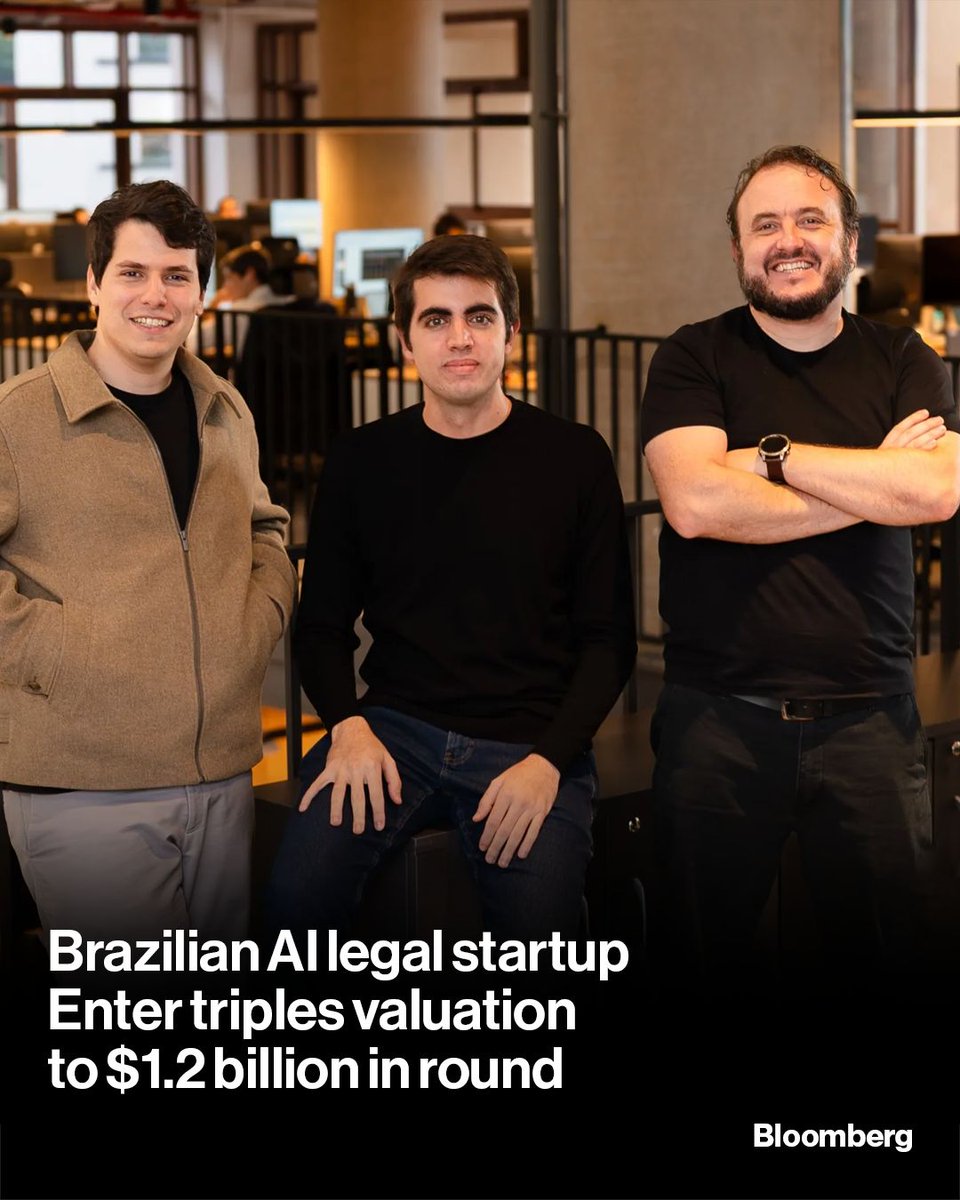
Brazilian AI legal startup Enter has tripled its valuation to $1.2 billion in a new round of funding, vaulting it into the upper ranks of artificial intelligence companies in Latin America. Read more: https://t.co/BluUzPnl74
📷: Enter
En dias pasados estuve dialogando en Negocios Ditu, con @VictorGrosso sobre remesas y migracion ambas en cifras récord, en Colombia. $1227 MM USD entraron en Marzo 2026 al pais.
Because we get asked a lot.
The Technological Republic, in brief.
1. Silicon Valley owes a moral debt to the country that made its rise possible. The engineering elite of Silicon Valley has an affirmative obligation to participate in the defense of the nation.
2. We must rebel against the tyranny of the apps. Is the iPhone our greatest creative if not crowning achievement as a civilization? The object has changed our lives, but it may also now be limiting and constraining our sense of the possible.
3. Free email is not enough. The decadence of a culture or civilization, and indeed its ruling class, will be forgiven only if that culture is capable of delivering economic growth and security for the public.
4. The limits of soft power, of soaring rhetoric alone, have been exposed. The ability of free and democratic societies to prevail requires something more than moral appeal. It requires hard power, and hard power in this century will be built on software.
5. The question is not whether A.I. weapons will be built; it is who will build them and for what purpose. Our adversaries will not pause to indulge in theatrical debates about the merits of developing technologies with critical military and national security applications. They will proceed.
6. National service should be a universal duty. We should, as a society, seriously consider moving away from an all-volunteer force and only fight the next war if everyone shares in the risk and the cost.
7. If a U.S. Marine asks for a better rifle, we should build it; and the same goes for software. We should as a country be capable of continuing a debate about the appropriateness of military action abroad while remaining unflinching in our commitment to those we have asked to step into harm’s way.
8. Public servants need not be our priests. Any business that compensated its employees in the way that the federal government compensates public servants would struggle to survive.
9. We should show far more grace towards those who have subjected themselves to public life. The eradication of any space for forgiveness—a jettisoning of any tolerance for the complexities and contradictions of the human psyche—may leave us with a cast of characters at the helm we will grow to regret.
10. The psychologization of modern politics is leading us astray. Those who look to the political arena to nourish their soul and sense of self, who rely too heavily on their internal life finding expression in people they may never meet, will be left disappointed.
11. Our society has grown too eager to hasten, and is often gleeful at, the demise of its enemies. The vanquishing of an opponent is a moment to pause, not rejoice.
12. The atomic age is ending. One age of deterrence, the atomic age, is ending, and a new era of deterrence built on A.I. is set to begin.
13. No other country in the history of the world has advanced progressive values more than this one. The United States is far from perfect. But it is easy to forget how much more opportunity exists in this country for those who are not hereditary elites than in any other nation on the planet.
14. American power has made possible an extraordinarily long peace. Too many have forgotten or perhaps take for granted that nearly a century of some version of peace has prevailed in the world without a great power military conflict. At least three generations — billions of people and their children and now grandchildren — have never known a world war.
15. The postwar neutering of Germany and Japan must be undone. The defanging of Germany was an overcorrection for which Europe is now paying a heavy price. A similar and highly theatrical commitment to Japanese pacifism will, if maintained, also threaten to shift the balance of power in Asia.
16. We should applaud those who attempt to build where the market has failed to act. The culture almost snickers at Musk’s interest in grand narrative, as if billionaires ought to simply stay in their lane of enriching themselves . . . . Any curiosity or genuine interest in the value of what he has created is essentially dismissed, or perhaps lurks from beneath a thinly veiled scorn.
17. Silicon Valley must play a role in addressing violent crime. Many politicians across the United States have essentially shrugged when it comes to violent crime, abandoning any serious efforts to address the problem or take on any risk with their constituencies or donors in coming up with solutions and experiments in what should be a desperate bid to save lives.
18. The ruthless exposure of the private lives of public figures drives far too much talent away from government service. The public arena—and the shallow and petty assaults against those who dare to do something other than enrich themselves—has become so unforgiving that the republic is left with a significant roster of ineffectual, empty vessels whose ambition one would forgive if there were any genuine belief structure lurking within.
19. The caution in public life that we unwittingly encourage is corrosive. Those who say nothing wrong often say nothing much at all.
20. The pervasive intolerance of religious belief in certain circles must be resisted. The elite’s intolerance of religious belief is perhaps one of the most telling signs that its political project constitutes a less open intellectual movement than many within it would claim.
21. Some cultures have produced vital advances; others remain dysfunctional and regressive. All cultures are now equal. Criticism and value judgments are forbidden. Yet this new dogma glosses over the fact that certain cultures and indeed subcultures . . . have produced wonders. Others have proven middling, and worse, regressive and harmful.
22. We must resist the shallow temptation of a vacant and hollow pluralism. We, in America and more broadly the West, have for the past half century resisted defining national cultures in the name of inclusivity. But inclusion into what?
Excerpts from the #1 New York Times Bestseller The Technological Republic: Hard Power, Soft Belief, and the Future of the West, by Alexander C. Karp & Nicholas W. Zamiska
https://t.co/8igjazz1On