On December 17 I am presenting at the NVIDIA FLARE webinar with Lilly’s TuneLab, the two largest federated data networks in drug discovery. The models that change decisions in a drug program are trained on proprietary data, and that data never moves between companies. Federated training is how you use it without anyone handing it over. We will show what that delivered across our co-folding and ADMET networks, measured against public baselines, with none of the data leaving each company. 6:00pm CET, free. Registration in the first reply.
Thanks to @holgerrroth and @NVIDIAHealth for hosting, and to the TuneLab team at @EliLillyandCo for sharing the stage.
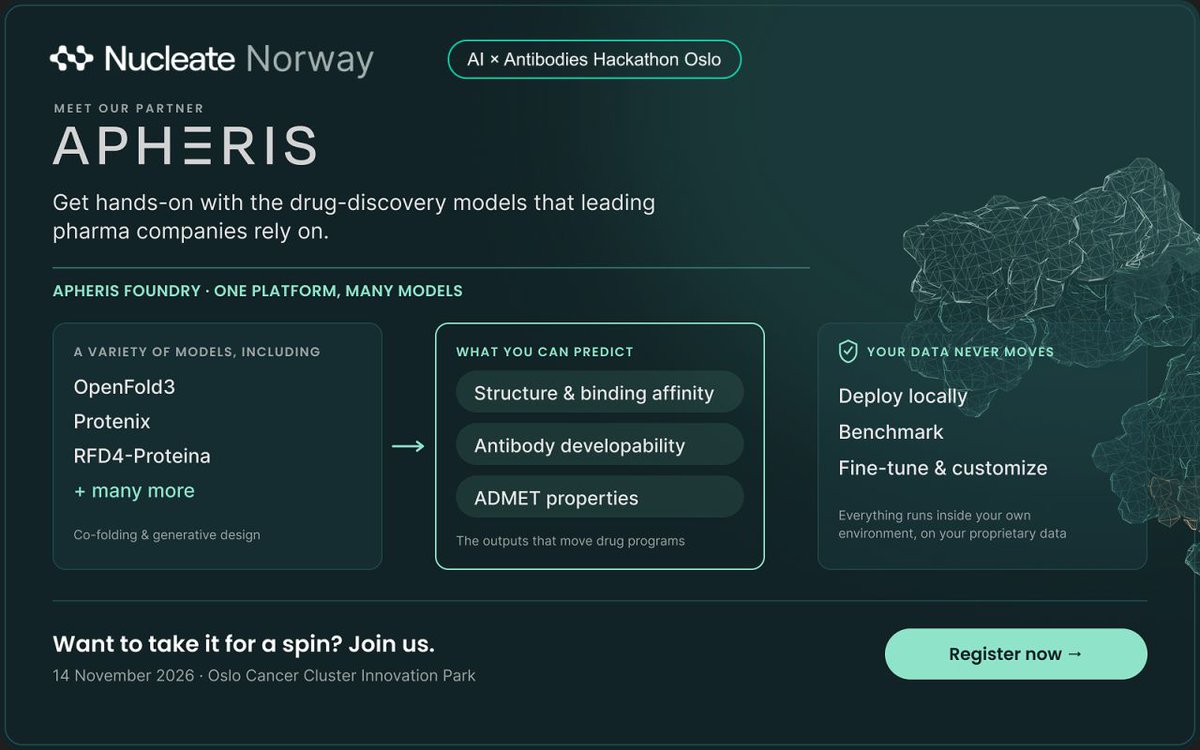
@DrLeucine thanks for driving this. The Hackthon is sponsored by Nucleate Norway at the Oslo Cancer Cluster. Compute credits from @AnthropicAI: https://t.co/TUpX1QqFMs
The Apheris team is sponsoring the AI × Antibodies hackathon in Oslo this Saturday. 16 teams get Foundry to design a new antibody against HER2 or improve Trastuzumab, with the best designs synthesized and tested by @adaptyvbio. Looking forward to seeing what they build.
@BioCentury covers the Antibody Developability Consortium we lead with @Ginkgo, one of four initiatives building the datasets AI models in biology are missing.
Only about 240 developability profiles for IgG sequences are public. Far more sit inside individual companies, measured to different standards. The consortium characterizes 10,000 antibodies under a single protocol. Members then fine-tune on their own sequences without exposing them.
Thanks to Yves Fomekong Nanfack at Takeda for sharing the member's view and @linzma01 for the write-up.
https://t.co/mKtypJaOa7
On OpenBind, molecular weight alone ranks compounds better than Boltz-2. We built ApherisAffinity to read the binding pocket instead: on size-matched pairs it ranks 66% correctly, vs 48% for weight alone. It now runs on Foundry, on teams’ own targets.
Today we’re announcing Foundry. Models trained on public data fall short on the targets programs are decided on. With Foundry, teams fine-tune them on their own data, inside their own infrastructure, and run them from their own agents. In the video my co-founder Michael explains how it works
Being able to build domain specific models with proprietary data is a moat.” @nvidia's @StacieCT, in a @TechCrunch Disrupt roundtable with @SandboxAQ CEO @jackhidary.
The premise behind the Virtual Cell Network we built with @SandboxAQ.
https://t.co/h9R16QdVLP
@dektwit you are right some mutations will not disrupt binding as much as others, and mutated enzymes may still have function. This spectrum is something we are aware of in our work, especially when we generate and curate our synthetic negative data.
An affinity model should stop predicting binding when you mutate away the binding site. Published tests show co-folding affinity rankings can survive that. We built one whose predictions drop to chance, designed to be fine-tuned on pharma’s own affinity data.
Public virtual cell models learn mostly from cancer cell lines and published compounds. Drug programs run on neither. With @SandboxAQ we launched the Virtual Cell Network: pharma partners train AQCell together without moving their data, then each fine-tunes it on its own program.
@NVIDIAHealth and the Institute for Protein Design, led by Nobel laureate David Baker, just released RFD4-Proteina today at GTC Berlin, an open model that designs a protein’s sequence and structure together against a target. Apheris is a launch distribution partner. We run RFD4-Proteina on your own GPUs, inside your environment, and you can fine-tune it on your own structures and assays to design VHHs, antibodies, binders and enzymes and customize it to your chemistry.
Round two! The Apheris x Wells Wood Lab have been busy (again!). Here are our 40 submissions for the TNF-α challenge of the @adaptyvbio x @AnthropicAI
Protein Design Competition!
GLP-1 next!
I’m told hashtags are still a thing:
#ProteinDesign#OpenScience#AI#Apheris#adaptyv
Charlotte Deane in a Nature Reviews Drug Discovery interview: “the bottleneck is data now.” Structure-based drug discovery lacks high-quality drug-like data. PDBbind, the de facto set of protein-ligand structures with measured affinity, has about 19,000 entries, and only about 5,300 are curated, high-quality crystal structures and affinity data.
Only training on more and diverse data will truly help bringing AI for drug discovery to the next level.
https://t.co/QMWSIXyeu4
Episode 2 of Nic Gautier’s federation-in-production series is out. In federated training the model travels to each site every round, trains locally, and the new weights are sent back. While it is moving, the GPUs sit idle. In one of our runs the model was 2.3 GB and a site’s link was slow, so each round spent about three minutes moving the model and ten seconds training. That left the GPUs idle 99% of the time. In the episode, Nic walks through how the team got it down to about 20% and how to push it lower.