Co-founder, @tqh_policy | @ylacofficial | Attempting to strengthen the governance ecosystem through public policy research, advocacy & citizen engagement
JUST IN | Retired Intelligence Bureau Special Director Yashovardhan Azad, and two other victims of pellet gun injuries — an artist and another professional, move Supreme Court to demand decommissioning or banning the use of wholly or partly metallic kinetic projectiles/pellets fired from pump action rifles or projectile action guns (PAG) for the purpose of crowd dispersal of civilian assemblies by law enforcement agencies and grant of exemplary compensation to all victims of pellet-injuries caused by the State action on July 20 as well as to ensure complete medical treatment, care and rehabilitation of the said victims.
- reports @vijaita
#IGPPExpertTalks - AI Special Series | The AI Transition: Education, Employment and India's Future
What the ongoing demonstrations in India are really telling us?
Are they simply some demonstrations, or do they point to deeper social anxieties about the future of work in an AI-driven world?
As artificial intelligence reshapes labour markets, skills and opportunities, the challenge is no longer just technological: it is social, economic and institutional. The pace of change is raising important questions about whether our education systems, public institutions and policy frameworks are prepared for the transition.
In this episode of #IGPPExpertTalks - AI Special Series, Mr. Rohit Kumar (@rohitkr_RK), Co-founder of The Quantum Hub (@TQH_Policy) and Young Leaders for Active Citizenship (YLAC), joins Dr. Manish Tiwari (@ManishTiwari), Director, Institute for Governance, Policies and Politics (@IGPPVMF), to examine how AI is transforming education, employment and opportunity and what these changes mean for India's future.
You can watch it here also:- https://t.co/n40LVgpf0d
#IGPPExpertTalks #AI #ArtificialIntelligence #Protests #Youth #Education #Employment #FutureOfWork #TechnologyPolicy #PublicPolicy #AIGovernance #DigitalEconomy #Skills #IndiaAI #IGPP
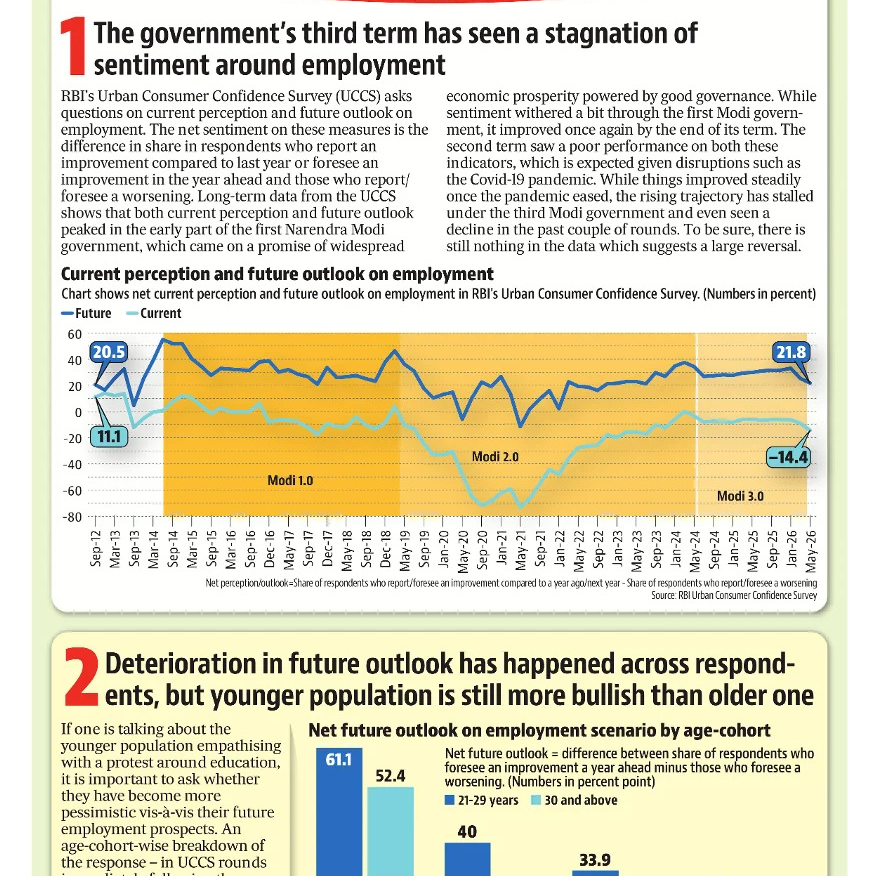
Spotted this piece in HT today. It offers a compelling lens to understand why Monday's #studentprotests resonated so widely. Rather than viewing them as a response to a single incident, it argues that they tapped into something deeper: growing anxiety about employment prospects and a weakening belief that education, hard work, and credentials will reliably translate into opportunity.
If that's true, I wonder if we're only seeing the beginning of a much larger challenge.
As #artificialintelligence reshapes labour markets, the skills needed to succeed are evolving rapidly, but our education and skilling systems are struggling to keep pace. I worry that we are underestimating the scale and urgency of the reforms needed to prepare young people for this transition. If we fail to prepare them in time, the gap between aspirations and opportunities is likely to widen, deepening the anxieties we're already seeing.
This isn't just an education or labour market issue. It is an #AIpolicy issue as well. If AI comes to be seen as reducing opportunities rather than creating them, public trust in the technology will inevitably suffer, making adoption more politically and socially contested.
India's AI ambitions will ultimately depend not just on compute, models, and regulation, but on whether young people believe they have a credible pathway to participate in, and benefit from, the AI economy.
@tqh_policy
The Quantum Hub (TQH) is expanding! We are looking for a Manager in New Delhi to anchor our growing Tech Policy practice.
At @tqh_policy, we work at the intersection of research, governance, and impact. As tech frameworks evolve rapidly, this role offers a platform to lead client-facing engagements, shape robust advocacy strategies, and direct research on critical issues like AI regulation, data privacy, and platform governance.
We are looking for someone with:
◾️6–8 years of experience in public policy, law, or tech regulation.
◾️An advanced degree or equivalent track record in the technology policy landscape.
◾️Strong analytical thinking and communication skills to navigate a fast-paced environment.
If you are passionate about emerging technologies and engaging with key institutional stakeholders on policy questions, we would love to hear from you.
How to apply:
Please submit your resume, a writing sample (max 8 pages), and two references through the application link below.
Details and application form: https://t.co/8Vv2ywprA9
Please share this within your network or tag individuals who might be a good fit!
#TechPolicy #PublicPolicy #Hiring #AIRegulation #DataPrivacy #PolicyJobs #TQH
Startup Central | With spam and scam messages still a major concern, why is WhatsApp prioritising usernames??
"WhatsApp's intent is perhaps fair, but the government's question is also legitimate..." Rohit Kumar of Quantum Hub explains the arguments from both sides
Full interview - https://t.co/bOe2BqoaiB
@SumitaKareer@rohitkr_RK #Meta #WhatsApp
So, the reactions to Alex Karp's recent comments have been tremendously interesting and they raise many good questions for Indian enterprise....
As AI gets embedded deeper into enterprise workflows, the risk is no longer just data leakage. The bigger question may be: who is learning from the way your business works?
Can frontier AI partners of today become competitors tomorrow? Should enterprises rent generic intelligence but own their context, workflows, governance and evaluation layers?
And does this create a major opportunity for Indian IT services to move up the value chain?
Read my thoughts at - https://t.co/LraXHx3wxO
The Anthropic blackout exposes an uncomfortable reality: if access to frontier AI can be switched off even for close partners, what exactly are those alliances worth?
For India, this complicates an otherwise compelling argument that our comparative advantage lies primarily in becoming the world’s leading AI use-case economy rather than building foundational capabilities ourselves. Unfortunately, what is economically efficient is not always geopolitically sufficient.
I wrote in the @IndianExpress last Friday on why we should treat this episode as a warning sign, and why India’s AI sovereignty debate needs to become more operationally precise. The right response should not be a panic-driven push for self-sufficiency across the entire value chain, but a sharper assessment of which parts of the AI stack create strategic exposure and require domestic capability. Not all dependencies are equal, and neither should our policy response be. Getting this wrong risks imposing costs on Indian businesses without meaningfully improving resilience or security.
P.S. There is also a lesson here for American technology companies. Decades of trust can unravel quickly if customers begin to believe that access ultimately depends on political decisions taken elsewhere. If governments and firms begin factoring geopolitical continuity into procurement decisions, the long-term cost to US technology leadership may be larger than is currently visible. Perhaps this is a signal for American tech to ramp up advocacy back home.
You can read the piece here: https://t.co/QucrUbnB0U
@tqh_policy
“Just released: new from IHDS-III (2022-24) 📢
Manish Sabharwal just released a report on “The Evolving Landscape of Digital Inclusion in India” jointly produced by NCAER in collaboration with @tqh_policy. The report highlights the layered and evolving nature of digital participation in India where mobile-first internet access has both expanded access and limited the quality of digital participation.
Read the full report here: https://t.co/QIuxDB8c2J
@ihdscorner | @TeamLease
Ultimately tenders only give the illusion of competition, when in fact they can very easily be rigged to award the contract to any vendor of the authority's choosing.
Which is why citizens need to pay far closer attention to changes in tender conditions. Every substantive modification should come with a public explanation. Transparency isn't just about publishing the tender; it's about explaining why the rules changed and who benefits from those changes.
More power to you, @sidhant_sarthak !
This is an unbelievable piece of work by Sarthak and something that requires amplification.
Let me explain what he found, in simple terms.
Sarthak is a Class 12 student from the 2025-26 batch, one of the 17 lakh students whose answer sheets went through CBSE's new On-Screen Marking system.
He spent days reading through CBSE's evaluation tenders, scraped all 576 tenders CBSE has issued, and tracked how the rules changed across three versions of the same tender.
The core finding is that the company that won the contract to scan and grade 17 lakh students' answer sheets is Coempt Eduteck.
Coempt used to be called Globarena Technologies. Globarena was the company behind the 2019 Telangana intermediate exam disaster, where software failures led to 3.8 lakh students getting wrong or missing marks, and 23 students died by suicide.
A government committee found systemic failure and negligence. Six months later, Globarena rebranded to Coempt Eduteck.
So a company with that track record won a contract to handle 17 lakh CBSE students. Sarthak's investigation is about how the rules were rewritten to let that happen.
The tender was issued three times.
> First tender, February 2025. It existed, then disappeared from the public GeM portal. Sarthak scraped all 576 CBSE tenders and this one was missing from the archive entirely.
> Second tender, May 2025. Four companies applied including TCS and Coempt. All four failed the technical evaluation. Cancelled.
> Third tender, August 2025. Coempt won. Between the second and third tender, a series of rule changes happened, and every single one made it easier for Coempt to qualify.
Here is what changed, one by one.
01. The old rules disqualified any company with a history of abandoning work, failing to complete contracts, or financial weakness. The new rules deleted this clause entirely. Coempt's Telangana history stopped being a barrier.
02. The old rules disqualified any company that was "blacklisted earlier." The new rules changed this to "currently blacklisted." Because Globarena rebranded after Telangana, removing the word "earlier" effectively erased their past.
03. The rules required Rs 50 crore average turnover over three years. Coempt's exact average came to Rs 50.86 crore. They cleared the bar by less than 1%. Earlier, a smaller company had asked CBSE to lower the bar to Rs 30 crore for fairer competition. CBSE refused. So the bar was kept high enough to block small players, but sat exactly low enough for Coempt to scrape through.
04. Software maturity is measured on the CMMI scale, 1 to 5. The old rules required Level 5. The new rules dropped it to Level 3. Coempt is a Level 3 company.
05. The cooling-off period for engaging retired CBSE officials was cut from two years to one. This makes it easier to use recently retired insiders to influence the process.
06. The old rules required experience with large projects of at least 5 lakh students each. The new rules removed the student count and counted cumulative answer-book volume across small projects instead. Coempt has many small fragmented university contracts. This helped Coempt and hurt TCS.
07. The old rules required bidders to own their own data centre and disaster recovery centre on Indian soil. The new rules allowed third-party MeitY-empanelled cloud hosting. Coempt runs on AWS and Azure. This helped Coempt and hurt TCS, which owns its own data centres. It also means student data is no longer on sovereign, Indian infrastructure.
08. The old rules required the bidder to own or control the complete source code of its software. The new rules deleted this. Coempt's platform runs on Microsoft's proprietary IIS, which they don't own.
09. A last-minute corrigendum, issued right before bid submission, removed CBSE's own power to blacklist the firm if its software failed catastrophically. So even a Telangana-scale failure couldn't get Coempt banned from future government tenders.
10. The penalty structure shifted from punishing mistakes to punishing delays. The old rules fined the vendor for wrong scanning, merged pages, and unscanned books. The new rules dropped those and instead levied Rs 50,000 per day for delays. This incentivises rushed scanning over accurate scanning.
11. The old rules had a hard accuracy threshold, error rate not to exceed 0.5%. The new rules removed this number entirely.
12. The old rules specified proper book and robotics scanners. The new rules just say "sufficient scanners." The definition was vague enough that, as Sarthak notes, the scanning could be done with a phone on a stand.
13. On the security side, the contract required a VAPT (vulnerability and penetration test) certified by CERT-In before go-live, and a restricted beta phase before launch. The system clearly wasn't restricted, because the other researcher, Nisarga, was able to access it and find vulnerabilities four days before go-live. So the mandatory security audit appears to have been bypassed.
These are more than a dozen rule changes, all between the failed tender and the winning tender, all pushing in the same direction, all benefiting the one company with the worst track record in the field.
The security holes Nisarga found last week now have an explanation. The system was built by a vendor that was specifically allowed to skip the security certification, the source code ownership, the data sovereignty, and the quality thresholds the original rules demanded.
Following things need to happen immediately;
1. An immediate CAG audit of the tender process.
2. A parliamentary debate on the topic.
3. An independent investigation into
> Why the first tender vanished?
> Why the disqualification clauses were deleted?
> Why the turnover bar was held exactly where it was?
> Why the security level was dropped?
> Why the blacklisting power was removed at the last moment?
Sarthak, this is genuinely exceptional investigative work. Far better than most journalists with full resources ever manage. Take a bow. :)
Yesterday, we submitted our inputs on the proposed amendments to the IT Rules, 2021.
The intent to strengthen online safety is important. But some of the proposed changes risk creating more uncertainty than clarity - and could have far-reaching consequences for how the internet is governed in India.
#1. When soft law becomes hard obligation
The proposal effectively makes compliance with advisories and SOPs a condition for safe harbour. This is a significant shift. Advisory instruments are typically non-binding and often issued without formal consultation. Turning them into enforceable obligations risks undermining due process and introducing legal uncertainty for platforms.
#2. Conflating duty of care with safe harbour
There is an important distinction between removing illegal content and designing safer systems. Safe harbour protects platforms from liability for user content, provided they act on notice. Duty of care, on the other hand, is about proactively building safer products. Linking such system-level responsibilities to loss of safe harbour creates a flawed enforcement model. We need a distinct framework for duty of care that is calibrated to systemic risks...🧵🧵
#ITRules #PlatformRegulation #TechPolicy
“It gives me great pleasure to see that, through this coalition, experts across disabilities will engage on intersectional issues, and a wide range of stakeholders will bring their lived experiences to help us shape the right approach to disability policy and interventions, “ says Manmeet Nanda, Additional Secretary, @socialpwds, on the newly launched The Accessibility Coalition (TAC).
TAC aims to strengthen collaborative civil society engagement with policy, bringing cross-disability perspectives together to ensure accessibility and inclusion are embedded across laws, institutions, and governance processes from the outset.
Learn more about the coalition here: https://t.co/EV9SgAwkR4
On 24 April, The Quantum Hub (@tqh_policy), India Autism Center (@IndiaAutismC), and Special Olympics Bharat (@SOlympicsBharat) hosted Sport for All: Building an Equitable Sporting Ecosystem for All. The event celebrated young swimmers with neurodevelopmental conditions who completed a remarkable 60+ km open-sea relay from Dhanushkodi, India to Talaimannar, Sri Lanka, and back. This achievement was made possible through the dedication of their head coach, Sathish Sivakumar, and the continued support of the Yadhavi Foundations, whose commitment to inclusive sport made this journey possible.
Our Chief Guest, Dr. Mallika Nadda, President, Special Olympics Bharat, recognised their achievement and delivered the keynote address, making a powerful case for sport as an avenue for empowerment for persons with disabilities. The event was also graced by our Guest of Honour, Smt. Geeta Mandaviya, Patron, Special Olympics Bharat Gujarat.
This was followed by a thoughtful lightning talk moderated by Sakhi Singhi (Head of Communications and Partnerships, India Autism Center), featuring Sathish Sivakumar, Gokulakrishnan Chandran, Selvan Kandaswamy, and Garikapati Ashlesha. The conversation offered intimate reflections on the swimmers’ journeys, highlighting resilience, emotional strength, and the ecosystems of care built by families and mentors...🧵🧵
We had a thoughtful and engaging all-hands learning session last week with @nitinsalujaa. Author of the new book ‘The Policy Self’, he unpacked the experiences that have shaped his thinking and approach to public policy, moving between the personal and the professional, and reflecting on how public policy is often less linear than it appears from the outside. He spoke about the quiet negotiations, trade-offs, and institutional realities that define the work, and the kind of judgement it takes to navigate them.
He framed public policy careers not as fixed tracks, but as paths that are constructed over time, through curiosity, constraints, and constant recalibration. The conversation was grounded, candid and enriched by lived experiences.
#publicpolicy #governance #careers #leadership #learning
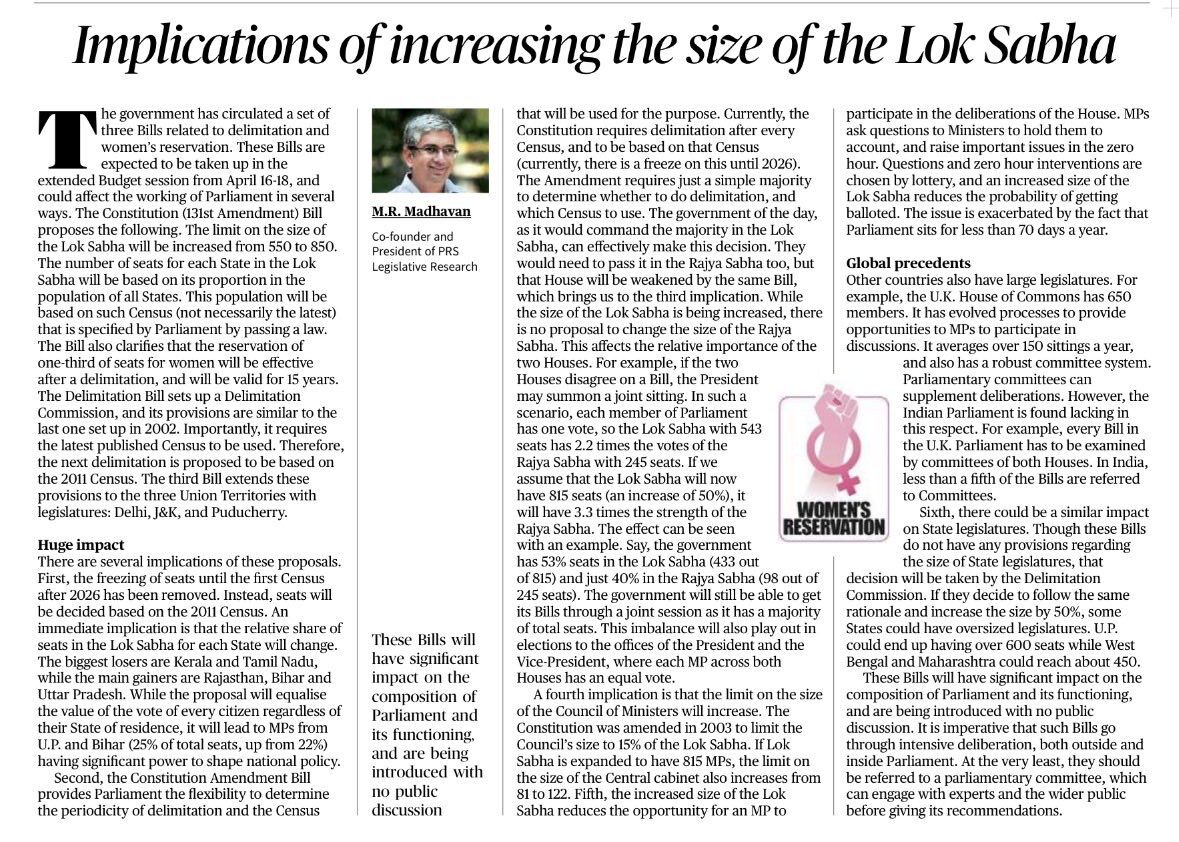
@Xstopsfreespch@BhartiAparajita@Lolita_TNIE Please read more carefully. Changing the number of seats by State, or increasing the size of the Lok Sabha, are *not* necessary for women's reservation.
@sanjg2k1@BhartiAparajita@Tejasvi_Surya I think the provisions of the Bills, and the statements by Minister Kiren Rijiju suggest - very clearly - that proportionality is with reference to population (and not current strength in LS); anything other articulation is simply misdirection.